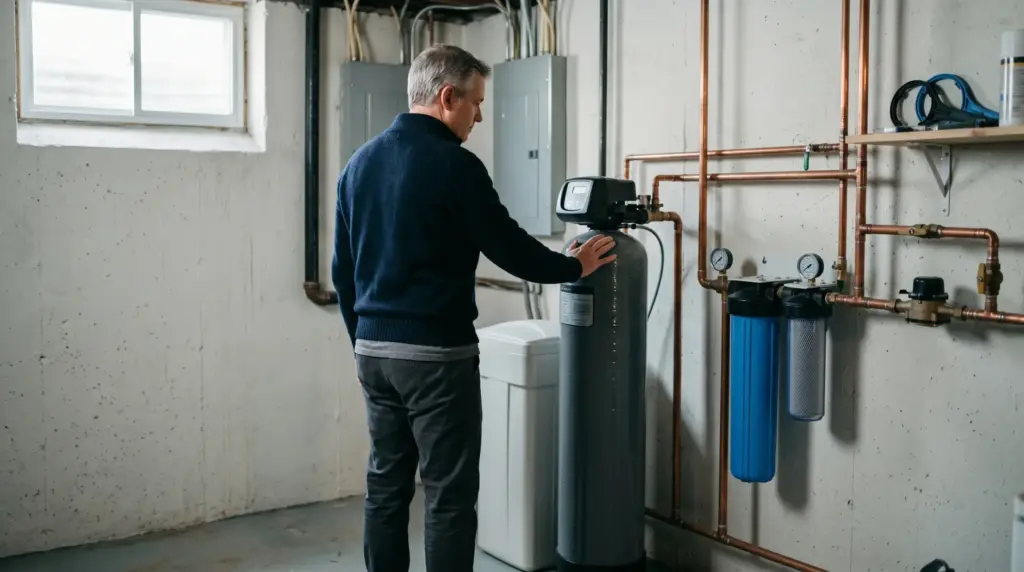
A water softener and a water filter solve different problems. A softener removes hardness minerals—mainly calcium and magnesium—that cause scale, soap scum, stiff laundry, and loss of water-heater efficiency. A filter targets particles, contaminants, or taste and odor problems, depending on the filter technology.
Many private-well owners need one of these systems. Some need both. Others need neither. Buying the wrong equipment can leave the actual water problem untouched and add equipment, installation or service work that does not address the test result. The right starting point is a laboratory water test, not a treatment-company sales pitch or an in-home demonstration designed to sell one brand.
A water softener removes hardness—not every unwanted substance
Hard water contains elevated levels of dissolved calcium and magnesium. Those minerals are not usually a health concern, but they can create household problems. They form crusty scale on fixtures, coat heating elements, restrict plumbing over time, leave spots on glassware, and interfere with soap.
A conventional salt-based softener treats that hardness through ion exchange. Inside the mineral tank are thousands of resin beads carrying sodium ions, or sometimes potassium ions. As hard water passes through, the beads hold calcium and magnesium and release sodium or potassium in their place.
Eventually, the resin fills with hardness minerals. The system then regenerates: it draws concentrated brine from a separate tank, flushes the calcium and magnesium off the resin, and sends that wastewater to an approved drain. A metered softener triggers regeneration according to actual water use, while older timer-based models regenerate on a fixed schedule whether the capacity has been used or not.
What softened water can improve
A correctly sized and adjusted softener can reduce:
- White or gray scale on faucets, shower doors, kettles, and plumbing fixtures
- Mineral deposits inside water heaters, dishwashers, washing machines, and other water-using appliances
- Soap scum and poor lathering
- Stiff or dull-feeling laundry caused by mineral residue
- The amount of soap and detergent needed for cleaning
- Energy loss caused by scale on water-heating surfaces
Softened water may feel more slippery during washing. That is generally a change in how soap behaves, not evidence that the soap remains on your skin.
What a standard softener does not correct
A conventional softener should not be treated as a general-purpose safety device. It does not reliably disinfect water or provide broad contaminant removal. In particular, a standard hardness softener is not the correct treatment for:
- Coliform bacteria, E. coli, viruses, or protozoa
- Nitrate
- Most arsenic problems
- PFAS unless the unit has a separate, verified claim for particular PFAS compounds
- Iron bacteria and the slime they produce
- Sediment such as sand, silt, or rust particles
- Hydrogen sulfide or other causes of objectionable odor
- Most organic chemicals and fuel-related contaminants
Some specialized ion-exchange equipment can target contaminants other than hardness, but that does not mean an ordinary water softener can. Always read the system’s certified reduction claims rather than relying on the general term “ion exchange.”
Salt-based softeners and salt-free conditioners are not equivalent
A salt-based softener physically removes calcium and magnesium from the water through ion exchange. A salt-free conditioner does not remove those minerals. It alters how some hardness minerals behave so they are less likely to form tightly bonded scale.
A conditioner may be useful where the goal is scale control and conventional softener discharge is restricted or undesirable. However, the water remains chemically hard. A hardness test taken after the conditioner will still detect calcium and magnesium, and the system will not provide all the cleaning and soap-performance benefits of true softening.
Salt-based softening also adds sodium to treated water when sodium chloride is used for regeneration. The amount depends largely on the original hardness. Some households leave the kitchen cold-water tap unsoftened or install reverse osmosis at that tap. Anyone following a medically prescribed sodium restriction should discuss the result with a qualified health professional. Potassium chloride can be used with compatible softeners, but it is not automatically appropriate for people who must restrict potassium.
“Water filter” can mean several very different technologies
A filter is not defined by the tank, cartridge, or marketing label on the outside. What matters is the material inside and the contaminant-removal claim attached to the complete system. A five-micron sediment cartridge and a reverse-osmosis membrane are both called filters, yet they perform entirely different jobs.
Sediment filters catch particles
Sediment filters remove suspended material such as sand, grit, silt, pipe scale, and visible rust particles. Their rating is usually stated in microns, a measure of particle size. A lower micron number captures smaller particles but may clog faster.
Sediment filtration can protect valves, appliances, UV equipment, carbon media, and other treatment stages. It does not normally remove dissolved hardness, nitrate, arsenic, salt, bacteria, or dissolved iron. Water can look clear and still contain those substances.
If a cartridge plugs repeatedly, the answer is not always a finer cartridge. Persistent sand may point to a well, pump, or screen problem that deserves inspection. Heavy loading may also call for a backwashing filter that cleans itself rather than disposable cartridges.
Activated carbon addresses taste, odor, and selected chemicals
Activated carbon has a highly porous surface that attracts and holds certain compounds. It is commonly used to reduce chlorine, unpleasant tastes, odors, and some organic chemicals. Carbon is often included before or after a reverse-osmosis membrane.
Carbon does not soften water and is not a universal contaminant barrier. Its performance depends on the carbon type, bed size, water flow, competing substances, and how much water has already passed through it. A product certified for chlorine-related taste does not automatically remove PFAS, lead, pesticides, or volatile organic compounds.
Carbon also has a finite capacity. Once it is exhausted, contaminants can pass through even if the water still looks normal. Replacement should follow measured capacity, manufacturer instructions, and follow-up testing—not taste alone.
Iron and manganese filters convert dissolved metals into removable particles
Well water can carry dissolved iron or manganese that is invisible when it leaves the tap. After exposure to air, the iron may form orange-brown particles and stains; manganese can produce dark staining. Treatment often oxidizes the dissolved metal—meaning it changes it into a solid—and then captures that solid in filter media.
Air, chlorine, hydrogen peroxide, ozone, or potassium permanganate may be used for oxidation, depending on the water chemistry and equipment. The correct approach is influenced by iron and manganese concentrations, pH, oxygen, flow rate, and whether sulfur odor or bacteria are also present.
A softener can remove limited amounts of dissolved iron under suitable conditions. It becomes a poor choice when the iron load is high, the iron has already formed particles, or iron bacteria are present. Iron deposits can coat the resin, reduce capacity, and increase service needs.
Reverse osmosis provides broad treatment at a drinking-water tap
Reverse osmosis, usually shortened to RO, uses household pressure to push water through a membrane. Water molecules and some small substances pass through; many dissolved salts and contaminants are rejected and leave through a wastewater line.
A properly selected RO unit can reduce hardness minerals, sodium, nitrate, and various metals. Certified systems are also available for particular arsenic and PFAS reduction claims. No RO unit should be assumed to remove everything. Arsenic chemistry matters, PFAS claims differ by product, and pretreatment may be necessary.
Most residential RO systems serve a dedicated kitchen faucet and sometimes a refrigerator or ice maker. Treating every gallon used for toilets, laundry, and outdoor taps with RO usually adds substantial equipment, storage, pumping, maintenance, and wastewater requirements without providing a matching benefit.
Ultraviolet light disinfects water but does not filter it
Ultraviolet treatment uses a lamp to expose microorganisms to a dose of UV light that prevents them from reproducing. A properly sized Class A system can address bacteria, viruses, and protozoa. UV does not remove sediment, hardness, nitrate, arsenic, PFAS, iron, or other chemicals.
UV performance depends on clear water, adequate intensity, correct flow, and maintenance. Sediment, color, iron, manganese, and hardness scale can shield microorganisms or coat the quartz sleeve surrounding the lamp. That is why filtration and other necessary treatment normally come before UV. The lamp and sleeve require scheduled attention even when the water appears unchanged.
Let the laboratory result choose the equipment
Arrange testing through a laboratory certified by your state in the United States or accredited or approved by your province or territory in Canada. A treatment salesperson’s hardness strip can be useful for sizing a softener, but it is not a substitute for a drinking-water analysis.
At minimum, private-well testing commonly includes total coliform bacteria, E. coli, nitrate, pH, and locally relevant contaminants. Hardness, iron, manganese, total dissolved solids, alkalinity, and turbidity help design treatment. Your local health authority can identify regional concerns such as arsenic, uranium, radon, pesticides, fuel compounds, or PFAS.
Sample the untreated water whenever possible. If equipment is already installed, testing before and after treatment can show both the source-water condition and whether the system is performing. Follow the laboratory’s collection instructions carefully; a contaminated bottle or faucet can produce a misleading result.
| Water problem | Treatment usually considered | Common wrong purchase | Why the wrong treatment fails |
|---|---|---|---|
| Hardness and scale | Salt-based ion-exchange softener; a conditioner only when scale control, rather than true softening, is acceptable | Sediment or carbon filter | Dissolved calcium and magnesium pass through ordinary particle and carbon filters. |
| Sand, silt, or visible particles | Sediment cartridge, spin-down separator, or backwashing filter; inspect the well if loading is persistent | Water softener | Particles can foul the resin and valves instead of being reliably captured. |
| Coliform bacteria or E. coli | Investigate and repair the contamination route; disinfect the well when appropriate; consider Class A UV or continuous disinfection | Softener or standard carbon filter | Neither is a dependable disinfection barrier. Carbon can support microbial growth if neglected. |
| Dissolved iron or manganese | Oxidation followed by filtration; a softener may handle limited dissolved iron under suitable conditions | Carbon filter alone | Ordinary carbon is not designed to carry a substantial dissolved-metal load. |
| Iron bacteria and slime | Well inspection, cleaning or rehabilitation, and disinfection planned for the actual condition | Larger softener | The biological growth can foul equipment and continue inside the well and plumbing. |
| Nitrate | Certified RO or nitrate-selective treatment, often at drinking and cooking taps | Carbon filter or hardness softener | Standard versions are not certified nitrate treatment. |
| Arsenic or PFAS | RO, adsorption media, or other equipment certified for the exact contaminant; arsenic may require speciation | A product advertised only as a “premium filter” | Broad marketing language does not establish a verified reduction claim or capacity. |
| Earthy, chemical, or rotten-egg odor | Carbon, aeration, oxidation, disinfection, or correction of a plumbing issue—after identifying the source | Softener selected from odor alone | Odor can come from hydrogen sulfide, bacteria, organics, a water heater, or plumbing; hardness may be unrelated. |
Some wells need both treatment and softening—and the order matters
Consider a well with dissolved iron, hard water, and nitrate. The iron affects fixtures and can damage downstream equipment. Hardness forms scale. Nitrate is mainly a drinking-water concern. One tank cannot responsibly be expected to solve all three.
A common treatment sequence might be:
- Coarse sediment protection, if the well produces particles
- Iron or manganese treatment, designed around the measured water chemistry
- Water softener for calcium and magnesium hardness
- Final sediment filtration and UV, if microbiological protection is required
- Carbon and reverse osmosis at the kitchen tap for certified drinking-water contaminant reduction and taste improvement
This is an example, not a universal design. Carbon used to remove an injected disinfectant may occupy a different position. Acidic water may need pH correction. Some oxidizing iron systems must be separated from softener resin, while other configurations are designed to work together.
The sequence matters because each stage changes the water presented to the next one. Particulate or oxidized iron can coat softener resin. Hardness can scale an RO membrane and shorten its service life. Cloudy water, iron, or manganese can interfere with UV transmission. Treating the upstream problems protects the more sensitive equipment downstream.
Ask the installer to show the treatment order on the written proposal and explain the purpose of every tank, cartridge, chemical feed, and drain line. In the US, confirm any required contractor license; in Canada, confirm the applicable provincial or territorial licence and plumbing requirements.
Compare softener and filter quotes
Water treatment pricing varies sharply by region, water chemistry, household flow, plumbing access, electrical work, drainage, equipment certification, and local labour. A house with an existing bypass loop, outlet, and drain may cost far less to equip than a finished basement that needs new plumbing and electrical service.
Request written amounts in USD for a U.S. project or CAD for a Canadian project. Ask providers to state equipment specifications, household-flow and water-test assumptions, installation work, labour, freight, certification, taxes, regional availability, quote date, validity period, exclusions and change responsibilities.
| System type | Equipment quote question | Installation quote question | Ongoing-service quote question | Primary job |
|---|---|---|---|---|
| Whole-house sediment treatment | Does the equipment quote identify the housing, filter size, cartridge type, rated flow and included accessories? | Does the installation quote itemize bypass and valve work, plumbing changes, labour, setup, testing and taxes? | Does the ongoing quote state cartridge type and quantity, replacement interval assumptions, service labour, testing and disposal? | Sand, silt, rust, and suspended particles |
| Salt-based softener | Does the equipment quote identify model, capacity, resin, control valve, brine tank and included accessories? | Does the installation quote itemize bypass, drain, outlet and plumbing work, setup, testing, labour and taxes? | Does the ongoing quote itemize salt assumptions, resin cleaning, control service, testing and service labour? | Calcium and magnesium hardness |
| Whole-house carbon | Does the equipment quote identify the vessel or housing, media or cartridges, capacity and certified reduction claims? | Does the installation quote itemize bypass and plumbing work, any required drain connection, setup, testing and taxes? | Does the ongoing quote itemize cartridges or media, service frequency assumptions, labour, testing and disposal? | Taste, odor, chlorine, and specified organic compounds |
| Iron or manganese filter | Does the equipment quote identify the treatment tank, media, controls and any oxidation stage proposed from the laboratory results? | Does the installation quote itemize plumbing, electrical and drain work, backwash setup, commissioning, testing and taxes? | Does the ongoing quote itemize chemicals or media, valve service, testing, labour and replacement assumptions? | Measured iron, manganese, and sometimes sulfur odor |
| Under-sink RO | Does the equipment quote identify the complete certified model, tank, faucet, membrane, cartridges and included monitoring parts? | Does the installation quote itemize under-sink plumbing, faucet and drain work, setup, testing, labour and taxes? | Does the ongoing quote itemize cartridges, membrane, testing, service labour and replacement assumptions? | Certified reduction of selected dissolved contaminants at one tap |
| Whole-house UV | Does the equipment quote identify the complete unit, rated flow, lamp, sleeve, controls and included monitoring parts? | Does the installation quote itemize plumbing, electrical and bypass work, setup, testing, labour and taxes? | Does the ongoing quote itemize lamps, sleeves, power assumptions, cleaning, testing and service labour? | Microbiological disinfection after suitable pretreatment |
Ask each provider whether major well repairs, pressure-system changes, extensive electrical work, septic or drainage modifications, and remediation of a contaminated source are included, excluded or conditional. Compare written proposals that use the same laboratory results and household flow requirements. Ask how the proposed capacity, certification, bypass arrangement and local service support match those inputs.
Whole-house treatment and point-of-use treatment serve different risks
Whole-house treatment, also called point-of-entry treatment, handles water where it enters the home. It makes sense when the problem affects plumbing, appliances, bathing, laundry, or every tap. Hardness, sediment, iron, manganese, and recurring microbiological concerns commonly fall into this category.
Point-of-use treatment handles water at one location, usually the kitchen sink. It can be the more proportionate choice when a contaminant matters primarily in water used for drinking, beverages, ice, and cooking. Under-sink RO is the familiar example.
The distinction is about exposure, not just price. Treating nitrate at the kitchen tap may be appropriate when all drinking and cooking water reliably comes from that outlet. A volatile chemical that can enter indoor air during showering may require a broader response. Bacteria found in the source may affect bathroom taps and toothbrushing as well as the kitchen. Young children, guests, and refrigerator lines also complicate a one-tap plan.
A point-of-use system needs a clearly understood boundary. Label any dedicated faucet, connect the refrigerator if necessary, and make sure everyone knows which water to use. Follow-up testing should be taken from the treated outlet under normal operating conditions.
Three purchasing mistakes create most disappointing results
Buying a softener for iron bacteria
Iron bacteria can produce orange, brown, or dark slime, oily-looking films, odors, and recurring fouling. This is a biological growth problem, not merely a high dissolved-iron reading. A softener may become coated and lose performance while the colony remains in the well and plumbing.
The well may need professional inspection, cleaning, rehabilitation, or disinfection. Severe cases can require ongoing management rather than a promised permanent cure. Never mix well-cleaning chemicals or combine chlorine and acid treatments; that work should be planned by someone qualified to assess the well.
Using reverse osmosis as the main answer to hard water
RO can remove calcium and magnesium, but an under-sink unit treats only a small amount of water. It will not protect the water heater, shower, dishwasher, or laundry plumbing. Feeding very hard water directly to an RO membrane also encourages scale and more frequent service.
Where both hardness and a drinking-water contaminant are present, whole-house softening followed by point-of-use RO is often the more durable arrangement. The laboratory result and equipment specifications still determine whether additional pretreatment is needed.
Ordering equipment before obtaining a complete test
A visible stain or odor is evidence of a symptom, not a full diagnosis. Orange staining may accompany dissolved iron, iron particles, corrosion, or iron bacteria. A rotten-egg odor may originate in the well, treatment equipment, plumbing, or only the hot-water system.
Testing first helps identify two mismatches: equipment that cannot address the problem and a treatment stage placed where another should have gone ahead of it. After installation, retest the treated water. Treatment is confirmed by laboratory results—not by a clear glass of water or the absence of odor on inspection day.
Sources and methodology
This article was developed by comparing current guidance from US and Canadian public-health agencies, independent treatment-certification information, university extension material on private-well problems, and an external consumer pricing resource. Treatment recommendations were matched to specific water-quality problems rather than brands.
- US Environmental Protection Agency: Protect Your Home’s Water — private-well testing, certified laboratories, and contaminant-led treatment.
- US Centers for Disease Control and Prevention: About Home Water Treatment Systems — capabilities and limitations of softeners, filtration, RO, and UV.
- Health Canada: Treat Your Well Water — point-of-use versus whole-home treatment and applicable NSF/ANSI standards.
- NSF: Standards for Water Treatment Systems — certification categories for carbon filters, softeners, UV systems, and RO.
- Penn State Extension: Iron and Manganese in Private Water Systems — treatment selection, water chemistry, and the limits of softeners for iron removal.
- US EPA: Identifying Drinking Water Filters Certified to Reduce PFAS — PFAS-specific carbon, ion-exchange, and RO certification guidance.
- HomeGuide: Water Filtration System Cost — general cost context dated September 17, 2025. Its categories and included scopes vary, so this article does not adopt a six-system split across equipment, installation and annual service or a combined U.S. and Canadian range. Request local written quotes based on test results and installation conditions.
Because treatment performance depends on contaminant concentration, water chemistry, flow, maintenance, and product certification, no technology in this article should be read as a guaranteed outcome for an untested well. Product labels should identify the specific NSF/ANSI standard and contaminant-reduction claim, and post-installation laboratory testing should confirm performance.