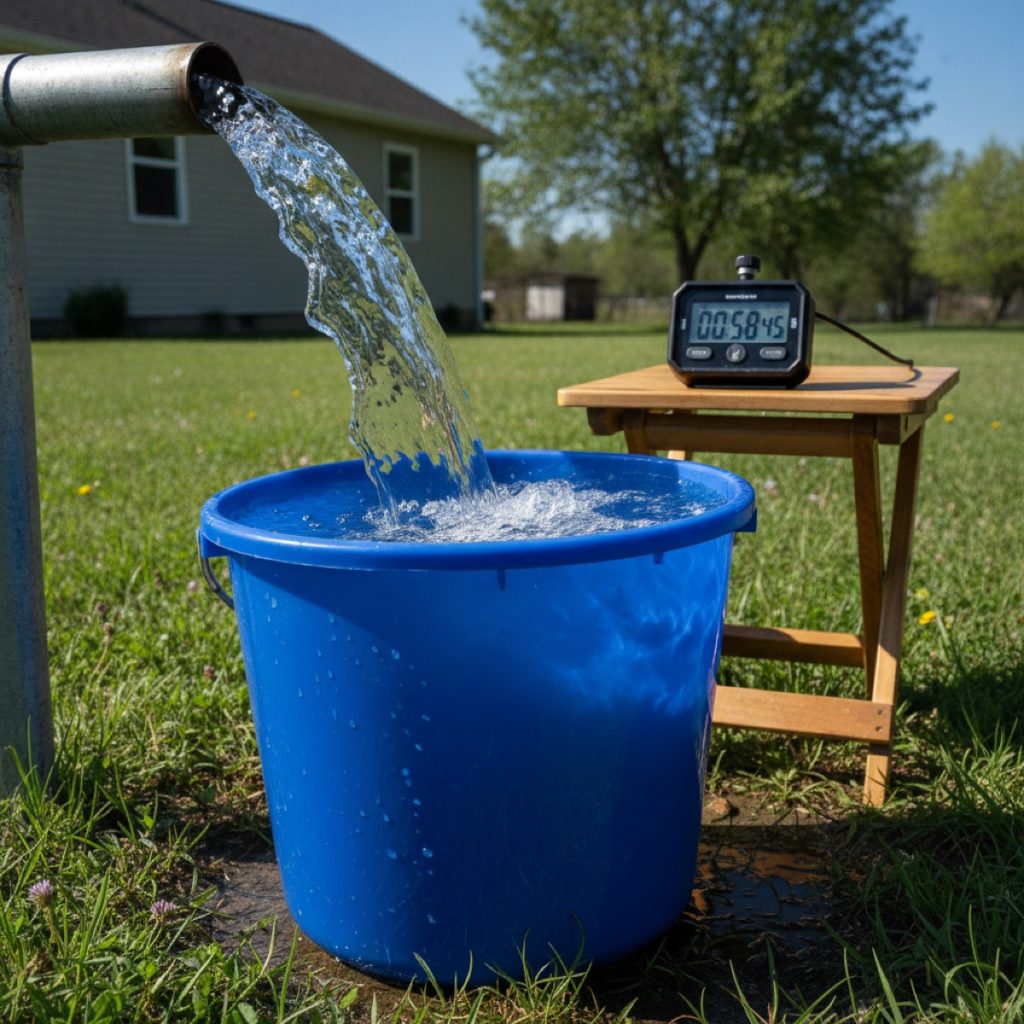
For most homes, a sustained well flow rate of 5 gallons per minute is a good target. It can usually support two ordinary fixtures running at once and meet the daily needs of a typical household. But 5 GPM is a rule of thumb, not a guarantee. A couple with efficient fixtures may live comfortably with 3 GPM, while a large family, several bathrooms, livestock, or lawn irrigation may push demand above 10 GPM.
The important word is sustained. A well that produces 8 GPM for 20 minutes and then falls to 1 GPM is not an 8 GPM well in any useful household sense. You need to know how long the tested rate was maintained, how far the water level fell, and how rapidly the well recovered afterward.
What a well’s GPM number actually measures
GPM means gallons per minute. In well work, it normally describes the rate at which water can be pumped from the well during a yield test. Canadian records may use litres per minute: 5 US GPM is approximately 18.9 L/min.
Be careful about which “gallon” appears on an older Canadian document. One Imperial gallon equals about 1.2 US gallons. Modern Canadian well records commonly include litres per minute, which avoids that confusion.
Sustained yield matters more than the highest observed flow
Sustained yield is the pumping rate the well can maintain without the water level continuing downward toward the pump intake. It describes what the aquifer—the water-bearing rock, sand, or gravel around the well—can keep supplying over time.
A short burst of strong flow may come partly from water already standing inside the well casing. A typical six-inch well contains about 1.5 gallons for each vertical foot of water in the borehole. If 150 feet of water sits above the pump, the well may begin a test with roughly 225 gallons in reserve. Pumping that reserve can make a low-yield well look impressive for the first several minutes.
This is why a 20-minute result should not be treated as equivalent to a four-hour or 24-hour result. Longer testing reveals whether the water level stabilizes, continues to decline, or reaches the pump intake. The test duration required by law varies between states, provinces, municipalities, construction types, and lending programs.
Recovery rate is the other half of the answer
Recovery is the rise in water level after pumping stops. It shows how the well refills after use. A technician records the water level at shutdown and again at set intervals until it approaches the pre-test level.
A well that drops substantially but recovers promptly may handle intermittent household use well. A well that takes many hours to recover needs more reserve capacity and tighter control over the pump. Recovery should always be interpreted with the pumping rate, test duration, water-column depth, and distance between the final water level and pump intake.
Household water demand happens in bursts
Daily consumption and peak demand are different calculations. Daily consumption is the total water used over 24 hours. Peak demand is the rate needed during the busiest few minutes—perhaps while two people shower, a toilet refills, and the washing machine takes on water.
A 1 GPM well could theoretically produce 1,440 gallons in 24 hours if it truly sustained that rate around the clock. That is more than many households use. The problem is that the family does not use water at a steady 1 GPM. A morning burst can exceed 8 or 10 GPM even when the daily total is modest.
| Fixture or appliance | Typical water demand | What matters for well sizing |
|---|---|---|
| Shower | 2.0 GPM for many efficient models; up to 2.5 GPM for a standard US showerhead | Long, continuous draw; two simultaneous showers can consume 4 to 5 GPM |
| Bathroom faucet | About 1.2 to 2.2 GPM | Usually intermittent, but it adds to a shower or appliance already running |
| Kitchen faucet | About 1.5 to 2.2 GPM; more on some older fixtures | Often overlaps with evening dishwasher, laundry, and bathing demand |
| Tank-type toilet | 1.28 to 1.6 gallons per flush for many modern toilets; the fill valve may momentarily draw roughly 2 to 4 GPM | Short draw, but several flushes can matter when the well is already serving showers |
| Dishwasher | An ENERGY STAR standard-size model uses no more than 3.2 gallons per cycle, taken in several short fills | Low total volume, but inlet flow overlaps with other uses |
| Clothes washer | About 14 gallons per load for an average ENERGY STAR model and around 20 gallons for a standard model; inlet flow can be several GPM | Intermittent but substantial fill periods; extra-rinse and bulky cycles use more |
| Outdoor hose bib | Often 4 to 8 GPM, with 10 GPM or more possible | Pressure, pipe size, hose length, nozzle, and elevation cause wide variation |
| Irrigation zone | Commonly 5 to 15 GPM or more | Must be designed separately; irrigation can exceed the entire indoor demand |
Fixture ratings are useful starting points, but the actual flow depends on water pressure, pipe diameter, restrictions, and the installed equipment. If you need a close calculation, measure each major fixture with a calibrated flow bag, water meter, or timed container rather than relying only on product labels.
A realistic peak-demand calculation
Suppose one shower uses 2.0 GPM, the kitchen faucet uses 1.8 GPM, and a toilet begins refilling at about 3 GPM. The brief combined demand is approximately 6.8 GPM. If the washing machine opens its inlet valve at the same time, the demand may rise above 9 GPM.
The well does not necessarily have to produce every one of those gallons at that instant. Water stored in the well, pressure tank, and any intermediate holding tank can cover part of the burst. However, the storage must refill before the next busy period. That relationship—not one isolated GPM number—is what determines whether the household runs comfortably.
Minimum flow-rate guidelines by household size
| Household | Practical sustained-yield guideline | Important conditions |
|---|---|---|
| 1–2 people | 3–5 GPM | Often adequate with efficient fixtures and little overlapping use |
| 3–4 people | 5–7 GPM | A sound range for a typical home; examine morning and evening overlap |
| 5 or more people | 7–10+ GPM | More may be needed with several showers, frequent laundry, or large tubs |
| Home with irrigation, livestock, or another dwelling | Calculate separately | Outdoor and agricultural demand can be much greater than indoor use |
These are planning guidelines, not legal minimums or promises of performance. Two homes with four occupants may need very different systems. One may have a single bathroom and efficient fixtures; the other may have three showers, a soaking tub, a water-treatment system that backwashes, and an irrigation system.
Multiple bathrooms increase the chance of simultaneous use even if they do not increase the daily total by themselves. Water softeners, iron filters, and other treatment equipment also deserve attention because regeneration or backwashing can draw several GPM for an extended period.
FHA and VA loans do not use the same well-flow rule
Lending requirements are frequently repeated incorrectly. The current FHA distinction is based primarily on whether the home is new or existing construction, while local requirements can impose a higher standard.
- FHA, existing construction: HUD’s Single Family Housing Policy Handbook states that an existing well must deliver continuous flow of at least 3 GPM.
- FHA, new construction: The handbook requires 5 GPM continuously over at least four hours.
- VA: The VA Lender’s Handbook requires a continuous supply of safe, potable water for drinking, bathing, showering, and sanitary use. It does not set one nationwide numerical GPM minimum for every private well. Applicable health-authority requirements, appraisal findings, and lender conditions matter.
A lender may apply requirements beyond the federal minimum, particularly when the appraiser reports inadequate supply, the local authority requires a longer test, or the property has unusual water demands. Water quantity and water quality are separate approval issues. Passing a yield test does not replace required laboratory testing for bacteria or other contaminants.
When a property does not meet the applicable requirement, the next steps may include an extended yield test, correction of pump or well problems, installation of an approved storage system, another appraisal inspection, or a different lending arrangement. A purchase agreement should give the buyer enough time to receive the full written test and resolve financing before the inspection condition expires.
A low-flow well can work with properly sized storage
A low yield does not automatically mean the well lacks enough water over an entire day. It usually means the well cannot replenish water as rapidly as the home consumes it during peak periods.
An intermediate storage tank separates well production from household demand
In this arrangement, the well pump fills a non-pressurized drinking-water tank at a rate the well can sustain. A separate booster pump supplies the house at the pressure and flow needed by the fixtures. The tank acts as a buffer between slow groundwater production and concentrated household use.
Residential holding tanks are often sized in the hundreds of gallons. Capacities of 500 to 1,500 gallons are used where the well is particularly slow, the household is large, or substantial reserve is required. That range should not be treated as an automatic specification. Some homes need less; irrigation, livestock, fire reserve, or a very low-yield well may require more.
Tank sizing should account for:
- The well’s verified sustained yield and recovery pattern
- Number of occupants and bedrooms
- Expected morning and evening peak demand
- Laundry, water-treatment backwashing, large tubs, and outdoor use
- Usable tank volume, not merely the capacity printed on the tank
- Space, freezing protection, sanitation, overflow, alarms, and access for maintenance
- Low-water protection that shuts the well pump down before the water level reaches its intake
A standard pressure tank is not a substitute for a large holding tank. Much of a pressure tank’s interior volume is occupied by compressed air or water that cannot be drawn before the pump starts. Its usable amount—called drawdown—is far smaller than the number printed on the label.
Constant-pressure equipment improves delivery, not well yield
A constant-pressure system adjusts pump speed to keep household pressure steadier as fixtures open and close. It can provide better showers and reduce noticeable pressure swings. It cannot make the aquifer supply more water.
Connecting a powerful pump to a low-yield well without suitable controls can make the situation worse by pulling the water level down to the intake. The pump capacity, well yield, available water column, and protection controls must be designed as one system.
Other ways to live with limited yield
- Use showerheads and faucets with lower rated flow.
- Run the dishwasher and washing machine at different times from showers.
- Avoid filling large tubs while other fixtures are operating.
- Repair leaks and running toilets promptly.
- Divide irrigation into smaller zones and operate it when indoor demand is low.
- Schedule water-treatment regeneration outside the household’s busiest periods.
Conservation can reduce peaks, but it should not be used to disguise an unreliable supply during a property sale. A buyer needs the measured yield, test duration, storage details, and operating limitations in writing.
How a professional yield test is performed
A proper pump test is conducted at a controlled rate while the technician measures both water flow and the changing water level in the well. Procedures vary by jurisdiction, so use a licensed well contractor in the United States or a licensed well contractor where provincial or territorial rules require a licence in Canada.
- Establish the static water level. This is the depth to water after the well has rested long enough to recover from prior pumping.
- Begin pumping at a measured rate. Discharge should be directed far enough away that it cannot run back and artificially recharge the well.
- Record pumping water levels. The difference between the static level and pumping level is the drawdown.
- Watch for stabilization. If the level stops falling while the pumping rate remains constant, the well is keeping pace at that rate under the test conditions.
- Continue for the required duration. A brief residential check may last 30 to 60 minutes. More useful tests often run four to six hours; difficult or high-stakes evaluations may run 24 hours or longer.
- Measure recovery. After shutdown, the technician records how rapidly the water level rises toward its original position.
Ontario’s well-yield procedure, for example, requires continuous pumping at a steady rate for at least one hour when the regulated yield test is performed, with water-level readings during pumping and recovery. Ontario guidance for certain development assessments calls for a minimum six-hour pumping test and recovery monitoring. Other jurisdictions use different minimums.
An extended test matters because some wells begin by drawing heavily from water stored in the borehole. Once that reserve is depleted, the true aquifer contribution becomes clearer. A useful report should list the pump rate, duration, static level, water levels over time, final drawdown, pump-intake depth, recovery readings, and any change in turbidity or sediment.
Geology, construction, age, and season all affect flow
Fractured-rock wells can vary over very short distances
In granite, shale, and other bedrock, much of the usable water moves through cracks rather than through the solid rock. One well may intersect several productive fractures while another nearby well intersects few. Greater depth may provide more water-bearing openings or more borehole storage, but depth by itself does not guarantee a higher yield.
Sand-and-gravel aquifers store and transmit water through spaces between particles. Proper screen length and screen opening size determine how effectively water enters the well while sand remains outside. A longer screen can expose more aquifer, but only if it is placed in productive material and matched to the formation.
Well performance can decline with age
Mineral scale, iron deposits, bacterial growth, sediment, corrosion, or a clogged screen can restrict water entry. A worn pump, damaged pipe, leaking check valve, or falling water level can produce symptoms that resemble declining well yield.
Before paying to deepen or replace a well, compare a new test with the original well record. If the aquifer still supplies water but the well’s measured performance has deteriorated, cleaning, redevelopment, pump work, or other rehabilitation may restore some capacity. The appropriate method depends on the construction and cause; results cannot be promised in advance.
Summer and drought testing may reveal risks hidden in spring
Groundwater levels change with recharge, rainfall, snowmelt, drought, and pumping. A test conducted during a wet spring may not represent late-summer performance. Nearby residential, municipal, agricultural, or irrigation wells can also lower the water level in a shared aquifer.
When purchasing in an area known for seasonal shortages, ask for older well records and test during the historically low-water period if timing allows. Neighbouring owners can provide useful context, but their experience does not replace testing the subject well.
Flow rate and water pressure are not the same thing
Well flow rate describes how much water the well can supply over time. Water pressure is the force pushing water through the plumbing, normally measured in pounds per square inch in the US and psi or kilopascals in Canada.
A high-yield well can produce disappointing pressure when the pump is undersized, the pressure switch is poorly set, the pressure tank has failed, a filter is clogged, or the plumbing is restrictive. Conversely, a low-yield well can initially deliver strong pressure because the pump and tank are pressurized. During heavy use, the stored water disappears and the system may lose pressure or activate its low-water protection.
Diagnosing weak showers therefore requires more than checking the well’s GPM. A technician may need to measure pressure before and after treatment equipment, test the pressure tank, confirm pump output, inspect the electrical controls, and compare the pumping water level with the pump intake.
When a low flow rate becomes a dealbreaker
For a typical property purchase, I would want documented sustained production of about 5 GPM as a strong baseline, preferably demonstrated over several hours with acceptable drawdown and recovery. I would not reject every 3 GPM well, but I would want a clear explanation of available borehole storage, household demand, seasonal history, pump protection, and any intermediate tank.
A 1 GPM well deserves much closer scrutiny. In theory it can produce 1,440 gallons per day, but only if that yield is genuinely sustainable. Daily life will depend on stored water, recovery time, working controls, and disciplined separation of heavy uses. The property also carries more equipment, maintenance, outage, financing, and resale risk than a comparable property with a stronger well.
Consider the supply unacceptable until proven otherwise when:
- The only evidence is a short faucet test or an undocumented statement from the seller.
- The pumping water level reaches or approaches the pump intake.
- The rate declines throughout the test without stabilizing.
- The well does not recover adequately before the next expected peak period.
- The proposed storage system has no design calculation, sanitation provisions, or low-water protection.
- The well fails the applicable local, provincial, state, FHA, VA, or lender requirement.
- Outdoor demand is essential but was excluded from the evaluation.
- There is no credible plan for a dry-season shortage.
For an existing home, the first step is diagnosis. Rehabilitation may make sense when the well once produced more and testing points to clogging or equipment trouble. Deepening may add borehole storage or reach additional water-bearing zones, but it can also encounter water with different mineral, salt, gas, or contamination characteristics.
Hydrofracturing a drinking-water well uses pressurized water to clean and open existing bedrock fractures. It can improve some low-yield bedrock wells but is not suitable for every geology and does not guarantee a lasting increase. It is different from oil-and-gas hydraulic fracturing and should be performed only where permitted by an appropriately licensed contractor.
A replacement well becomes the stronger option when the existing construction is defective, rehabilitation is unlikely to address the cause, required yield cannot be achieved with acceptable storage, or long-term water quality makes the source unsuitable. Drilling cost ranges vary enormously with depth, geology, casing, access, permits, disposal, pump equipment, treatment, and the risk of an unproductive hole. Obtain site-specific written proposals rather than using a national cost-per-foot figure as a budget.
Sources and methodology
This article uses US gallons. Household ranges combine fixture ratings with peak-demand planning rather than treating daily water consumption as a required continuous pumping rate. Regulations vary, so the current local authority and lender must be checked for a specific property.
- US Department of Housing and Urban Development, FHA Single Family Housing Policy Handbook 4000.1 — FHA requirements for individual wells in existing and new construction.
- US Department of Veterans Affairs, VA Lender’s Handbook — current minimum property requirements for water supply and individual wells.
- New York State Department of Health, Well Yield, Water Demand, and Storage — 5 GPM household guidance, borehole storage, and low-yield storage planning.
- US EPA WaterSense, Showerheads and Bathroom Faucets — fixture flow ratings.
- ENERGY STAR Dishwasher Criteria and ENERGY STAR Clothes Washers — appliance water-consumption figures.
- Ontario Ministry of the Environment, Conservation and Parks, Yield Test — water-level, pumping-rate, and recovery measurement practices.
- Health Canada, Build Your Well — provincial and territorial regulation and licensed-contractor guidance.
- US Geological Survey, Groundwater Wells — seasonal water levels, pumping effects, aquifers, and nearby-well interference.
- Penn State Extension, Using Low-Yielding Wells — intermediate storage, pressure-tank limitations, and low-yield system design.
Related Guides
- How a Water Well Is Drilled
- Well Casing and Grouting
- How Much Does It Cost to Drill a Well?
- How to Test Well Water
- Do You Need a Permit to Drill a Well?
Browse all Planning Your Well guides →

Author: Well Drilling Guide Editorial Team
The Well Drilling Guide editorial team researches and writes our guides on water-well drilling, pumps, and well water for homeowners across the US and Canada. We translate current cost data, NGWA and state well-construction standards, and EPA and CDC guidance into clear, practical answers. What we stand for: honest, independent help. Every price and claim is researched and fact-checked against multiple 2026 sources — never guessed, never borrowed from a single advertiser. We answer to homeowners, not to the companies we write about, because our only goal is to help you make a confident, well-informed decision about your water.
Find verified, local contractors who handle new installations, pump service, and water quality testing — in your area.