How much does it cost to drill a well?
A dated publisher estimate, the costs a complete quote should include, and why nearby well records matter more than a national depth chart.
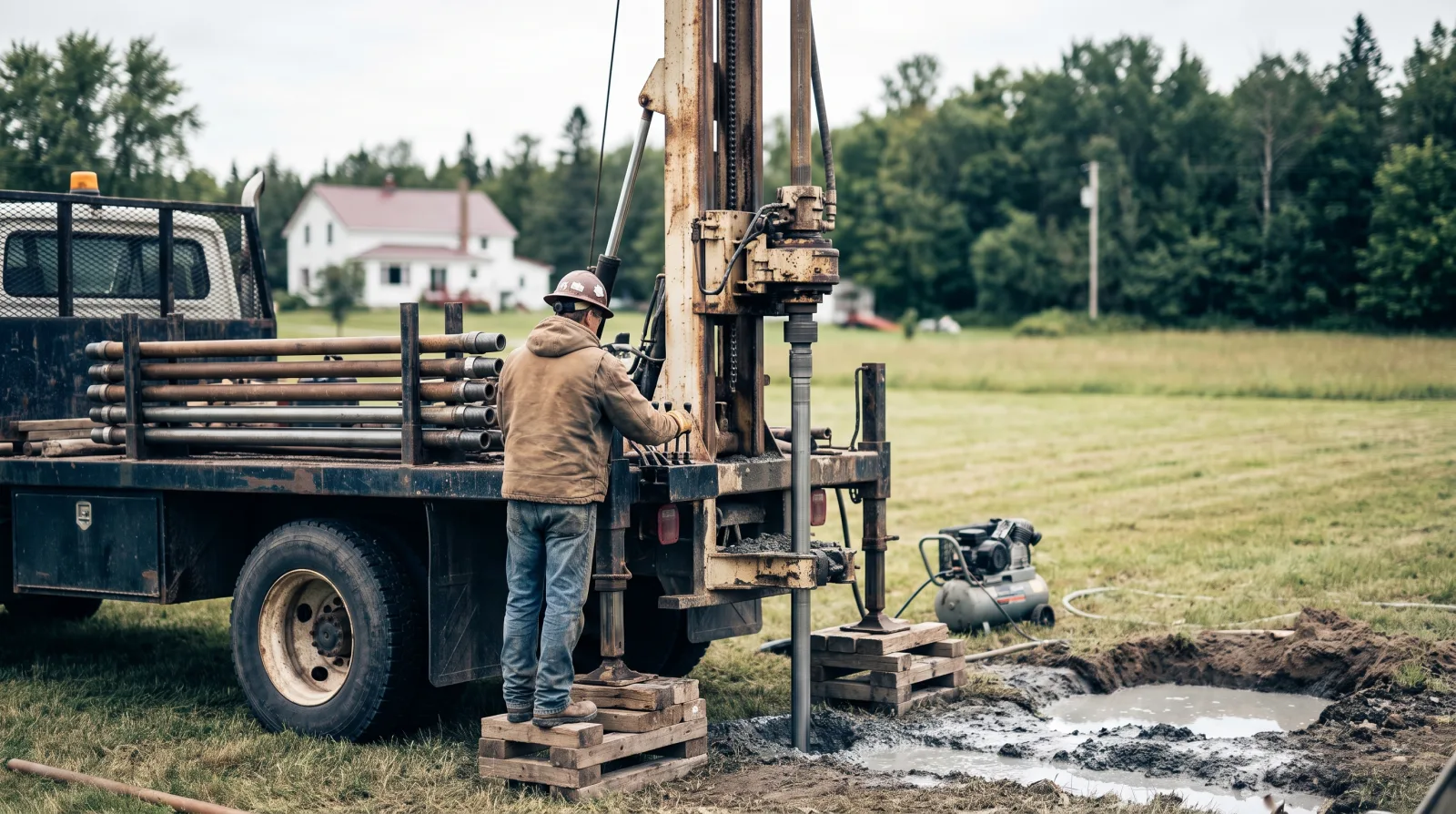
HomeAdvisor’s cost guide, updated 19 June 2026 and checked 7 September 2026, displays these U.S.-dollar figures. They are a publisher reference, not a local quote or a complete-system budget. Its per-foot table covers drilling only and excludes casing, pumps, filtration and other equipment and materials.
A national price cannot predict one property.
The final price depends on how deep the driller must go, what material the rig encounters, the construction required in that location, access for the equipment, and which parts of the finished water system are included.
HomeAdvisor describes customer surveys, research and interviews as its general method. The page does not identify how many well projects were studied or when their prices were collected, and the locations represented by these figures are unclear. Its publication date does not establish current local prices. Compare written quotes with the same scope and currency.
This guide does not provide a Canadian national price range. Use itemized Canadian-dollar quotes and confirm taxes, travel, equipment and construction scope; do not convert these U.S. figures into a Canadian project estimate.
What affects the cost of drilling a well?
The largest variables are the required depth, the ground encountered, well-construction materials, equipment access and everything included beyond the bore itself.
Required depth
A deeper bore requires more drilling and usually more casing.
Ground conditions
Rock and difficult formations can require more time or different equipment.
Well construction
Casing size and material, screen, grout and sanitary seals affect the scope.
Property access
Rig access, site preparation and the distance to the home affect the work required.
Local requirements
Permits, records, inspections and water testing vary by location.
Included equipment
A drilling-only price is not a complete system with the pump, tank, controls and connections.
A U.S. Geological Survey study used about 7.6 million well records. The same research documents substantial variation among and within aquifers.
A local quote is more useful than a national depth chart.
Depth matters, but a depth-only calculator leaves out too much to produce a dependable finished-project budget.
The USGS national well-depth study found a median depth of 142 feet for domestic-supply wells in the contiguous United States. It also found that depths vary by aquifer and hydrogeologic setting. A national median cannot tell you how deep the next well on your property will need to be.
Ask local drillers what nearby well records show. The useful comparison is the recorded depth, construction, yield and geology of wells close to the property.
Make every contractor price the same work.
A low per-foot drilling rate can become an expensive finished project when essential work is excluded. Ask each contractor for an itemized written quote.
Mobilization and access
Bringing the drilling equipment to the property and preparing the route and work area.
Drilling terms
The stated rate or method when additional depth or unexpected formations are encountered.
Well construction
Casing, screen, grout, sanitary seals and the construction required in that location.
Development and yield
Well development and a documented yield or pumping test.
Water-system equipment
The pump, pressure tank, controls, wiring and any treatment specified after testing.
Connections
The buried water line, plumbing connections and electrical work.
Records and testing
Permits, inspections, completed well records and initial laboratory testing.
Unsuccessful bore terms
The written price and responsibility if the first bore is dry, unusable or must be properly closed.
Ten questions to ask before you sign.
- What nearby well records support the estimated depth and construction?
- What exactly is included in the quoted price, and what is excluded?
- How will additional depth or a change in ground conditions be priced?
- Does the price include the pump, tank, controls, electrical work and water line?
- Who obtains permits, files the completed well record and arranges inspections?
- What test will document the well’s yield?
- Which laboratory water tests are included?
- What happens, and what will I owe, if the first bore is dry or unusable?
- What workmanship and equipment warranties are provided?
- What license and insurance details can I verify with the responsible authority?
The lowest drilling number is not necessarily the lowest finished cost. Compare the terms for unexpected work and the contractor’s verifiable qualifications as well.
Permit and licensing requirements must be checked locally.
United States
Private wells are not regulated under the federal Safe Drinking Water Act. The EPA directs owners to state-specific programs, so the responsible authority and requirements must be confirmed for the state and locality where the work will occur.
Canada
Health Canada says most provinces and territories have specific well-construction requirements and tells owners to contact their province or territory for the rules they must follow.
These tools are starting points. Confirm every result with the responsible government authority, and request proof of current insurance before hiring.
Laboratory testing belongs in the project budget.
U.S. testing guidance
The EPA recommends annual testing for total coliform bacteria, nitrate, total dissolved solids and pH. It recommends additional testing when local conditions, nearby land uses or earlier results indicate a risk, using a state-certified laboratory.
The EPA says more than 43 million people, about 15% of the U.S. population, rely on private wells. Owners are responsible for their water’s safety.
Canadian testing guidance
Health Canada recommends testing for microbial contamination at least every six months and general water quality every two years.
The schedule for specific chemical tests depends on local concerns. Consult the local public-health authority and use an accredited laboratory.
Assistance exists only for some eligible projects.
Do not assume that a loan program, grant or home-insurance policy will pay for a new well.
USDA Section 504
The USDA’s Section 504 Home Repair program may help qualifying very-low-income rural homeowners with eligible repairs or improvements. Eligibility depends on the applicant, property, location and proposed work. Confirm written eligibility before authorizing work.
FHA-financed properties
For a purchase or refinance involving a private well, use the current lender and appraisal requirements for that loan. The official FHA Single Family Housing Policy Handbook is the source for FHA requirements; it is not a rebate or grant program.
Well drilling cost FAQ.
Sources and price limits.
The price reference comes from the named publisher below. We have checked that it displays the quoted figures; we have not independently verified the underlying project records. The project range and average do not specify a consistent complete-system scope, and the per-foot rate is drilling only. Use local written quotes for a project budget.
- HomeAdvisor — Well Drilling Cost: Published U.S.-dollar project figures and drilling-only rate; source updated 19 June 2026, checked 7 September 2026. The data collection period and sample are not specified.
- U.S. Geological Survey — Depth of groundwater used for drinking-water supplies: national well-record study and depth context.
- U.S. EPA — Private Drinking Water Wells: ownership, regulation and population context.
- U.S. EPA — Protect Your Home’s Water: U.S. testing guidance.
- U.S. EPA — State Private-Well Programs: state program directory.
- Health Canada — Build Your Well: Canadian construction requirements.
- Health Canada — Test Your Well Water: Canadian testing guidance.
- USDA Rural Development — Section 504: official eligibility information.
- HUD — FHA Handbook 4000.1: official FHA requirements.
- U.S. Department of Energy — Geothermal Heat Pumps: distinction between geothermal systems and water wells.
General information only: Property conditions and legal requirements vary. Confirm construction, testing, permits and contract terms with the responsible local authorities and qualified professionals.
Find listed well drillers in your area.
A directory listing is a starting point, not proof of licensing. Verify every contractor’s current credentials with the responsible authority before hiring.
Find Well Drillers