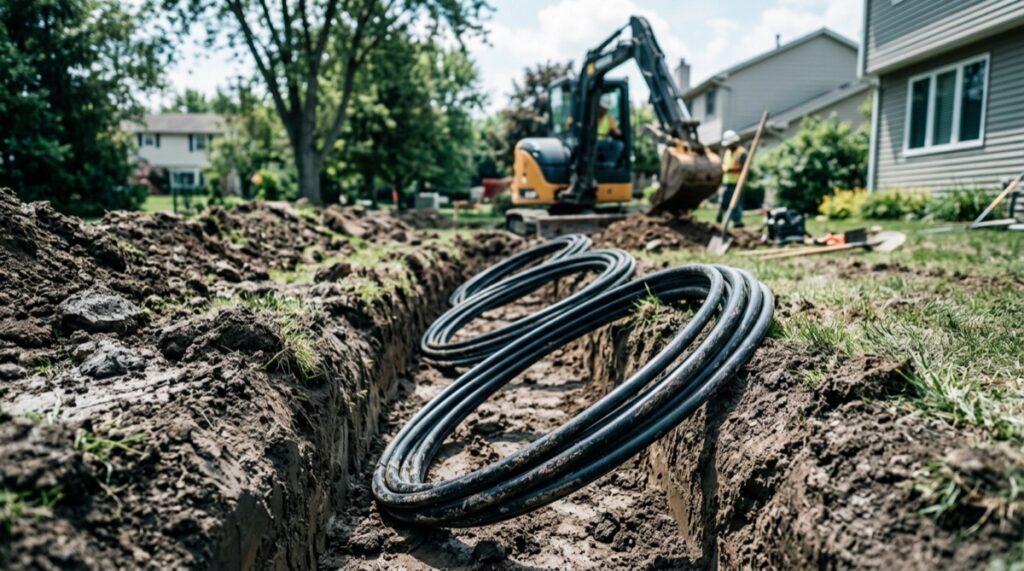
A geothermal heat pump does not create heat by burning fuel. It moves heat between a building and the ground through an underground collector made from connected pipe. The collector may be installed horizontally, vertically or in a suitable body of water. The right layout depends on the building, the site and the local rules—not on one universal depth-per-ton shortcut.
What a geothermal loop field does
The U.S. Department of Energy describes a ground-source or geothermal heat pump system as three connected parts: an underground heat collector, the heat pump and the building's heat-distribution system. Fluid circulating through the underground pipes absorbs heat from or releases heat to the surrounding ground. See the Department of Energy's geothermal heat-pump overview.
In a closed-loop system, the circulating fluid stays inside the pipe. The U.S. Environmental Protection Agency explains that closed-loop collectors may be installed in horizontal trenches or vertical boreholes and commonly circulate water or a water-and-antifreeze mixture. Read the EPA manual on geothermal heat-pump systems.
Vertical, horizontal and pond collectors
Vertical boreholes
A vertical field places the collector pipe in drilled boreholes. It is often considered where the site does not have enough usable land for long trenches or where near-surface conditions make trenching impractical. Boreholes must be laid out, piped and sealed as part of the complete ground heat exchanger.
Horizontal trenches
A horizontal field places pipe in trenches across a larger area of land. It avoids deep boreholes, but it needs suitable space and workable soil conditions. Future structures, utilities, landscaping and access also matter when reserving the loop area.
Pond or surface-water collectors
Some projects can use a suitable pond or other surface-water source. The Department of Energy notes that surface-water designs depend on the water body's temperature profile through the seasons. Access, ownership, environmental requirements and local approval must be checked before treating this as an option.
Why a simple feet-per-ton rule is not a design
The final loop size begins with the building's peak heating and cooling loads. It also depends on subsurface temperature, thermal conductivity, climate, the collector arrangement and how the system will operate. The Department of Energy says accurate knowledge of the ground conditions is important and that larger projects often measure thermal properties at the site. Review the Department of Energy's design guidance.
That is why this guide does not publish a universal bore length, bore count or spacing table. Those numbers can look reassuring while being wrong for the building or the ground. Use the planning checklist to organize questions about the proposed system. A checklist cannot replace a load calculation and a ground-loop design.
Who should be involved
The Department of Energy recommends using a geothermal designer or local professional engineer to assess whether a home or business suits this type of system. A drilling contractor may construct the boreholes, while a geothermal designer and heating contractor coordinate the collector, heat pump and building loads. One company may cover several roles, but the responsibilities should be explicit in the proposal. See the Department of Energy's installer and designer guidance.
For U.S. and Canadian projects, the International Ground Source Heat Pump Association identifies CSA/ANSI/IGSHPA C448:2025 as its current bi-national design and installation standard. Local codes and licensing requirements still control the project. Check the current IGSHPA standards page.
Permits and groundwater protection
Requirements vary by state, province and municipality. Depending on the system and location, the work may involve building, mechanical, drilling, environmental or water-related approvals. Do not assume that a water-well licence automatically covers every geothermal role, or that a closed loop is exempt from local review.
Ask the project team which authority has jurisdiction, who obtains each approval, what records will be filed and what sealing or grouting standard will be used. Start with the Well Drilling Guide regulations overview, then confirm the current requirements with the responsible local authority.
How to compare geothermal drilling proposals
- Building load: identify who calculated the peak heating and cooling loads and which method was used.
- Ground assumptions: ask what is known about the local geology and thermal properties, and whether site testing is needed.
- Collector design: request the proposed layout, bore or trench count, depth or length, spacing, pipe, grout and connection details.
- Responsibility: state who designs, drills, connects, pressure-tests, commissions and warrants each part.
- Approvals: list the permits, inspections and completion records included in the price.
- Allowances: separate firm quantities from allowances for difficult drilling, access, spoil handling, restoration and unexpected ground conditions.
Use the checklist to prepare questions
The geothermal planning checklist helps organize questions for a designer and contractor. It does not calculate bore length or project cost. Use it alongside a site-specific design and itemized contractor proposals.
Sources
- U.S. Department of Energy — Geothermal Heat Pumps
- U.S. Department of Energy — Purchasing Energy-Efficient Geothermal Heat Pumps
- U.S. Department of Energy — Installation and Professional Guidance
- U.S. EPA — Manual on Environmental Issues Related to Geothermal Heat Pump Systems
- IGSHPA — Current Design and Installation Standards
Preparing to speak with a drilling contractor?
Bring the building-load information, the proposed collector design and a written list of what the drilling price includes. Confirm every contractor's current credentials and scope locally.