Is Reverse Osmosis Worth It for Well Water? Under-Sink vs. Whole-House Systems Compared

24 Jun 2026 18 min read No comments Water Quality
Featured image

Reverse osmosis is one of the most thorough water-treatment technologies available for home use. A properly selected and maintained system can remove roughly 95% to 99% of many dissolved contaminants. That includes substances that ordinary sediment and carbon filters barely touch.

But that does not mean every private well needs reverse osmosis. RO can waste approximately two to four gallons of water for every gallon it produces, remove minerals along with contaminants, and require substantial pre-treatment. A whole-house system commonly costs $3,000 to $8,000 or more installed, with regional labor rates and water conditions causing considerable variation.

The real question is not whether reverse osmosis works. It does. The question is whether your laboratory water test shows a problem that RO is well suited to solve—and whether you need to treat every gallon entering the house or only the water used for drinking and cooking.

Key takeaway: For most well owners who need reverse osmosis, an under-sink system is the practical choice. It treats the water people consume while avoiding the cost, wastewater, storage requirements, and extensive pre-treatment of whole-house RO. Choose treatment only after an accredited laboratory identifies the contaminants and concentrations in your well.

How reverse osmosis treats well water

A reverse osmosis system forces water under pressure against a semi-permeable membrane. That is a tightly constructed barrier that permits water molecules to pass while rejecting a large share of dissolved salts, metals, and other contaminants.

The process creates two water streams:

  • Permeate is the treated water that passes through the membrane. It goes to a storage tank, a dedicated faucet, or—in a whole-house installation—a larger atmospheric storage tank.
  • Reject water, sometimes called concentrate or brine, carries the contaminants that did not pass through the membrane. It normally goes to a drain or an approved disposal location.

The reject stream is not an optional by-product. Water must move across the membrane surface to carry concentrated material away. Without adequate flushing, minerals collect on the membrane, production declines, and the membrane can fail prematurely.

What is inside a typical RO system?

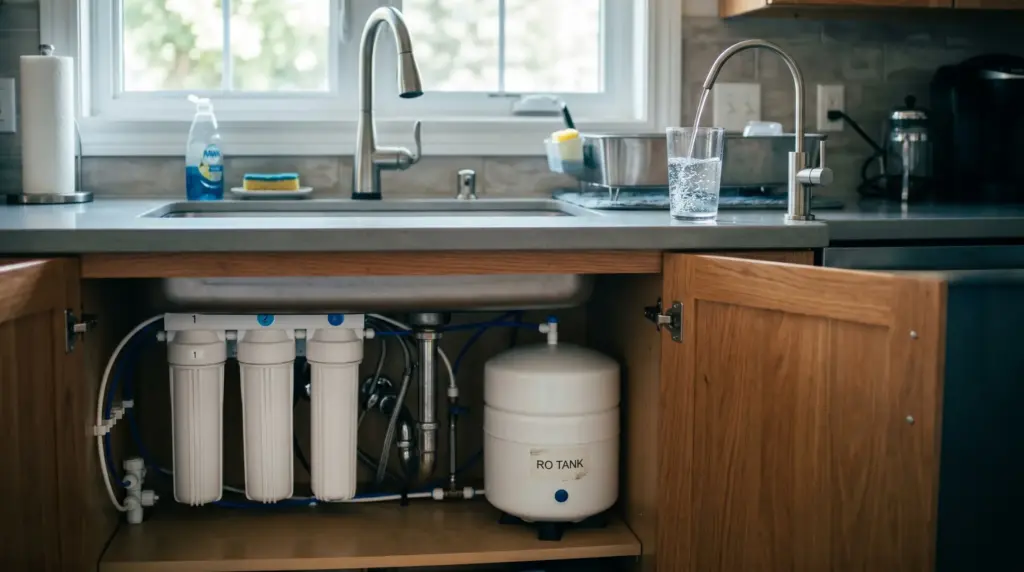
The membrane gets most of the attention, but it cannot operate reliably by itself. A common under-sink reverse osmosis system includes:

  1. A sediment filter to catch sand, silt, rust particles, and other suspended material.
  2. One or more carbon filters to reduce tastes, odors, and certain organic chemicals. Carbon also protects some membrane materials from oxidizing disinfectants when RO is used on chlorinated water.
  3. The RO membrane to reduce dissolved contaminants.
  4. A pressurized storage tank because a residential membrane produces water gradually rather than at full faucet flow.
  5. A post-carbon filter that polishes the water before it reaches the dedicated faucet.
  6. An optional remineralization cartridge that adds a controlled amount of calcium or magnesium after treatment.

Whole-house systems use the same basic principle on a much larger scale. They generally need higher-capacity membranes, pressure controls, pumps, monitoring equipment, a storage tank, and a repressurization pump to supply treated water to the house.

What can RO remove?

Reverse osmosis is especially useful for contaminants dissolved in water rather than floating in it. Depending on the membrane, operating pressure, water chemistry, and system certification, RO can substantially reduce:

  • Total dissolved solids, usually abbreviated as TDS
  • Arsenic, with important limits depending on the form of arsenic present
  • Lead and certain other heavy metals
  • Nitrate and nitrite
  • Sodium and chloride
  • Fluoride
  • Uranium, radium, and some other radionuclides
  • Many PFAS compounds when the system is designed and certified for that purpose

No homeowner should assume that every RO unit removes every contaminant. Look for independent certification covering the substance found in your test. In the United States, that commonly means certification to an applicable NSF/ANSI standard. In Canada, look for certification from an accredited certification body and confirm that the specific reduction claim appears in the product documentation.

Watch out: A low-cost product described merely as an “RO system” may not carry a verified reduction claim for arsenic, nitrate, PFAS, or radionuclides. Match the equipment to the exact contaminant and concentration reported by the laboratory.

When reverse osmosis makes sense for well water

RO earns its place when a well contains a dissolved contaminant that presents a health concern, causes severe salinity problems, or cannot be reduced reliably enough by a more targeted treatment method.

Arsenic, lead, or PFAS is detected

Arsenic can occur naturally in groundwater, while lead may enter water from plumbing components or well equipment. PFAS can reach wells from firefighting foam, landfills, industrial activity, contaminated soil, or other sources. These contaminants cannot be judged by appearance, taste, or odor.

Reverse osmosis may be an effective treatment for all three, but selection matters. Arsenic exists mainly in two forms in groundwater. Some RO membranes remove arsenic in the pentavalent form more effectively than arsenic in the trivalent form. Oxidation—the conversion of one form to the other—may be required before treatment.

For PFAS, membrane performance and system testing matter more than marketing language. Confirm that the unit has a relevant certified reduction claim and follow its replacement schedule. A system that performed well when new may not provide the same protection after neglected filter changes, pressure loss, membrane fouling, or damaged seals.

Nitrate levels are elevated

Nitrate can enter groundwater from fertilizer, manure, septic systems, and natural sources. It is particularly concerning for infants and during pregnancy. Boiling does not remove nitrate; it can concentrate it as water evaporates.

RO and nitrate-selective ion exchange are two commonly considered treatment methods. An under-sink RO system often makes sense when the immediate goal is producing drinking and cooking water. The choice should account for the measured concentration, daily household demand, ongoing testing, and whether another contamination source is affecting the well.

Treatment does not replace investigating the source. A damaged well cap, poor surface drainage, inadequate separation from a septic system, or a deteriorated casing can permit continued contamination.

Total dissolved solids are unusually high

TDS is the combined concentration of dissolved minerals and salts in the water. High TDS can cause salty or bitter taste, deposits, corrosion, and poor performance from appliances or other treatment equipment. However, TDS by itself does not tell you which substances are present or whether the water poses a health risk.

RO is one of the strongest residential options for reducing broad mineral content. Before buying equipment, request testing that identifies the major dissolved constituents. Treating water dominated by sodium and chloride may require a different design from water containing high sulfate, hardness minerals, or a specific metal.

Uranium, radium, or another dissolved contaminant is present

Some wells draw from rock formations that naturally release uranium, radium, or other dissolved substances. RO can reduce certain radionuclides, but the concentrate contains the material removed from the drinking water. Disposal requirements may vary by jurisdiction and by contaminant concentration.

This is a situation for a qualified water-treatment professional working from certified laboratory results. In the United States, check state well and drinking-water guidance and confirm any contractor licensing requirements. In Canada, consult the province or territory and hire a professional who holds the applicable licence or recognized certification where required.

A targeted treatment method cannot provide enough reduction

Sometimes several contaminants occur together, or the required reduction exceeds what a single adsorptive filter can deliver reliably. RO can act as a final barrier after other equipment prepares the water. It is also useful when sodium remains after ion-exchange softening, since a conventional softener exchanges hardness minerals for sodium rather than removing overall dissolved solids.

When RO is the wrong tool—or more treatment than you need

Reverse osmosis has a broad treatment range, but it is not a universal first step. Many common well-water complaints are handled more effectively by equipment designed for that particular problem.

Iron, manganese, hardness, and sediment

Orange staining, metallic taste, black deposits, cloudy water, scale, and gritty particles often lead homeowners to consider RO. These problems usually require treatment before water reaches an RO membrane.

Sediment is addressed with properly sized sediment filtration or correction of the well condition producing the material. Iron and manganese may require oxidation followed by filtration, depending on their form and concentration. Hardness is commonly managed with an ion-exchange water softener.

An under-sink RO unit can polish already-conditioned water, but using its membrane as the primary iron, scale, or sediment filter is an expensive way to shorten its life.

Bacteria

RO should not be treated as the primary answer to bacterial contamination in a private well. Some membranes can physically reject microorganisms when the system is intact, but residential RO equipment is not designed to compensate for a contaminated well, unsanitary plumbing, a failed seal, or neglected maintenance.

Bacteria can colonize filter housings and foul membrane surfaces. Disinfection and correction of the contamination pathway come first. Ultraviolet treatment is often used as an ongoing microbial barrier after the water has been filtered sufficiently for UV light to penetrate it. Depending on the situation, shock disinfection, well repairs, plumbing disinfection, or another corrective measure may also be needed.

After any bacterial problem, retesting is essential. A clear glass of water and an absence of odor do not confirm microbiological safety.

Hydrogen sulfide and sulfur odors

The rotten-egg odor associated with hydrogen sulfide requires treatment that removes or converts the gas. Aeration, oxidation, catalytic carbon, or another sulfur-specific system may be appropriate after the source and concentration are identified.

An RO membrane is not the preferred first treatment for sulfur gas. Allowing hydrogen sulfide, sulfur bacteria, iron, or oxidized particles to reach the membrane can create fouling and odor problems throughout the equipment.

Water problem Treatment usually considered first Possible role for RO
Sand, silt, or rust particles Sediment filtration and well inspection None until particles are controlled
Hardness and scale Water softener or another scale-control method Drinking-water polishing after pre-treatment
Iron or manganese Oxidation and filtration selected from test results Only after iron and manganese are controlled
Bacteria Source correction, disinfection, and often UV Possible additional barrier, not the primary remedy
Hydrogen sulfide odor Aeration, oxidation, or sulfur-specific media Generally unnecessary after effective odor treatment
Nitrate, arsenic, sodium, or high TDS Contaminant-specific treatment assessment Often a strong point-of-use option

Under-sink versus whole-house reverse osmosis

The most important design decision is where treatment occurs. An under-sink system treats a small amount of water at one location. A whole-house system treats water before it is distributed to fixtures, appliances, showers, and toilets.

Factor Under-sink RO Whole-house RO
Typical installed price About $200–$600 for many standard installations About $3,000–$8,000+, with complex systems costing more
Water treated Drinking and cooking water at one faucet All or nearly all household water
Storage Small pressurized tank under the sink or nearby Large atmospheric tank, often holding hundreds of gallons
Power use Many conventional units use no electricity; pumps may be added Usually needs membrane and repressurization pumps
Wastewater volume Limited because only consumption water is treated Potentially substantial because showers, laundry, and toilets are included
Installation demands Space, drain connection, dedicated faucet, and adequate pressure Equipment room, drainage, storage, pumps, controls, and extensive pre-treatment

These prices are planning ranges, not quotations. Regional labor costs, required permits, treatment capacity, plumbing changes, storage-tank size, raw-water quality, and disposal arrangements can move the installed price substantially.

Why most well owners need only under-sink RO

Most health-related exposure from nitrate, arsenic, lead, PFAS, sodium, and similar dissolved contaminants occurs through ingestion. Treating the kitchen faucet—and sometimes a refrigerator or second drinking faucet—concentrates the treatment budget where it matters most.

There is rarely a benefit to using highly treated RO water for flushing toilets or washing a driveway. Treating only consumption water also reduces reject-water volume, replacement-filter costs, storage needs, and the load placed on the household drainage or septic system.

An under-sink system can still require professional planning. Low well pressure, limited cabinet space, a distant drain, incompatible plumbing, high contaminant levels, or demand from several fixtures can change the equipment selection.

When whole-house RO may be justified

Whole-house RO is usually reserved for severe or unusual water conditions, such as:

  • Extremely high TDS or salinity affecting plumbing, fixtures, laundry, and bathing
  • A dissolved contaminant that must be controlled at every fixture because exposure is not limited to drinking
  • Several contaminants that cannot be managed reliably with a less water-intensive treatment train
  • A household that depends on delivered water or another supply arrangement where RO is part of a professionally designed system
  • A documented medical or operational need for low-mineral water throughout the building

A whole-house unit must be sized for peak demand, not merely average daily use. A home may use relatively little water over 24 hours but still need several gallons per minute when showers, faucets, and appliances run together. Because membranes produce water more gradually, a storage tank holds treated water and a separate pump sends it back into the plumbing at usable pressure.

Watch out: Whole-house RO water can be low in minerals and more aggressive toward certain metals, fittings, concrete tanks, and plumbing materials. The system may need remineralization or pH adjustment before treated water enters the household plumbing.

Why well water usually needs pre-treatment before RO

Municipal water is normally clarified, disinfected, and maintained within controlled operating ranges before it reaches a home. Private well water can vary with geology, pumping conditions, rainfall, seasonal recharge, nearby land use, and the condition of the well itself. That variability makes well water harder on RO equipment.

Sediment filtration is mandatory

Every well-water RO installation needs protection from suspended particles. Sand, silt, clay, corrosion debris, and oxidized iron can plug the membrane’s flow channels and damage pumps or valves.

The correct filter rating depends on the particle size and the amount of material present. A fine filter placed on heavily sedimented water may block rapidly and reduce pressure. In that case, staged filtration or correction at the well may be required.

Iron must be controlled

Dissolved iron can oxidize after it contacts air or an oxidizing treatment chemical, producing particles that coat filters and membranes. Iron bacteria can create slime that is even more difficult to manage. Manganese can cause similar fouling while producing dark stains.

Untreated iron will damage RO performance and can destroy a membrane long before its expected service life. The treatment plan may require aeration, chemical oxidation, catalytic media, or another iron-removal process before the RO system.

Hard water needs softening or other scale control

Calcium and magnesium create hardness. Inside an RO unit, the reject stream becomes progressively more concentrated as treated water passes through the membrane. That concentration encourages minerals to form scale on the membrane surface.

A water softener is commonly installed before RO when hardness is significant. The softener replaces calcium and magnesium with sodium or potassium, which is less likely to form scale. The RO system then reduces much of the added sodium from the drinking water.

Whole-house RO may use additional scale-control methods based on the chemistry and recovery rate—the percentage of incoming water converted into treated water. This requires professional sizing because pushing a system to recover more water can increase scaling risk.

Pressure and temperature affect production

RO production ratings are measured under specified laboratory conditions. A membrane rated for a certain number of gallons per day may deliver less on cold groundwater or at low pressure. Many private wells provide colder water than the test condition used for product ratings.

If pressure is inadequate, a booster pump may be necessary. With whole-house equipment, the well pump, pressure tank, RO feed pump, storage tank, and delivery pump must work as a coordinated system.

What reverse osmosis costs to own

The purchase price is only part of the expense. Replacement filters, membranes, water sent to the drain, testing, sanitation, electricity, and pre-treatment maintenance all contribute to the long-term cost.

Filters and membranes

Many under-sink systems require sediment and carbon filter replacement about every six to twelve months. A typical set may cost roughly $40 to $150, although proprietary cartridges and specialty filters can cost more. High sediment loads, heavy household use, and poor pre-treatment can shorten the interval.

Residential membranes often last approximately two to five years under suitable operating conditions. Replacement may range from about $50 to $250 or more, depending on capacity and certification. Whole-house membranes, service labor, and system sanitation can cost considerably more.

Do not use the calendar alone. Monitor treated-water quality, production rate, pressure, and manufacturer-specified performance indicators. A conductivity or TDS meter can help reveal declining salt rejection, but it does not identify individual health contaminants. Laboratory testing remains necessary where treatment protects against arsenic, nitrate, uranium, PFAS, or another health concern.

Reject water

Many residential systems discharge approximately two to four gallons for every gallon of treated water they produce. Efficient models may do better under suitable pressure and water conditions, while aging, poorly configured, or low-pressure systems may perform worse.

For a household producing three gallons of RO drinking water per day, a 3:1 reject ratio would send about nine gallons to the drain. That may be manageable. Applying the same ratio to hundreds of gallons of whole-house demand is a different calculation, particularly for a low-yield well or a home on a septic system.

Reject water also contains a higher concentration of the contaminants removed. Reuse may be possible for some non-potable purposes, but not when the concentrate contains substances that make handling or discharge inappropriate. Local plumbing, wastewater, and environmental rules take priority.

Electricity

Many basic under-sink systems operate from existing water pressure and use no electricity. Tankless units, systems with permeate pumps, and installations with low feed pressure may require power.

Whole-house RO normally uses electricity for a booster pump and a pump that repressurizes treated water from storage. Actual consumption depends on household use, raw-water pressure, system efficiency, pump size, and the amount of water rejected.

Remineralization and pH correction

RO removes desirable minerals along with undesirable dissolved substances. This is not usually a nutritional concern for people eating a balanced diet, since food provides most dietary minerals. However, low-mineral water can taste flat, and its chemistry may make it corrosive to certain plumbing materials.

A remineralization cartridge can add calcium or magnesium to under-sink water. Whole-house systems may use a mineral contact tank or controlled chemical feed to raise pH and stabilize the water. These components add media replacement, monitoring, and maintenance costs.

Alternatives that may fit the test results better

The best treatment is the one matched to the contaminant, concentration, water chemistry, household demand, and maintenance capacity. RO deserves consideration, but several alternatives may provide more targeted treatment with less wastewater.

Activated carbon

Activated carbon can improve taste and odor and reduce many organic chemicals. Specialized carbon media can also reduce certain PFAS compounds when the equipment is properly sized and replaced before breakthrough—the point at which the media can no longer retain the contaminant reliably.

Carbon does not significantly reduce hardness, sodium, nitrate, or overall TDS. It can also support bacterial growth if neglected, so replacement and sanitation schedules matter.

Ion exchange

Ion exchange uses resin beads to trade unwanted dissolved ions for less troublesome ones. Conventional softeners remove calcium and magnesium. Specialty resins can target nitrate, arsenic, uranium, or other contaminants.

The tradeoffs include regeneration salt or chemicals, wastewater, resin maintenance, and the possibility that competing substances in the water will reduce performance. A detailed water analysis is needed before selecting specialty media.

Ultraviolet disinfection

UV treatment exposes flowing water to ultraviolet light that inactivates bacteria and other microorganisms. It adds no disinfectant to the water and produces no concentrate stream.

UV does not remove dissolved chemicals, sediment, metals, or hardness. The water must also be clear enough for the light to reach microorganisms. That often means sediment, iron, manganese, and turbidity need treatment first. The lamp, quartz sleeve, intensity monitor, and pre-filters require ongoing attention.

Distillation

A distiller boils water and condenses the vapor, leaving many dissolved contaminants behind. It can be practical when only small volumes of drinking water are required and plumbing an RO unit is undesirable.

Distillation is slow, uses electricity, produces heat, and needs regular cleaning as minerals accumulate in the boiling chamber. Some volatile chemicals require additional carbon treatment because they can travel with the steam.

How to decide whether RO is worth it

Start with a laboratory test, not a filter advertisement. Use an accredited laboratory and request analysis appropriate to local geology, nearby land use, well construction, and household concerns. At minimum, private wells are commonly checked for bacteria and nitrate, with additional tests selected for substances such as arsenic, lead, manganese, uranium, PFAS, pesticides, sodium, chloride, hardness, and TDS where relevant.

Then work through these questions:

  1. What exactly needs to be removed? Record the contaminant, concentration, applicable health guideline or standard, and desired treated-water level.
  2. Is exposure mainly through drinking and cooking? If so, under-sink RO may provide the needed protection without treating showers, laundry, and toilets.
  3. Does the water contain sediment, iron, manganese, hardness, sulfur, or bacteria? These conditions must be corrected or controlled before relying on RO.
  4. Can the well support the reject-water demand? A marginal well may not have enough capacity for a wasteful whole-house design.
  5. Where will reject water go? Confirm that the drain, septic system, and local rules can accommodate it.
  6. Can the household maintain and test the system? Treatment that is not serviced becomes an unreliable barrier.
  7. Does the proposed unit carry a verified claim for the contaminant? General claims about “pure water” are not a substitute for independent certification.

Reverse osmosis well water treatment is worth the cost when it solves a confirmed dissolved-contaminant problem more reliably or practically than the alternatives. It is poor value when it is purchased to treat iron stains, hardness scale, sediment, bacteria, or sulfur odor without addressing those problems first.

For most households with arsenic, nitrate, sodium, high TDS, or another ingestion-related contaminant, the strongest starting point is a certified under-sink system supported by the necessary pre-treatment and follow-up testing. Whole-house RO belongs in a narrower category: severe water chemistry, a documented need to treat every fixture, and a professionally designed installation that accounts for storage, pressure, corrosion control, wastewater, and long-term maintenance.

Related Guides

Browse all Water Quality guides →

Well Drilling Guide Editorial Team
Author: Well Drilling Guide Editorial Team

The Well Drilling Guide editorial team researches and writes our guides on water-well drilling, pumps, and well water for homeowners across the US and Canada. We translate current cost data, NGWA and state well-construction standards, and EPA and CDC guidance into clear, practical answers. What we stand for: honest, independent help. Every price and claim is researched and fact-checked against multiple 2026 sources — never guessed, never borrowed from a single advertiser. We answer to homeowners, not to the companies we write about, because our only goal is to help you make a confident, well-informed decision about your water.

Need a Licensed Well Driller?

Find verified, local contractors who handle new installations, pump service, and water quality testing — in your area.

Find a Contractor
Free · No obligation

Get Matched With Local Drillers

Tell us your project and we’ll line up to 3 free quotes from licensed well drillers near you.

Licensed pros No spam, ever US + Canada

Your details go to licensed local drillers only — never sold.

Your details go only to matched drillers — never sold or spammed.

By submitting, you agree we may share your details with up to 3 licensed well drillers near you (US & Canada) so they can contact you about your project. No fees, no obligation — and we never sell your information. See our Privacy Policy.

Tell us your project
We match local drillers
Up to 3 free quotes

Takes about 30 seconds.

Prefer a ballpark first?
Try the free Well-Cost Estimator →