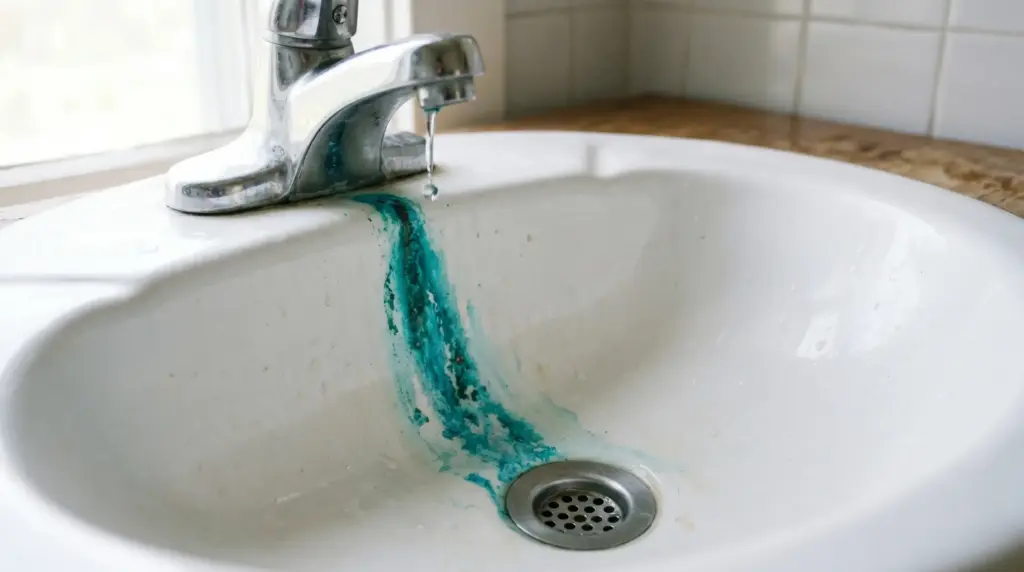
The first clue is often in the plumbing, not at the well. Blue-green stains around a tub drain, recurring pinhole leaks in copper pipe, or a metallic taste can all point to acidic well water—water with a pH below 7.0. The concern becomes more serious as the pH falls, especially below about 6.5.
Acidic water can gradually dissolve copper, brass, galvanized steel, solder, and other metal components. That may put copper—and, in older plumbing, lead—into the water coming from your taps. It can also shorten the working life of fixtures, valves, water heaters, and household plumbing.
The usual treatment is a whole-house acid neutralizer tank. Most contain crushed calcite, a calcium carbonate mineral that dissolves into acidic water and raises its pH. More acidic water may require a calcite and magnesium oxide blend or a soda ash feed system. Treatment can prevent further corrosion, but it cannot restore metal that has already been lost from a pipe.
What pH tells you about well water
pH describes how acidic or alkaline water is. The scale runs from 0 to 14:
- Below 7.0: acidic
- 7.0: neutral
- Above 7.0: alkaline, sometimes called basic
The scale is logarithmic. In practical terms, water at pH 6 has ten times the hydrogen-ion activity of water at pH 7. Water at pH 5 has one hundred times the activity of water at pH 7. That is why a change that looks small on a laboratory report can make a meaningful difference to plumbing.
Not all water below pH 7 will attack pipes at the same rate. Corrosion is also influenced by alkalinity, hardness, dissolved carbon dioxide, temperature, oxygen, chloride, sulfate, water velocity, and the metals used in the plumbing. A pH reading is therefore an important warning sign, not a complete corrosion assessment.
For private wells, problems commonly become noticeable below pH 6.5. Water in that range may have too little mineral content to form a protective coating inside metal pipes. Below pH 6, copper corrosion can become much more aggressive. Water near pH 5 or lower requires careful treatment design because ordinary calcite may not raise the pH enough during periods of high water use.
Why groundwater becomes acidic
Low-pH groundwater is usually the result of natural conditions rather than contamination. Rainwater absorbs carbon dioxide from the air. As it moves through soil, it picks up additional carbon dioxide produced by roots and soil organisms. The gas reacts with water to form weak carbonic acid.
What happens next depends on the ground beneath the property. Limestone and other carbonate-rich rocks can neutralize that acidity. Granite, quartz-rich sandstone, and some glacial sands contribute far less buffering material. Water moving through those formations may reach a well while it is still acidic and low in alkalinity.
Acid deposition from rain and snow can also influence shallow groundwater, particularly where the soil and bedrock have little ability to neutralize it. Its importance varies by location, well depth, soil, and local geology.
Where low-pH wells are common
Acidic wells are frequently encountered in parts of New England, the Atlantic provinces, and areas of the Canadian Shield where groundwater moves through granite or other low-carbonate rock. They also occur in sandy portions of the Atlantic Coastal Plain, including parts of New Jersey, the Delmarva Peninsula, and the southeastern United States.
These are broad patterns, not property-level predictions. Two nearby wells can draw from different fractures, depths, or sediment layers and produce very different water. A neighbour’s neutralizer is a reason to test your water, but it is not a substitute for your own laboratory report.
What acidic water does to a house
Corrosion usually develops out of sight. Water removes a small amount of metal whenever it sits in or moves through vulnerable plumbing. The homeowner may not notice until stains, leaks, restricted fittings, or premature equipment failures appear.
Copper pipes and blue-green staining
When acidic water contacts copper pipe, it can dissolve copper from the pipe wall. The dissolved copper may later form blue or green deposits where water evaporates. Common locations include sink drains, bathtub outlets, shower surfaces, and the white porcelain around a dripping faucet.
Blue-green staining is strong evidence that copper is moving through the plumbing, but low pH is not the only possible cause. High water velocity, certain salts, poor soldering practices, and localized conditions inside a pipe can also contribute.
Uniform corrosion gradually thins a larger area of pipe. Pitting corrosion attacks small spots and can eventually produce pinhole leaks. Repeated pinholes in different sections of copper pipe should be treated as a water-quality warning, not merely a series of unrelated plumbing failures.
Lead from solder, fixtures, and older components
Private well water does not have to contain lead underground for lead to appear at a kitchen tap. The source may be lead-bearing solder, an older brass faucet, a bronze pump component, a fitting, or another plumbing material.
Acidic, corrosive water can dissolve lead from these materials. The risk is greatest in homes with older plumbing, but newer plumbing should not be assumed lead-free without testing. Brass components can contain small amounts of lead, and replacement work may connect new materials to older ones.
Lead has no reliable taste, smell, or colour in drinking water. A clear glass of water does not establish that the water is safe.
Iron, galvanized pipe, and rusty water
Acidic water also attacks iron and galvanized steel. The resulting corrosion may produce reddish-brown water, rust particles, staining, or metallic flavours. Rust can narrow the inside of old galvanized pipes even as corrosion weakens the remaining metal.
Rusty water may also originate in the well, pressure tank, or naturally occurring iron in the aquifer. Samples taken at several points in the system can help separate a groundwater iron problem from corrosion inside the house.
Fixtures and water heaters
Faucet bodies, shutoff valves, toilet components, pump fittings, appliance connectors, and mixing valves often contain copper alloys or other metals susceptible to corrosion. Seals can begin leaking after the metal surface around them deteriorates.
A water heater can be especially vulnerable because heat accelerates many chemical reactions. Acidic water may attack connections, the tank, valves, and exposed components. The eventual symptom may be rusty hot water, a leaking fitting, or a tank failure earlier than expected. Low pH is not the only cause of water-heater failure, but it belongs in the investigation when other corrosion signs are present.
The health concern is dissolved metal, not the sourness of the water
Low pH itself is generally treated as an operational and corrosion issue in drinking water. The health concern is what corrosive water can pick up before it reaches the glass.
Too much copper can cause nausea, vomiting, stomach pain, and other effects. Lead exposure is especially concerning for infants, children, and pregnant people because it can affect the brain and nervous system. If a certified test finds elevated lead, follow the drinking-water guidance from your state, province, local health department, or public health unit. Raising the pH is part of corrosion control, but drinking-water use may also require an interim lead-certified filter or another measure while the source is addressed.
How to test for acidic well water
Start with a certified laboratory test
A certified drinking-water laboratory provides the most dependable basis for treatment. In the United States, use a laboratory certified by your state. In Canada, use a laboratory accepted by your province or territory and follow the sampling directions provided by the lab or local public health authority.
Ask for at least:
- pH
- alkalinity
- hardness
- copper
- lead
- iron and manganese
- total dissolved solids or conductivity
- chloride and sulfate
pH can change after a sample is collected because dissolved carbon dioxide escapes when water contacts air. The laboratory may require delivery within a limited time or recommend measuring pH at the property. Follow its container, flushing, storage, and delivery instructions rather than filling an unapproved household jar.
For treatment design, collect an untreated-water sample from a point after the pressure tank but before existing filters or conditioners. If there is no suitable sampling valve, the laboratory or water-treatment professional can identify one.
Use strips or a meter for screening
Home pH strips can tell you whether water is broadly acidic, neutral, or alkaline. Choose strips with a narrow range intended for water testing; wide-range pool or aquarium strips may not show enough detail around pH 6 to 7.
A digital meter can provide a more precise screening result, but only when it is calibrated with fresh reference solutions and the probe is clean and stored correctly. An uncalibrated meter can display several decimal places while still being wrong.
Home testing is useful for checking trends between laboratory tests or noticing that a neutralizer needs attention. It should not be the sole basis for buying or sizing equipment.
Test copper and lead at the tap
A raw-water sample tells you what comes from the well. It does not reveal everything the water collects while sitting in household plumbing. Copper and lead should also be tested at a tap used for drinking or cooking.
The laboratory may request a first-draw sample after the water has remained unused for several hours. It may also recommend a second sample after flushing. Comparing those samples can help show whether metals are coming from the well, the faucet, or the plumbing between them.
Do not flush the tap, remove the aerator, or change normal water use before sampling unless the laboratory’s instructions tell you to do so. Lead and copper results are highly dependent on how the sample is collected.
How an acid neutralizer fixes low pH
An acid neutralizer is usually installed as a whole-house system after the well pressure tank. Incoming water passes through a bed of alkaline mineral media. The acidic water dissolves a controlled amount of that media, increasing pH and alkalinity before the water enters the household plumbing.
The treatment goal is not to chase a particular number without context. It is to produce stable, non-corrosive water while avoiding excessive hardness, mineral scale, high sodium, or poor flow.
| Treatment | Where it commonly fits | Main trade-off |
|---|---|---|
| Calcite tank | Mild to moderate acidity, often around pH 6.0–6.9 | Adds calcium hardness |
| Calcite/Corosex blend | More acidic water, often around pH 5.5–6.0 | Can over-correct or create scale if the blend is too aggressive |
| Soda ash feed | Very low pH, variable chemistry, or cases where added hardness is undesirable | Requires chemical mixing, pump maintenance, and monitoring; adds sodium |
These pH ranges are starting points, not universal equipment rules. Alkalinity, hardness, carbon dioxide, peak flow, and the manufacturer’s media specifications can change the recommendation.
Calcite: the most common neutralizer media
Calcite is a naturally occurring form of calcium carbonate—the same basic mineral found in limestone and marble. Acidic water dissolves some of the crushed calcite as it moves through the tank. This consumes acidity, raises alkalinity, and usually moves the pH closer to neutral.
Calcite is often described as self-limiting because it dissolves more readily in acidic water and less readily as the water approaches equilibrium. That does not mean it cannot be misapplied. A tank still needs enough media depth and contact time to treat water during peak demand.
Neutralizer tanks may use an upflow design or a control valve that periodically backwashes the media. Backwashing loosens the bed and carries accumulated sediment to a drain. It also requires the well and pump to supply the specified backwash flow without losing pressure.
Corosex for more acidic water
Corosex is a trade name for magnesium oxide media. It reacts more strongly than calcite and is commonly considered when the raw pH is below about 5.5 or when calcite alone cannot provide enough correction.
Because magnesium oxide is aggressive, residential systems generally use it as a smaller part of a calcite blend rather than filling the entire tank with it. The correct proportion depends on test results and expected flow. Too much can push the pH too high, create cloudy water, increase scale, or cause the media bed to harden.
Calcite and Corosex blends
A blended bed is often used for moderate to strong acidity where calcite needs additional lifting power. Calcite provides the bulk of the media while magnesium oxide increases the neutralizing response.
The blend should be selected from actual water chemistry, not from a generic percentage printed in an online discussion. Carbon dioxide and alkalinity can make two wells with the same pH behave differently. The first fill may also need adjustment after treated-water testing under normal household use.
Soda ash chemical feed
A soda ash system mixes sodium carbonate with water in a solution tank. A metering pump injects a measured amount into the well-water line, usually in coordination with operation of the well pump. The chemical neutralizes acidity without adding calcium hardness.
This approach is useful for very low pH, water with high dissolved carbon dioxide, or homes where a calcite tank would create an unwanted hardness problem. It also permits the dose to be adjusted when chemistry varies.
The trade-off is greater owner involvement. The solution tank must be refilled and cleaned, the feed pump maintained, and the treated pH checked. The design may require a retention or mixing tank so the chemical has adequate contact with the water. Soda ash also adds sodium, which matters for people following medically prescribed sodium restrictions and for homes using certain downstream treatments.
Side effects to plan for
Calcite can turn soft water into hard water
Because calcite dissolves calcium into the water, treated water is harder than raw water. How much harder depends on the starting pH, carbon dioxide, water use, and media contact time.
A modest increase may not be noticeable. A larger increase can produce mineral scale on shower glass, fixtures, heating elements, and appliances. Soap may lather less readily. When testing predicts a significant increase, a water softener is commonly installed after the neutralizer.
Corosex can raise pH too far
An overly aggressive magnesium oxide blend may create high pH, mineral deposits, cloudy water, or a cemented media bed. This is one reason the blend and tank size should be matched to laboratory results rather than chosen from pH alone.
Soda ash adds sodium
Soda ash does not create the calcium hardness associated with calcite, but it increases sodium in the treated water. The amount depends on the required chemical dose. If sodium is a health or irrigation concern, include it in the before-and-after testing plan.
Every tank has a flow limit
A neutralizer needs enough contact time for the media to react with the water. When household demand exceeds the tank’s service-flow rating, water may pass through without receiving full correction. An undersized system can also reduce pressure at showers and appliances.
A backwashing model creates a second flow requirement: the well must deliver enough water to lift and clean the media bed. A large tank connected to a low-yield well may not backwash correctly. Peak household flow and available well flow must both be measured.
Installation, sizing, and realistic costs
Residential water-treatment prices vary widely by region, equipment size, plumbing layout, permits, freight, and the amount of work needed around existing tanks and filters. Online prices are usually for hardware and media, not a completed installation.
| System type | Typical installed US range | Typical installed Canadian range |
|---|---|---|
| Calcite neutralizer | About $1,500–$4,000 USD | About $2,000–$5,500 CAD |
| Calcite/Corosex system | About $1,800–$4,500 USD | About $2,500–$6,000 CAD |
| Soda ash feed system | About $2,000–$5,000 USD | About $2,750–$6,750 CAD |
These are broad planning ranges, not quotations. A system bundled with a softener, sediment filter, retention tank, electrical work, or extensive plumbing changes can cost more. Remote travel, Canadian freight, local labour rates, and permit requirements can also move a proposal outside these ranges.
What proper sizing considers
Bathroom count is sometimes used as a sales shortcut, but it is not enough on its own. Sizing should account for:
- Raw-water pH and alkalinity
- Existing and expected treated-water hardness
- Dissolved carbon dioxide where relevant
- Peak household flow in gallons per minute or litres per minute
- The well pump’s sustained output
- The backwash requirement of the selected tank
- Available water pressure
- Iron, manganese, sediment, and other treatment equipment
- Space, drain access, freeze protection, and service clearance
A larger tank can provide more media and contact time, but it may demand more water during backwashing. The correct system balances treatment performance, water pressure, maintenance, and the well’s actual capacity.
Media replacement and ongoing cost
Calcite is consumed as it treats the water. Check the media level at least every six to twelve months until the household’s consumption pattern is known. Many homes need a top-up somewhere between every six and twenty-four months. Less acidic water and lower use may stretch that interval; very acidic water and high use can shorten it.
Current retail prices vary by brand and freight. A 50- to 55-pound bag of calcite commonly falls around $100–$200 USD, while comparable Canadian retail prices are often around $150–$250 CAD. Magnesium oxide media generally costs more and can reach roughly $200 USD or $300–$350 CAD per bag. A service visit adds labour, testing, travel, and any valve maintenance.
Top-ups are not the same as replacing the entire media bed. Full rebedding is less frequent and depends on the tank design, sediment loading, media condition, and maintenance history.
DIY installation versus professional work
A neutralizer may involve cutting the main water line, adding a bypass, supporting heavy equipment, providing a drain for backwash, programming a control valve, and verifying that the well can meet the required flow. A filled tank can weigh several hundred pounds.
An experienced homeowner may be able to install some upflow equipment where local rules permit. However, treatment selection and sizing still need professional-quality testing. Incorrect flow direction, poor drainage, inadequate backwash, or an unsuitable media blend can leave the water corrosive even though a new tank is present.
Professional installation is usually the safer choice when the pH is below 6, copper or lead has already been detected, multiple treatment systems are involved, or the house has recurring pipe failures. In the United States, confirm any required plumbing license. In Canada, confirm the applicable provincial or local plumbing licence and permit requirements.
What to verify after treatment
Installation is not the end of the diagnosis. Test the treated pH after the system has been flushed and the household has returned to normal water use. Check again under higher-flow conditions to confirm that the pH remains controlled when more than one fixture is running.
Repeat copper and lead sampling at the tap according to laboratory instructions. Metal levels may not drop immediately because corrosion deposits can remain inside plumbing. If results are still elevated, the house may need additional flushing, fixture replacement, pipe assessment, or point-of-use treatment while the cause is investigated.
Keep the original laboratory report, the equipment settings, the media type, and each follow-up result together. Those records show whether the neutralizer is working and help predict when media will need replenishment.
Acidic well water is manageable, but the correct response begins with testing rather than stains alone. A properly selected neutralizer can reduce future corrosion; damaged plumbing and elevated metals require their own follow-up. Treating both sides of the problem protects the water at the tap as well as the pipes carrying it there.
Related Guides
- Tannins in Well Water
- Radon in Well Water
- Annual Well Maintenance Checklist
- How to Shock Chlorinate a Well
- How to Test Well Water
Browse all Water Quality guides →
Find verified, local contractors who handle new installations, pump service, and water quality testing — in your area.
