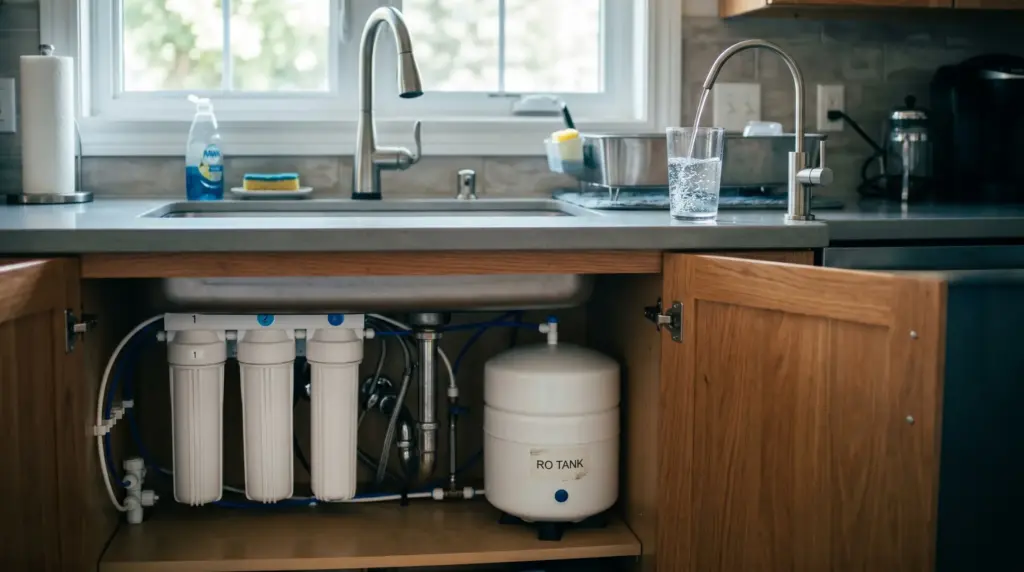
Reverse osmosis (RO) can be a useful well-water treatment when a laboratory test identifies a contaminant and a particular system is certified to reduce it. It is not a default upgrade for every well. Start with the test result, decide which taps need treated water, and compare the exact model’s certified claims, output, feed-water limits, reject-water use, and maintenance instructions.
How reverse osmosis works
RO uses pressure to move water through a semipermeable membrane. It produces treated water, called permeate, and a separate concentrate or reject stream. EPA describes these streams for point-of-use systems. Ask the installer where the reject stream will go and whether that destination meets local requirements. See EPA’s point-of-use RO guidance.
A point-of-use unit treats water at one fixture, such as a kitchen tap. A point-of-entry or whole-home system treats most or all water entering the building. Ask which location matches the tested concern and intended uses. See CDC’s treatment-location definitions.
Begin with a laboratory result
In the United States, CDC advises testing tap water and choosing a system for the harmful chemicals or germs of concern. In Canada, Health Canada advises matching treatment to test results and addressing the contamination source where possible. An appearance, taste, odour, or general “well water” sales claim does not identify what a system must reduce.
- Record the contaminant name, measured concentration, sample location, laboratory, and test date.
- Ask the laboratory or the health or drinking-water authority responsible for your location how to interpret the result.
- Decide whether treatment is needed at one drinking-water tap or at the building entry.
- If the result concerns contamination entering through a damaged or poorly protected well, address that source as part of the response.
Our well-water testing guide explains what information to gather before comparing equipment.
Read certification at the model-and-contaminant level
NSF explains that NSF/ANSI 58 covers point-of-use RO systems. The standard includes a required total-dissolved-solids reduction claim, while many other contaminant claims are optional. A system marked only with the standard number therefore should not be assumed to reduce every contaminant named in the standard.
Check the certification body’s current product listing for the exact manufacturer and model. Confirm that the listing names the contaminant found in your test and applies to the complete configuration you plan to install. Keep the performance data sheet and replacement instructions. Certification for one claim does not establish performance for an unlisted claim.
Microbial test results need a specific response
CDC describes RO as capable of removing parasites, bacteria, and viruses, but also tells consumers to check the system label for the particular germs or chemicals at issue. Do not infer microbial protection from an RO label alone. Follow the direction of the authority responsible for drinking water in your location, correct the contamination pathway when possible, and verify any treatment claim for the exact model.
Health Canada recommends testing water entering and leaving an installed treatment device with an accredited laboratory and maintaining the device to its manufacturer’s instructions. That before-and-after check is more informative than taste or a general dissolved-solids reading.
Under-sink or whole-home?
Choose the treatment location from the exposure and use you need to manage. For a whole-home proposal, ask a qualified installer to document the assumed simultaneous flow, storage, pressure, distribution plumbing, reject-water handling, and compatibility with the building’s materials and equipment. Ask the installer to explain how the proposal was checked against peak use.
| Question | Point-of-use RO | Whole-home RO |
|---|---|---|
| Where is water treated? | At a selected fixture | Near the building entry |
| What demand will the installer document? | Intended drinking-water use and proposed storage/output | Assumed simultaneous flow, storage, and delivery method |
| What should the quote identify? | Faucet, drain, tank or tankless output, and cartridge access | Any proposed feed or delivery pumps, storage, controls, drain arrangement, and plumbing work |
Check the proposed system against your water and plumbing
Do not assume every well needs the same prefilters or conditioning. Compare the measured water chemistry with the selected manufacturer’s limits and instructions. Ask how sediment, iron, manganese, hardness, temperature, and feed pressure affect that model; which preparation is required; and how the installer will verify acceptable operating conditions. This keeps a model-specific requirement from becoming a universal treatment rule.
Compare rated output at the manufacturer’s stated test conditions with the water you actually need. Ask what happens when feed pressure or temperature differs, how much stored water is available, and how recovery is restored after a high-use period. For point-of-use systems in the United States, EPA explains that a WaterSense label provides a separately certified efficiency benchmark; compare it alongside the contaminant claim rather than as a substitute for that claim.
Ask for the full ownership cost
Internet price ranges do not describe a specific well or installation. Request an itemized quote that identifies the exact model and certified claim, plumbing and drain work, storage, pressure equipment, any test-supported preparation, start-up sampling, cartridges and membranes, sanitation, service visits, electricity where applicable, and reject-water implications. Ask which tasks the homeowner may perform and which require service.
For each replaceable part, record the part number, the manufacturer’s replacement trigger or interval, the expected local availability, and the action required if treated-water output or quality changes. Do not substitute a universal filter or membrane lifespan for the selected system’s instructions and measured performance.
A practical comparison checklist
- Laboratory report and interpretation from the appropriate local authority
- Exact model and current certification listing for the target contaminant
- Treatment location: selected tap or building entry
- Required treated-water flow and storage at peak use
- Manufacturer feed-water, pressure, temperature, and maintenance limits
- Reject-water rate, proposed destination, and local approval status
- Itemized installation and ongoing service scope
- Plan for sampling before and after treatment
RO is worth considering when this evidence lines up. If the test result, model claim, operating conditions, or maintenance plan does not line up, keep comparing options rather than relying on a broad promise of “pure” water.
Primary sources
- CDC: About Home Water Treatment Systems (United States; accessed September 7, 2026)
- Health Canada: Treat Your Well Water (Canada; accessed September 7, 2026)
- NSF: NSF/ANSI 58 Reverse Osmosis Drinking Water Treatment Systems (accessed September 7, 2026)
- US EPA WaterSense: Point-of-Use Reverse Osmosis Systems (United States; accessed September 7, 2026)