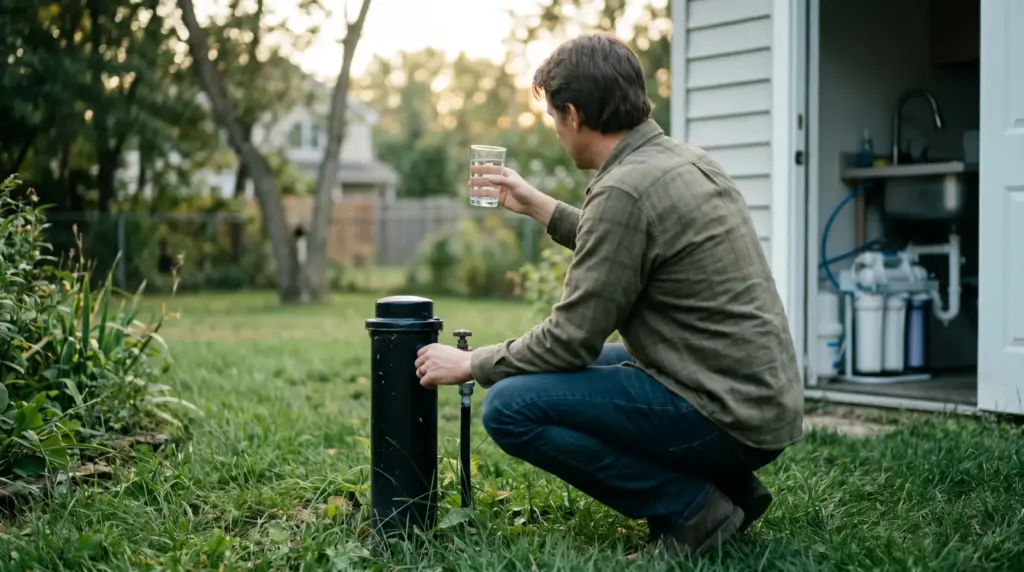
PFAS in well water cannot be detected by taste, smell, or appearance. The only reliable way to know whether your well is affected is to order a specialized laboratory test; if PFAS are found, the household treatment methods with the strongest evidence are granular activated carbon, reverse osmosis, and PFAS-selective ion exchange resin.
PFAS—short for per- and polyfluoroalkyl substances—are a family of thousands of synthetic chemicals. Their unusually strong chemical bonds resist natural breakdown, which is why they are called “forever chemicals.” PFAS have been detected in private wells across the United States and Canada, particularly around military bases, airports, landfills, firefighting training areas, and certain industrial properties.
The US Environmental Protection Agency established enforceable PFAS limits for public water systems in 2024. Private household wells, however, are not covered by those federal requirements. In Canada, Health Canada has established a national drinking-water objective, but provinces and territories decide how it is applied. For most private-well households, arranging testing, interpreting the result, and maintaining any treatment equipment remain the owner’s responsibility.
PFAS were built to resist water, oil, heat, and decay
PFAS became commercially valuable because they can repel grease and water while tolerating heat and harsh chemicals. Manufacturers have used various members of this chemical family in nonstick coatings, stain-resistant materials, water-repellent fabrics, grease-resistant food packaging, industrial processing aids, and some cosmetics and cleaning products.
One of the most important groundwater sources is aqueous film-forming foam, usually abbreviated AFFF. This firefighting foam was designed to spread across burning fuel and cut it off from oxygen. It was widely used at military installations, civilian airports, fire-training grounds, fuel terminals, and emergency-response sites. Repeated training exercises could release foam onto the ground, where PFAS moved into soil and groundwater.
Other possible routes into groundwater include:
- Discharges or spills from facilities that manufactured, processed, or used PFAS;
- Landfill leachate—the contaminated liquid that drains through buried waste;
- Wastewater treatment plants, which receive PFAS but were not generally designed to destroy them;
- Biosolids, also called sewage sludge, applied to agricultural land as fertilizer;
- Firefighting equipment storage, cleaning, and maintenance areas;
- Waste lagoons, disposal pits, and historic dump sites.
The same properties that made PFAS useful make a contaminated aquifer difficult to manage. Many PFAS do not readily break apart through sunlight, bacteria, or ordinary environmental processes. Some attach more strongly to soil than others, but the more mobile compounds can move with groundwater for miles or kilometres. Canada’s federal PFAS assessment notes that some have travelled several kilometres below ground from a source.
That movement does not occur as a perfect circle. Groundwater follows differences in elevation, permeable sand and gravel, fractures in bedrock, pumping patterns, and seasonal recharge. A well three miles downgradient—meaning in the direction groundwater flows—may deserve more attention than a well one mile away on the other side of a groundwater divide.
This is why a five-mile radius is a useful screening distance, not a scientific guarantee. It is wide enough to prompt investigation around a known source, but it cannot tell you whether PFAS have reached your particular well.
The health concern is repeated exposure, not an immediate poisoning event
PFAS in drinking water are generally discussed as a chronic exposure issue. “Chronic” means repeated exposure over months or years. They are not usually an acute poison that causes an obvious reaction after one glass of water, and a result above a drinking-water benchmark does not mean that illness is inevitable.
Risk depends on which PFAS are present, their concentrations, how much contaminated water a person consumes, how long the exposure lasts, and individual health factors. Researchers also know far more about a few compounds—particularly PFOA and PFOS—than they do about the thousands of other substances in the family.
Studies reviewed by agencies such as the US EPA, Agency for Toxic Substances and Disease Registry, and Health Canada have associated exposure to certain PFAS with:
- Kidney, testicular, and some other cancers;
- Changes involving thyroid hormones or thyroid function;
- Reduced immune response, including lower antibody response to some vaccines;
- Developmental effects, including small reductions in birth weight;
- Pregnancy-related high blood pressure;
- Changes in cholesterol and liver enzymes;
- Other reproductive, metabolic, liver, and kidney effects.
“Associated with” matters here. It means researchers have found a relationship in the evidence; it does not mean every exposed person will develop one of these conditions or that PFAS caused a particular person’s diagnosis.
How the US and Canadian numbers compare
One part per trillion, abbreviated ppt, is equivalent to one nanogram per litre, abbreviated ng/L. These are extremely small concentrations, but PFAS benchmarks are set at this scale because the concern involves persistent, long-term exposure.
| Jurisdiction | Benchmark | What it means for a private well |
|---|---|---|
| United States | The 2024 federal rule set maximum contaminant levels of 4 ppt for PFOA and 4 ppt for PFOS. It also established individual limits for PFHxS, PFNA, and HFPO-DA, plus a hazard-index calculation for mixtures containing two or more of PFHxS, PFNA, HFPO-DA, and PFBS. | These enforceable limits apply to covered public water systems, not an individual household well. They are still useful reference points when discussing a result with state health officials. |
| Canada | Health Canada’s objective is 30 ng/L for the sum of 25 specified PFAS, with concentrations kept as low as reasonably achievable. | This is a group-based national objective rather than a federal limit enforced directly against every private well. Provincial or territorial guidance should be used for decisions about a particular result. |
The two approaches should not be compared as though 30 ng/L in Canada were simply a looser version of the US 4 ppt limit. The US values apply to individual compounds, while the Canadian objective adds together 25 specified PFAS. They answer different regulatory questions.
The US position is also changing. As of August 2026, EPA has proposed retaining the 4 ppt limits for PFOA and PFOS while rescinding the individual limits for PFHxS, PFNA, and HFPO-DA and the four-chemical hazard index. Those proposed changes are not final merely because they have been announced. The current status is available on the EPA PFAS drinking-water regulation page.
A routine well test will miss PFAS
Standard private-well packages usually cover bacteria, nitrate, hardness, pH, and selected minerals or metals. PFAS analysis requires specialized equipment capable of measuring concentrations in parts per trillion, so it must be ordered separately.
For drinking water in the United States, look for a laboratory certified by the relevant state program and approved to perform EPA Method 533 or EPA Method 537.1. Together, these methods can measure 29 PFAS, although an individual laboratory package may report a smaller list. EPA Method 537.1 has replaced the older Method 537 for most current applications.
In Canada, use a laboratory accredited for PFAS analysis and ask whether its panel covers the 25 compounds included in Health Canada’s objective. Do not assume that a test advertised as “PFOA and PFOS” is equivalent to a broader PFAS panel.
What to include in a PFAS testing quote
Request a written quote for the PFAS panel and the number of samples proposed, in USD for a U.S. laboratory or CAD for a Canadian laboratory. Ask for the contaminants included, reporting limits, sampling requirements, turnaround time, any expedited service, taxes, quote date and validity.
Ask what is included before ordering. The quoted amount may or may not cover the sampling kit, preservative, overnight shipping, a field blank, professional collection, or a second sample. A field blank is laboratory-grade PFAS-free water handled beside your sample. It helps identify contamination introduced during collection or shipping. Ask whether its analysis is included or charged separately.
PFAS sampling requires unusual precautions
At parts-per-trillion concentrations, material from sampling equipment or household products can compromise a sample. The laboratory should send the correct bottles, preservative, labels, and written instructions. Use that kit exactly as supplied.
- Confirm the sampling location. To learn what is entering the house, collect untreated water from a tap before the softener, carbon filter, reverse-osmosis system, or other treatment. Remove hoses, faucet aerators, and attachments if instructed.
- Do not substitute containers. PFAS methods specify suitable plastic bottles and caps. Glass may hold onto some PFAS, while fluoropolymer materials can introduce contamination.
- Avoid PTFE and related fluoropolymers. PTFE is commonly known by the Teflon brand name. It may be present in tubing, thread-seal tape, bottle-cap liners, and plumbing parts.
- Keep personal products away from the sample. Follow the laboratory’s directions concerning sunscreen, cosmetics, lotion, insect repellent, stain-resistant clothing, waterproof paper, food wrappers, and fabric softener.
- Use the supplied label and an approved pen. Some sampling instructions prohibit permanent markers because their materials may interfere with very low-level analysis.
- Do not touch the bottle opening or inside of the cap. Do not rinse a pre-preserved bottle unless the laboratory explicitly tells you to do so.
- Keep the sample cool and meet the shipping deadline. PFAS kits normally include temperature, packing, and delivery requirements.
If the first result is unexpected—especially a low detection from a self-collected sample—discuss confirmation sampling with the laboratory or health agency before making a major purchase. If treatment is installed, collect a separate post-treatment sample after the equipment has been flushed and placed into normal service.
Who should put PFAS testing higher on the list?
PFAS can occur outside recognized contamination zones, so no location is automatically exempt. Testing deserves higher priority when a well is:
- Within roughly five miles of a military installation, airport, fire academy, or known AFFF release;
- Near a chemical manufacturer, metal-finishing operation, textile or paper-coating facility, fuel terminal, or other facility known to use PFAS;
- Near a landfill, historic dump, wastewater treatment plant, sewage lagoon, or land where biosolids were applied;
- Downhill or downgradient from a suspected source;
- Near other wells where PFAS have already been detected;
- Inside or close to a state, provincial, territorial, military, or federal investigation area.
Start with your state environmental or health department’s PFAS map and private-well pages. EPA maintains a directory of state PFAS resources and a national PFAS Analytic Tools map. Canadian homeowners can check provincial environment and public-health sites, federal contaminated-site records, and local public-health information.
Maps have limits. A blank area may mean nobody has sampled there, not that testing found clean groundwater. Public-water results also do not describe every nearby private aquifer. Use mapped information to understand potential sources, then use a laboratory result to evaluate your own well.
Three treatment methods have credible PFAS-removal evidence
The best treatment depends on the compounds and concentrations in your result, the amount of water being treated, and the rest of your water chemistry. Iron, manganese, hardness, sediment, organic matter, and competing contaminants can shorten media life or damage membranes.
Granular activated carbon works best on many long-chain PFAS
Granular activated carbon, or GAC, is a highly porous material. As water passes through it, PFAS collect on the carbon’s internal surfaces—a process called adsorption.
GAC is well studied and can be effective for longer-chain compounds such as PFOA and PFOS. Shorter-chain PFAS generally do not attach as strongly and may pass through sooner. Performance also depends on the amount of carbon, water-flow rate, contact time, background organic matter, and how long the media has been in service.
A carbon cartridge that is too small or left in service too long can allow PFAS to break through. “Breakthrough” means the media has lost enough capacity that contaminants begin appearing in the treated water. You cannot detect this by taste. Replacement must follow a conservative schedule supported by testing.
Reverse osmosis is highly effective for a broad range of PFAS
Reverse osmosis, or RO, uses pressure to push water through a membrane that rejects many dissolved contaminants. Studies have found it highly effective for both long- and short-chain PFAS when the system is properly selected, installed, and maintained.
RO is often a strong choice under the kitchen sink because most PFAS exposure from household water comes from swallowing it. An under-sink unit can provide treated water for drinking, cooking, coffee, ice, and infant formula without processing every gallon used for showers and laundry.
RO does produce a reject stream containing the removed contaminants, and it requires cartridge and membrane replacement. Hardness, iron, manganese, sediment, or low well pressure may require other equipment ahead of the RO unit. Whole-house RO is less common because it needs higher capacity, storage, pumping, wastewater management, and attention to how low-mineral water interacts with plumbing.
Ion exchange resin can provide high PFAS capacity
Ion exchange uses small resin beads that attract charged contaminants. PFAS-selective anion resin is designed to capture negatively charged PFAS molecules; it is not the same media used in an ordinary water softener.
Properly designed ion exchange can remove a broad range of PFAS and may hold more contaminant than GAC in some water conditions. The trade-offs include media replacement charges, sensitivity to competing substances, and disposal of exhausted resin. Product selection and vessel sizing should be based on the laboratory result and household flow, not merely the number of bathrooms.
Compare the proposed equipment, installation and ongoing service
| Treatment | Common household use | Questions about the quoted scope | Main ongoing expense |
|---|---|---|---|
| Certified GAC or carbon-block filter | Pitcher, faucet, under-sink, or larger whole-house vessels | Does the quote identify the product, capacity, cartridges or bulk media, installation, plumbing changes and confirmation testing? | Cartridge or bulk-media replacement and confirmation testing |
| Point-of-use reverse osmosis | One drinking-water faucet, usually at the kitchen sink | Does the quote include the unit, faucet, plumbing, pretreatment, installation, start-up and confirmation testing? | Pre-filters, carbon cartridges, membrane replacement, and testing |
| PFAS-selective ion exchange | Point-of-use cartridges or professionally designed whole-house treatment | Does the quote identify the cartridges or vessels, resin, design, installation, disposal arrangements and confirmation testing? | Resin replacement, disposal, and confirmation testing |
| Whole-house PFAS treatment train | All water entering the home, often using two media vessels and pretreatment | Does the quote identify the treatment stages, vessel capacity, pretreatment, plumbing and electrical work, installation and confirmation testing? | Media, service visits, other well-water treatment, and repeated laboratory analysis |
Request itemized USD or CAD amounts, assumptions, exclusions, taxes, quote date and validity. Ask how equipment capacity, PFAS concentration, household demand, plumbing access, electrical work, pressure-tank arrangement, iron or hardness treatment, labor and local disposal rules affect each proposal. Canadian homeowners should expect quotes in Canadian dollars and should verify provincial certification or licence requirements.
A contractor should explain the intended flow rate, media volume, replacement schedule, sampling ports, and what happens to used cartridges or resin. Where licensing applies, use a licensed contractor in the US or a properly licensed/licenced or certified professional under the relevant state or provincial rules.
Boiling, softening, and UV do not remove PFAS
Boiling does not destroy PFAS. As water evaporates, the PFAS remain behind and may become more concentrated. Boiling is useful for certain microbial emergencies, but not for a PFAS exceedance.
A standard water softener is not PFAS treatment. Most softeners exchange calcium and magnesium for sodium or potassium. PFAS-selective ion exchange uses different resin designed for different charged chemicals.
Ultraviolet treatment does not remove PFAS. Household UV units are intended to inactivate microorganisms. They do not capture dissolved forever chemicals.
Ordinary sediment filters do not remove dissolved PFAS. They can protect downstream equipment from sand or rust but do not address the contamination itself.
An uncertified carbon pitcher cannot be relied upon. Some pitcher and faucet filters have independent PFAS-reduction certification, but a standard taste-and-odor carbon filter may have no verified PFAS claim. Certification to a broad standard alone is not enough; the product listing must specifically identify PFAS, PFOA/PFOS, or total-PFAS reduction.
Point-of-use treatment is often the practical starting point
A point-of-use system treats one tap. A point-of-entry system treats water as it enters the house.
Because drinking, cooking, brushing teeth, and preparing infant formula are the main household ingestion routes, a certified under-sink RO or other proven point-of-use system may control the most relevant exposure. Health Canada advises that bathing, showering, laundry, and dishwashing with PFAS-contaminated water are unlikely to add substantially to exposure because very little PFAS is absorbed through skin or inhaled from water.
Whole-house treatment may be warranted when several drinking taps must be protected, residents cannot reliably use one treated faucet, a home-based food business uses the water, or site-specific health guidance calls for broader treatment. It may also be selected when a responsible party or public program is paying for installation and ongoing service.
Either design requires maintenance. Record installation dates, cartridge changes, media replacement, laboratory results, and service visits. Sample the treated water after installation and at intervals recommended by the health agency, laboratory, or system designer. If testing shows breakthrough, stop using that outlet for consumption until the media is replaced and performance is confirmed.
Regulation and homeowner assistance are changing rapidly
Federal public-water limits are only one part of the PFAS landscape. Some US states have their own maximum contaminant levels, health advisories, groundwater standards, investigation criteria, or private-well response programs. A state rule written for public utilities may not legally bind a household well, yet the same state may use its value to decide who receives bottled water, treatment, repeat testing, or a public-water connection during a contamination investigation.
Canada’s 30 ng/L objective covers the sum of 25 specified PFAS and replaces earlier federal drinking-water values for individual compounds. Provinces and territories remain responsible for drinking-water oversight and may issue additional instructions based on local conditions.
Financial help is uneven but worth checking before paying for testing or treatment. US EPA’s Emerging Contaminants in Small or Disadvantaged Communities program allows participating states and territories to support eligible private-well testing, point-of-use or whole-house treatment, replacement wells, and public-water connections. States decide which households and areas receive assistance.
Separate programs may be available through state health departments, environmental agencies, military or Superfund investigations, counties, responsible polluters, or settlement-funded projects. Ask whether any current program covers testing, treatment, alternative drinking water or a public-water connection, and whether eligibility depends on location, income, laboratory results or an identified contamination source.
Program availability and PFAS rules can change faster than a treatment system wears out. The dependable approach is to keep the original laboratory report, confirmation results, treatment records, and receipts, while checking the current state, provincial, territorial, or local health guidance used for your property.