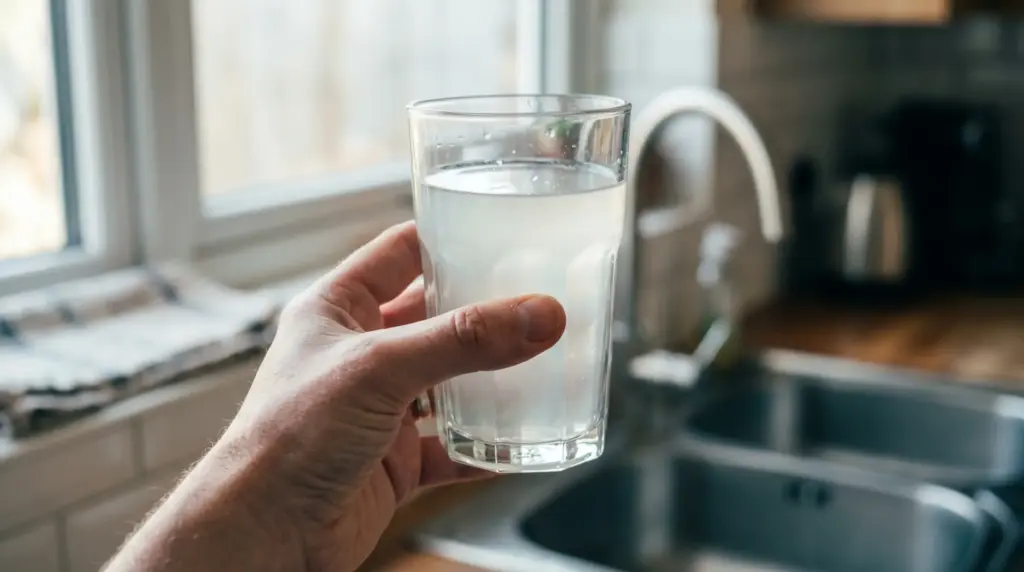
Cloudy well water is usually caused by one of two things: tiny trapped gas bubbles or actual material suspended in the water. Ordinary air bubbles are generally harmless and disappear within minutes. Suspended sand, silt, clay, rust, mineral particles or biological growth needs investigation.
You can usually tell which category you are dealing with before calling anyone. Fill a clear glass and watch it for 60 seconds. If the water clears from the bottom upward, rising bubbles are leaving the water. If it remains cloudy, clears from the top downward or leaves material on the bottom, particles are present.
Start with the 60-second glass test
Use a clean, clear drinking glass with smooth sides. Run the cold water for about 30 seconds, fill the glass and place it on a well-lit counter. Do not swirl it. Watch what happens for at least one minute, then leave it undisturbed for another 10 to 15 minutes if particles are still visible.
The direction in which the water clears matters:
- Bottom to top: Tiny bubbles are rising and escaping. The clear area begins at the bottom and moves upward.
- Top to bottom: Particles are falling. A clear layer develops at the surface and gradually extends downward.
- No meaningful change: Very fine particles, called colloids, may be too small to settle during a short test. Iron, manganese and clay can behave this way.
- A layer forms on the bottom: The water contains sediment such as sand, silt, clay particles or rust.
| What you see | Most likely cause | Harmless or investigate? | Next step |
|---|---|---|---|
| Clears from the bottom upward | Ordinary air bubbles | Usually harmless | Check other faucets and monitor |
| Clears from the top downward | Settling suspended material | Investigate | Save a sample and arrange water testing |
| Sand or grit collects on the bottom | Well sediment or pipe scale | Investigate | Have the well and pump inspected |
| Cloudiness remains evenly distributed | Clay, precipitated minerals or biological material | Investigate | Order turbidity, mineral and bacteria testing |
| Bubbles continue after standing or resemble carbonated water | Persistent air or a naturally occurring gas such as methane | Investigate if persistent | Ventilate and ask a laboratory about dissolved-gas testing |
Repeat the test at more than one faucet
Test an unfiltered cold-water tap near the pressure tank if one is available, then compare it with a kitchen or bathroom faucet. Remove the faucet aerator before testing when practical. An aerator deliberately mixes air into the stream, so a clogged or damaged one can make water from one faucet look milky even when the well water is clear.
If only one faucet produces cloudy water, the cause is probably at that fixture or in the nearby plumbing. If every cold-water tap does it, look toward the pressure system, pump or well. Cloudiness found only in hot water points toward the water heater rather than the well itself.
Air bubbles are the most common cause
Groundwater naturally contains dissolved gases. Water under pressure can hold more gas than water exposed to open air. When the water passes through the pump, pressure tank, plumbing and faucet, the pressure falls. The gas comes out of solution as thousands of tiny bubbles, much as bubbles appear when a carbonated drink is opened.
Those bubbles scatter light and give the water a white or milky appearance. As they rise to the surface, the lower part of the glass becomes clear first. Ordinary air does not leave grit, colour or a film behind.
After pump replacement or plumbing work
A new pump, pressure tank replacement, filter change or plumbing repair can introduce air into the system. The water may look cloudy or sputter from faucets until the trapped air has been displaced. This should improve as water is used.
Do not assume that continuing spurts and bubbles are part of the adjustment period. If the condition persists, a contractor should check for a leaking connection, faulty check valve, pressure-tank problem, low water level or a pump drawing more water than the well can supply.
After a power outage
A brief outage does not automatically contaminate a well. However, air can enter if the system loses pressure or water drains back toward the well. When power returns, the faucets may spit air before the flow becomes steady.
Persistent air following an outage deserves attention, particularly if the system lost all pressure. Loss of pressure can create an opportunity for unwanted water to enter through a damaged connection. If the water also changes colour, smell or taste, arrange a bacteria test rather than waiting for the appearance to improve.
Cold groundwater entering a warm house
Cold water can hold more dissolved gas. When very cold groundwater enters a warm building and leaves the pressurized plumbing, some of that gas is released. This is why milky water caused by air can be more noticeable during winter or at a faucet where the water experiences a sharp pressure change.
No treatment is needed when the glass test consistently confirms ordinary air, the water has no new smell or colour, and the cloudiness disappears promptly.
When bubbles could be methane
Methane occurs naturally in groundwater in some geological areas. It is colourless and odorless, so smell cannot rule it out. Dissolved methane can make well water appear milky or unusually fizzy as the gas escapes.
Methane in the water is not the same issue as ordinary air. The main concern is gas accumulating after it leaves the water, particularly in a confined bathroom, laundry room, well pit or other poorly ventilated area. At sufficient concentrations in air, methane can create a fire or explosion hazard.
Cloudiness that does not clear is suspended material
Water professionals call this condition turbidity, meaning that particles are scattering light and reducing the water’s clarity. Turbidity describes what the water looks like; it does not identify the material or establish whether the water is safe.
The source could be mineral sediment, corrosion, biological growth or water entering from near the ground surface. The timing, colour, texture and smell provide useful clues, but laboratory testing and a well inspection are what separate one cause from another.
Sand, silt or clay entering from the well
A few grains appearing after work on the well may be material disturbed during servicing. Repeated sediment is different. It can indicate that the well screen is damaged or unsuitable for the surrounding formation, the pump is positioned too close to the bottom, the well is being pumped faster than the formation can replenish it, or an aging well is deteriorating.
Coarse sand usually settles quickly and feels gritty between the fingers. Silt settles more slowly. Clay particles can remain suspended for hours and may give the water a grey, tan or whitish haze.
A cartridge filter can protect household fixtures from sediment, but it does not correct a failing screen or an improperly positioned pump. Treating the symptom while the well continues to produce sand can lead to clogged filters, worn pump components and sediment accumulation in the pressure tank or water heater.
Iron or manganese coming out of solution
Iron and manganese may be dissolved and invisible while the water is underground. After the water meets oxygen, these minerals can change form and become solid particles. This process is called precipitation. It is the same general reason that clear water containing dissolved iron can later turn rusty or leave orange staining.
Freshly precipitated particles can be extremely fine. They may remain suspended rather than forming an obvious layer during the glass test. Iron commonly produces yellow, orange or reddish-brown tones. Manganese may cause grey, brown or black particles and stains. A very pale mineral haze can initially look white.
Testing should measure iron and manganese and should ideally distinguish between dissolved and total amounts. Water pH also matters because it affects which treatment method will work reliably.
Iron bacteria and sulfur bacteria
Iron bacteria and sulfur-related bacteria can form a sticky biological coating called a biofilm inside the well, pump, pressure tank and plumbing. The organisms themselves are not the same as disease-causing fecal bacteria, but their growth can foul equipment and create unpleasant water.
Possible signs include stringy material, an oily-looking film, reddish or dark slime inside a toilet tank, swampy or musty odours, and recurring particles after the plumbing has been flushed. Sulfur-related activity may also accompany a rotten-egg odour, although hydrogen sulfide can have non-biological causes.
A smell does not identify a particular organism, and clear, odorless water can still contain harmful bacteria. Include total coliform and E. coli testing whenever biological growth is suspected.
Surface water entering the well
The most concerning explanation for new cloudy well water is runoff or shallow groundwater reaching the well without adequate natural filtration. Possible entry points include a loose or damaged cap, cracked casing, failed grout around the casing, an old well pit, electrical openings that are not sealed, or ground that slopes toward the wellhead.
Rain and melting snow can carry soil, animal waste, septic contamination, fertilizers and other material. If the well becomes cloudy soon after heavy precipitation, the visible particles may be only one part of the problem. Bacteria and dissolved contaminants may also be present, and many of them cannot be seen, smelled or tasted.
Shallow dug and driven wells are especially vulnerable because they draw from water close to the surface. A drilled well can also be affected when its casing, cap or grout no longer prevents water from travelling down the outside of the casing.
When cloudy well water is a health concern
Cloudiness alone does not prove that water contains a harmful contaminant. It also cannot prove the water is safe. Treat a sudden unexplained change as a warning sign, especially under any of these conditions:
- The water changed after heavy rain, flooding or rapid snowmelt.
- The well is shallow, dug, driven or located where water ponds around the casing.
- The water has a new sewage-like, musty, swampy or rotten-egg smell.
- Cloudiness appeared after the well lost pressure or after well equipment was repaired.
- People in the household have unexplained gastrointestinal illness.
- The water contains visible slime, organic debris or recurring fine sediment.
In those situations, use bottled water or another known-safe source for drinking, cooking, brushing teeth, making ice and preparing infant formula until testing provides an answer. Contact the local health department in the United States or the local public health unit or provincial authority in Canada for location-specific advice.
At minimum, request tests for total coliform bacteria and E. coli. Depending on the event and local conditions, the laboratory or health authority may recommend nitrate, turbidity or other tests. Collect the sample before shock chlorination unless the authority instructs otherwise. Chlorinating first can temporarily suppress bacteria and prevent the original sample from showing what was happening.
Match the treatment to the cause
Do not buy a filter based only on the word “cloudy.” Different causes require different equipment, and some causes require a well repair rather than water treatment. Begin with the glass test, a laboratory analysis and, when sediment or surface entry is suspected, a physical inspection by a qualified well contractor.
Use the table below to prepare questions for a written quote. Request USD for a U.S. project or CAD for a Canadian project. Ask how well depth, accessibility, local geology, labour, equipment capacity, permits and deterioration affect the proposed scope. Request itemized amounts, assumptions, exclusions, taxes, quote date and validity, and responsibility for changes.
| Confirmed cause | Likely response | Questions about the quoted work |
|---|---|---|
| Ordinary dissolved air | No water treatment; repair the pressure or pump system only if air persists | If a visit or repair is proposed, what diagnosis, inspection, parts, labour and testing does the quote include? |
| Sand, silt or clay | Pump adjustment, well rehabilitation, screen work and/or sediment filtration | Are filtration, pump adjustment, rehabilitation and screen work quoted separately, with the proposed scope and exclusions identified? |
| Iron or manganese particles | Properly sized oxidation and filtration system based on laboratory results | Are equipment capacity, media, controls, plumbing, installation, start-up and testing itemized? |
| Iron or sulfur bacteria | Shock chlorination plus cleaning or rehabilitation if biofilm is established | Does the quote distinguish inspection, cleaning, disinfection, rehabilitation, flushing and follow-up tests? |
| Surface-water intrusion | Repair cap, casing, grout or drainage; disinfect and retest afterward | Does the quote identify the proposed cap, casing, grout or drainage work, access, permits, disinfection, testing and exclusions? |
| Methane | Outdoor venting and a purpose-designed aeration or gas-removal system | Site-specific; obtain a design and quote after dissolved-gas testing |
Ordinary air: monitor first, repair persistent entry
Ordinary air that clears from the bottom upward does not need a filter. After recent work, allow normal water use to displace trapped air while watching for improvement. If bubbles or sputtering continue, have the pump, pressure tank, water level and valves checked. An air-release or bleed valve may be part of the correction, but only after the source of the air is understood.
Sediment: protect the plumbing and correct the well
A sediment filter can capture particles before they reach fixtures and appliances. Filter size must match both the particle size and the home’s required flow. A cartridge that is too fine may clog rapidly and cause a noticeable pressure drop.
When the well itself is producing sand, the lasting correction may involve raising the pump, reducing the pumping rate, rehabilitating the well or repairing the screen. Screen replacement is not possible or economical in every well. A camera inspection, pumping test and review of the original well record can help a contractor determine what is practical.
Iron and manganese: oxidize, then filter
An oxidation filter converts dissolved iron or manganese into particles and then captures them. The oxidizing step may use air, chlorine, hydrogen peroxide, potassium permanganate or specialized filter media. The correct approach depends on mineral concentration, pH, water demand and whether hydrogen sulfide or bacteria is also present.
A household sediment cartridge alone will not reliably remove dissolved iron because the iron can pass through while still invisible. Test first, then size the treatment for peak household flow as well as the laboratory results.
Bacteria: disinfect, then find out why it returned
Shock chlorination uses a high chlorine concentration to disinfect the well and plumbing. It should be followed by thorough flushing and laboratory retesting at the interval specified by the local authority. In the United States, use a licensed well contractor where required. In Canada, use a contractor holding the licence or certification required by the province or territory.
Chlorination may control a recent contamination event, but recurring bacteria means the source has not been resolved. Thick iron-bacteria biofilm can also shield organisms from chlorine. Established growth may require physical well cleaning or rehabilitation in addition to disinfection.
Surface intrusion: repair before relying on treatment
When runoff is entering the well, installing a household filter without repairing the entry point leaves the water supply vulnerable. The contractor should inspect the sanitary cap, casing condition, casing height, electrical penetrations, grout seal and drainage around the wellhead.
After repairs, the well and plumbing are normally disinfected, flushed and retested. A clear appearance after chlorination is not proof of safety; acceptable laboratory results provide that evidence.
Information to collect before the contractor arrives
A short record can reduce guesswork and help separate a well problem from a plumbing problem. Note:
- Whether the glass clears from the bottom, top or not at all
- How long clearing or settling takes
- Whether sediment is gritty, slimy, coloured or powdery
- Which cold and hot faucets are affected
- Whether the condition is strongest when the pump starts
- Recent rain, snowmelt, drought, flooding, outages or excavation
- Recent pump, pressure tank, filter or plumbing work
- Any change in pressure, flow, taste, colour or smell
- The age, depth and construction of the well, if records are available
Photograph the glass at the start and after one, five and 15 minutes. Keep any settled material in the glass for the contractor to see, but use the laboratory’s sterile container and sampling instructions for formal water testing.
Sources and methodology
This article separates visual observations from confirmed diagnoses. The glass test is used as an initial screening step, while health and treatment recommendations are based on current government guidance for private wells. No visual test can replace laboratory analysis.
- US Centers for Disease Control and Prevention: Guidelines for Testing Well Water
- US Centers for Disease Control and Prevention: Guidelines for Treating Well Water
- US Environmental Protection Agency: Learn About Private Water Wells
- US Environmental Protection Agency: Potential Well Water Contaminants and Their Impacts
- Health Canada: Testing Private Well Water
- Health Canada: Drinking Water Turbidity Guidance
- Illinois Department of Public Health: Methane in Groundwater
- Wisconsin Department of Natural Resources: Iron Bacteria Problems in Wells
This guide uses quote questions rather than assembled residential price ranges. Compare proposals based on the same inspection and laboratory results. Ask each provider to explain how local geology, well construction, access and contractor availability affect its proposed work and charges.