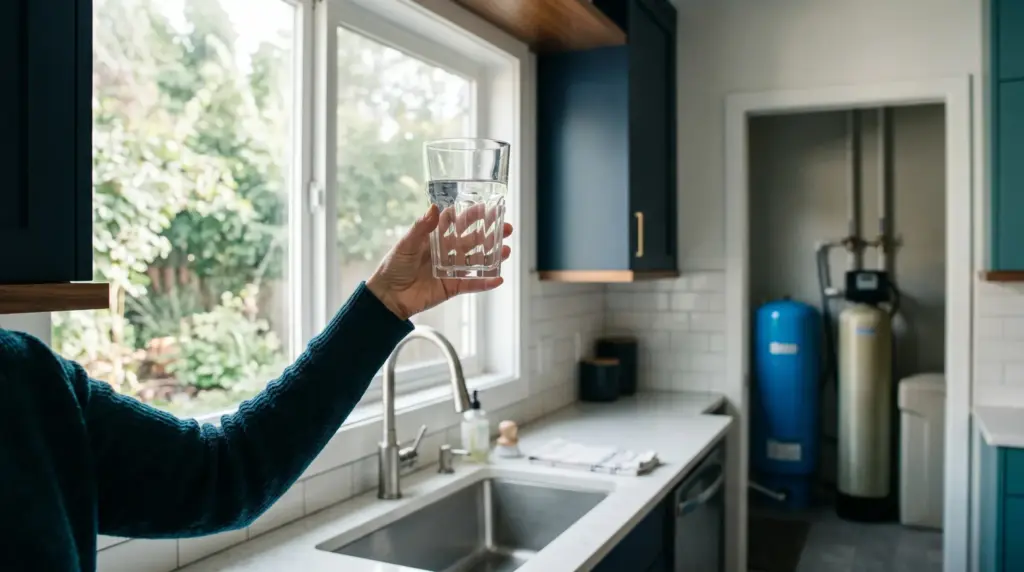
A new salty taste is a reason to investigate your well water. Arrange testing and contact your local health or environmental authority for advice about the appropriate tests. Taste cannot identify the contaminant or establish whether the water is suitable for drinking. CDC: Testing well water.
What can make well water taste salty?
Groundwater dissolves minerals as it moves through soil and rock. Human activities can also add dissolved substances: road deicing, irrigation, wastewater and fertilizers are examples. These are possible sources to investigate, not diagnoses that can be made from a glass of water. USGS: Chloride, salinity and dissolved solids.
Total dissolved solids, or TDS, is a combined measure of dissolved material. Sodium and chloride can contribute, but so can calcium, magnesium, sulfate and other substances. A TDS reading does not separate them. Ask the laboratory which individual measurements are needed to explain your result. USGS: Chloride, salinity and dissolved solids.
Road salt can enter groundwater. A USGS investigation of four affected Maine bedrock wells found changes during winter thaws and also during summer recharge. That study is a reason to ask about repeat sampling; it does not predict the timing or cause of a change in your well. USGS: Road-salt investigation in four Maine wells.
Near a coast, pumping can draw saltwater into parts of an aquifer that previously supplied fresh water. Movement can be sideways or upward from deeper zones. Ask a local groundwater specialist to examine the well record, pumping history and water-quality trends before proposing a deeper well or a different pumping arrangement. USGS: Saltwater intrusion.
Which tests answer the question?
Discuss chloride, sodium, sulfate and TDS with the laboratory, along with any additional tests recommended for the surrounding land use. A combined salt or mineral result is not a substitute for identifying the substances present. Keep the units and the sampling location with each result. USGS: Chloride, salinity and dissolved solids.
In the United States, use a state-certified drinking-water laboratory. CDC recommends annual testing for total coliform bacteria, nitrate, TDS and pH, plus local contaminants of concern. A new taste, nearby contamination, flooding or a well repair can require additional testing rather than waiting for that annual visit. CDC: Testing well water.
In Canada, ask your local public health unit or provincial or territorial authority about an accredited laboratory. Health Canada recommends microbial testing at least every six months; chemical-testing frequency depends on the contaminant and local advice. Report changes in taste and nearby activities when arranging the tests. Health Canada: Testing well water.
Follow the laboratory's instructions for the container, collection, labeling, storage and delivery. If a softener or another treatment system is present, ask the laboratory and installer to identify suitable sampling points. Do not assume that an outdoor faucet supplies untreated water. Health Canada: Testing well water.
What do chloride and sodium results mean?
EPA lists 250 mg/L for chloride as a secondary standard addressing effects such as salty taste. Secondary standards are federal guidance for public water systems, rather than federal health limits for private wells. Being below that figure does not answer whether other contaminants are present. EPA: Secondary drinking-water standards.
Health Canada's March 2025 guidance also sets a chloride aesthetic objective of no more than 250 mg/L. That taste-based objective is distinct from its assessment of health effects at elevated concentrations. Ask your public health authority to interpret the complete report, particularly when sodium is also high. Health Canada: Operational parameters.
A sodium-based softener can increase sodium in treated water. Health Canada highlights this for people who need to restrict sodium and advises against sodium-softened drinking water for children under eight. Ask your health professional about an appropriate drinking-water source; an untested bypass supply is not automatically a suitable alternative. Health Canada: Operational parameters.
Choose treatment after the results
Reverse osmosis can reduce sodium and chloride, but its label must identify the substances the particular system treats. Distillation is another process that can remove sodium. Neither description means that an unspecified device makes every well suitable for drinking; selection must address the actual contaminants. CDC: Home water-treatment systems.
A single-tap system treats that outlet; a whole-home system treats water entering the home. Ask which locations need treatment and whether the exact device is certified for the contaminants identified. Use an accredited laboratory to compare water entering and leaving the installed device, and follow its maintenance instructions. Health Canada: Choosing well-water treatment.
Boiling does not remove harmful chemicals from water. If testing identifies harmful contamination, follow local advice about using another suitable water source and the corrective work needed. Do not treat boiling as a remedy for a chemical-water problem. CDC: Testing well water. CDC: Chemicals in tap water.
Prepare for a useful service visit
Bring the original and current test reports, the well record, and the treatment make and model. Note when the taste changed, which taps are affected, recent repairs and any nearby spill or land-use change. Ask for a written explanation of the evidence behind the proposed cause.
Request an itemized quote covering the tests, proposed equipment, installation, ongoing supplies and follow-up checks. Ask which problem each item addresses and who will service it. Compare the quoted total and currency directly; this guide does not supply a verified current market price.