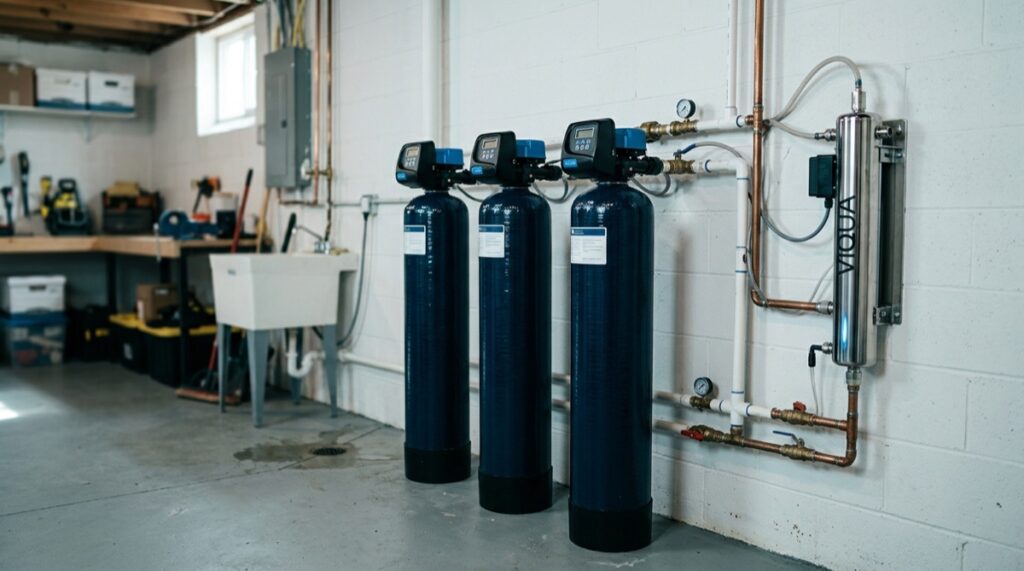
There is no single “well water treatment system.” The right equipment depends on what your water test found, how much is present, and how much water your household uses. Iron calls for a different treatment process than bacteria. Arsenic requires another approach. Hardness, sulfur odor, sediment, and PFAS each behave differently.
The mistake is buying equipment that does not match the problem. A water softener may remove hardness and limited amounts of dissolved iron, yet it will not make bacterially contaminated water safe. An ultraviolet unit can disinfect clear water, yet it will not remove arsenic or nitrates. A carbon filter may improve taste while leaving dissolved minerals untouched.
A sound treatment plan starts with measured concentrations from a qualified laboratory. The equipment comes second.
Start With a Laboratory Water Test
Private well owners are responsible for monitoring their own water. In the United States, federal drinking-water rules generally do not cover an individual private well. Canadian provinces and local health authorities also place much of the responsibility on the well owner.
The U.S. Environmental Protection Agency recommends annual testing for total coliform bacteria, nitrates, total dissolved solids, and pH. Health Canada recommends testing for microbial contamination at least every six months, with chemical testing based on local conditions and public-health advice.
Ask a state-certified laboratory in the U.S. or an accredited laboratory in Canada for a private-well panel. Follow its sampling instructions. Bacteria samples require sterile bottles, careful handling, and delivery within a set time. A poorly collected sample can produce a result that tells you more about the sampling method than the well.
The basic panel
A useful baseline panel should include:
- Total coliform and E. coli: Total coliform is an indicator that the well may be open to contamination. E. coli points more directly to contamination from human or animal waste.
- Nitrate and nitrite: These can enter groundwater from fertilizer, manure, septic systems, and natural sources. Infants are especially vulnerable to high nitrate exposure.
- pH: This measures how acidic or alkaline the water is. Low-pH water can corrode plumbing and release copper or lead from household materials.
- Hardness: Calcium and magnesium create scale in water heaters, fixtures, and appliances. Hardness is mainly an operating and household-use issue rather than a health contaminant.
- Iron: Iron can stain laundry and fixtures, affect taste, clog equipment, and support iron-bacteria growth.
- Manganese: Manganese can leave dark stains and deposits. At elevated concentrations, it can also become a health concern.
- Turbidity or suspended solids: This measures cloudiness and helps determine whether sediment pretreatment is needed.
When to order an extended panel
Local geology and nearby land use should drive additional testing. Ask the laboratory, health department, provincial health authority, or local groundwater office which contaminants are common in your area.
- Arsenic: Worth testing where it occurs naturally in bedrock or regional groundwater. It has no reliable taste, color, or smell.
- Lead and copper: Especially relevant in homes with older plumbing, brass components, solder, or acidic water. Sample at the tap because the well may not be the source.
- PFAS: Consider testing near airports, military facilities, landfills, fire-training areas, and certain industrial sites. PFAS sampling requires careful handling to avoid contamination.
- Radon, uranium, radium, or gross alpha: Appropriate in regions known for radioactive minerals. The recommended panel varies by geology.
- Hydrogen sulfide and sulfate: Useful when water smells like rotten eggs, causes black staining, or has a bitter taste. Testing can help separate dissolved gas from bacterial activity or a water-heater problem.
- Tannins and color: Relevant when clear-looking water turns tea-colored, particularly in shallow wells near wetlands or organic soils.
- Volatile organic compounds, pesticides, or fuel-related chemicals: Consider these when the well is near farming, buried fuel tanks, dry cleaners, landfills, industrial property, or a known spill.
Test again after flooding, well repairs, pump work, changes in taste or color, nearby excavation, or an unexplained illness. If a health-related contaminant is found, confirm the result and follow the laboratory or public-health authority’s directions. Use an alternate safe source for drinking and food preparation when advised.
Why a home test kit is not enough
Home kits can screen for hardness, pH, iron, or a few other characteristics. They rarely provide the accuracy, detection limits, quality controls, or contaminant detail needed to design treatment for a health concern.
Concentration matters. A trace of iron and a heavy iron load may require different equipment. Arsenic treatment can depend on whether the arsenic is present as arsenic III or arsenic V. A nitrate treatment unit must be sized against the measured concentration and household water use. A color strip marked “high” does not provide enough information for those decisions.
Well Water Treatment Options by Contaminant
The table below gives practical starting points and questions for a written quote. Request amounts in USD for a U.S. project or CAD for a Canadian project. Ask each provider to itemize equipment, capacity assumptions, installation, plumbing, electrical work, drains, pretreatment, testing, travel, taxes, exclusions, quote date and validity, and change responsibilities.
| Contaminant or problem | Common system type | How it works | Questions about the installed scope | Maintenance |
|---|---|---|---|---|
| Iron and manganese | Air-injection or other oxidizing filter; manganese-dioxide or greensand media; chemical oxidation for difficult water | Converts dissolved metals into particles, then traps them in filter media. The choice depends on pH, oxygen, metal concentration, sulfur, and flow rate. | Does the quote include the filter, media, controls, drains, installation, start-up and water tests? | Automatic backwashing, injector cleaning, chemical replenishment where used, and eventual media replacement |
| Hardness | Ion-exchange water softener | Exchanges calcium and magnesium for sodium or potassium. It reduces scale but does not disinfect water. | Are the softener model, capacity, bypass, plumbing, drain, installation and start-up itemized? | Salt or potassium, brine-tank cleaning, control-valve service, and resin replacement as it ages |
| Bacteria | Well correction and disinfection; Class A UV; continuous chlorination when justified | Well work addresses the entry route. UV inactivates microorganisms as clear water passes the lamp. Chlorine requires the correct dose and contact time. | UV: Are the unit, pretreatment, electrical work, installation and testing included? Chlorination: Are the feed equipment, tank, filtration, installation and testing included? |
Annual UV lamp, sleeve cleaning, pretreatment filters, chemical refills, pump checks, and regular bacteria testing |
| Nitrates | Under-sink reverse osmosis; nitrate-selective anion exchange for whole-house treatment | RO pushes water through a membrane that rejects much of the nitrate. Specialized resin exchanges nitrate for chloride. | POU RO: Are the unit, faucet, connections, installation and testing included? Whole-house: Are equipment, pretreatment, installation and testing itemized? |
Cartridge and membrane changes, resin regeneration, salt, and periodic laboratory confirmation |
| Arsenic | Certified POU RO; adsorptive media; specialized ion exchange | A membrane or treatment media captures arsenic. Arsenic III may need oxidation into arsenic V before reliable removal. | POU: Does the quote identify the unit, installation and testing? Whole-house: Does it identify equipment, media, installation, testing and disposal? |
Media or membrane replacement, raw and treated-water testing, and proper handling of spent media |
| Lead | Certified lead-reduction filter or POU RO; corrosion correction; plumbing replacement | The filter protects a drinking tap. Correcting low pH and replacing lead-bearing plumbing addresses the source. | POU: Are the unit, cartridges, installation and follow-up testing itemized? Is any plumbing or source-correction work quoted separately? |
Cartridge changes on schedule and follow-up first-draw and flushed-tap testing |
| PFAS | Certified granular activated carbon, POU RO, or PFAS-selective ion exchange | Carbon or resin adsorbs certain PFAS. RO rejects many PFAS at a membrane. Performance varies by compound and water chemistry. | POU: Are equipment, installation, testing and replacement materials itemized? Whole-house: Are pretreatment, media, installation, testing and disposal included? |
Conservative cartridge or media changes, laboratory testing for breakthrough, and appropriate disposal |
| Hydrogen sulfide | Aeration, air injection, oxidizing media, or chlorination followed by filtration | Releases the gas or converts it into particles that a filter can capture. The concentration determines which method is suitable. | Are the proposed equipment, vents, drains, installation, start-up and follow-up tests included? | Backwashing, vent inspection, injector cleaning, chemical refills, and media replacement |
| Sediment | Spin-down separator, cartridge filter, or backwashing sediment filter | Captures sand, silt, rust, and other particles before they reach plumbing or finer treatment equipment. | Are the housing, separator or filter, plumbing, installation, initial cartridges and testing included? | Flushing, cartridge changes, and investigation if sediment suddenly increases |
| Tannins | Organic-scavenging anion-exchange resin; POU RO for limited drinking-water demand | Specialized resin captures dissolved organic color. Iron and sediment may need removal first. | Are resin, tank, controls, pretreatment, plumbing, installation and start-up included? | Salt regeneration, resin cleaning, pretreatment service, and eventual resin replacement |
| Low pH | Calcite or blended-media neutralizer; soda-ash chemical feed for very acidic water | Dissolves alkaline mineral into the water or meters an alkaline solution to raise pH and reduce corrosion. | Are media or feed equipment, controls, plumbing, installation, start-up and monitoring included? | Media top-ups, chemical mixing, pump service, pH checks, and cleaning |
| Radon in water | Whole-house aeration; specialized carbon in selected cases | Aeration strips radon gas from water and vents it safely outdoors. The home’s indoor air must also be tested. | Are the treatment equipment, venting, electrical work, installation and follow-up monitoring included? | Blower, vent, tank, pump, and post-treatment monitoring; carbon disposal may need special handling |
| Uranium or other radionuclides | Specialized ion exchange or RO, selected for the exact radionuclide | Resin exchanges charged contaminants, while RO rejects many dissolved radionuclides at a membrane. | POU: Are the unit, installation, laboratory testing and disposal itemized? Whole-house: Are equipment, pretreatment, installation, testing and waste handling included? |
Laboratory monitoring and professional guidance on resin, brine, membrane, and concentrate disposal |
These are starting points, not product prescriptions. A treatment professional needs the complete laboratory report, the well’s flow rate, household peak demand, plumbing layout, and available space. Ask for equipment certified for the specific contaminant claim. NSF explains the major residential treatment standards, including NSF/ANSI 44 for softeners, 55 for UV, 53 for health-effect filters, and 58 for reverse osmosis. A standard number alone is insufficient; the certification must name the contaminant you need reduced.
Whole-House Treatment Versus Point-of-Use Treatment
A whole-house system, also called point-of-entry treatment, processes water where it enters the building. A point-of-use system treats water at one fixture, usually the kitchen sink.
When whole-house treatment makes sense
Use whole-house treatment when the contaminant affects plumbing, bathing, laundry, equipment, or every tap. Iron, manganese, hardness, sediment, low pH, and hydrogen sulfide usually belong in this category. Bacterial contamination also calls for a whole-water-supply response because people can swallow water at more than one fixture.
Whole-house equipment must handle the home’s peak flow. An undersized iron filter may work at one faucet and allow staining when two showers and the washing machine run together.
When one drinking-water tap may be enough
Point-of-use treatment can be appropriate for arsenic, nitrate, lead, PFAS, uranium, and other ingestion-related contaminants when one protected tap supplies all drinking, cooking, ice, and infant-formula water. This approach avoids treating toilet, laundry, and outdoor water to drinking-water standards.
The plan must account for every place where water is swallowed. A filtered kitchen faucet offers little protection if the refrigerator ice maker, bathroom cups, and a basement kitchenette remain untreated.
When you need both
Many wells need a treatment sequence. Sediment, iron, hardness, or low pH may require whole-house correction so that a kitchen RO membrane can survive. A home with bacteria and arsenic might use sediment filtration and UV for the whole house, followed by certified RO at the drinking tap. A hard, iron-bearing well may need an iron filter and softener before POU treatment for nitrate or PFAS.
Order matters. Each stage should protect the stage after it.
How the Main System Types Work
Sediment filters
Sediment filtration removes particles rather than dissolved chemicals. A coarse spin-down filter can catch sand. A cartridge can capture finer silt. A backwashing tank is often better for heavy, recurring loads because it flushes collected material to a drain.
A sudden increase in sand should trigger a well inspection. It can indicate a damaged screen, pump problem, falling water level, or disturbance in the well. Replacing cartridges forever may hide a source problem.
Carbon filters
Activated carbon has a large internal surface that adsorbs certain organic chemicals, tastes, and odors. It can reduce PFAS when the unit carries the proper certified claim. Carbon has limited capacity. Once its sites fill, contaminants can pass through without a visible warning.
Ordinary carbon is not a universal well-water filter. It does not soften water, remove nitrate reliably, or provide dependable disinfection. Carbon placed after chlorination can remove residual chlorine and improve taste.
Water softeners
A softener exchanges hardness minerals for sodium or potassium. It protects water heaters, plumbing, fixtures, and soap performance. Some softeners can handle limited dissolved iron or manganese, but heavy metal loading, oxidized particles, and iron bacteria foul the resin.
If sodium intake is a concern, discuss potassium regeneration or an unsoftened drinking-water line with a health professional and treatment specialist. Health Canada recommends bypassing the kitchen drinking tap where appropriate because softening adds sodium or potassium.
Iron filters
Iron treatment usually has two jobs: turn dissolved iron into a solid, then trap the solid. Air-injection systems add oxygen. Manganese-dioxide and greensand media promote oxidation and filtration. Some systems use chlorine, peroxide, ozone, or potassium permanganate when the water chemistry demands stronger oxidation.
Birm media depends on adequate dissolved oxygen, pH, and favorable chemistry. Hydrogen sulfide, organic matter, or disinfectants can make it a poor fit. Greensand can handle a wider range but may require regeneration chemicals. Air injection avoids a chemical feed in suitable water, though it still requires cleaning, backwashing, and correct sizing.
Ultraviolet disinfection
UV exposes flowing water to ultraviolet light that inactivates microorganisms. It adds no disinfectant to the water and leaves no protective residual in downstream plumbing. The water must be clear enough for the light to reach the organisms.
Iron, manganese, tannins, hardness scale, and turbidity can shield microbes or coat the quartz sleeve around the lamp. CDC guidance notes that UV performs better with filtration ahead of it. A Class A unit certified to NSF/ANSI 55 is the usual residential choice for disinfecting contaminated water.
Reverse osmosis
RO sends water under pressure across a thin membrane. Water molecules pass through more readily than many dissolved salts and contaminants. Under-sink units usually include sediment and carbon prefilters, a storage tank, and a dedicated faucet.
RO produces treated water and a reject stream containing the removed material. Recovery rate, pressure, temperature, and feed-water quality affect output. Whole-house RO may require pretreatment, storage, repressurization, and corrosion planning.
Acid neutralizers
A calcite tank raises pH as acidic water dissolves the mineral bed. It can add hardness, which may create a later need for softening. Very low pH or variable water chemistry may call for a metered soda-ash solution instead. The feed pump and solution strength must stay calibrated.
Aeration
Aeration exposes water to air. It can release hydrogen sulfide, radon, methane, and some volatile chemicals. It can also oxidize iron and manganese before filtration. Off-gas must be vented safely outdoors, and atmospheric tanks require protection against contamination.
Chlorination and chemical feed
A chemical-feed pump meters disinfectant or another treatment chemical into the water. Effective disinfection depends on concentration, pH, temperature, water demand, and contact time. A contact tank gives the chemical time to work. Filtration may then remove oxidized iron, manganese, sulfur, and excess chlorine.
This equipment needs regular attention. An empty chemical tank or failed feed pump can leave the house without treatment while water continues to flow.
Four Treatment Planning Mistakes
1. Buying a softener for iron bacteria
Rust-colored slime, oily-looking surface films, clogged fixtures, and recurring odor can indicate iron bacteria rather than dissolved iron alone. A softener may foul rapidly because bacterial slime coats the resin.
Confirm iron bacteria through laboratory testing and inspection. The well may need physical cleaning and professional disinfection. The Minnesota Department of Health warns that iron bacteria can be difficult and expensive to control, with treatment sometimes only partly effective.
2. Installing RO without adequate pretreatment
Sediment blocks prefilters. Iron and manganese coat membranes. Hardness creates scale. Organic matter and bacteria form fouling layers. These problems reduce output, waste water, and shorten membrane life.
The raw-water report should determine what belongs ahead of the RO unit. Ask for separate installation and ongoing-maintenance amounts for the proposed pretreatment.
3. Treating the symptom while ignoring the source
A filter cannot repair a cracked well cap, poor surface drainage, a failing casing, or a damaged screen. UV may provide a barrier against bacteria while contaminated surface water continues to enter the well. A lead filter can protect one tap while corrosive water continues damaging plumbing elsewhere.
Odor deserves the same care. Rotten-egg odor only in hot water may come from the water heater rather than the well. Sediment that appears after pump work may have a mechanical cause. Find the entry point before building a permanent equipment train around it.
4. Over-treating clean water
More tanks do not guarantee safer water. Each added stage creates pressure loss, maintenance, replacement expense, and another place where bacteria or scale can collect.
A well with acceptable health results and moderate hardness may need only a softener, if the homeowner wants one. A sediment cartridge may be enough for a light particle problem. One certified drinking-water filter may address a localized lead concern. A quoted multi-stage package needs a contaminant-by-contaminant explanation before it earns space in the basement.
The Maintenance Cost Is Part of the Purchase
Every treatment system consumes something: salt, filter cartridges, lamp output, membrane life, mineral media, chemicals, electricity, water for backwashing, or professional service time. Ask for a written five-year maintenance schedule before buying.
| System type | Questions about recurring charges | Main recurring work |
|---|---|---|
| Sediment cartridges | What are the cartridge, cleaning and service charges, and which usage assumptions determine the quantity? | Cartridges, housing cleaning, and pressure checks |
| Whole-house carbon | What are the media or cartridge, labour, disposal and performance-testing charges? | Cartridge or media replacement and performance testing |
| Water softener | What are the salt or potassium, cleaning and service charges for the stated household use? | Salt or potassium, cleaning, and occasional service |
| Iron or sulfur filter | What are the injector-service, oxidant, backwashing and media-replacement charges? | Injector service, oxidant where used, backwashing, and media allowance |
| UV disinfection | What are the lamp, sleeve service, prefilter and testing charges, and the stated electricity use? | Lamp, quartz-sleeve cleaning, electricity, and prefilters |
| Under-sink RO | What are the filter, membrane, sanitizing and testing charges and replacement assumptions? | Prefilters, postfilter, membrane allowance, sanitizing, and testing |
| Neutralizer | What are the media, cleaning, service and pH-monitoring charges? | Calcite or blended media, cleaning, and pH monitoring |
| Chemical feed | What are the chemical, pump-part, cleaning, calibration and service charges? | Treatment chemical, pump parts, tank cleaning, and calibration |
Ask which water-use and water-chemistry assumptions determine the quoted maintenance quantities and charges. A sediment cartridge that lasts six months in one house may plug in two weeks in another. Carbon treating a low contaminant load may last far longer than carbon facing a high organic or PFAS load. Laboratory testing, rather than the calendar alone, should guide replacement for health-related contaminants.
What neglected maintenance looks like
- Pressure falls: Loaded cartridges and media restrict flow through the house.
- Contaminants break through: Exhausted carbon, resin, or adsorptive media can stop reducing the target contaminant without changing the water’s appearance.
- RO production drops: Fouled membranes make less treated water and may reject contaminants less effectively.
- UV protection weakens: A lamp can still glow after its useful germicidal output has fallen. A scaled sleeve further blocks the light.
- Softener performance fades: An empty brine tank, salt bridge, fouled resin, or failed valve allows hardness and iron to return.
- Chemical treatment stops: An empty solution tank or stalled feed pump removes the treatment barrier while faucets continue working normally.
Keep a log beside the equipment with filter dates, salt and chemical use, pressure readings, service work, and laboratory results. Label bypass valves. Keep replacement part numbers and operating instructions where the next homeowner can find them.
After installation, test both untreated and treated water through an accredited laboratory. Repeat the health-related tests on the schedule recommended by the laboratory or public-health authority. If equipment treats bacteria, arsenic, nitrate, lead, PFAS, or radionuclides, appearance and taste cannot prove performance.
For work involving the well itself, confirm that the contractor holds the required license in your U.S. state or licence in your Canadian province. Treatment equipment should arrive with a written design basis: the laboratory result, target treated concentration, rated flow, required pretreatment, maintenance schedule, waste discharge needs, and applicable certification.
The laboratory report identifies the job. The treated-water sample is the proof that the equipment completed it.
Related Guides
- Tannins in Well Water
- Radon in Well Water
- Annual Well Maintenance Checklist
- How to Shock Chlorinate a Well
- How to Test Well Water
Browse all Water Quality guides →
Request Contact from Listed Well Drillers Near You
Tell us about your needs. A listed well driller in your area may contact you about the project. Free, no obligation.