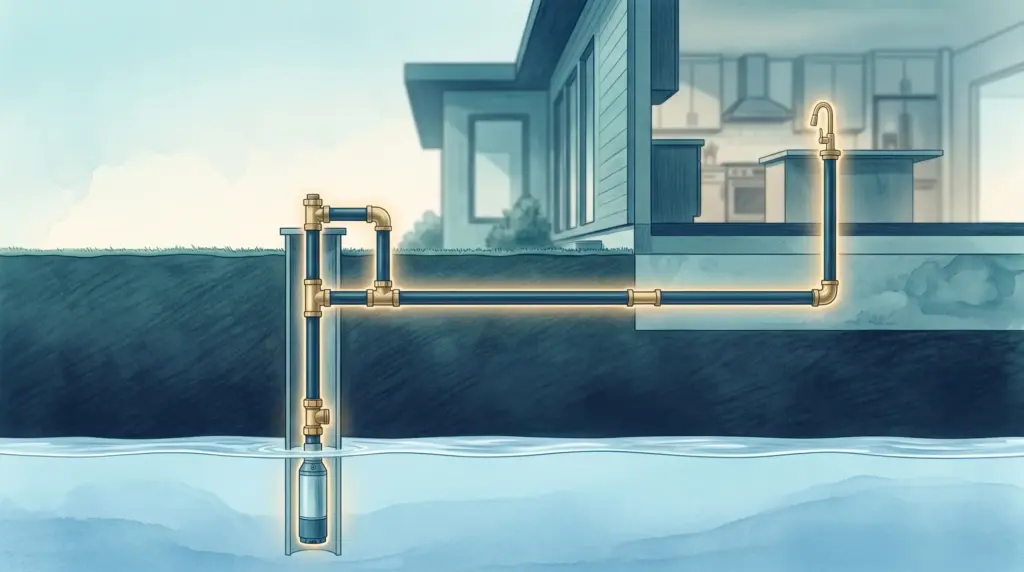
Finding lead in well water can send a homeowner in the wrong direction. The first instinct is often to blame the aquifer or assume the well has been contaminated. In most homes, that is not what happened.
Lead rarely occurs naturally in groundwater at a concerning concentration. When a laboratory detects lead at a private-well tap, the source is usually somewhere between the well and the drinking glass: lead solder on older copper joints, lead-containing brass fixtures or valves, an old supply line, or occasionally a component in the well system itself.
This distinction matters because the remedy is usually on the plumbing side, not the drilling side. Replacing or deepening the well will not solve lead released by a kitchen faucet.
Homes plumbed before 1988 deserve particular attention in the United States because lead solder was widely used before federal restrictions took effect. Older Canadian plumbing has similar concerns, although adoption dates varied by province and plumbing code. Lead can also come from older brass parts, some of which contained as much as 8% lead before tighter “lead-free” requirements took effect in 2014.
The current U.S. Environmental Protection Agency action level is 15 parts per billion, or ppb. That number is a regulatory trigger for public water systems—not a line separating safe water from dangerous water, and private household wells are not regulated by the EPA in the same way. Health Canada’s maximum acceptable concentration is more stringent at 5 ppb. For children, health authorities have not identified a safe level of lead exposure.
Where lead in well water actually comes from
A drilled well can deliver water containing no measurable lead, yet that same water can pick up lead before it reaches the kitchen sink. Water is an active chemical solution. As it rests against metal surfaces, it can dissolve tiny amounts of those materials or carry away particles from corrosion deposits.
The amount released depends on the materials in the system, the chemistry and temperature of the water, and how long the water remains still. That is why one sample may be low while another sample from the same faucet is elevated.
Lead solder on copper pipe joints
For much of the twentieth century, plumbers commonly joined copper tubing with solder containing lead. The solder is visible as a metallic ring around each copper fitting, but its composition cannot be confirmed reliably by appearance alone.
In the United States, Congress prohibited lead solder in plumbing carrying drinking water in 1986, with implementation following by 1988. Existing soldered joints were not automatically removed, and restricted materials continued to appear in some later installations and repairs. The age of a house therefore provides a useful clue, not definitive proof.
Canadian timelines differ somewhat. Lead solder was limited through standards during the late 1980s and officially prohibited for new potable-water plumbing and repairs in the 1990 National Plumbing Code. Provincial adoption did not necessarily happen on the same date. If an older Canadian home has copper plumbing, ask a plumber licensed or licenced in the applicable jurisdiction to assess its materials.
Solder can be an important source because it is in direct contact with the water. Low-pH or low-mineral water can corrode the solder, allowing dissolved lead or lead-bearing particles to enter the line. Numerous joints between the pressure tank and the kitchen can create more contact points than a homeowner expects.
Brass faucets, valves, fittings, and well components
Brass is an alloy commonly used in faucets, shutoff valves, check valves, pressure controls, adapters, and pump fittings. Historically, manufacturers added lead because it made brass easier to machine and shape. Older brass components could contain up to 8% lead while still being described as “lead-free” under the definition used at the time.
Federal requirements that took effect in the United States in 2014 reduced the allowable weighted average lead content of the wetted surfaces of most plumbing products to 0.25%. Modern certified products are therefore substantially different from many older brass parts, but the words “lead-free” on their own do not tell you when a component was made or what certification it carries.
Do not limit the inspection to visible faucets. A private-well system may contain brass or bronze parts at the pump, wellhead, pitless adapter, pressure tank, treatment equipment, and distribution manifold. Older submersible pump components have also been investigated as potential lead sources. If flushed water remains elevated after the household plumbing has been ruled out, those upstream parts deserve attention.
Lead service or supply lines
A lead service line is most often associated with municipal water, where it connects the public water main to a building. Private wells normally use plastic, copper, galvanized steel, or another approved material between the well and the house, so a true lead service line is less common.
Less common does not mean impossible. An older property may have a buried lead section, a lead connector, an abandoned connection to a former water supply, or undocumented work from an earlier renovation. Farms and rural properties also tend to accumulate plumbing changes over many decades, sometimes without plans or permits.
If the buried line’s material is unknown, do not scrape, cut, or disturb it merely to identify it. A qualified well contractor or plumber can review the entry point, available records, and exposed sections and decide whether further investigation is warranted.
Natural geological sources
Lead-bearing minerals can occur in rock and soil, so geological lead is possible. It is more plausible near historic lead or zinc mining, mine waste, smelting sites, industrial contamination, or known mineralized formations. Damaged well construction may also allow contaminated shallow water to enter a well.
Even in these settings, a high tap result does not prove that the aquifer is responsible. Plumbing remains a frequent source. A raw-water sample collected as close as practical to the well or pressure tank—before household plumbing and treatment—can help separate groundwater contamination from lead added within the building.
Acidic water accelerates lead release
Water with a pH below 7 is acidic. In general, acidic water is more aggressive toward metal plumbing and can increase the release of lead, copper, iron, and other metals. Low alkalinity also matters. Alkalinity is the water’s ability to resist a change in pH; water with little buffering can remain corrosive even when a single pH reading does not look extreme.
Temperature, dissolved minerals, oxygen, chloride, sulfate, and existing coatings inside the pipe also affect corrosion. For that reason, pH is a valuable warning sign but not a complete corrosion diagnosis.
What lead exposure can do to health
Lead accumulates in the body. Exposure from water adds to lead that may come from paint, household dust, soil, food, hobbies, or a workplace. The health concern is therefore the total exposure over time, not whether a single glass causes symptoms.
Children and pregnancy
Children absorb lead more readily than adults, and their developing brains and nervous systems are especially vulnerable. Lead exposure is associated with effects on learning, attention, behaviour, hearing, and neurological development. These effects may occur without any outward sign that a child has been exposed.
No safe level of lead exposure has been identified for children. Infants can receive a comparatively large water exposure when tap water is used to prepare formula. During pregnancy, lead stored in an adult’s bones can also enter the bloodstream and reach the developing fetus.
If a child or pregnant person may have consumed water with elevated lead, contact a physician or public health unit. A water result cannot show how much lead is in a person’s body; that requires medical assessment and, when appropriate, a blood test.
Adults
Adults are less vulnerable to some developmental effects, but lead is not harmless to them. Sustained or higher exposure has been associated with increased blood pressure, cardiovascular effects, reduced kidney function, reproductive effects, and damage to the nervous system. People with occupational lead exposure may have additional risk from the combination of sources.
How to interpret 15 ppb and 5 ppb
| Reference | Lead concentration | What it means |
|---|---|---|
| Current U.S. EPA action level | 15 ppb | A regulatory action trigger used by public water systems. It is not a health-based safe limit for an individual household sample. |
| Health Canada maximum acceptable concentration | 5 ppb | The Canadian guideline for total lead measured at the tap, with concentrations kept as low as reasonably achievable. |
| Children’s health guidance | No safe exposure level identified | A result below a regulatory number should not be treated as permission to ignore a known lead source. |
One part per billion is equivalent to one microgram per litre, written as µg/L. Laboratories may use either unit. Thus, 15 ppb and 15 µg/L mean the same concentration.
The EPA’s 15 ppb action level is often misunderstood. Public systems compare a group of household samples using a prescribed calculation; the number was not created as a guarantee that every glass below 15 ppb is risk-free. Private-well owners can use it as a serious treatment and investigation trigger, but they should aim to reduce lead as far as reasonably achievable. The EPA has finalized a lower 10 ppb public-system action level scheduled to apply beginning in November 2027.
How to test lead in well water correctly
A lead test is partly a test of timing. If you let the faucet run before collecting the only sample, you may wash out the water that had the longest contact with lead solder or a brass fixture. If you take only the first water of the morning, you may detect a problem but learn little about how far upstream it begins.
A useful investigation normally includes at least two samples from the same cold-water drinking tap: a first-draw sample and a flushed sample. Ask the laboratory for lead-specific containers and instructions before collecting either one. Sample volume, preservation, and handling can affect the result.
First-draw sample: test the water that sat in the plumbing
For a first-draw sample, choose a cold-water kitchen or bathroom faucet that is regularly used for drinking. The water should remain undisturbed for at least six hours—overnight is usually practical. Do not run that faucet, flush toilets, shower, operate a dishwasher, or use other water during the stagnation period if the laboratory’s procedure requires the entire house to remain unused.
Place the supplied bottle under the tap, open the cold-water control, and collect the first water that emerges. Do not rinse the bottle. Do not remove or clean the aerator unless the laboratory specifically instructs you to do so; particles caught in the aerator can be part of the exposure at that tap.
This sample emphasizes the faucet, nearby fittings, soldered joints, and other plumbing that held water during the stagnation period.
Flushed sample: look farther back in the system
A flushed sample is collected after the cold water has run for the period specified by the laboratory. Two minutes is a commonly used interval for investigating an individual well system, although the correct time can depend on plumbing length, pipe diameter, flow rate, pressure-tank arrangement, and the location being investigated.
The goal is to move the water that sat in the faucet and nearby household pipes and collect water representing a deeper part of the system. A specialist may also request a sample at the pressure tank, before treatment equipment, or at another upstream location.
Reading the pattern, not just one number
| Sample pattern | What it suggests | Reasonable next investigation |
|---|---|---|
| First-draw high; flushed low | The faucet or household plumbing is the likely source. | Inspect the fixture, nearby brass parts, and older soldered copper joints. |
| First-draw and flushed samples high | The source may be farther upstream or present throughout the system. | Sample near the pressure tank and review the buried supply line, well components, treatment equipment, and local geology. |
| One faucet high; other faucets low | A fixture or branch of household plumbing is implicated. | Compare fixture age and materials, then retest after corrective work. |
| Results vary sharply between tests | Stagnation time, flow, loose particles, or changing water chemistry may be affecting the sample. | Repeat testing with tightly controlled collection conditions and recorded times. |
These patterns are diagnostic clues rather than final proof. Lead particles can be released unpredictably, and flushing can sometimes dislodge deposits instead of reducing the reading. A technician may recommend sequential sampling—several bottles filled one after another—to estimate where a contaminated section lies.
Use a certified or accredited laboratory
Lead is measured at concentrations too low for appearance, taste, or smell to provide any warning. Consumer test kits can be useful as rough screening tools, but they generally do not offer the precision, quality controls, or source-location value of a laboratory analysis.
In the United States, use a state-certified drinking-water laboratory. In Canada, use a laboratory accredited for drinking-water lead analysis under the applicable provincial or territorial program. Tell the laboratory that the home uses a private well and that you want paired first-draw and flushed samples. Request pH and alkalinity at the same time.
If a result is elevated, confirm it with another properly collected laboratory sample while taking immediate exposure precautions. Do not postpone those precautions while waiting for confirmation, especially when children or a pregnant person live in the home.
How to reduce exposure immediately
The following measures reduce exposure while the source is being investigated. They manage the water at the tap; they do not remove the underlying lead-containing material.
- Flush the cold-water line before drinking or cooking. After water has been sitting for several hours, run the cold tap for roughly 30 seconds to two minutes, or until it becomes noticeably colder and the temperature stabilizes. A long pipe run may require more time. Laboratory results can show whether the chosen flushing period is effective in your house.
- Use only cold water for consumption. Hot water can release lead from plumbing more readily. Begin with flushed cold water for coffee, tea, soup, infant formula, cooking, and pet water, then heat it in a clean vessel.
- Use a filter specifically certified for lead reduction. Look for a point-of-use filter carrying a lead-reduction claim under NSF/ANSI Standard 53, or a reverse-osmosis system certified for lead reduction under NSF/ANSI Standard 58. The standard number alone is not enough; the performance label must identify lead reduction.
- Replace cartridges on schedule. A filter that has exceeded its rated capacity cannot be assumed to protect the household. Follow the manufacturer’s flow, flushing, and replacement instructions.
- Provide confirmed low-lead water for infants and young children. If reliable filtered water is not yet available, use an appropriate alternate drinking-water source until testing confirms that the water used for consumption is adequately controlled.
Boiling does not remove lead. As water evaporates, the remaining water may become more concentrated. Bathing and showering are not normally important routes of exposure because lead in water is not readily absorbed through intact skin and is not released as a gas.
Long-term ways to correct the source
The appropriate permanent work depends on where the lead originates and why the water is releasing it. That is why sampling should come before a major plumbing estimate.
Replace lead-soldered plumbing sections
If testing and inspection identify older lead-soldered copper joints, the most durable response is to remove the affected pipe sections and replace them with current drinking-water materials. Replacing one visible joint may leave dozens of similar joints upstream, so the scope should follow the plumbing layout and sample evidence.
Disturbing old plumbing can temporarily release accumulated metal particles. Keep using exposure controls during the work and retest after the system has been flushed according to the contractor’s and laboratory’s directions.
Replace older brass fixtures and valves
When one faucet produces a high first-draw result and other locations do not, replacing that fixture and its nearby connectors may resolve the identified source. Choose products certified for contact with drinking water and compliant with current lead-content requirements.
If several taps are affected, inspect upstream brass valves, manifolds, pressure-tank fittings, treatment bypasses, and pump components. Replacing every faucet while leaving the responsible central valve in place would spend money without addressing the source.
Correct corrosive water
When low pH or low alkalinity is driving metal release, an acid-neutralizing system may be recommended. A common design passes water through calcite, a calcium-carbonate mineral that raises pH and adds alkalinity. Other designs use blended media or controlled chemical feed, depending on the water chemistry and required flow.
Neutralization can reduce the rate at which lead leaches from plumbing and may lower tap concentrations substantially. It also changes the chemistry of all water entering the house, addressing the condition that attacks multiple metal components.
It is not a guaranteed substitute for removing lead-containing materials. Treatment must be selected using a full water analysis, sized for the household’s peak demand, maintained, and verified with follow-up testing. Calcite can increase water hardness, while poorly controlled pH adjustment can create other water-quality or equipment problems.
Replace a lead supply line or contaminated well component
If a buried lead section is found, full replacement is the preferred long-term measure. Partial replacement can leave an exposure source in place and may temporarily increase lead release when deposits are disturbed.
If testing points to the pump or another well component, use a qualified water-well contractor. In the United States, confirm the contractor holds the licence or license required by the state. In Canada, confirm the provincial licence and any required well-technician classification. Work inside a well affects both water quality and the physical integrity of the water supply.
When lead is confirmed in raw groundwater, the response may include point-of-entry treatment, point-of-use treatment, well rehabilitation, correction of construction defects, or development of another water source. The decision should be based on repeated raw-water results, local geological information, other contaminants present, and a treatment professional’s design—not on a tap sample alone.
Why pH and lead should be tested together
Lead-containing material creates the potential source. Corrosive water controls how aggressively that source is attacked. Testing one without the other leaves out half of the investigation.
Water below pH 7 is acidic and generally presents a greater risk of metal leaching. The farther the pH falls, the more concerned I become about solder, brass, copper, galvanized components, fixtures, pressure tanks, and water-heating equipment. Blue-green stains, pinhole leaks in copper, metallic taste, or premature equipment failure can support a corrosion concern, but their absence does not rule it out.
Alkalinity should be included because two wells with the same pH can behave differently. One may contain enough dissolved carbonate to resist chemical change, while the other has little buffering and remains aggressive toward plumbing. Hardness, chloride, sulfate, dissolved solids, and copper results can provide additional context.
Correcting acidic water often reduces lead concentrations without wholesale plumbing replacement, particularly when the lead is being released from numerous solder joints or brass parts at low levels. That outcome must be demonstrated by follow-up testing. It should never be assumed from the new pH reading alone.
- Test lead using controlled first-draw and flushed samples.
- Test pH and alkalinity from representative raw and household-water locations.
- Identify lead-containing materials and compare results from different taps.
- Install or repair only the treatment and plumbing shown to be relevant.
- Flush after the work and repeat both first-draw and flushed lead tests.
- Continue periodic monitoring because media depletes, water chemistry changes, and plumbing ages.
The central question is not merely, “Does this well contain lead?” It is, “Where does the water first acquire lead, and what allows that release to happen?” Once the sampling plan answers that question, the response becomes much more focused: protect drinking water immediately, correct corrosive chemistry where necessary, remove the responsible plumbing material, and verify the result at the tap where the household actually drinks.
Related Guides
- Tannins in Well Water
- Radon in Well Water
- Annual Well Maintenance Checklist
- How to Shock Chlorinate a Well
- How to Test Well Water
Browse all Water Quality guides →
Find verified, local contractors who handle new installations, pump service, and water quality testing — in your area.
