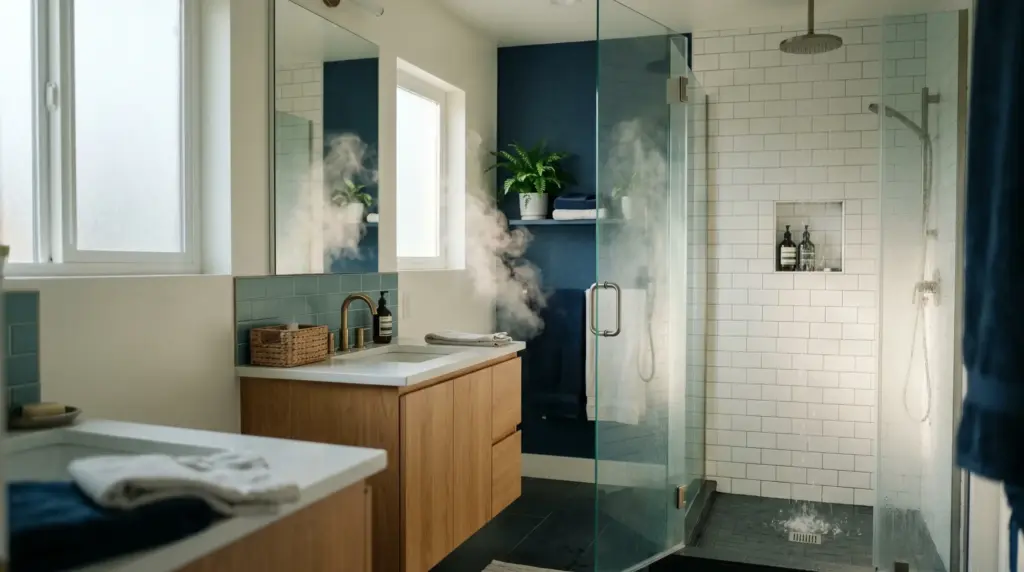
Most people associate radon with basement air. Private well water can be another source. Radon dissolves in groundwater, travels through the plumbing, and escapes into the home whenever water is sprayed, heated, churned, or exposed to air. Showers release it. So do dishwashers, washing machines, faucets, and even toilet flushing.
Drinking water that contains radon carries some risk, but breathing the gas after it leaves the water is the larger concern. Lung tissue is more vulnerable to radon’s radioactive decay products than the stomach lining.
Homes in regions with elevated indoor-air radon deserve particular attention. The same uranium-bearing rock that releases radon into soil gas can release it into groundwater. An air result cannot predict a water result, however. Each must be tested separately.
What radon is and how it reaches a private well
Radon-222 is a colorless, odorless radioactive gas. It forms during the natural breakdown of uranium and radium in rock and soil. Those elements occur in varying amounts across North America, so some radon exists almost everywhere. The concentration beneath a particular home or inside a particular aquifer can differ sharply from the concentration a short distance away.
As radon forms in rock, some of it moves through pores and fractures. In dry soil it may travel as a gas toward the surface and enter a building through gaps around pipes, cracks in concrete, sump openings, crawl spaces, or other contact points with the ground. Below the water table, radon can dissolve into groundwater.
A drilled bedrock well may collect water that has spent considerable time in contact with uranium-bearing minerals. The pump then brings that water into a closed plumbing system before much of the gas has escaped. This is why private wells and small groundwater systems are more likely to contain measurable radon than water drawn from lakes, rivers, or reservoirs. Surface water loses much of its radon through natural exposure to open air.
Geology influences risk, but it cannot diagnose your well
Higher groundwater concentrations are often associated with granite, some light-colored volcanic rocks, dark shale, phosphate-bearing sedimentary formations, and metamorphic rock formed from those materials. Fractures, mineral composition, groundwater chemistry, and the position of radioactive minerals within the rock also affect how much radon reaches the water.
A geological map can identify areas where testing deserves priority. It cannot tell you the concentration in one house. Wells drawing from the same broad formation may produce very different results because they intersect different fractures and water-bearing zones.
Household water use transfers radon into the air
Radon stays dissolved more readily while groundwater is under pressure. Once the water enters the house and is heated or broken into droplets, some of the gas escapes. A long hot shower creates far more water-to-air contact than filling a glass at the kitchen sink. Dishwashers and washing machines agitate warm water in enclosed spaces, then release humid air into the home.
The amount transferred depends on the water concentration, household water use, room ventilation, plumbing layout, and the size and air-exchange rate of the home. This variability is one reason an indoor-air test remains necessary even after the water has been tested.
The health risk: inhalation deserves most of the attention
Radon gas itself is chemically unreactive, but it does not remain radon forever. It decays into radioactive particles that can be inhaled and trapped in the lungs. As those particles continue to decay, they release energy that can damage lung tissue.
The U.S. Environmental Protection Agency identifies radon as the second-leading cause of lung cancer in the United States after smoking. Smoking and radon exposure multiply one another’s danger, which makes elevated radon especially urgent in a household where anyone currently smokes or has smoked in the past.
Risk develops from cumulative exposure. A single shower in a home with elevated water radon does not define the outcome. The concern is repeated exposure over months and years, often combined with radon entering from soil beneath the building.
Drinking and breathing are different exposure routes
Some dissolved radon remains in water long enough to be swallowed. Researchers have examined whether this could increase the risk of internal cancers, particularly stomach cancer. The estimated ingestion risk is much smaller than the estimated lung-cancer risk from breathing radon released by household water.
The difference comes partly from the tissues involved. Radon decay products can lodge in delicate lung tissue after inhalation. The stomach lining is more resistant, and much of the gas can leave the body before delivering a comparable dose.
This distinction affects treatment design. A small filter serving only the kitchen drinking-water tap addresses one narrow exposure route. It leaves showers, laundry, toilets, and other water uses untreated. Radon treatment therefore belongs where the main water line enters the house, a configuration known as point-of-entry treatment.
Understanding the 10,000-to-1 transfer estimate
A commonly used rule estimates that 10,000 picocuries per litre (pCi/L) of radon in water adds roughly 1 pCi/L to the average indoor-air concentration. A picocurie is a unit used to describe radioactive activity.
For example, water measuring 20,000 pCi/L might contribute around 2 pCi/L to the home’s average air concentration. This is a rough planning estimate, not a substitute for air testing. A heavily used shower in a small bathroom may produce a temporary local concentration unlike the whole-house average.
Canadian laboratories may report water results in becquerels per litre (Bq/L). One Bq/L in water is approximately 27 pCi/L. Indoor air in Canada is generally reported in becquerels per cubic metre (Bq/m³), while U.S. reports usually use pCi/L.
What happened to the proposed EPA drinking-water limits?
The EPA proposed a radon drinking-water rule with two possible levels for community groundwater systems:
- 300 pCi/L as the proposed maximum contaminant level, or MCL.
- 4,000 pCi/L as a proposed alternative maximum contaminant level for systems participating in approved programs that also reduced radon in indoor air.
The proposal was never finalized. These figures are still widely quoted, but they are reference points rather than an enforceable federal standard for private wells. The EPA does not regulate individual private wells under the federal public-water rules.
The proposed 4,000 pCi/L alternative was tied to a broader risk-reduction plan, not a declaration that every private well below 4,000 pCi/L requires no further thought. Indoor-air results, local guidance, household smoking history, treatment feasibility, and the reliability of the water result all matter.
Canada takes a different regulatory approach. Health Canada does not set a maximum acceptable concentration for radon in drinking water. It emphasizes testing indoor air because an air measurement captures radon from the ground, water, and other contributing sources. The Canadian indoor-air guideline is 200 Bq/m³.
How to test for radon in well water
A routine well-water panel usually checks bacteria, nitrate, pH, hardness, and selected minerals. Some packages include arsenic, lead, uranium, or other regional concerns. Radon is commonly absent unless you request it by name. A gross-alpha test, which screens for certain radioactive particles, also does not replace a radon-in-water test.
Use a laboratory certified or approved for radon-in-water analysis by your state, province, or relevant local authority. Ask for its collection kit before taking the sample. The vials, caps, filling method, paperwork, shipping deadline, and requested sampling location may be specific to that laboratory.
Why collection technique matters
Radon can escape while the sample is being collected. Splashing water into an open jar, leaving an air bubble in the vial, or filling from a faucet aerator can produce a result below the true concentration.
Laboratory instructions commonly require the homeowner or sampler to:
- Choose a cold-water tap that supplies untreated water, often near the pressure tank.
- Remove the faucet aerator, hose, screen, or other attachment.
- Run the water long enough to draw a fresh sample from the well and pressure system.
- Reduce the flow to avoid splashing.
- Fill the laboratory vial completely and cap it without trapping an air bubble.
- Record the exact collection date and time.
- Deliver or ship the sample within the laboratory’s required holding time.
Follow the kit instructions even if they differ from this general outline. Some laboratories ask for duplicate vials so they can identify a sampling problem when the two results disagree.
Radon-222 has a half-life of about 3.8 days. Half-life means the time required for half of the radioactive atoms in a sample to decay. Prompt delivery is therefore essential. Many programs call for overnight shipping or another tightly controlled turnaround.
What to include in a testing quote
Request a complete written testing quote in USD for a U.S. laboratory or CAD for a Canadian laboratory. Ask for analysis, kit fees, sample collection, time-sensitive shipping, taxes and any additional samples to be itemized. Confirm sampling and delivery requirements before ordering.
If a result could lead to a treatment purchase, confirmation testing is sensible. Radon concentrations can vary with groundwater conditions and season. A second properly collected sample can show whether the first result represents the well consistently.
Test the indoor air separately
Arrange an indoor-air radon test even if the water result is low. Soil gas beneath the foundation is usually the dominant source of indoor radon. A low water result says little about that pathway.
Likewise, a high water result does not reveal the home’s total airborne exposure. The 10,000-to-1 estimate can help explain the likely contribution, but direct measurement provides the evidence needed for a treatment decision.
For an initial U.S. air assessment, follow EPA or state instructions concerning test placement, closed-house conditions, and test duration. In Canada, Health Canada recommends a long-term test lasting at least three months, ideally during the heating season. A long-term measurement gives a better picture of average exposure than a reading taken during one shower or one week of unusual weather.
Whole-house treatment options for radon in well water
Two technologies dominate residential radon treatment: granular activated carbon and aeration. Both are installed on the main water line so they treat water before it reaches household fixtures.
The right system depends on the confirmed radon concentration, peak household flow, water chemistry, available space, ventilation route, electrical supply, maintenance support, and local rules for handling spent treatment media. Iron, manganese, sediment, hardness, acidity, bacteria, and sulfur compounds may require pretreatment or change the maintenance plan.
| Method | Typical use and effectiveness | Questions about the installed scope | Maintenance | Main advantages and limits |
|---|---|---|---|---|
| Granular activated carbon (GAC) | Often considered for moderate concentrations. Some authorities advise against using it above 5,000 pCi/L because radioactive material can build up in the tank. Performance depends on tank size, flow, contact time, and water quality. | Does the quote identify tank size, carbon, pretreatment, plumbing, installation, performance testing and the service and disposal plan? | Periodic water testing, inspection, sediment-filter service, and professional carbon replacement or disposal. | No powered air blower in many designs. The carbon can collect radioactivity, may support bacterial growth if neglected, and eventually requires replacement. |
| Point-of-entry aeration | Preferred for high concentrations and often capable of roughly 85% to more than 99% reduction when properly designed, installed, and maintained. | Does the quote identify capacity, tanks, pumps, controls, electrical work, outdoor venting, pretreatment, installation and performance testing? | Cleaning spray nozzles or diffusers, checking the blower and vent, servicing pumps and controls, managing scale or biofilm, and periodic performance testing. | Strong removal at high levels and no radioactive carbon bed. It uses electricity, makes noise, needs space, and must vent outdoors safely. |
Request itemized USD or CAD amounts with scope, assumptions, exclusions, taxes, quote date and validity, and responsibility for changes. Ask how remote access, plumbing access, water demand, cold-climate venting, electrical work and competing contaminants affect the proposal. Obtain a written proposal based on laboratory results and a measured household flow rate.
Granular activated carbon
A GAC system passes water through a large tank filled with porous carbon. Radon adheres to the carbon while treated water continues through the plumbing. The tank must provide enough carbon and contact time for the home’s flow rate. A small cartridge meant for taste and odor control should not be treated as a radon system.
GAC is often discussed for water below about 5,000 pCi/L. That figure is a cautious upper boundary used by authorities such as Massachusetts rather than a universal performance threshold. A qualified designer may recommend a lower limit after considering tank location, expected service life, water chemistry, and disposal options.
The tank should be placed away from frequently occupied areas when practical. The installer also needs a plan for testing treated water and changing the media. Carbon can become fouled by sediment, iron, manganese, or organic material, reducing useful contact and treatment performance.
Point-of-entry aeration
An aeration system deliberately transfers radon from water into a controlled air stream before the water enters the household plumbing. Depending on the design, it may spray water inside a tank, force air through the water, or pass water over packing material that creates a large contact surface. A blower carries the radon-laden air through a dedicated vent to the outdoors.
The treated water may then require repressurization before it reaches the fixtures. This can add a storage tank, pump, controls, and electrical components. The vent termination must keep discharged radon away from windows, doors, soffit vents, decks, and other building openings.
Aeration is generally the most effective residential option for high water concentrations. It also avoids a carbon bed that accumulates radioactive decay products. Its performance can still decline if nozzles clog, scale coats internal parts, drains fail, or the blower stops. Alarms and visible operating indicators are valuable because water may continue flowing even when part of the treatment process is no longer working as intended.
Post-treatment testing proves performance
An installation is not complete merely because treated water reaches the taps. Collect a post-treatment sample according to the laboratory’s timing and sampling instructions. The sample should come from a location after the treatment equipment and should be compared with the untreated result.
Retest on the schedule recommended by the laboratory, regulator, equipment manufacturer, or treatment professional. Also retest after major service, prolonged shutdown, a change in well performance, flood damage, or a finding that the system has not been operating correctly.
Air radon and water radon require separate controls
Radon can enter a home along two distinct routes:
- From the ground: Soil gas is drawn through openings in the foundation by pressure differences between the house and the surrounding soil.
- From the well: Dissolved radon leaves the water during normal household use.
A sub-slab depressurization system addresses the first route. A fan draws soil gas from beneath the concrete floor and vents it above the roof or at another approved outdoor location before it enters the living space. The method does not remove radon dissolved in well water.
Aeration or GAC treatment addresses the second route. It does not stop soil gas from entering through the foundation.
Some homes need one system. Others need both. Test results determine which sources matter.
How to make sense of paired results
Suppose a home has an indoor-air result of 7 pCi/L and well water at 2,000 pCi/L. The transfer rule suggests the water may contribute around 0.2 pCi/L to the air. Soil beneath the building is likely responsible for most of the measured air concentration, so foundation-focused mitigation deserves priority. Water treatment may still be considered under local guidance, but it would not be expected to reduce the air result from 7 pCi/L to a low level.
Now consider a home with air at 6 pCi/L and water at 30,000 pCi/L. The water might contribute roughly 3 pCi/L on average. Treating the water could remove a meaningful share, yet soil gas might still keep the indoor air elevated. Follow-up air testing would show whether the foundation also needs mitigation.
These examples illustrate the calculation. They do not predict the result in a particular house. Actual transfer changes with water use and ventilation, which is why direct testing remains the basis for decisions.
When a homeowner should act
Private-well owners do not have one enforceable North American action level for radon in water. The EPA’s proposed 300 and 4,000 pCi/L levels were never finalized. States can publish advisory levels, testing triggers, or treatment recommendations that differ from one another. Provincial guidance and laboratory reporting practices also vary across Canada.
A practical decision process looks like this:
- Test indoor air in every home. Building age, foundation style, and a neighbour’s result cannot rule out elevated radon.
- Request a radon-in-water test when the home uses a private well and local geology or nearby results indicate elevated radon potential. Water testing also deserves consideration when indoor air remains elevated or behaves unexpectedly.
- Confirm a result that would trigger costly treatment. Use the correct laboratory kit and collection method.
- Compare the results with current state, provincial, or local health guidance. Ask the authority specifically about private wells, because public-system rules may not apply.
- Match treatment to the source and concentration. Soil-gas entry calls for an air-radon system. Dissolved radon calls for point-of-entry water treatment. Some properties need both.
- Retest after the work. The treated water and indoor air should be measured independently.
Questions to ask a treatment professional
In the United States, look for any radon or water-treatment license required by your state. In Canada, confirm the applicable provincial licence, certification, or competency requirements. Ask whether the professional has designed systems for the measured concentration and for wells with water chemistry like yours.
A useful written proposal should identify:
- The untreated radon result used for system sizing.
- The expected treatment range without promising a guaranteed health outcome.
- The home’s peak water-flow requirement.
- Any sediment, iron, manganese, hardness, acidity, sulfur, or bacterial issue that could affect the system.
- The equipment location and, for aeration, the outdoor vent route.
- The service schedule and likely recurring expenses.
- The method and timing for post-treatment sampling.
- The plan for handling spent carbon if GAC is proposed.
- The response if follow-up testing shows inadequate reduction.
Be wary of anyone selecting equipment from a regional radon map alone, selling an under-sink filter as whole-house protection, or treating an air result and a water result as interchangeable. The measurements describe different pathways. Good work begins with both numbers, identifies the dominant source, and proves performance after installation.
Keep the original laboratory reports, treatment specifications, service records, and follow-up results with the property documents. Radon cannot be judged by taste, smell, or water clarity. A reliable record is the clearest evidence of what was found, what was installed, and whether it continues to perform.