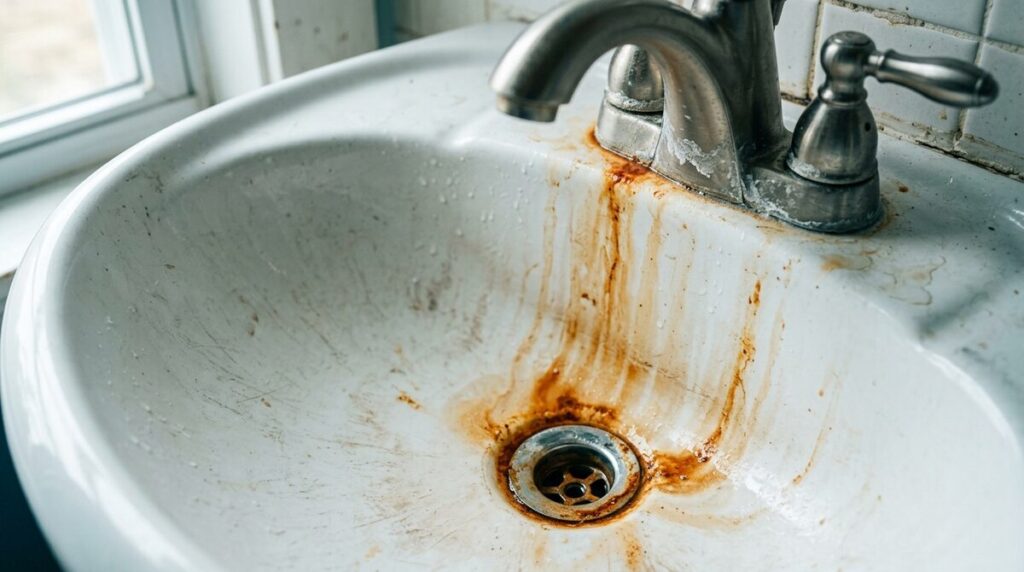
The color of a well-water stain is a useful clue to what is dissolved in the water. Orange and rust-colored stains usually mean iron. Black or dark-brown stains usually point to manganese. Blue-green stains usually mean acidic water is dissolving copper from your plumbing.
Those problems do not share one universal treatment. An iron filter cannot correct corrosive water, an acid neutralizer does not remove a heavy iron load, and a water softener can be damaged when it is asked to handle more iron than it was designed for. Buying equipment before testing can leave the stains unresolved. Use the laboratory results to define the proposed treatment before comparing quotes.
Start with the stain color, confirm the cause through a certified laboratory, and then size the treatment around the contaminant level, water chemistry, household flow demand, and well-pump capacity.
Use the stain as a clue, not a final diagnosis
A stain records what happened after water touched air, plumbing, heat, detergent, or a fixture surface. That makes color valuable evidence, but it is not a substitute for laboratory results. Iron and manganese may occur together, while copper can be present without producing an obvious stain at every faucet.
| Stain or deposit | Most likely cause | Where it comes from | Health concern? | Treatment direction | Common wrong treatment |
|---|---|---|---|---|---|
| Orange or rusty, especially after water sits | Dissolved iron | Iron-bearing soil and rock around the aquifer | Usually an appearance, taste, and plumbing concern at typical well concentrations | Oxidation followed by filtration; a softener may work at low dissolved levels | Installing only a sediment or carbon cartridge |
| Orange or red water immediately from the tap | Oxidized iron particles | Iron has already reacted with oxygen in the well, pressure system, or plumbing | Usually an appearance and sediment problem, but sudden changes warrant investigation | Particle filtration, sometimes combined with oxidation treatment | Sending the particles directly through softener resin |
| Black or very dark brown | Manganese | Naturally occurring minerals in groundwater | Yes at elevated concentrations, particularly for infants and children | Oxidation and filtration designed for manganese | Assuming any iron filter will remove manganese under all pH conditions |
| Blue-green | Copper corrosion | Copper pipe, brass fittings, valves, or plumbing components | Potentially; the same corrosive water may also release lead | Correct the pH and corrosion conditions, then assess damaged plumbing | Buying an iron filter or repeatedly cleaning the fixture |
| Reddish-brown gelatinous slime | Iron bacteria | A biofilm growing in the well and water system | Iron bacteria are mainly a fouling concern, but their presence does not prove the water is free of harmful bacteria | Well cleaning and disinfection, periodic shock treatment, or continuous chlorination | Treating it as dissolved iron alone |
Orange and rust stains usually mean iron in well water
Iron is the most common source of staining in private well systems. Groundwater dissolves small amounts of iron while moving through soil and rock. The iron can remain invisible underground because the water contains little oxygen. Once the water is pumped into the house and exposed to air, heat, or disinfectant, the iron changes form and begins producing rust-colored particles.
This is why a glass of water can look perfectly clear when first drawn and still leave an orange ring later. The timing of the color change helps identify which form of iron you have.
Clear water that turns orange contains dissolved iron
Dissolved iron is commonly called ferrous iron. Ferrous means the iron is in a water-soluble form. You cannot see individual particles when the water first leaves the faucet, so technicians also call it “clear-water iron.”
Set a clean, colorless glass on the counter and observe it for 20 to 30 minutes. If clear water develops an orange tint, reddish cloud, or fine sediment, oxygen is converting the dissolved iron into solid rust particles. Heating can speed up the reaction, which is why the staining may appear worse around a bathtub, dishwasher, washing machine, or water heater.
A normal sediment cartridge cannot reliably solve dissolved iron because there are no solid particles to capture when the water enters the cartridge. The iron must first be oxidized—chemically changed into particles—and then filtered.
Water that is already red or orange contains oxidized iron
If water comes from the tap with visible orange material, much of the iron has already oxidized. This is called ferric iron or “red-water iron.” A filter can capture the particles, but the job is not always limited to installing a finer cartridge.
The technician should determine where oxidation is occurring and whether the well is producing sediment. A sudden burst of rusty water after the pump starts, after plumbing work, or after a period of low use may come from deposits in the pressure tank, water heater, or steel plumbing rather than a stable concentration in the aquifer.
Ferric iron can also clog small cartridge filters rapidly. A backwashing filter—which periodically reverses water through its media and sends accumulated particles to a drain—is often better suited to a whole-house iron load.
Orange slime points to iron bacteria rather than iron alone
Open the toilet tank rather than judging only the bowl. A soft orange coating, gelatinous strands, or a reddish mass that feels slippery is characteristic of iron bacteria. These organisms use iron in their biological processes and create a protective slime layer called a biofilm.
Dissolved iron may still be present, but a filter selected only for the laboratory’s iron number will not control a colony living in the well casing, pump, pressure tank, and plumbing. Iron bacteria require a disinfection strategy and may also require physical cleaning of affected well components.
How much iron is too much?
The U.S. Environmental Protection Agency lists 0.3 milligrams per litre (mg/L) as the secondary standard for iron. One mg/L is approximately one part per million in water. A secondary standard addresses noticeable effects such as staining, taste, color, and deposits; it is not the same as a health-based federal limit.
Some households notice staining below 0.3 mg/L. The result depends on how much water is used, how readily the iron oxidizes, the temperature of the water, fixture surfaces, detergent chemistry, and whether deposits have already accumulated. A result below the secondary standard therefore does not guarantee a stain-free home.
Choosing treatment for iron
For moderate or high dissolved iron, the usual approach is oxidation followed by filtration. Air-injection systems mix oxygen into the water. Birm and other catalytic media help convert dissolved iron into particles. Manganese greensand uses an oxidizing surface and may require regeneration with potassium permanganate or another approved oxidant. Chemical-feed systems use chlorine or hydrogen peroxide ahead of a contact tank and filter.
Each method has operating limits. Birm depends on adequate dissolved oxygen and suitable pH. Air injection may not control an established bacterial slime. Greensand requires disciplined regeneration and backwashing. Chemical injection adds a feed pump, solution tank, contact time, and more maintenance, but it can be appropriate for heavy iron loads or multiple water problems.
A water softener can remove low concentrations of dissolved iron while also treating hardness. It should not be treated as the default iron system. Oxidized particles and larger iron loads coat the resin beads, reduce capacity, increase salt consumption, and can shorten the useful life of the softener.
Black stains usually point to manganese
Manganese often occurs alongside iron because both can dissolve from groundwater minerals under similar conditions. It is usually present at a lower concentration, but it takes very little manganese to produce an obvious black or dark-brown stain.
Look for dark streaks beneath faucets, black residue in toilet tanks, gray-black spotting on laundry, or dark particles that appear after clear water sits. Do not diagnose manganese by color alone if the water also smells like rotten eggs. Sulfide compounds and deteriorating rubber components can produce dark material, so laboratory confirmation matters.
The EPA secondary standard for manganese is 0.05 mg/L. That low threshold is based on staining, color, and taste. Health Canada uses an even lower aesthetic objective of 0.02 mg/L, reflecting how visible manganese can become at small concentrations.
Manganese requires more demanding treatment conditions
Manganese is generally harder to oxidize than iron. A system that removes iron successfully may let manganese pass through if the water’s pH is too low, the oxidant is too weak, or the filter does not provide enough contact time.
Treatment commonly combines an oxidizing step with manganese-capable filter media. Depending on the test results, that may involve air injection, greensand, manganese-dioxide media, chlorine, hydrogen peroxide, or another professionally selected process. The system must also be able to backwash at the flow rate required by its media. A well pump that cannot supply that rate may leave the filter bed dirty and reduce performance.
Low levels of dissolved manganese can sometimes be removed by a softener, but the acceptable concentration depends on pH, hardness, iron, and the equipment manufacturer’s limits. Where manganese is the main problem, use equipment with documented manganese performance under water conditions comparable to the laboratory report.
Blue-green stains usually come from copper plumbing
A blue-green ring in a tub or sink is usually not a mineral arriving directly from the well. It is copper residue from the home’s plumbing. The well water creates the conditions for corrosion, but the color develops after that water dissolves copper from pipes, fittings, valves, or brass components.
Low-pH water is a common cause. The pH scale describes how acidic or alkaline water is; lower numbers are more acidic. The EPA’s secondary range for drinking-water pH is 6.5 to 8.5, with low pH associated with corrosion and metallic taste. However, pH is not the whole corrosion picture. Alkalinity, hardness, dissolved gases, temperature, chloride, sulfate, water age, and plumbing materials also influence how aggressively water attacks metal.
Blue-green staining may be most noticeable where water drips, evaporates, or is heated. A stain does not reveal how much copper is present in a glass of drinking water. That requires a properly collected tap sample.
Test the water at the well and at the tap
For a corrosion investigation, ask the laboratory about paired samples. A flushed sample—collected after the water has run—helps describe the incoming well water. A first-draw sample—collected after water has remained in the plumbing for the laboratory’s specified period—can reveal metals released while the water sat against pipes and fixtures.
At minimum, test for:
- pH to identify acidic or alkaline conditions;
- copper to measure what has entered the water from plumbing or source materials;
- lead, particularly in homes with older solder, brass, fixtures, pumps, or well components;
- alkalinity and hardness to help a professional select and size corrosion treatment; and
- chloride and sulfate when the laboratory or water professional recommends a broader corrosion assessment.
Acid neutralizers correct the water before it attacks the pipes
A calcite neutralizer passes acidic water through calcium-carbonate media. The media dissolves gradually and raises the pH and alkalinity. Calcite can also add hardness, so the final design may require a softener downstream if the treated water becomes objectionably hard.
A soda ash injection system meters a solution of sodium carbonate into the water. This gives the installer more control where the pH is very low or the household flow varies substantially. It also requires solution refills, pump inspection, calibration, and enough mixing or retention before the water reaches the plumbing.
Neutralizing the water reduces future corrosion; it does not restore pipe walls that have already thinned. Plumbing with pinhole leaks, heavy internal damage, or failing joints may still need replacement after the water chemistry is corrected.
Reddish-brown slime is a living iron-bacteria biofilm
Iron bacteria are different from dissolved iron. They are microorganisms that build a sticky biofilm while interacting with iron in the water. The result may look like orange jelly, rusty strings, oily-looking surface material, or a soft coating inside toilet tanks.
The colony may extend beyond the house. It can occupy the well casing, screen, pump, drop pipe, pressure tank, treatment equipment, and distribution plumbing. Over time, this material can restrict water movement, plug filter media, create musty odors, and contribute to reduced well performance.
Iron bacteria are not used as the standard indicator of fecal contamination, and their presence does not automatically mean the water will make someone ill. It also does not establish that the water is microbiologically safe. Total coliform and E. coli testing remain necessary because stain color and slime cannot identify disease-causing organisms.
Why shock chlorination often provides temporary relief
Shock chlorination exposes the well and plumbing to a high chlorine concentration for a controlled period. It can reduce an iron-bacteria population and remove symptoms for a time. Established colonies are difficult to eradicate because the slime protects organisms underneath, and chlorine may not penetrate every part of the well or plumbing.
When slime returns, repeatedly adding household bleach without accounting for well depth, standing water volume, casing material, water chemistry, and discharge conditions can damage equipment or release highly chlorinated water where it harms a septic system, vegetation, or surface water. A licensed well contractor in the United States, or a properly licensed/licenced well professional under the applicable Canadian province, should evaluate persistent cases.
Longer-term control may involve:
- physical cleaning of the well casing and accessible components;
- professional shock chlorination followed by flushing and laboratory retesting;
- planned periodic disinfection where recurrence is manageable;
- continuous chlorination with adequate contact time and downstream filtration;
- removal of accumulated dead biomass and oxidized iron; and
- rehabilitation of a well whose screen or water-producing fractures have become heavily fouled.
A treatment unit installed only in the house may improve water at the fixtures while leaving the colony established inside the well. That distinction matters when choosing between symptom control and well rehabilitation.
Get a test that distinguishes the problems
A hardness strip can tell you something about calcium and magnesium. It cannot identify the form of iron, measure low manganese accurately, diagnose corrosion, detect lead, or confirm bacteria. Equipment selected from a hardness reading and a stain photograph is being selected with most of the important information missing.
Use a state-certified drinking-water laboratory in the United States or an accredited laboratory recognized by the appropriate province in Canada. Ask whether the laboratory has a private-well package and explain the observed color, when it appears, whether it is slimy, and whether hot and cold water behave differently.
Request these core measurements
- Total iron: dissolved iron plus iron particles in the sample.
- Dissolved iron: the fraction passing through the laboratory’s specified filter, which helps separate ferrous iron from particles.
- Total manganese: needed for both treatment selection and health interpretation.
- pH: preferably measured promptly because air exposure can change the reading.
- Copper and lead: particularly when stains are blue-green or the plumbing shows corrosion.
- Total coliform and E. coli: the routine biological safety indicators for a private well.
- Iron-bacteria testing: where slime or recurring biofilm is present; this may require a laboratory offering specialized analysis.
- Hardness and alkalinity: needed to assess a softener, neutralizer, and the overall treatment sequence.
Sampling location can change the result
A sample taken after an existing filter tells you what the equipment is delivering, not what the well is producing. For treatment design, collect untreated water from a suitable point before the softener, filter, or neutralizer. For copper and lead, follow the laboratory’s tap-sampling instructions because the purpose is to measure what the plumbing contributes.
Do not rinse sterile bacteria bottles, remove their preservative, or collect them through a swivel faucet, garden hose, or dirty aerator unless the laboratory specifically directs you to do so. Record whether each sample is raw well water, first-draw tap water, flushed tap water, hot water, or treated water.
Once equipment is installed, test both untreated and treated water. A clear glass and a clean toilet bowl can show that staining has improved, but only follow-up testing confirms how much iron, manganese, copper, or lead the system is actually reducing.
How the main treatment systems compare
Request property-specific amounts in USD for a U.S. project or CAD for a Canadian project. Ask each provider to itemize equipment, installation, electrical and plumbing work, drain access, travel, permits, testing, setup and taxes; state the household-flow and water-chemistry assumptions; and identify exclusions, quote date, validity period and change responsibilities.
| System | What it treats | Itemized quote question | Typical maintenance | Best suited to |
|---|---|---|---|---|
| Water softener | Hardness and limited dissolved iron; sometimes low manganese under suitable conditions | Does the quote identify softener model and capacity and itemize equipment, installation, bypass, drain and electrical work, setup, testing and taxes? | Salt, resin cleaning, control-valve service, and periodic testing | Hard water with a low, confirmed ferrous-iron concentration |
| Air-injection oxidation filter | Dissolved iron, some manganese, and sometimes hydrogen sulfide | Does the quote itemize the treatment tank, media and controls, plumbing, electrical and drain work, startup testing, travel and taxes? | Backwashing, valve service, injector cleaning, and eventual media replacement | Moderate iron where pH, oxygen demand, and pump capacity are suitable |
| Birm or catalytic-media filter | Iron and, under narrower conditions, manganese | Does the quote identify the vessel, media and controls and itemize plumbing, drain and backwash setup, testing, labour and taxes? | Regular backwashing and periodic media or valve service | Water meeting the media’s specified pH and dissolved-oxygen requirements |
| Greensand or manganese-dioxide filter | Iron and manganese after or during oxidation | Does the quote identify the media, controls and any chemical-feed equipment and itemize plumbing, electrical and drain work, setup and testing? | Backwashing; some designs require oxidant replenishment and regeneration | Confirmed manganese or combined iron-and-manganese problems |
| Chemical oxidation, contact tank, and filter | Higher iron or manganese, sulfur odor, and some biological fouling problems | Does the quote separately list the feed system, solution and contact tanks, filter, containment, plumbing, electrical work, commissioning and testing? | Chemical refills, pump calibration, tank cleaning, backwashing, and carbon service where used | Heavy or combined contaminant loads needing controlled oxidation time |
| Calcite acid neutralizer | Low pH and corrosive-water conditions | Does the quote identify the vessel, media and controls and itemize plumbing, drain work, initial media fill, setup, testing and taxes? | Calcite replenishment, backwashing where applicable, and pH checks | Moderately acidic water where added hardness is acceptable or treated downstream |
| Soda ash injection | Lower pH requiring adjustable chemical dosing | Does the quote identify the feed pump, tank and controls and itemize containment, plumbing, electrical work, calibration, testing and taxes? | Solution preparation, pump service, calibration, cleaning, and pH monitoring | Very acidic water or conditions requiring closer pH control |
| Well cleaning and chlorination system | Iron-bacteria biofilm and recurring bacterial fouling | Does the quote distinguish limited well service from ongoing treatment equipment and itemize inspection, cleaning, chemicals, contact or filtration equipment, testing and follow-up? | Chlorine refills, feed-pump service, residual checks, filter cleaning, and periodic well inspection | Confirmed iron bacteria, with the design based on where the colony is established |
More equipment is not automatically better. Every treatment tank reduces pressure to some degree, every backwashing unit requires adequate pump output and drain capacity, and each chemical-feed stage adds maintenance. The goal is a correctly ordered system that treats the laboratory findings without creating another water problem.
Three mistakes that keep the stains coming back
Using a softener for a high iron load
A softener may appear to work for several weeks because fresh resin can exchange some dissolved iron. As iron accumulates, the resin becomes coated and regeneration becomes less effective. The homeowner responds by using more salt or stronger resin cleaner while staining gradually returns.
When iron is oxidized, bacterial, or beyond the softener manufacturer’s warranted limit, remove it before the softener. If hardness is also high, the softener can then do the job it was selected to perform.
Ignoring blue-green stains
Scrubbing away copper residue does nothing to change the water that produced it. Continued corrosion can thin copper pipes, damage fixtures, create pinhole leaks, and release metals into drinking water. The absence of a visible stain at the kitchen faucet does not rule out copper or lead exposure.
Correct the water chemistry, verify the treated pH and metal concentrations, and have already-damaged plumbing assessed separately.
Treating the surface instead of the water chemistry
Acid cleaners can remove rust or manganese deposits from a fixture, but the next water use begins another stain cycle. A finer cartridge may catch visible ferric iron while doing nothing to dissolved ferrous iron. A carbon filter may improve an odor yet have little useful capacity for the metal causing the color.
A durable result comes from identifying the source, measuring the concentration and form, choosing a compatible treatment process, and confirming performance with a treated-water test.
Sources and methodology
This article uses stain color as an initial diagnostic clue and then separates four different mechanisms: naturally occurring dissolved metals, metals that have already oxidized into particles, corrosion that releases plumbing metals, and biological fouling caused by iron bacteria. Treatment recommendations were compared against current government guidance and university-extension material rather than being inferred from stain appearance alone.
- The U.S. Environmental Protection Agency’s secondary drinking-water standards support the 0.3 mg/L iron value, 0.05 mg/L manganese value, pH range, and the connection between copper corrosion and blue-green staining.
- The EPA’s Drinking Water Health Advisory for Manganese provides the 0.3 mg/L lifetime health-advisory context.
- Health Canada’s manganese guidance provides the 0.12 mg/L health-based guideline, 0.02 mg/L aesthetic objective, and information about greater risk to formula-fed infants.
- The CDC’s guidance on corrosive groundwater and lead in private wells supports testing for lead when water is attacking plumbing.
- CDC private-well testing guidance supports annual bacteria, nitrate, dissolved-solids, and pH testing through a certified laboratory.
- Penn State Extension’s guidance on iron and manganese treatment and iron-bacteria biofilms informed the distinctions among softening, oxidation, filtration, shock chlorination, and ongoing bacterial control.
No national installed-cost range is adopted here. Final equipment selection depends on laboratory results, peak household water demand, the pump’s backwash capacity, available drainage, electrical and plumbing work, local labour rates, and the maintenance the owner is prepared to perform. Request a written quote in USD or CAD that states how those inputs affect the proposed equipment and work, plus assumptions, exclusions, taxes, date, validity and change responsibilities. Private-well requirements and professional license/licence rules vary by U.S. state and Canadian province.