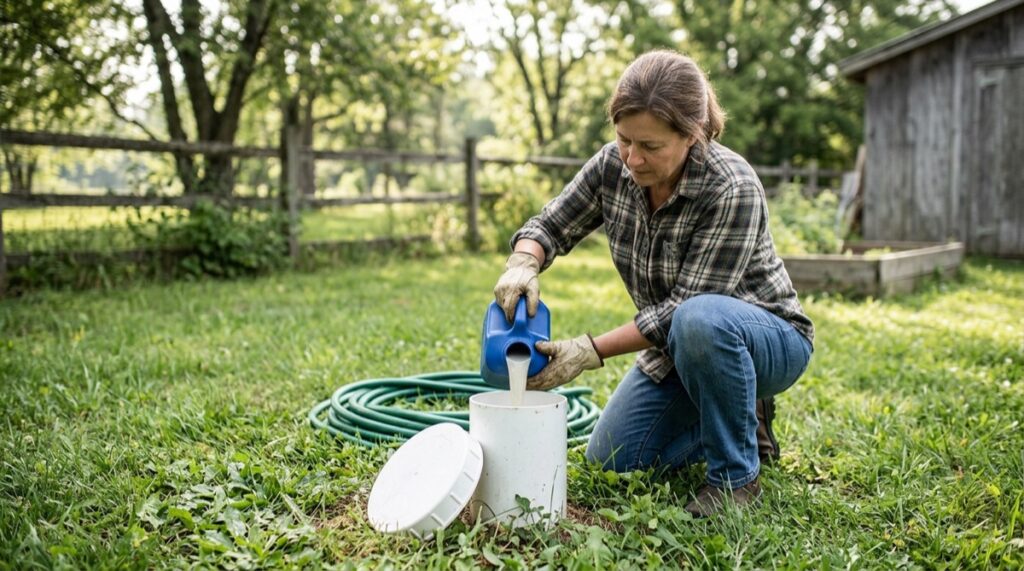
Shock chlorination is a temporary treatment for bacterial contamination. It does not repair a damaged well or remove chemical contaminants. This educational guide explains the Vermont Department of Health method used by our well disinfection calculator. Check with your local drinking-water authority before applying it to your property.
Developed with AI assistance; not reviewed by a licensed well or water-treatment professional. The calculator uses fixed arithmetic from the published source. Neither this guide nor a calculated result establishes that water is safe. See our calculator conditions of use.
Which situations this calculator covers
This version supports preliminary research for a first disinfection attempt after an initial bacteria result or routine repair: one household supplied by an ordinary drilled well, with known measurements and fresh, unexpired, unscented liquid bleach labelled 6% or 8.25% sodium hypochlorite, without detergents or other additives. It covers inside water-column diameters from 4 to 10 inches and total depths up to 2,000 feet, and withholds amounts below ¼ US cup. These are limits of this tool, not approval of a well design.
Get situation-specific help for flooding, fuel or chemical contamination, arsenic concerns, damaged equipment, recurring bacteria, flowing wells, springs, cisterns, public supplies, multiple buildings or unusual storage. Do not use this calculation to treat these cases. Unknown dimensions or product strength also mean no estimate. The CDC's emergency-well guidance addresses a different situation; its quantities and timing are not part of this calculator.
What the number means
The source is Vermont's Well Disinfection Chlorine Concentration Calculator spreadsheet, checked on September 8, 2026. Its calculation estimates the bleach added to produce a nominal 100 parts per million (ppm) in the water standing in the well. It does not measure the chlorine actually remaining after mixing or circulating through household plumbing.
- Water-column height in feet = total well depth minus depth to the static water level. Both measurements must use the same reference point. The volume model assumes a constant inside diameter along the water-filled column; a changing or unknown diameter is outside this worksheet. Static means the resting level, not the level while pumping.
- Standing water in US gallons = π × (inside diameter in inches ÷ 24)² × water-column height × 7.48.
- Bleach in US gallons = standing-water gallons × 0.0001 ÷ (label percentage ÷ 100).
- Bleach in US cups = bleach gallons × 16. These are US units, not Imperial gallons or metric cups.
For a 150-foot well with a static level 50 feet below the same reference and a 6-inch water-column diameter, the source method gives approximately 146.87 US gallons of standing water. The calculated amount is approximately 3.92 US cups of 6% bleach, or 2.85 US cups of 8.25% bleach. Use the result for the actual product strength; do not combine the amounts.
The spreadsheet adds no separate household-plumbing or storage allowance. We have not invented one. Water chemistry, incoming groundwater and equipment affect the actual concentration. A predicted 100 ppm is not a measurement or a whole-system guarantee. The tool does not select a repeat dose, double the amount, or round up to a whole cup. If the calculation exceeds 2 US gallons, it withholds the amount and directs you to a drinking-water authority or licensed well contractor, as the source advises.
Safety before following any procedure
Electricity: Have damaged wiring, caps, seals and casing repaired before treatment. Turn the pump power OFF and verify it is off before opening, touching or resealing the wellhead. Keep electrical connections dry. Turn power ON only when needed for pumping, with people clear of electrical parts. If you cannot work safely or verify isolation, have a licensed well contractor handle the work. Never enter a well or well pit.
Chemicals: Follow the bleach label. Wear chemical-resistant gloves and eye protection, work in a ventilated area and keep children and animals away. Never mix bleach with acids, ammonia, cleaners or other treatment chemicals. Do not substitute scented, splashless, gel or pool products. Prepare known-safe alternative water for people and animals, and prevent household use during treatment.
These general precautions draw on Minnesota's well-disinfection safety guidance. In particular, we explicitly state power OFF before resealing: Vermont's written step at resealing omits that reminder. We use Vermont's calculation, contact time and retesting schedule, without importing Minnesota's doses or timing.
Understanding the Vermont procedure
Read the complete Vermont instructions and its printable well guide before work. The following sequence preserves the method; the estimate alone is not a treatment instruction.
- Prepare. Inspect for contamination routes and repair them. Consider nitrate and chloride testing. Obtain well records and an alternative water supply for 3–5 days. Flush sediment if present without pumping the well dry or discharging into the septic system; Vermont also advises bacteria testing after this preliminary flushing.
- Protect equipment. Bypass or disconnect treatment devices; arrange their separate disinfection following each manufacturer's instructions. Gather a bucket, brush, hose, measuring cup, gloves and eye protection. Keep children and pets away.
- Open safely. Turn pump power OFF and verify it before removing the cap. Stop for wiring or well defects. Apply the electrical precautions above throughout the work.
- Clean. Vermont specifies 1 US cup of bleach in ½ US gallon of water for cleaning the cap and, for dug wells, the sides. Dug-well dosing is outside this calculator. Keep this cleaning liquid separate from the calculated amount; dispose of it away from the septic system and streams.
- Add and circulate. Calculate using the supported well measurements and actual bleach strength, then carefully add the calculated amount. With the hose secured and people clear, restore power for circulation. Run water through the hose back into the well and along the casing for 15–60 minutes.
- Reseal. Turn power OFF and verify isolation before handling the wellhead or replacing the cap. Replace a brittle or missing gasket. Restore power for the next pumping step once the well is closed and electrical parts are protected.
- Reach the fixtures. Start at the farthest indoor faucet. Run cold and hot water separately until chlorine can be smelled, then close each. Repeat for all faucets, showers, baths, toilets and outside spigots. Remove faucet screens that could clog. Check appliance instructions before exposing washing machines, dishwashers or refrigerator filtration to chlorinated water.
- Allow contact. Keep the chlorinated water in place for 8–12 hours. Prevent use during this period. Longer exposure can damage plumbing. The source's smell check does not measure chlorine concentration; it does not establish a safe-water result.
- Flush outside, then inside. After the contact period, pump through an outside hose to a suitable gravel or brushy area away from septic systems, streams and other water bodies until the chlorine smell is gone. Avoid damaging vegetation or running the well dry; use reduced flow or recovery pauses as necessary. Then flush each hot and cold indoor tap. Clean and replace faucet screens. Restore bypassed equipment only according to its manufacturer's disinfection and return-to-service instructions.
- Arrange laboratory testing. Vermont calls for bacteria testing 2–3 days after the chlorine smell is gone. Follow the laboratory's container, faucet preparation and sampling instructions. Continue using a known-safe water supply until testing and the responsible authority support resuming use.
If the result or treatment does not fit
Do not use smell to calculate additional bleach. Vermont identifies chlorine indicator strips as an option for investigating continuing problems; use a test suited to the relevant concentration and follow its instructions. This calculator does not provide a measured-chlorine “pass,” a redosing decision or an automatic contact-time timer. If circulation is unsuccessful, flow falls, electrical problems appear, the product or measurements are uncertain, or you cannot assess the concentration, stop and seek situation-specific guidance.
Persistent or recurring bacteria require investigation of the well and contamination source. A negative bacteria sample describes that sample; it does not rule out arsenic, nitrate, fuel or other contaminants. Chlorination can also affect arsenic release in susceptible wells, discussed in University of Georgia Extension's guidance. Such cases are excluded from this calculator.
For sampling help, see how to test well water. To discuss the well itself, contact your local drinking-water authority or look for a well contractor and confirm their qualifications directly.
Method: Vermont Department of Health, well-disinfection page updated January 29, 2026; linked calculator spreadsheet and July 2024 printable instructions checked September 8, 2026. WDG educational implementation v1.0.0. No official endorsement or professional review of WDG's implementation is claimed.