Nobody routinely regulates or tests private well water for you. Unlike a municipal supply, your well has no utility collecting mandatory samples and warning you when the water changes. The homeowner is responsible for arranging the tests, keeping the records and responding to the results.
The minimum responsible schedule is an annual laboratory test for coliform bacteria, E. coli and nitrate. The CDC also recommends annual pH and total dissolved solids testing. Canadian guidance is more cautious about microorganisms: Health Canada recommends microbial testing at least every six months.
Annual testing is only part of the answer to how to test well water. You also need a comprehensive baseline when you buy a rural property, move into a home with a well or put a new well into service. After that, add targeted tests when local geology, nearby land use, a flood, well work or a change in the water gives you a reason to look deeper.
Clear water is not proof of safe water. Bacteria, nitrate, arsenic, lead and PFAS can be present without changing the taste, smell or appearance.
Start with a baseline panel that covers safety and water behavior
A useful baseline does two jobs. First, it checks for immediate health concerns. Second, it describes how the water will interact with plumbing, appliances and treatment equipment. A result from before a problem began is especially valuable because it gives you something meaningful to compare with later tests.
Coliform bacteria and E. coli
Total coliforms are a broad group of bacteria found in soil, vegetation, surface water and fecal material. Most are not themselves the organisms that make people ill. Laboratories use them as indicators that water may have entered the well through a route that should not be open.
E. coli is the more urgent finding. Its presence indicates recent fecal contamination and means disease-causing organisms may also be present. Possible entry routes include floodwater, a damaged well cap, a casing defect, poor surface drainage or contamination from human or animal waste.
Request both total coliform and E. coli, and test at least annually. In Canada, Health Canada recommends microbial testing every six months or more frequently for vulnerable wells. If E. coli is detected, do not rely on smell, taste or a second glass of water to judge the danger. Use another safe water supply for drinking, food preparation and brushing teeth while obtaining instructions from the laboratory or public-health authority.
Nitrate
Nitrate can enter groundwater from fertilizer, manure, septic systems and sewage. It can also occur naturally. Infants younger than six months are particularly vulnerable because excessive nitrate can interfere with the blood’s ability to carry oxygen, a condition commonly called blue baby syndrome.
Test nitrate annually and whenever an infant will be drinking the water or having formula prepared with it. Pay close attention to the units on the report: laboratories may report nitrate as nitrate-nitrogen or as nitrate. Ten milligrams per litre as nitrate-nitrogen is approximately equivalent to 45 milligrams per litre as nitrate. Those numbers are not interchangeable.
pH
pH describes how acidic or alkaline the water is. It is not usually the contaminant causing a health problem, but it strongly affects corrosion, scale formation and the performance of treatment equipment.
Low-pH water can corrode metal plumbing and encourage lead, copper or other metals to enter the water. High-pH water can contribute to deposits and may affect disinfection or filtration. A pH result should therefore be interpreted alongside alkalinity, hardness, plumbing materials and any metal results.
Hardness
Hardness mainly measures dissolved calcium and magnesium. It is generally an operating and household-performance issue rather than a health hazard. Hard water can leave scale in water heaters, reduce soap lather and shorten the useful life of fixtures and appliances. Very soft or naturally acidic water may be more corrosive.
Testing before buying a softener matters. The correct equipment size depends on the measured hardness and household demand. Iron and manganese can also influence equipment selection, so hardness should not be considered by itself.
Iron and manganese
Iron commonly produces orange or reddish staining, sediment and a metallic taste. Manganese tends to leave dark brown or black staining. Both can foul fixtures, laundry and treatment equipment, and both may support deposits or biological growth inside plumbing.
Iron is usually treated as an aesthetic concern at levels encountered in drinking water. Manganese deserves more care: Health Canada has both a low aesthetic objective and a health-based maximum because elevated exposure may affect neurological development, with formula-fed infants receiving particular attention.
Total dissolved solids
Total dissolved solids, usually shortened to TDS, estimates the combined amount of dissolved mineral material in the water. It does not identify the individual substances. A high result may reflect calcium, magnesium, sodium, chloride, sulfate or other dissolved material.
TDS is best understood as a general indicator. A rising result can reveal a change worth investigating, but it cannot tell you whether the water contains nitrate, arsenic or another specific contaminant. Further testing is needed to identify the cause.
Add specialized tests when the property gives you a reason
Testing for every possible chemical is rarely the best first move. Build the specialized panel from local groundwater information, the property’s history, nearby activities and the people who will use the water. Your county or state health department, provincial or territorial authority, local public-health unit and nearby accredited laboratories can identify recurring regional concerns.
Arsenic
Arsenic can dissolve naturally from certain rock and soil formations. It has no dependable taste, smell or colour warning. Long-term exposure increases the risk of several cancers and can affect the skin, circulation and nervous system.
Test at least once as part of a comprehensive baseline in a region known for arsenic in groundwater. Repeat testing may be warranted after a major change in the well, pumping conditions or water chemistry. Do not assume the neighbor’s result applies to your well; concentrations can differ substantially over a short distance.
Radon
Radon forms during the natural decay of uranium. Groundwater in some granite and other uranium-bearing bedrock regions can carry radon into a home, where it is released into indoor air during showering, laundry and other water use. Inhalation is generally the larger radon concern.
Ask the state or provincial radiation authority whether water testing is recommended locally, and test the home’s indoor air as well. There is no current federal EPA drinking-water MCL for radon. Water results therefore require regional guidance rather than comparison with a single nationwide private-well number.
Lead
Lead usually enters household water from plumbing, solder, brass fixtures, galvanized components or older well equipment rather than from the aquifer. Corrosive water increases the likelihood of leaching.
A lead test should be included when the plumbing history is unknown, when the water is acidic or when a pregnant person, infant or young child uses the water. Because lead often comes from the building, the sampling method matters: a first-draw tap sample answers a different question from a flushed source-water sample.
PFAS or “forever chemicals”
Consider PFAS testing near military installations, airports, firefighting-training areas, landfills, certain manufacturing sites and locations where firefighting foam has been used. These chemicals persist in the environment, and meaningful testing requires very low detection limits.
Ask whether the laboratory’s method reaches the comparison level you need. PFAS sampling also requires careful contamination control because some clothing, packaging, personal-care products and sampling materials may contain related compounds.
Volatile organic compounds
Volatile organic compounds, or VOCs, include fuel components, solvents and industrial chemicals. Add a VOC panel when a property is near a gas station, dry cleaner, industrial site, waste area, buried fuel tank or known spill. Agricultural areas may also justify testing for locally used pesticides or herbicides.
VOC bottles are collected without an air space because the target chemicals can escape from the water. This is one test for which improvising with a household jar can ruin the result.
Uranium, fluoride and sulfate
These substances may occur naturally at elevated concentrations in particular geological formations. Uranium can affect the kidneys and also presents a radiological concern. Excess fluoride may affect teeth and, at higher long-term exposures, bone. Sulfate is commonly a taste and operating concern, although very high concentrations can have a laxative effect.
Regional groundwater maps, public-health advisories and results from nearby wells can help decide whether these belong in your baseline. EPA recommends that well owners in areas of radionuclide concern ask the local drinking-water or radiation-control program which radionuclide tests are appropriate.
Use a schedule instead of waiting for the water to look different
| When | What to test | Why | Laboratory quote question |
|---|---|---|---|
| Every year | Total coliform, E. coli and nitrate; preferably pH and TDS | Checks for common safety concerns and tracks basic water quality | Does the quote identify each recommended annual test, collection kit or service, shipping, reporting, detection limits, turnaround, taxes and exclusions? |
| Every six months in Canada | E. coli and total coliforms | Matches Health Canada’s general microbial-testing guidance | Some public-health programs subsidize testing. Does the local program cover E. coli and total-coliform testing, and what eligibility, collection, reporting and separate-charge terms apply? |
| Buying, moving in or commissioning a new well | Baseline panel plus locally relevant metals, chemicals and radionuclides | Establishes safety and a record for future comparisons | Does the quote list every proposed baseline test and method, detection limits, collection, shipping, reporting, turnaround, taxes and exclusions? |
| After flooding, well or septic work, nearby construction, or an earthquake that may have disturbed the system | Bacteria, nitrate and indicators suggested by the event; add fuel, metals or other chemicals when relevant | Checks whether the well, casing, plumbing or surrounding ground was affected | Does the quote identify the event-specific tests, collection or sampling service, shipping, expedited turnaround, reporting and follow-up work? |
| Taste, odour, colour or staining changes | Bacteria plus tests matched to the symptom, such as iron, manganese, sulfate, chloride, pH or VOCs | Identifies the cause before treatment equipment is selected | Does the quote separately identify the symptom-matched tests, collection materials, shipping, reporting, turnaround and any follow-up panel? |
| Pregnancy, a new infant or unexplained recurring stomach illness | Nitrate and lead specifically; bacteria for illness concerns | Addresses contaminants and exposure routes important to vulnerable household members | Does the quote identify nitrate, lead and bacterial tests separately, the required sampling points or timing, collection materials, turnaround and reporting? |
Request written amounts in USD for a U.S. property or CAD for a Canadian property. Ask the laboratory to list each test and method, required detection limits, collection materials or service, shipping, turnaround, reporting, taxes, quote date, validity period, exclusions and the process for authorizing changes.
Test promptly if the water develops a fuel smell, unusual colour, new sediment, persistent rotten-egg odour or sudden staining. Recurring gastrointestinal illness also warrants testing and medical advice. These signs help select tests, but their absence does not establish safety.
Send health-related samples to a qualified drinking-water laboratory
Finding a laboratory in the United States
Use a laboratory certified by the state for drinking-water analysis. Start with the EPA directory of state certification programs and certified laboratories, or contact the state environmental or health department. County health departments may provide bacteria or nitrate testing directly.
Ask whether the laboratory is certified for the specific contaminant and method you need. A laboratory can be qualified for bacteria testing without offering certified PFAS, VOC or radionuclide analysis. If well repairs become necessary, confirm that the contractor holds the license required by the state.
Finding a laboratory in Canada
Contact the provincial or territorial drinking-water authority or local public-health unit for an accredited laboratory. Requirements and public programs differ by province and territory. Some areas provide microbial bottles and testing through public-health offices, while chemical panels are handled by private accredited laboratories.
Confirm the laboratory’s accreditation for each requested analysis. If physical well work is required, use a contractor holding the licence required in that province or territory.
Why home kits are only screening tools
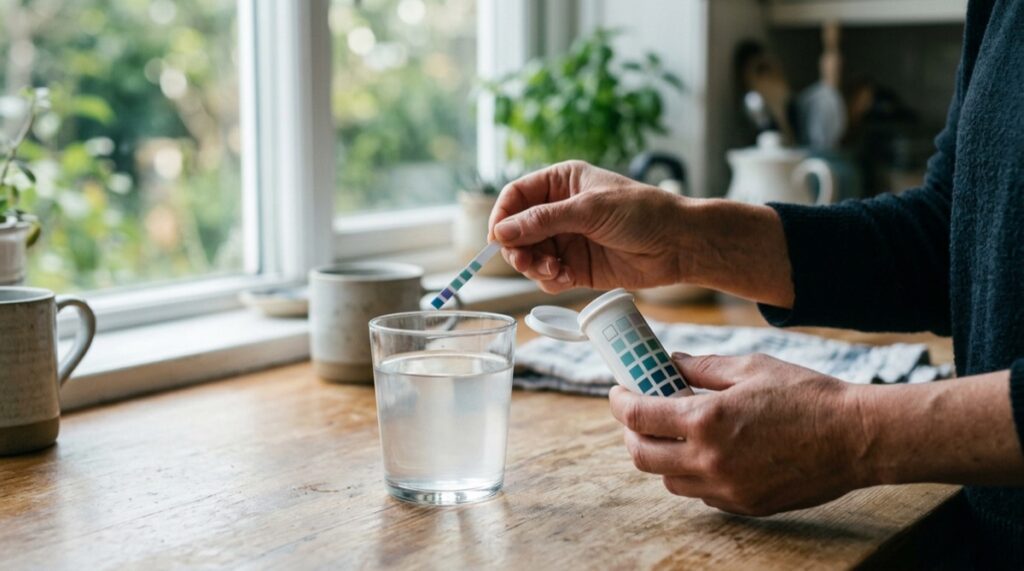
Test strips and countertop kits can be useful for checking trends in hardness, pH or iron. They are not equivalent to health-grade laboratory results for bacteria, nitrate, arsenic, lead, PFAS or VOCs.
Home kits may have higher detection limits, limited quality controls and colour readings that depend on lighting and user interpretation. They also provide no independent record of how the sample was collected, stored or analyzed. Use a screening result to decide whether more investigation is needed, not to clear questionable water for drinking.
Collect the sample the way the laboratory specifies
Contact the laboratory before opening a faucet. Tell it whether you want to assess untreated well water, water after treatment, or the water people actually drink. The laboratory should provide bottles, instructions, forms and delivery deadlines for the selected tests.
- Choose the sampling points. A raw-water sample taken before treatment describes the well supply. A kitchen-tap sample after treatment describes household exposure. Paired samples can show whether equipment is working.
- Use the supplied bottles. Do not substitute food jars or rinse laboratory containers. Some bottles contain preservatives that must remain inside.
- Follow faucet instructions. Remove filters or aerators only if the laboratory says to do so. Bacteria protocols may require cleaning or disinfecting the outlet and flushing before collection.
- Avoid touching the sterile surfaces. Do not touch the bottle rim, inside of the cap or interior of the container.
- Record the details. Note the exact tap, whether the sample was raw or treated, the date and time, recent weather, and any treatment-system settings.
- Keep and deliver it as directed. Many samples must be chilled without freezing and reach the laboratory within a limited holding time.
First-draw and flushed samples answer different questions
For lead and often copper, the laboratory may request a first-draw sample from a cold-water tap after the plumbing has remained unused for at least six hours. This captures water that has been in contact with household plumbing and fixtures.
For nitrate, arsenic, hardness and many source-water measurements, the laboratory commonly requests a flushed sample. Water runs until conditions such as temperature stabilize, reducing the influence of water that sat in the building’s pipes. The required flushing time varies with the plumbing and test, so follow the laboratory’s directions rather than selecting an arbitrary time.
A flushed result cannot rule out lead released by a faucet or indoor pipe. Conversely, a first-draw result may not accurately represent the aquifer. When the source is uncertain, testing both conditions can separate a well-water problem from a plumbing problem.
Containers and preservation are part of the test
Sterile bacteria bottles may contain sodium thiosulfate to neutralize chlorine. Metals bottles may be acid-preserved. VOC vials generally must be filled without bubbles or headspace. PFAS testing uses approved containers and contamination-control instructions. Other samples may need immediate refrigeration or delivery within hours.
Preservatives can be hazardous, and an overflowing bottle may remove the measured amount. Do not pour them out or handle them beyond the laboratory’s directions.
Chain of custody matters for legal, lending and property purposes
A chain-of-custody form records who collected, handled, transported and received the sample. It may also document seals, times, preservation and laboratory condition on arrival.
Routine homeowner monitoring may not require formal custody documentation. A lender, regulator, real-estate agreement, insurance claim or legal dispute may require it, and some situations require collection by laboratory staff or another authorized person. Confirm those requirements before collecting; a well-tested sample can still be rejected for the transaction if the documentation is inadequate.
Read the result as a measurement, not a pass-or-fail sticker
In the United States, a Maximum Contaminant Level, or MCL, is an enforceable limit for public water systems under federal drinking-water rules. Most private wells are not federally regulated by those rules. Homeowners and health departments nevertheless use MCLs as important comparison benchmarks.
Canada uses Maximum Acceptable Concentrations, or MACs, in its national drinking-water guidelines. Provinces and territories determine how drinking-water requirements are implemented. Both countries also publish aesthetic or operating values for conditions such as taste, staining, scale and corrosion.
The table below summarizes common comparison points. Values can change, local requirements may be more protective and “below the benchmark” does not always mean zero risk. Units matter: 1 mg/L is approximately one part per million in water, while 1 ng/L is approximately one part per trillion.
| Contaminant | US EPA / Health Canada comparison benchmark | Common in wells? | Concern level | Typical treatment direction |
|---|---|---|---|---|
| E. coli | None detectable in 100 mL | Possible, especially in vulnerable or damaged wells | Immediate health concern | Alternate safe water; locate entry route; repair and disinfect; verify with follow-up samples |
| Nitrate | US: 10 mg/L as nitrogen. Canada: 10 mg/L as nitrate-nitrogen or 45 mg/L as nitrate | Yes, particularly near agriculture or septic influence | High for infants; health-based | Reverse osmosis, distillation or suitable anion exchange; correct the source where possible |
| Arsenic | US and Canada: 0.010 mg/L; keep as low as reasonably achievable | Regionally common in certain formations | Serious long-term health concern | Adsorptive media, reverse osmosis or anion exchange selected from full water chemistry |
| Lead | US public-system action level: 0.010 mg/L. Canada MAC: 0.005 mg/L. No known risk-free exposure level | Usually a plumbing or equipment issue | High, especially for children and pregnancy | Remove lead-bearing components, control corrosion and use a certified lead-reduction filter as needed |
| Iron | US secondary level: 0.3 mg/L. Canada aesthetic objective: 0.1 mg/L | Very common in some aquifers | Usually aesthetic and operational | Oxidation and filtration, or other media chosen for iron form, pH and concentration |
| Manganese | US secondary level: 0.05 mg/L. Canada: 0.12 mg/L MAC and 0.02 mg/L aesthetic objective | Regionally common | Aesthetic at low levels; health-based concern at higher exposure | Oxidation-filtration, suitable ion exchange or reverse osmosis depending on chemistry |
| Uranium | US: 0.030 mg/L. Canada: 0.020 mg/L | Geology-dependent | Long-term kidney and radiological concern | Reverse osmosis or ion exchange; plan for appropriate disposal of concentrated waste |
| Fluoride | US MCL: 4.0 mg/L; secondary level 2.0 mg/L. Canada MAC: 1.5 mg/L | Geology-dependent | Health and cosmetic concern depending on dose and duration | Activated alumina, reverse osmosis or distillation |
| PFOA and PFOS | US MCL: 4 ng/L each. Canada objective: 30 ng/L for the sum of 25 specified PFAS | Site-dependent rather than universal | Serious long-term concern | Granular activated carbon, ion exchange or reverse osmosis verified for the compounds detected |
| TDS | US and Canada aesthetic level: 500 mg/L | Common as a broad water-quality measure | Usually aesthetic or operational; identify the dissolved constituents | Treatment depends on composition; reverse osmosis or distillation may reduce dissolved minerals |
Confirm an elevated result before buying treatment equipment
An elevated result deserves action, but it does not automatically identify the cause or the right equipment. First, contact the laboratory and local health authority. Ask whether the result requires an immediate alternate water supply, whether the sample should be repeated and whether a different sampling point is needed.
Retesting helps rule out collection error and establishes whether the concentration is persistent. An exception is an urgent result such as detected E. coli: take protective measures immediately while confirmation and investigation proceed.
Next, determine whether the contaminant comes from the aquifer, the well structure, household plumbing or treatment equipment. A first-draw lead result may point toward a faucet or pipe. Bacteria after a flood may point toward a well opening or casing problem. A raw-water and post-treatment pair may reveal exhausted media or equipment that is no longer performing as intended.
Only then should treatment be specified. Equipment should be independently certified for the contaminant, concentration and flow rate involved. It also needs a maintenance and follow-up testing plan. Treatment can fail silently when media is exhausted, lamps age, filters bypass or water chemistry changes.
Sources and methodology
This article uses current federal public-health and drinking-water guidance as comparison material for private-well owners in the United States and Canada. The principal sources are the CDC’s well-water testing guidance, the EPA’s guidance on testing and protecting private wells, the EPA’s National Primary Drinking Water Regulations and secondary drinking-water standards.
Canadian recommendations and values come from Health Canada’s private-well testing guidance and the December 2025 Guidelines for Canadian Drinking Water Quality summary tables. PFAS values were checked against the EPA’s current PFAS drinking-water standards page.
Federal public-water limits are presented as comparison benchmarks, not as a claim that federal agencies routinely regulate individual private wells. State, provincial, territorial, tribal, Indigenous and local requirements can differ. For price planning, request a written laboratory quote that separately identifies panels, collection services, shipping, detection limits, currency, date, validity, taxes, exclusions and change responsibilities.