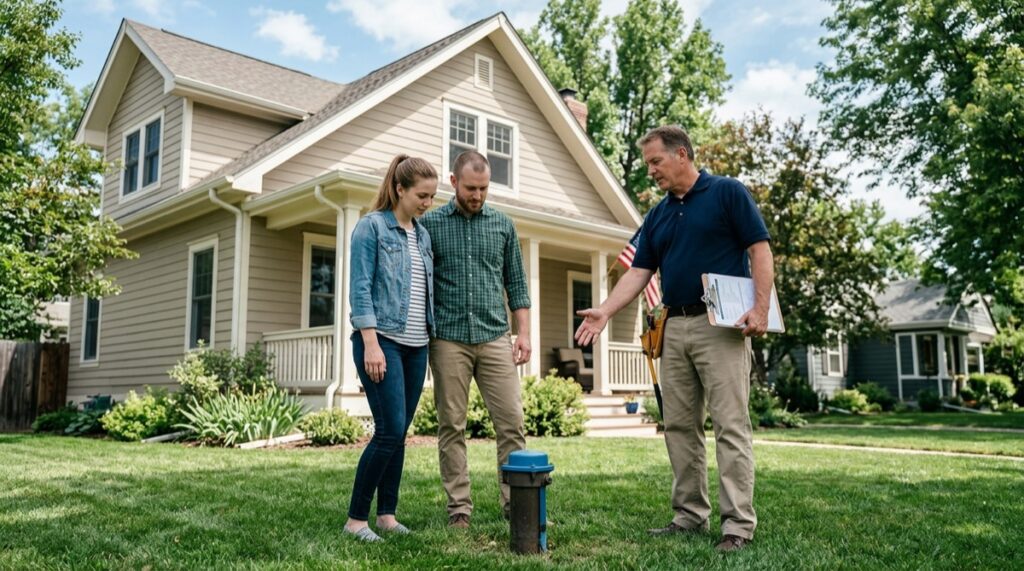
If you are buying a home with a well, arrange two separate checks before closing: a professional well inspection and a laboratory water-quality test. A standard home inspection generally does not evaluate the well’s construction, sustained water supply, pump performance, or water safety in meaningful depth.
Request a written quote for the exact well-evaluation scope, stating USD for a U.S. property or CAD for a Canadian property. Ask whether travel, system measurements, sampling, laboratory work, reporting, taxes, and return visits are included. Have the quote name any expanded laboratory panels—such as PFAS, pesticides, volatile organic compounds, or radionuclides—and show each charge. Schedule the work early in your inspection period so the results can guide your negotiation instead of arriving after your contingency expires.
A proper well inspection tests the supply, not just the faucet
A home inspector may identify an exposed wire, leaking pressure tank, or visibly damaged well cap. That is useful, but it is not the same as evaluating the entire water system. Depending on local rules, the specialist may need to be a licensed well driller, pump installer, or certified well-system professional. Check the contractor’s license in the United States or licence in Canada rather than relying only on a general home-inspection credential.
The written report should identify what was tested, how long the test ran, the measurements recorded, any limitations, and the inspector’s recommendations. “Water ran during the inspection” is not an adequate conclusion.
Flow rate shows how much water the system can deliver
A flow or yield test measures water production over time. The inspector runs water at a controlled rate and observes whether the well and pumping system can maintain that output. The test should last long enough to place meaningful demand on the system.
A brief faucet test can be misleading. Water stored in the pressure tank or well casing may provide strong flow for several minutes even when the well itself produces water slowly. The important question is whether the system can support the expected household demand through showers, toilets, laundry, dishwashing, and outdoor use.
There is no universal minimum flow rate that makes every house acceptable. A lower-yield well paired with properly designed storage may serve a modest household reliably, while a higher reading from a short test may conceal a seasonal shortage. Local regulations, the number of bedrooms, household use, irrigation plans, and available storage all matter.
Recovery rate shows how the well responds after pumping
Recovery is the rate at which groundwater returns to the well after the water level has been lowered by pumping. Where the well’s design permits water-level measurements, the inspector may record the level before pumping, during the test, and as the well recovers.
Slow recovery is not automatically a failed well. It becomes concerning when the available stored water and recovery rate cannot support realistic demand. Ask the inspector to explain the result in household terms: how much water could be used during a busy morning, how long the system needs to recover, and whether additional storage would be required.
The wellhead should keep surface contamination out
The visible casing should be sound, securely capped, and protected from runoff, insects, rodents, and damage from vehicles or equipment. The surrounding ground should direct water away from the casing. A wellhead in a depression, a loose cap, damaged vent screening, or a casing that ends below grade creates a route for contaminated surface water to enter.
The inspector should also compare the well’s location with applicable setback rules for septic components, manure storage, livestock areas, fuel tanks, shorelines, and other contamination sources. Required distances vary by state, province, municipality, soil conditions, and the age of the well. A generic distance found online cannot replace the local rule.
Review the pump and pressure system
The inspection should evaluate pump operation, electrical controls, the pressure switch, pressure tank, visible piping, valves, and any storage or treatment equipment. The inspector watches how pressure changes while water is running and how often the pump turns on and off.
Repeated starts only seconds apart—called short cycling—can point to a waterlogged pressure tank, incorrect air charge, failing control, leak, or another system problem. It also puts additional wear on the pump. Pressure that collapses under demand, air sputtering from fixtures, unusual vibration, cloudy water after pumping, or a breaker that trips deserves further investigation.
Buyer’s well inspection checklist
| Item | What it tells you | Red-flag threshold | Action if flagged |
|---|---|---|---|
| Sustained flow or yield | Whether the system can maintain useful output under continued demand | Flow declines materially, the pump draws air, or output cannot support expected occupancy without added storage | Extend the test and obtain a written plan and estimate for storage, pump work, rehabilitation, or replacement |
| Recovery rate | How the water level rebounds after pumping | Insufficient recovery for the household’s likely peak demand | Have the well professional calculate usable storage and expected daily capacity |
| Well cap and casing | Whether the well is protected from surface contamination | Loose or non-sanitary cap, cracked casing, open vent, below-grade termination, or visible entry points | Require a licensed/licenced contractor’s repair assessment and repeat bacteria testing afterward |
| Site drainage and setbacks | Exposure to runoff, septic waste, fuel, animals, and other hazards | Standing water at the casing or failure to meet the applicable local setback | Confirm legal compliance and feasible correction with the local authority before closing |
| Pump operation | How the pump performs under load | Failure to hold output, abnormal noise, tripped protection, air discharge, or excessive electrical draw | Request pump diagnostics and a replacement estimate |
| Pressure tank and controls | Whether pressure is stored and regulated properly | Pump starts every few seconds, pressure swings abnormally, or the tank leaks | Price the tank, switch, controls, and labor as one repair scope |
| Delivery at fixtures | How the complete system performs inside the home | Pressure falls near zero or becomes unusable when several fixtures operate | Separate well-production problems from clogged filters, undersized pipes, or treatment restrictions |
| Unused wells | Whether abandoned openings create safety or contamination risks | Unsealed, undocumented, or hidden well openings | Obtain a compliant sealing or decommissioning estimate |
Test the water separately from the equipment
A mechanical inspection cannot tell you whether the water is safe to drink. Use a laboratory certified or accredited for drinking-water analysis in the property’s jurisdiction. Follow its bottle, preservation, and delivery instructions exactly. Bacteria samples, in particular, can be invalidated by poor handling.
Ideally, an independent professional collects the sample. At minimum, the buyer should control the process. Do not rely on an unlabeled jar, a seller-administered test strip, or a report that cannot be tied to the property, collection date, sampling location, and laboratory.
If treatment equipment is installed, ask for two sampling points: untreated water before the equipment and treated water at the kitchen tap. The first identifies the source-water problem; the second shows what occupants are actually drinking. Ask whether the seller recently disinfected the well with chlorine because recent disinfection can temporarily suppress a bacteria result.
Start with a useful baseline panel
A purchase test should include total coliform bacteria, E. coli, nitrate, pH, and hardness. Total coliform is an indicator that the well may be vulnerable to contamination. E. coli points more specifically toward fecal contamination. Nitrate is especially important near farms, septic systems, and fertilized land. pH helps identify corrosion or treatment concerns, while hardness predicts scale and appliance impacts.
A bare “potability” panel may contain only bacteria and nitrate. That might satisfy a lender while leaving major regional contaminants untested. Ask the laboratory for an itemized list rather than assuming the word “potability” means comprehensive testing.
Add contaminants that fit the location and the house
Region-specific testing may include arsenic, uranium, radium, radon in water, lead, copper, PFAS, pesticides, volatile organic compounds, iron, manganese, chloride, sodium, sulfur compounds, and total dissolved solids. The county or state health department, provincial health authority, local public-health unit, and nearby well records can help identify what occurs in the area.
- Farm fields, feedlots, or septic density: consider nitrate, bacteria, and locally used pesticides.
- Landfills, airports, fire-training areas, military sites, or certain industries: ask about PFAS and industrial chemicals.
- Fuel tanks, repair shops, or a petroleum odor: consider volatile organic compounds.
- Mining areas or certain bedrock formations: ask about arsenic, uranium, radium, and other metals.
- Older plumbing or corrosive water: test lead and copper at the tap, not only at the wellhead.
- Salty taste or road-salt exposure: test chloride, sodium, and total dissolved solids.
- Known radon areas: test indoor air first and ask the local authority whether a water-radon test is warranted.
How to interpret common water-test results
The figures below are screening benchmarks, not universal private-well regulations. Local standards and laboratory advice control. “No health-based limit” does not mean a result should be ignored; it means the concern may be corrosion, staining, taste, odor, or equipment damage rather than a defined drinking-water health threshold.
| Contaminant | Level to use as a screening benchmark | Common in wells? | Main concern | Potential response |
|---|---|---|---|---|
| Total coliform and E. coli | Not detected in a 100 mL sample | Possible where construction, drainage, or maintenance is poor | A pathway for contamination; E. coli indicates fecal contamination | Stop drinking the water as directed locally, inspect the well, disinfect if advised, and retest; persistent results require source correction |
| Nitrate | 10 mg/L as nitrate-nitrogen, equal to about 45 mg/L as nitrate | Common in some agricultural and septic-affected areas | Serious risk to infants; other health concerns with continued exposure | Use an approved alternate supply while obtaining professional advice; treatment may include reverse osmosis, distillation, or anion exchange. Boiling does not remove nitrate. |
| pH | No health-based limit; 6.5–8.5 is a common U.S. secondary benchmark | Yes | Low pH can corrode plumbing and release metals; high pH can contribute to deposits | Test alkalinity and metals, then size neutralization or other treatment to the complete water chemistry |
| Hardness | No health-based limit; above 180 mg/L as calcium carbonate is classified as very hard | Very common | Scale, soap performance, and reduced equipment efficiency | A correctly sized softener may be appropriate; include salt, water use, and maintenance in the operating cost |
| Arsenic | 10 µg/L in both U.S. and Canadian drinking-water guidance | Regional; often naturally occurring | Cancer and other effects from long-term exposure | Confirm the result and obtain treatment testing; adsorption media, reverse osmosis, or another water source may be considered |
| Lead | As low as reasonably achievable; the U.S. health goal is zero and Canada’s maximum acceptable concentration is 5 µg/L | Usually associated with plumbing and corrosive water rather than the aquifer | Developmental, neurological, kidney, and cardiovascular effects | Identify plumbing sources, address corrosion, and use certified lead-reduction treatment while permanent work is planned |
| PFAS | U.S. public-water limit of 4 ng/L each for PFOA and PFOS; Canadian objective of 30 ng/L for the sum of 25 specified PFAS | Location-dependent | Potential immune, developmental, liver, thyroid, reproductive, and other effects | Confirm with an appropriate method and compare treatment or alternate-source costs; activated carbon and reverse osmosis may be options |
| Iron and manganese | U.S. secondary levels: 0.3 mg/L iron and 0.05 mg/L manganese; Canada also has a health-based manganese limit of 0.12 mg/L | Common in many aquifers | Staining, taste, deposits, and possible manganese health concerns at higher levels | Treatment may involve oxidation and filtration, a softener, or specialized media based on water chemistry |
| Sulfur compounds | No general U.S. health-based limit for the familiar rotten-egg odor; local guidance applies | Common in some groundwater | Odor, taste, corrosion, or bacterial activity | Determine whether the odor originates in the well, plumbing, or water heater before choosing aeration, oxidation, or filtration |
The well record explains what you are actually buying
A well construction record—also called a well log or completion report—is the closest thing the well has to a birth certificate. Start with the seller, then search the state or provincial well database. County environmental-health offices, local health departments, conservation authorities, building departments, and the original driller may also hold records.
Search by property address, parcel number, current or former owner, well identification number, and driller. Rural addresses and parcel boundaries change, so a nearby map point is not enough. Match the record using location, construction date, depth, and physical details.
- Total depth identifies how far the borehole extends, but not how much usable water is available.
- Casing depth and material show how the upper part of the well was stabilized and protected from shallow contamination.
- Static water level is the resting water level at the time it was measured.
- Pump setting shows where the pump sits relative to the water level and bottom of the well.
- Yield at completion records the driller’s estimate when the well was built. It is historical information, not proof of current performance.
- Construction date helps frame the likely age of components and the rules in effect at the time. It does not provide an automatic expiration date.
- Geologic notes may identify soil, rock, water-bearing fractures, and depths where water entered the borehole.
“The well is 200 feet deep” tells you almost nothing by itself. Two wells of equal depth can have different water levels, casing lengths, yields, water chemistry, pump settings, and seasonal behavior. Depth must be read alongside the construction record, current performance test, and laboratory results.
Red flags that deserve more than reassurance
| Red flag | Why it matters | What a buyer should request |
|---|---|---|
| The seller will not allow an independent yield test or water sample | You cannot verify the property’s primary water supply | Access during the contingency period or an extension; do not substitute verbal assurances |
| The test is stopped before meaningful demand is placed on the well | Stored water may conceal weak production or slow recovery | A longer controlled test appropriate to the well and expected occupancy |
| Bacteria returns after proper disinfection and retesting | There may be an ongoing contamination pathway or source | A construction investigation, source assessment, and written corrective plan |
| A health-related chemical exceeds the applicable limit | Long-term treatment or a replacement source may be required | Confirmation testing and independent capital and operating-cost estimates |
| The wellhead is buried, damaged, or surrounded by standing water | Surface water and contaminants may enter the well | A licensed/licenced contractor’s repair plan followed by water testing |
| Pressure collapses, the pump short-cycles, or air appears during testing | The pump, tank, controls, piping, or water supply may be failing | Diagnosis that separates equipment defects from inadequate well production |
| An unused well is open or undocumented | It can become a direct route for contamination and create legal obligations | Location records and a compliant decommissioning estimate |
| A shared well has no recorded agreement | Access, electricity, repairs, testing, capacity, and future disputes may be unresolved | Legal review and a lender-acceptable recorded agreement before closing |
FHA, VA, and conventional loans may add well requirements
A buyer’s due diligence and a lender’s approval are not the same thing. A lender may accept a narrow bacteria test even though the buyer needs a broader chemical panel. Conversely, a lender may require documentation that is not normally part of a homeowner-focused inspection.
FHA loans
FHA-financed properties must have an adequate supply of safe, potable water. When testing is required, the lender must obtain a valid report from the local health authority or a laboratory qualified in that jurisdiction. FHA policy states that a required report may not be more than 180 days old at disbursement.
For existing homes, FHA announced a 2026 waiver affecting certain federal well-distance requirements. A property may rely on the local jurisdiction’s accepted distances when the well’s current configuration is locally compliant or recognized and the lender documents acceptable water-test results. This does not remove the need to satisfy the lender, local authority, or other FHA conditions.
VA loans
VA minimum property requirements call for an individual water supply that is safe and adequate. The lender and appraiser use state or local requirements, applicable VA guidance, and evidence from an acceptable laboratory or authority. Sampling rules can be specific about who may collect the water, and shared wells require additional documentation.
VA requirements vary by location, so ask the lender for its written well-testing list immediately after the property is identified. A VA appraisal is not a substitute for the buyer’s well inspection or broader water analysis.
Conventional loans
There is no single nationwide test panel applied to every conventional mortgage. Requirements can come from the lender, loan investor, appraiser, state or provincial law, local health authority, mortgage insurer, or the property’s condition. An appraiser who observes a damaged wellhead, unusual water, or inadequate service may trigger further review.
Canadian lenders and mortgage insurers also apply their own documentation rules alongside provincial and municipal requirements. In either country, obtain the lender’s written conditions before ordering samples so the laboratory report satisfies both financing and buyer-protection needs.
Use the findings to price risk, not to win a cosmetic repair
Findings that support a price reduction or seller-funded work
Negotiation is strongest when it is based on a written defect, a defined correction, and independent estimates. Appropriate items may include a failing pump, waterlogged pressure tank, damaged casing, non-sanitary cap, required wellhead extension, insufficient storage, an improperly abandoned well, or treatment needed for a confirmed contaminant.
For treatment equipment, include both installation and ownership costs. A system may require replacement media, filters, salt, UV lamps, electricity, wastewater discharge, service visits, and repeat laboratory testing. A low purchase price for the equipment does not represent the full obligation.
A closing credit or price adjustment often gives the buyer control over the contractor and equipment selection. However, lender rules can limit credits or require certain defects to be corrected before closing. Coordinate the remedy through the real estate and lending professionals handling the transaction.
Findings that may justify ending the purchase
No single laboratory result automatically decides every transaction. Still, a buyer should be prepared to pause or withdraw when the property lacks a dependable potable supply and there is no verified correction within the buyer’s budget and risk tolerance.
Examples include a well that cannot support expected occupancy, recurring fecal contamination with no identified repair, contamination associated with a wider groundwater plume, a replacement well that cannot legally be located, unresolved access to a well on another property, or a shared system with no enforceable rights. A seller’s refusal to permit independent testing is also a substantial warning.
Conditions that are often manageable
Hard water, iron staining, sulfur odor, an older construction date, or a modest yield are not automatic reasons to reject a property. Many rural homes use treatment or storage successfully. What matters is whether the condition is accurately identified, the solution is proven for that water chemistry, and the ongoing work and expense fit the buyer’s plans.
Normal pump cycling between established pressure settings is expected. Rapid cycling every few seconds is not. A deep well is not automatically superior to a shallow one, and an old well is not automatically defective. Current condition and performance carry more weight than a single descriptive number.
Insurance will not replace due diligence
Standard homeowners insurance generally should not be assumed to cover a dry well, declining groundwater, contamination, wear, corrosion, or equipment that reaches the end of its service life. Coverage for a pump, pressure tank, underground water line, or resulting water damage depends on the policy language and the cause of loss.
Before binding coverage, tell the insurer that the property uses a private or shared well and ask in writing:
- Is the pump treated as dwelling equipment, an outside structure, or excluded property?
- Are underground pipes covered, and is excavation included?
- Would an equipment-breakdown or service-line endorsement apply?
- Which causes of electrical or mechanical failure are covered?
- Are contamination, drought, groundwater depletion, and gradual deterioration excluded?
- Does the policy require disclosure of treatment equipment, prior water damage, or business and agricultural water use?
Keep the well record, inspection report, laboratory results, photographs, equipment model numbers, and maintenance invoices after closing. They establish the system’s condition and can help with future service, resale, and insurance questions.
Questions to ask the seller before the inspection
- Can you provide the well construction record and the location of every active or unused well?
- Who drilled the well, and when was it completed?
- When were the pump and pressure tank installed or replaced?
- Do you have invoices for repairs, pump work, well cleaning, or rehabilitation?
- Has the well ever run short, drawn air, or lost pressure during drought or heavy household use?
- What is the largest number of people who have occupied the home, and did the supply meet their needs?
- Does the well also serve irrigation, livestock, an accessory dwelling, or another property?
- When was the water last tested, what was included, and can you provide the complete laboratory reports?
- Has any test ever found bacteria, nitrate, arsenic, PFAS, lead, or another health-related contaminant?
- When was the well last disinfected with chlorine, and was that before or after the most recent sample?
- What treatment equipment is installed, what problem does each component address, and where can untreated water be sampled?
- How often are filters, media, salt, and UV lamps replaced, and what does that cost?
- Are there buried fuel tanks, former livestock areas, landfills, spills, or other contamination sources nearby?
- If the well is shared, where is the recorded agreement covering access, power, testing, repairs, and replacement?
- Have neighboring owners reported falling water levels, dry wells, contamination, or new high-volume water use?
Treat the answers as leads to verify, not substitutes for records and testing. A seller may have used the well for years without recognizing slow recovery, corrosive water, or a contaminant that has no taste or odor.
Sources and methodology
This guide was developed from current homeowner and technical guidance published by the U.S. Environmental Protection Agency’s private-well program, the EPA’s primary drinking-water regulations and secondary standards, Health Canada’s private-well testing guidance, and the current Guidelines for Canadian Drinking Water Quality.
Inspection coverage was cross-checked against recommendations from the National Ground Water Association and government property-transfer guidance. Financing information was reviewed against the current FHA Single Family Housing Policy Handbook and the VA Lender’s Handbook minimum property requirements.
Private wells are governed primarily by state, provincial, and local rules. Laboratory benchmarks and loan requirements can change, and the correct test panel depends on local geology and nearby land use. The applicable health authority, lender, certified laboratory, and licensed/licenced well professional should therefore review property-specific results.