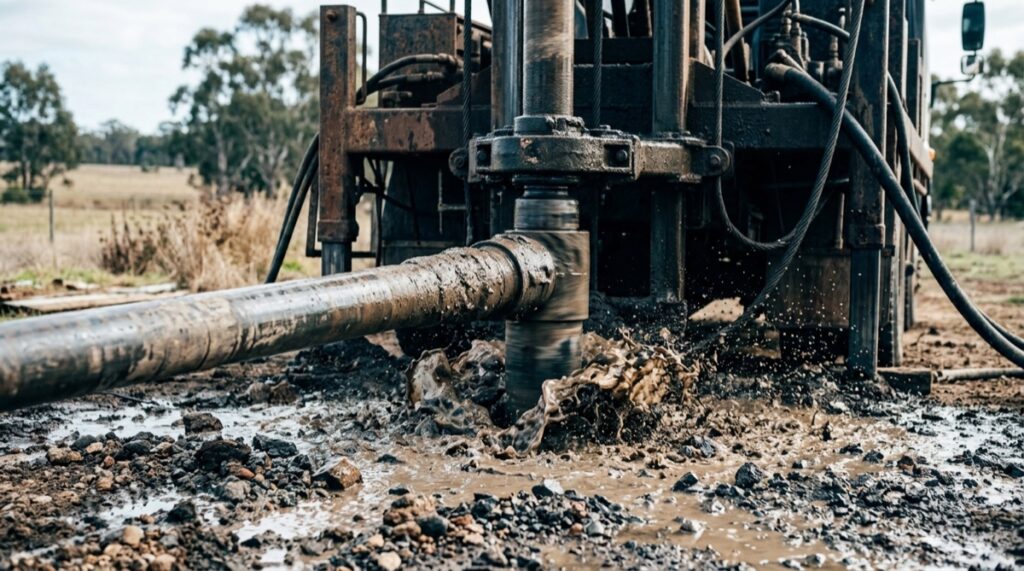
There are three basic types of private water wells: drilled, bored and driven. The right one for a property depends mainly on the local geology, the depth of usable groundwater and the construction rules where you live.
Drilled wells go deepest and generally provide the strongest protection against contamination. Bored wells can work where groundwater is shallow and the ground contains soft material rather than rock. Driven wells, also called sand-point wells, are usually the shallowest option—but they are also the most exposed to contamination from septic systems, agriculture, flooding and other surface activities. Many jurisdictions ban or restrict driven wells for household drinking water.
For most homeowners comparing a drilled vs. bored well, the decision also involves testing, treatment, seasonal water levels, local construction rules, and the written scope proposed for the property. A deep drilled well usually offers a more dependable household supply and a better physical barrier between the water intake and the surface.
How the three well types compare
The table is a starting point for comparing construction methods, not a design specification or property quote. Local well records may show considerably different depths, construction details and service lives. The “contamination risk” column assumes competent construction and maintenance; a damaged drilled well can be less sanitary than a well-maintained shallow well.
| Well type | Typical depth | Quote scope to compare | Contamination risk | Best suited to | Poor fit for | Typical lifespan |
|---|---|---|---|---|---|---|
| Drilled | About 50–1,000+ feet | Drilling-only versus complete installation; mobilization, casing, grout, pump, trenching, electrical work, testing, treatment, permits, taxes, allowances and exclusions | Usually lowest of the three when properly constructed | Permanent homes, deep groundwater, bedrock and most residential settings | Sites a heavy rig cannot reach without substantial preparation | Often several decades; 30–50+ years is a common planning assumption |
| Bored or augered | About 15–50 feet, although some local designs are deeper | Boring-only versus complete installation; diameter, casing, cover, pump, access, testing, treatment, permits, taxes, allowances and exclusions | Moderate to high | Shallow aquifers in clay, silt, sand or other soft formations without rock | Bedrock, deep water tables, flood-prone ground and sites near contamination sources | Can serve for decades if the casing, cover and aquifer remain sound |
| Driven or sand point | Often 15–30 feet; some regulated installations reach 30–50 feet | Point-only versus complete installation; legal-use research, connections, pump, testing, treatment, permits, taxes, allowances and exclusions | Usually highest | Temporary or seasonal supplies, cottages and irrigation where regulations and geology allow | Most new homes, rocky soil, low water tables and properties near septic or agricultural activity | Often shorter; corrosion, screen blockage and falling groundwater can end service early |
Request property-specific written quotes in USD for a U.S. project or CAD for a Canadian project. Compare drilling or boring alone with the complete installed scope, and ask each provider to itemize labour, equipment travel, casing, well-depth assumptions, taxes, quote date, validity period, allowances, exclusions, and responsibility for changes.
Drilled wells: the usual choice for a permanent home
How a drilled well is constructed
A drilled well is made with a truck-mounted or track-mounted drilling rig. Most residential contractors use a rotary rig, which turns a drill bit while air, water or drilling fluid carries broken material out of the hole. Cable-tool drilling uses a heavy cutting tool that repeatedly rises and falls to break the formation. It is an older method, but it remains useful in certain geological conditions.
The contractor installs steel or approved plastic casing through loose soil and unstable formations. The casing supports the opening and keeps shallow soil and unwanted groundwater from falling or draining into the well. In a bedrock well, the casing commonly extends through the soil and weathered upper rock, while the lower section may remain an open borehole in competent rock. Water then enters through fractures in the bedrock.
The space between the borehole and the outside of the casing is called the annular space. A contractor seals the required portion of that space with grout—usually a cement-based or bentonite-clay material. Grout is not cosmetic backfill. It is the barrier intended to stop contaminated shallow water from travelling down the outside of the casing and reaching the aquifer.
A completed well also needs an approved cap, appropriate casing height above grade, drainage that carries rain and snowmelt away from the wellhead and a sanitary connection for the water line. In cold climates, a pitless adapter allows that connection to leave the casing below the frost line without putting the top of the well in a pit.
Depth and suitable geology
Residential drilled wells may be around 50 feet deep in productive shallow formations or more than 1,000 feet deep where usable groundwater lies far below the surface. Wells of 100 to 400 feet are common in many areas, but a regional average should never be treated as a promise for one property.
Drilling is the only one of these three methods that can routinely pass through hard rock and reach deep bedrock aquifers. It is therefore suitable for the widest range of residential properties, including locations where a bored auger would stop at rock or a sand point could not be driven.
Why homeowners usually choose a drilled well
- Access to deeper groundwater: The well is not limited to the shallow water table immediately below the property.
- Better sanitary protection: Depth, continuous upper casing and a grouted seal create more separation from many surface contaminants.
- Broader geological reach: Modern rigs can work through soil, gravel and consolidated rock using methods selected for local conditions.
- Greater seasonal reliability: A deeper intake is generally less sensitive to ordinary short-term changes in the shallow water table, although no depth guarantees a particular yield.
- Better regulatory acceptance: Drilled construction is the established pattern for most new permanent residences served by private water.
What you give up in return
A drilled-well quote should account for the access needed by the proposed rig. A full-size rig needs room to enter, set up and leave. Ask how trees, overhead wires, steep grades, narrow gates, landscaping and soft ground affect the proposed access and site-work scope or the available drilling location.
Installation also involves more than making the hole. Ask whether mobilization, casing, grout, a pump, drop pipe, pressure equipment, electrical work, trenching, permits, water testing and possible treatment are included, excluded, or allowances. If a quote uses a per-foot unit, ask for its depth assumption, included minimum, and change process. Depth remains uncertain: the driller can use nearby well records and geological experience, but cannot inspect the aquifer from the surface.
Bored wells store more water, but draw from a vulnerable zone
How a bored or augered well is constructed
A bored well is made with a large-diameter earth auger. The auger removes soil while creating a cylindrical opening, often two feet or more across. Contractors usually line the opening with concrete tile, concrete pipe or steel casing to prevent collapse. The intake portion may use unsealed joints, perforated casing or a screen so groundwater can enter.
Bored wells are closely related to dug wells, but the construction method differs. A dug well is excavated with hand tools, a backhoe or similar equipment; a bored well is cut by an auger. In homeowner guidance and some regulations, the two categories are grouped together because both are shallow, large-diameter wells with similar sanitary concerns.
Where bored wells make sense
A bored well normally works only where a usable aquifer lies near the surface and the formation is soft enough to auger. Clay, silt, sand and unconsolidated deposits may be suitable. Rock, large boulders and a deep water table are not.
A typical depth is about 15 to 50 feet, although equipment and local rules may allow deeper construction. The well usually extends only a limited distance below the water table. If the water table drops during a dry season, the available water column can shrink significantly.
The storage advantage—and its limit
The main operational advantage of a bored well is its diameter. A large casing can hold far more water per vertical foot than a six-inch drilled well. That stored volume can help a household through short periods of heavy use when the surrounding formation releases groundwater slowly.
Storage should not be confused with well yield. Yield is the rate at which groundwater flows back into the well. A bored well may begin with hundreds of gallons in reserve yet recover slowly after that water is pumped. A proper yield test should measure both pumping performance and recovery rather than relying on the amount of water visible on one day.
Advantages of a bored well
- Provides another construction method to consider where local geology and rules allow it.
- Large stored water volume inside the casing.
- Useful in shallow, low-yield formations where storage can compensate for slow recharge.
- Service access may be less restricted by a narrow casing, although entering or opening a large well introduces serious safety and contamination concerns.
Disadvantages of a bored well
- The intake is close to surface activities and weather.
- Concrete-tile joints and older covers can admit shallow drainage if not properly sealed.
- The method cannot penetrate competent rock.
- Seasonal drought can reduce the water column or leave the well dry.
- A large opening presents a physical hazard and must have a secure, sanitary cover.
- Modern setback, casing, grouting and wellhead rules may make an older design unacceptable for new construction.
An existing bored well should not be condemned based on its type alone. Its condition, location, laboratory history and response after heavy rain are more informative. Repeated bacterial detections, a buried or cracked cover, ponding water, nearby livestock or an inadequate setback from the septic system are strong reasons for a professional assessment.
Driven wells depend on shallow groundwater and local rules
How a sand-point well is installed
A driven well uses a narrow steel pipe fitted with a screened, pointed end. Short pipe sections are joined together and hammered or mechanically driven into saturated sand or fine gravel. The screen lets groundwater enter while holding back larger sediment particles.
The method depends on ground that will accept the point without crushing it or blocking the screen. Clay, dense till, cobbles and bedrock can stop installation. A sand point also needs shallow groundwater within the practical lifting or pumping limits of the chosen equipment.
Many sand-point wells are 15 to 30 feet deep. Government guidance in some regions describes regulated driven wells in the 30-to-50-foot range, and certain codes impose minimum pipe depths. The legal minimum—not a generic online diagram—controls the installation.
Where a driven well may be useful
Where permitted, a driven well may supply seasonal cottages, livestock watering, gardens, construction water or other limited uses. Some jurisdictions allow one for a private residence if it meets the same siting, testing and completion requirements applied to other wells. Others permit driven points only for irrigation or temporary dewatering and prohibit them for drinking water.
Property owners sometimes install sand points themselves where owner construction is legal. That does not remove requirements for permits, setbacks, disinfection, construction records or laboratory testing. In other locations, only an authorized contractor may perform the work.
Advantages of a driven well
- Uses a narrow driven pipe and screened point.
- Smaller equipment footprint than a drilling rig.
- Faster installation under favourable sand-and-gravel conditions.
- Ask whether local rules allow replacement points or multiple points.
Why it is rarely the preferred household well
- Very shallow intake: The well draws from the portion of the aquifer most directly affected by land use and rainfall.
- Low or variable yield: The small screen area and thin saturated zone can limit household capacity.
- Screen problems: Mineral deposits, fine sediment or corrosion can reduce flow.
- Drought sensitivity: A modest fall in the water table may put the intake above the usable water level.
- Regulatory limits: Driven wells are banned for potable use in some jurisdictions and subject to extra approval in others.
- Limited sanitary protection: The design offers less opportunity for a substantial grouted seal around the upper casing than a conventionally drilled borehole.
Contamination risk is the most important difference
Depth helps because it increases the distance—and often the travel time—between surface activity and the well intake. Soil and rock layers may filter microorganisms or slow contaminant movement as water travels downward. A deeper aquifer beneath a protective clay or competent rock layer is usually less exposed than an unconfined shallow aquifer, which has no substantial barrier above it.
Depth is only one part of the protection system. Well location, groundwater-flow direction, casing condition, grouting, wellhead elevation and nearby contaminant sources can matter just as much.
| Risk factor | Drilled well | Bored well | Driven well |
|---|---|---|---|
| Distance from the surface | Usually greatest | Limited because the aquifer is shallow | Usually very limited |
| Casing | Continuous approved casing through unstable and shallow formations | Large concrete or steel casing; joints and age require attention | Continuous narrow drive pipe, but shallow intake remains exposed |
| Grouted seal | Normally designed with a regulated annular seal | Possible and often required, but the large diameter and joints demand careful work | Construction rules vary; the driven design may provide less sealing space |
| Flooding and ponding | Lower risk with an elevated casing and sanitary cap, but flooding can still contaminate it | High concern because of the large cover and shallow joints | High concern because the aquifer and wellhead are shallow |
| Septic and agricultural nitrate | Generally lower exposure when deep and properly separated | Higher exposure in permeable shallow formations | Often highest exposure |
| Seasonal water-table change | Usually less sensitive, depending on aquifer | Can lose a significant part of its stored water | A small decline can reduce or stop production |
Why older shallow wells deserve extra attention
Older bored and driven wells combine several risk factors: shallow groundwater, construction standards from another era, uncertain records and decades of casing or cover deterioration. A buried wellhead or well pit is especially concerning because runoff can collect around the opening. Older concrete covers may crack, tile joints may shift and steel pipe may corrode.
Bacteria and nitrate are the two routine concerns most closely associated with shallow household wells. Bacteria can enter with runoff, floodwater, septic leakage or animal waste. Nitrate is mobile in groundwater and may originate from fertilizer, manure or septic systems. Health Canada reports that elevated nitrate is most often associated with private shallow wells in permeable soils, particularly shallow bored or dug wells in unconfined aquifers.
Boiling does not solve a nitrate problem; it can concentrate nitrate as water evaporates. Treatment must be selected from actual laboratory results, and recurring bacterial contamination may indicate a construction or siting problem that disinfection alone will not correct.
What written well quotes should include
Ask each provider to distinguish construction of the borehole from a complete installed water system. If quotes use a per-foot rate or another unit, request the same written inclusions, exclusions, allowances, taxes, and change responsibilities so the scopes can be compared.
A complete installed scope may need to identify:
- permit and construction-record fees;
- equipment mobilization and difficult site access;
- casing, screen and grout;
- the pump, drop pipe and electrical cable;
- a pressure tank and controls;
- trenching and the buried water line to the house;
- yield testing, disinfection and laboratory analysis;
- water treatment selected after testing;
- restoration of driveways, lawns or access routes; and
- proper decommissioning of an old well.
Ask how the written quote handles additional depth, extra casing, hard rock, lost drilling fluid, unsuccessful attempts, and changes in pump size. Confirm the unit used, any included minimum, the approval process for changes, and the complete installed scope rather than relying on a borehole-only line item.
Changing well types usually means constructing a new well
A bored or driven well normally cannot be “converted” into a modern drilled well by inserting a drill and continuing downward. The old opening may be in the wrong location, lack the required separation from a septic system or have casing that cannot meet current standards. Drilling through the bottom can also create a path that connects contaminated shallow water with a deeper aquifer. Ontario expressly prohibits constructing a well by drilling or driving through the bottom of a bored or dug well.
The usual approach is to:
- Select a compliant location for a new drilled well.
- Construct, develop and disinfect the new well.
- Complete yield and water-quality testing.
- Install any treatment supported by the test results.
- Connect the new system only after it has been accepted for its intended use.
- Decommission the old well under local rules.
Decommissioning means more than placing a lid over the opening. An unused well can act as a vertical channel carrying surface contamination into groundwater. The casing may need to be removed or cut down, and the opening filled and sealed with approved materials by a qualified professional. Requirements differ, so the abandonment record is part of the job.
Regulations may determine which well types can be considered
In the United States, private household water quality is generally not regulated under the federal Safe Drinking Water Act in the same way as a public water system. Well construction is instead governed through state, county, tribal and municipal rules. These rules may cover permits, contractor licensing, casing, grout, minimum depth, setbacks, testing and abandonment.
In Canada, provinces and territories establish well-construction requirements, while local public-health and building authorities may add approval or testing conditions. Use a contractor holding the required license in the United States or licence in Canada, and confirm the credential with the responsible authority.
Many local authorities and building-approval processes now require a drilled well for new residential construction, or impose sanitary and performance standards that shallow designs cannot satisfy. This is not universal. Iowa, for example, allows permits for drilled, bored and sand-point wells, while identifying properly constructed drilled wells as the majority of new installations. Wisconsin permits regulated driven points for several private uses. Kentucky does not approve driven-point and jetted wells for drinking-water supply. Some Ontario municipalities require proof of an individual drilled well before issuing certain rural building permits, even though provincial rules recognize several construction methods.
That variation is why legality must be checked at the property level. A sand point that is lawful across a county line—or accepted for irrigation—may not be approved as the potable supply for a new home.
Sources and methodology
This article distinguishes wells by construction method rather than by regional naming convention. “Bored” is used for a large-diameter augered well, while “driven” means a narrow pipe and screened point driven into unconsolidated material. Some agencies group bored and dug wells together because their depth and sanitary risks are similar.
Technical and health information was checked in August 2026 against the following primary or authoritative references:
- U.S. Environmental Protection Agency: Learn About Private Water Wells, for well categories, casing, grout and relative contamination risk.
- U.S. Geological Survey: Domestic (Private) Supply Wells, for construction methods and geological applications.
- U.S. Centers for Disease Control and Prevention: Well Water Safety, for the sanitary advantages of properly constructed drilled wells.
- U.S. Environmental Protection Agency: Septic Systems and Drinking Water, for the effects of depth, groundwater flow, casing condition and separation from septic systems.
- Health Canada: Well Water and Your Health, for private-well testing and microbial risk.
- Health Canada: Nitrate and Nitrite Technical Guidance, for the relationship between shallow wells, permeable soils and nitrate occurrence.
- Ontario: Water Supply Wells—Constructing, Casing and Covering the Well, for Canadian construction examples and restrictions on drilling through an existing bored or dug well.
- Iowa Department of Natural Resources: Water Supply Wells, for drilled, bored and sand-point applications.
- Wisconsin Department of Natural Resources: Driven Point Wells, as an example of a jurisdiction that permits driven wells under detailed construction rules.
For additional pricing information, see This Old House and HomeGuide. Check each page’s date, geography, currency, and included scope before using its figures. Lifespan descriptions are planning guidance rather than warranties; construction quality, water chemistry, casing material, aquifer conditions, maintenance and changing groundwater levels can matter more than the well category itself.