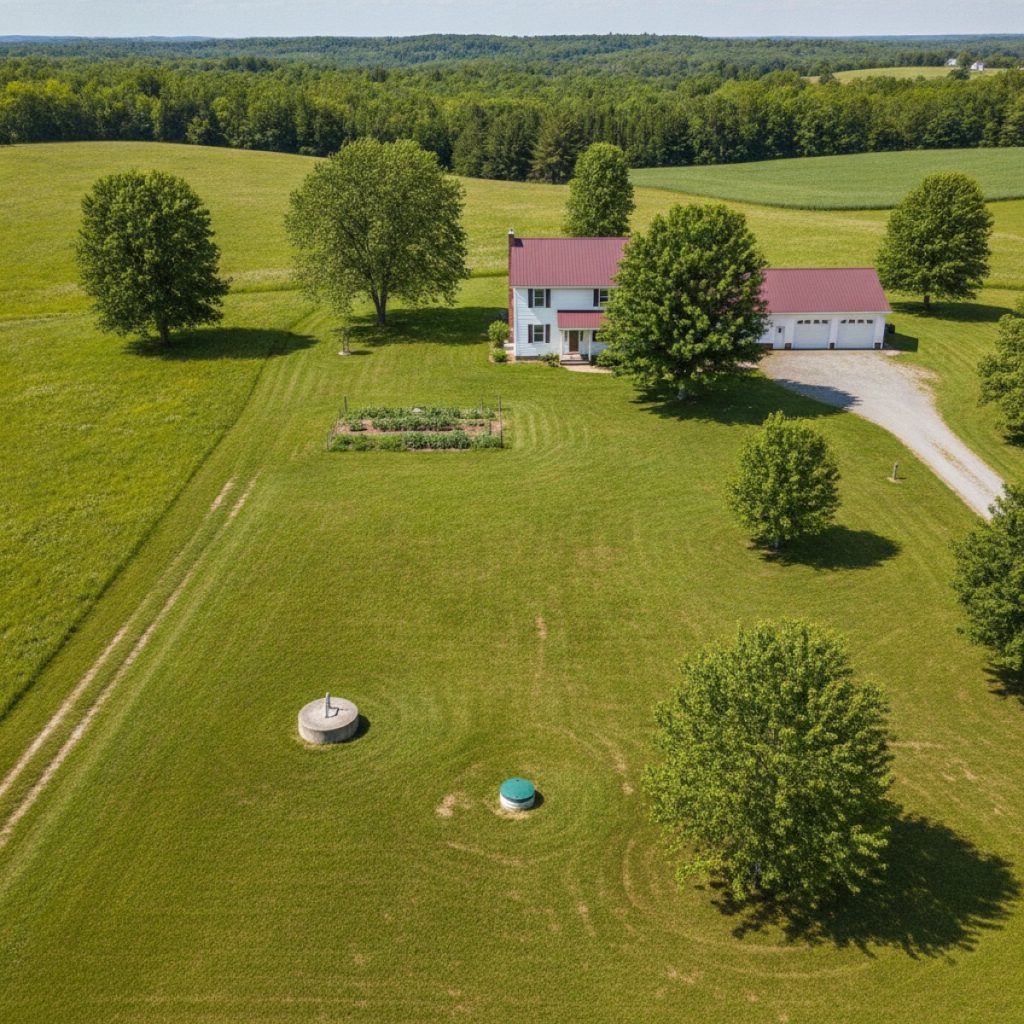
The usual minimum distance between a private well and a septic system is 50 to 100 feet from the septic tank and 100 to 150 feet from the drain field. Those numbers are useful for early planning, but they are not universal. Some jurisdictions allow 50 feet to an entire residential system, while others require 100 feet or more.
Your actual well septic setback distance depends on state or provincial rules, local ordinances, well construction, soil and bedrock, groundwater flow, septic-system design, and whether the well is uphill or downhill from the wastewater system. The county health department, local environmental health office, building authority, or provincial regulator has the final word.
A septic tank and a drain field are also treated differently in many codes. The tank is intended to be watertight. The drain field—also called a leach field, absorption field, dispersal field, or nitrification field—deliberately releases partially treated wastewater into the soil. That is why the drain-field setback is often greater.
Why well and septic setbacks exist
A conventional septic system separates solids in a buried tank, then sends liquid effluent to perforated pipes or chambers in the drain field. The soil below the field provides much of the treatment. It filters particles, holds or breaks down some contaminants, and exposes wastewater to microorganisms that help remove pathogens.
The process reduces risk, but it does not turn the effluent into drinking water. Nitrate, bacteria, viruses, household chemicals, and other dissolved substances may reach groundwater. A failing, overloaded, poorly located, or densely clustered group of septic systems increases that risk.
The setback creates travel distance between the wastewater source and the well. More distance generally provides more time for filtration, biological treatment, dilution, and natural die-off of pathogens. How much protection that distance provides depends heavily on what lies underground.
A hundred feet of unsaturated, fine-textured soil may provide much more protection than a hundred feet of fractured limestone. A shallow water table, coarse sand, sinkholes, improperly sealed well casing, or cracks in bedrock can let contaminants bypass much of the soil that would otherwise help treat them.
Common state and provincial requirements
The table below summarizes commonly applicable requirements for a private residential well and conventional onsite septic system. It is a planning reference, not a permit determination. Local authorities may require more distance, and special rules apply to shared wells, public supplies, large wastewater flows, seepage pits, spray systems, mounds, and unusual geology.
| Jurisdiction | Well to septic tank | Well to drain field | Well/property-line note |
|---|---|---|---|
| Texas | 50 ft | 100 ft | Normally 50 ft; certain enhanced casing and grouting can permit placement as close as 5 ft. |
| California | 100 ft in the state combined well standards | 100 ft | Set locally. Counties administer well standards and may use different or greater distances. |
| Florida | 75 ft from a private potable well | 75 ft | Well-to-line rules are local. The septic system itself is generally kept at least 5 ft from a property line. |
| Pennsylvania | 50 ft | 100 ft | Private-well construction is not comprehensively regulated statewide; municipal requirements may apply. |
| Michigan | 50 ft | 50 ft | Local sanitary codes may require more. No single statewide residential well-to-line distance applies in every situation. |
| North Carolina | 50 ft for a single-family dwelling | 50 ft for a single-family dwelling | County rules may be more protective. Shared and non-residential wells commonly require 100 ft. |
| New York | 50 ft | 100 ft | Local sanitary codes control lot-line placement. A field upgradient and in the drainage path to a well may require 200 ft. |
| Ohio | 50 ft | 50 ft | Private water sources are generally kept 10 ft from lot lines and easements. |
| Virginia | 50 ft | 50 ft for Class IIIA/IIIB drinking-water wells; 100 ft for Class IIIC wells | Usually 5 ft; generally 50 ft beside certain agricultural properties of 3 acres or more unless an allowed exception applies. |
| Ontario | 15 m (about 50 ft) | 15 m for a well with watertight casing at least 6 m deep; 30 m (about 100 ft) for other wells | The Wells Regulation uses site conditions rather than one universal well-to-line number. Greater separation is recommended where possible. |
| Alberta | 10 m (about 33 ft) | 15 m (about 50 ft) | Municipal and development requirements must also be checked. |
| British Columbia | 30 m (about 100 ft) from a new sewerage system | 30 m | Local siting rules also apply. A separate holding tank may use a 15 m setback under provincial regulation. |
Read the footnotes before relying on a number. California requirements are enforced locally. Virginia distances change with well construction. Ontario distinguishes between wells with adequate watertight casing and other wells. British Columbia treats a conventional septic tank and field as parts of the sewerage system for its 30-metre well setback.
What else needs a setback?
A well must be protected from more than the homeowner’s septic field. Regulators may consider features on neighboring properties as well as your own. The ranges below show distances commonly found in US and Canadian regulations; they are not universal requirements.
| Feature | Common planning range | Why it matters |
|---|---|---|
| Property line | 5–50 ft; locally determined in many areas | Protects access and reduces exposure to future contamination sources on neighboring land. |
| Building or foundation | 3–25 ft | Allows drilling and maintenance access and avoids foundation drainage or termite-treatment chemicals. |
| Stream, lake, pond, wetland, or ditch | 10–100 ft or more | Floodwater and surface runoff can carry microorganisms and chemicals to the wellhead. |
| Fuel storage | 50–300 ft or more | Distance depends on tank size, contents, secondary containment, and whether it is commercial storage. |
| Barnyard, animal enclosure, or manure storage | 50–150 ft; larger for concentrated manure storage | Animal waste can contribute pathogens and nitrate. |
| Road, driveway, or parking area | 5–50 ft | Protects the casing from vehicle damage and reduces exposure to runoff, salt, oil, and fuel. |
| Another well | 5–50 ft or more | Prevents construction conflicts and may reduce hydraulic interference between wells. |
| Pesticide, fertilizer, or chemical storage | 100–300 ft or more | Spills can create a long-lived groundwater problem that household treatment may not reliably address. |
Uphill versus downhill: direction matters
Putting the well uphill from the septic system is generally preferable, but “uphill” is a surface description. Groundwater moves from higher hydraulic pressure toward lower hydraulic pressure. That direction often follows the general land slope toward streams, lakes, or valleys, but buried layers, pumping, fractures, and confined aquifers can change the path.
A well upgradient of the septic system—that is, groundwater normally flows from the well area toward the septic area—has more natural protection. A downgradient well sits in the likely direction of groundwater movement and may intercept the septic plume.
You can make an initial assessment by reviewing the property contours, nearby water bodies, wet areas, and well records. Groundwater commonly moves toward a stream or low area, but a surface map is not proof. Reliable determination may require static water-level measurements from several wells taken over the same period and plotted as groundwater-elevation contours.
Do not open well caps or lower measuring devices into wells yourself. That can introduce contamination or damage equipment. A licensed well contractor in the US, a licensed well contractor where required in Canada, or a hydrogeologist can evaluate the records and site.
Groundwater flow can also change seasonally or when a high-capacity well is pumped. The well creates a zone in which water is drawn toward it. A septic system that appears beside rather than directly uphill from the well can still fall within that zone.
Soil type changes the equation
Sandy and gravelly soil
Water moves readily through large pore spaces in sand and gravel. That helps a properly designed drain field accept effluent, but it may provide less contact time and less physical filtration before the water reaches the aquifer. Coarse soil combined with a shallow water table is a particular concern.
Clay and fine-textured soil
Clay slows water movement and can capture more suspended particles. It is not automatically a protective advantage, however. Poorly permeable clay can cause effluent to move sideways, perch above a tight layer, break out on a slope, or overload a conventional field. Regulators consider both horizontal distance and the depth of suitable unsaturated soil beneath the field.
Fractured bedrock
Cracks and joints in bedrock can act as preferential pathways—routes that let water travel around the filtering soil. The direction of individual fractures may matter more than the surface slope. A drilled well that intersects the same fracture network receiving septic effluent can be vulnerable even when the tape-measure distance complies with code.
Karst and limestone terrain
Karst develops where soluble rock, commonly limestone or dolomite, forms enlarged fractures, cavities, springs, and sinkholes. Water can move rapidly through these openings with limited filtration. Thin soil over karst, exposed rock, disappearing streams, or sinkholes may justify substantially greater separation or make part of a property unsuitable for a conventional system.
Other important factors include the seasonal high water table, depth of well casing and grout, well intake depth, septic loading, neighboring systems, and the cumulative density of wells and septic fields in the area.
What if the lot cannot meet the setback?
Start with the authority that issues well or septic permits. Depending on location, that may be a county health department, local sewage enforcement officer, environmental health unit, building department, health authority, or safety-codes office.
A variance or reduced-setback request commonly requires:
- A scaled site plan showing the well, every septic component, replacement field, buildings, boundaries, water bodies, neighboring wells, and neighboring septic systems.
- Well records describing depth, casing, grout, and the water-producing zone.
- Soil evaluation, seasonal water-table information, and details of the proposed wastewater system.
- An explanation of why compliant locations are unavailable.
- Supporting work from a qualified well professional, septic designer, engineer, geoscientist, or hydrogeologist when site risk warrants it.
An approval may require deeper watertight casing, more grout around the casing, a sanitary well cap, enhanced wastewater treatment, pressure distribution, disinfection, monitoring, or a different system location. British Columbia, for example, allows a different well setback only with written advice from a professional competent in hydrogeology. Other jurisdictions use their own findings and procedures.
A reduced setback is not guaranteed. Some lots do not have enough suitable area for a private well, an operating septic system, and the required replacement field. The practical alternatives may include connecting to public water or sewer, obtaining a documented off-lot easement where permitted, using a permitted holding tank, combining parcels, or deciding that the proposed development cannot be supported.
Costs cannot be predicted from setback distance alone. Professional studies, deeper casing, advanced treatment, pumping requirements, easements, monitoring, and future maintenance can change the project cost substantially. A contractor’s price before the authority confirms an approvable layout is not a reliable final budget.
Old wells and pre-existing conditions
An older well and septic system that are closer than today’s minimum are not automatically illegal. They may have been permitted under earlier rules, constructed before permits were required, or approved through an exemption. People often call this “grandfathered,” although the exact legal status differs by jurisdiction.
That status does not prove that the water is safe, and it does not necessarily authorize future work. Replacing the well, moving the drain field, enlarging the home, adding bedrooms, changing the building’s use, or repairing a failed septic system may trigger current requirements.
Before buying or renovating, obtain the well completion record, septic permit, approved site plan, repair history, water-test results, and any written variance. Confirm whether the approved replacement field remains available. A lawn, garage, pool, driveway, property split, or neighboring well may have consumed space that the original plan reserved.
If the existing distance is short, inspect both systems. The well assessment should cover casing height, cap, grout information, drainage around the wellhead, and signs of flooding or damage. The septic assessment should locate the tank and field and check for leakage, surfacing effluent, backup, hydraulic overloading, or an undocumented alteration.
How to measure the setback correctly
Measure the shortest horizontal distance between the relevant features. Do not measure to the centre of a tank or field.
- Septic tank: Measure from the well to the nearest outside wall or boundary of the tank.
- Drain field: Measure to the nearest trench, bed, chamber, infiltrative surface, or other boundary specified by local code—not the centre of the field.
- Raised or mound system: Some rules measure to the toe of the fill or basal area rather than the visible pipes.
- Replacement area: Include it when the jurisdiction protects a designated reserve field.
- Property line: Use the surveyed legal boundary, not a fence, hedge, mowing line, or online parcel overlay.
- Neighboring systems: A well setback normally applies to contamination sources on adjoining land too.
Begin with county, municipal, or health-authority permit records. A septic pumper may have marked the access lids, and previous pumping invoices may identify the tank location. The line leaving the house can help a qualified contractor trace the system, but it does not reveal the complete field layout.
Probing can puncture plastic tanks, pipes, electrical lines, or pressurized components. Before any ground disturbance, use the applicable utility-location service and have uncertain septic components located by a qualified septic professional. Record the final locations on a scaled drawing and with permanent surface reference points.
When to test your well water
The US Environmental Protection Agency and Centers for Disease Control and Prevention recommend testing a private well at least annually for total coliform bacteria, nitrate, total dissolved solids, and pH. Local health authorities may recommend additional tests based on geology, agriculture, industry, or known groundwater problems.
Testing is especially important when:
- The well is near the minimum septic setback.
- The well is downhill or likely downgradient from the field.
- The property has sandy soil, shallow groundwater, fractured rock, or karst.
- The septic system backs up, smells, surfaces effluent, or receives unusually high water use.
- Flooding or major runoff reaches the well area.
- The well, pump, casing, or septic system has been repaired.
- The water changes in taste, odour, colour, or clarity.
- A pregnant person, infant, older adult, or immunocompromised person uses the water.
How to read the most relevant results
Total coliform bacteria indicate that the well or water system may have a route through which surface contamination can enter. They do not identify a septic system as the source, but a positive result requires follow-up.
E. coli indicates recent fecal contamination and must be treated as an urgent health concern. Stop using the water for drinking, cooking, making ice, brushing teeth, and preparing infant formula until the health authority or qualified water professional provides instructions and follow-up testing confirms safety.
Nitrate may come from septic effluent, fertilizer, manure, or natural sources. A rising trend can be an important warning even below the legal benchmark. The US maximum contaminant level is 10 milligrams per litre measured as nitrate-nitrogen. Health Canada’s maximum acceptable concentration is 45 milligrams per litre measured as nitrate, which is equivalent to 10 milligrams per litre as nitrate-nitrogen. Check which unit your laboratory uses.
Boiling does not remove nitrate and can increase its concentration as water evaporates. If nitrate exceeds the applicable health limit, use another safe water supply and obtain guidance on investigation and treatment.
If contamination is confirmed
Do not begin by disinfecting the well and assuming the problem is resolved. Disinfection may temporarily remove bacteria from the plumbing, but it will not correct a leaking tank, failing field, damaged cap, inadequate casing, poor surface drainage, or contaminated aquifer.
- Use bottled water or another confirmed safe source as directed by the health authority.
- Confirm the result through an accredited or certified drinking-water laboratory and follow its sampling instructions.
- Have the wellhead, casing, cap, grout, drainage, and plumbing inspected.
- Have the septic system inspected and its actual components located.
- Investigate other possible sources, including livestock, flooding, fertilizers, abandoned wells, and neighboring systems.
- Correct the source before disinfecting or installing treatment.
- Retest after corrective work and at the interval specified by the health authority.
Ultraviolet treatment can control microorganisms in properly prepared water, while reverse osmosis, distillation, or ion exchange may be used for nitrate in appropriate installations. Treatment equipment requires correct design, maintenance, monitoring, and follow-up testing. It does not make a failing septic system or defective well acceptable.
Sources and methodology
This article was prepared by comparing current government regulations and technical guidance available in August 2026. The jurisdiction table focuses on ordinary private residential wells and conventional onsite systems. Where state or provincial rules defer to local authorities, the table says so rather than assigning a nationwide or province-wide number that may not apply.
- Texas Department of Licensing and Regulation: Well Drilling and Pump Installing Technical Guidance
- California Department of Water Resources: Water Well Construction Standards
- Florida Statutes, Section 381.0065
- Pennsylvania Code, Section 73.13
- Michigan EGLE: Minimum Well Isolation Distances
- North Carolina Session Law 2024-49
- New York State Department of Health: Appendix 5-B Standards for Water Wells
- Ohio Administrative Code, Chapter 3701-28
- Virginia Administrative Code: Private Well Location
- Ontario: Water Supply Well Siting Requirements and Best Practices
- Alberta Private Sewage Codes and Standards
- British Columbia Sewerage System Regulation
- US EPA: How Septic Systems Work
- US EPA: Protect Your Home’s Water
- CDC: Guidelines for Testing Well Water
- Health Canada: Drinking Water Guidelines for Nitrate and Nitrite
Regulations change, and municipal rules may be stricter than the sources above. The applicable permitting authority should confirm the required distance before a well or septic location is finalized.
Related Guides
- Do You Need a Permit to Drill a Well?
- How Much Does It Cost to Drill a Well?
- How to Choose a Well Driller
- How Deep Should a Well Be?
Browse all Regulations & Permits guides →

Author: Well Drilling Guide Editorial Team
The Well Drilling Guide editorial team researches and writes our guides on water-well drilling, pumps, and well water for homeowners across the US and Canada. We translate current cost data, NGWA and state well-construction standards, and EPA and CDC guidance into clear, practical answers. What we stand for: honest, independent help. Every price and claim is researched and fact-checked against multiple 2026 sources — never guessed, never borrowed from a single advertiser. We answer to homeowners, not to the companies we write about, because our only goal is to help you make a confident, well-informed decision about your water.
Find verified, local contractors who handle new installations, pump service, and water quality testing — in your area.