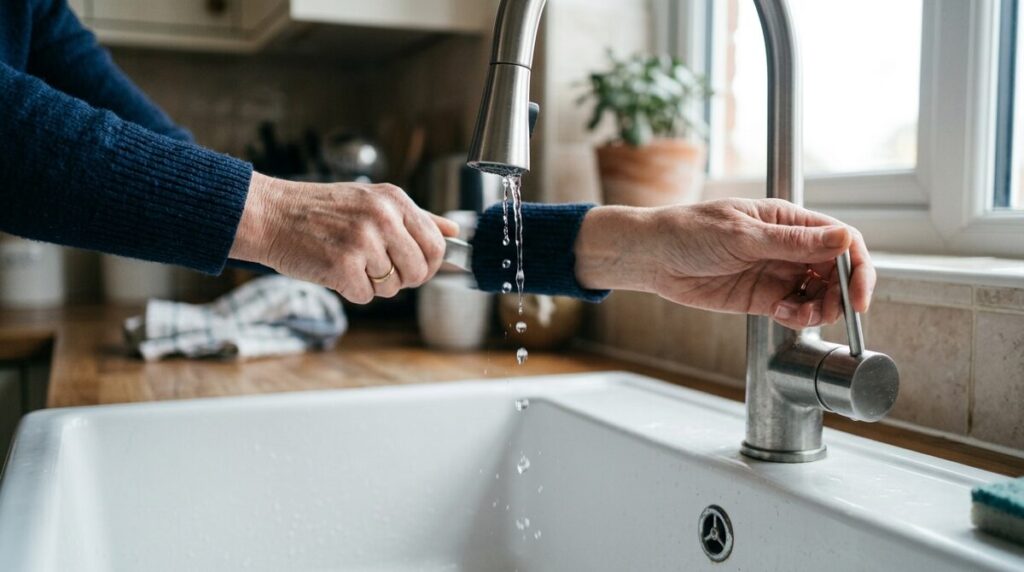
A well running dry does not necessarily mean the aquifer is gone. Most often, it means the water level has fallen below the pump intake because of drought, a seasonal low, heavy household use, irrigation, or pumping from nearby wells. Once demand stops, some wells recover within hours. Others need days, weeks, or a wet season. A well that repeatedly fails to recover may be showing long-term groundwater decline or deterioration inside the well itself.
The first question is not merely, “Is there water in the well?” It is, “How much water enters the well, how far does the level fall while pumping, and how quickly does it rise afterward?” A licensed well contractor in the United States or a licensed or registered well technician in Canada can measure those conditions through a drawdown and recovery test.
Warning signs that your well is losing yield
A household can develop water problems for reasons unrelated to the aquifer. A worn pump, leaking pipe, failed pressure tank, plugged filter, or electrical fault can imitate a low-yield well. The pattern of symptoms helps narrow the cause, but measurements are needed before selecting a repair.
Air sputters from the faucets
Bursts of air followed by water can occur when the pump draws the water level down near its intake. The pump begins pulling air or gas along with water, and that air reaches the plumbing. Sputtering can also result from a leaking drop pipe, a faulty check valve, or work recently performed on the plumbing.
If sputtering appears only near the end of a shower, irrigation cycle, or laundry day, declining water level is a strong possibility. Stop high-demand use rather than continuing to run the pump against an inadequate supply.
The water becomes muddy or carries sediment
Sand, grit, cloudiness, or muddy water may appear when the water level falls and flow around the well changes. A pump installed too close to the bottom can disturb settled material. Sediment can also point to a damaged screen, deteriorated casing, unstable formation, or an excessively powerful pump.
Do not assume sediment proves the aquifer is dry. It does mean the system deserves prompt attention. Abrasive sand can damage pump components, clog treatment equipment, and wear plumbing fixtures.
Pressure falls during heavy use, then returns later
A low-yield well may supply one modest flow but fail when several fixtures run together. Pressure might be normal at breakfast, fall when a shower and washing machine operate at the same time, and return after the household stops using water.
This pattern often means demand is exceeding the rate at which groundwater enters the well. A failing pump, clogged filter, undersized pipe, or pressure-system problem can create similar symptoms, so pressure alone does not settle the diagnosis.
The pump runs much longer before pressure builds
A healthy system should reach its pressure-switch shutoff point within a reasonably consistent period under similar conditions. Longer run times can mean the pump is moving less water, the pumping level has dropped, the pump is worn, or water is escaping through a leak.
A pump that runs continuously without reaching shutoff pressure should not be ignored. Extended operation can overheat or damage equipment, especially if the intake is no longer fully submerged.
Each pump cycle delivers less usable water
You may hear the pump start, receive a brief period of normal flow, and then notice pressure fading sooner than it did before. After the pump rests, another small amount becomes available. This can happen when the well stores some water between cycles but refills more slowly than the household uses it.
Frequent starting and stopping can also be caused by a failed pressure tank. A contractor should check the pressure system as well as the well’s water level so that a tank problem is not mistaken for groundwater shortage.
Water stops during showers or combined fixture use
Running out of water during a single short use is more serious than a slight pressure change. If service returns after the pump rests, the well probably still receives water, but its current yield is below peak household demand. If water does not return, the cause could be a severely lowered water level, pump damage, electrical failure, frozen piping, or a major leak.
| Sign | Likely causes | Urgency | What to do |
|---|---|---|---|
| Pressure drops only when several fixtures run | Demand exceeds well yield; clogged filter; pump or pressure-system issue | Moderate | Stagger water use and arrange a system assessment if the pattern repeats. |
| Air sputters late in a long water-use period | Water approaching the pump intake; leaking drop pipe or valve | High | Stop heavy use and have the pump setting and water levels checked. |
| Muddy water, sand, or grit | Low water level, disturbed sediment, damaged screen or casing | High | Reduce pumping and obtain a well inspection and water test. |
| Pump runs continuously without reaching normal pressure | Very low yield, worn pump, leak, blockage, or failed controls | Urgent | Stop unnecessary use and call a qualified pump or well contractor. |
| Water disappears and does not return after a rest period | Water below intake, pump failure, electrical fault, frozen line, or major leak | Urgent | Do not keep forcing the system to run. Arrange diagnosis and secure safe temporary water. |
A temporary shortage and a permanent decline can look alike at first
Drought or a seasonal low water table
Shallow wells connected to an unconfined aquifer, where groundwater rises and falls more directly with rainfall and snowmelt, often respond to dry weather sooner than deep confined wells. During drought, recharge slows while lawn watering, crop irrigation, and livestock demand may increase. The combined effect lowers groundwater levels.
A drought-affected well may recover after household demand stops, after neighboring irrigation ends, or when sustained precipitation replenishes the aquifer. Recovery after one evening does not mean the seasonal problem has ended. The well can fail again the next time demand exceeds inflow.
Overpumping by your property or nearby users
Every pumping well lowers water pressure around itself. This creates a temporary lowered area in the groundwater surface. If nearby wells draw from the same aquifer, those lowered areas can overlap.
A new subdivision, agricultural irrigation system, commercial user, or cluster of deeper wells can change local conditions even when your equipment has not changed. A shortage that follows a predictable irrigation schedule may suggest pumping interference. Well records, regional monitoring data, and measurements from more than one property can help establish whether that is occurring.
Long-term aquifer depletion
Where total pumping persistently exceeds recharge, regional groundwater levels can decline over years. A wet month may improve conditions without restoring the former water level. Warning clues include dry-well reports across a wider area, progressively deeper replacement wells, and your own static water level becoming lower from one season or year to the next.
A new or deeper well may reach water in such an area, but greater depth alone does not guarantee a sustainable supply. The proposed aquifer, nearby well records, pumping pressure, water quality, and expected household demand all matter.
The well may be deteriorating even when the aquifer is healthy
Mineral scale, iron bacteria, biological growth, or fine sediment can restrict the openings that admit water. A screened sand-and-gravel well may develop a clogged screen or clogged gravel pack. A bedrock well may have mineral deposits or debris restricting fractures.
This distinction matters because drilling deeper will not remove a blockage. If records show that the surrounding groundwater level remains adequate but the well’s specific capacity, meaning the amount of water produced for each foot of water-level decline, has worsened, rehabilitation may be the better candidate.
How long does a dry well take to recover?
There is no dependable household rule such as “wait two hours.” A well may provide water again after 30 minutes yet still be unable to support a shower. Another may take a day to refill but then store enough water for normal peak demand. In a severe seasonal decline, meaningful recovery may not occur until rainfall or snowmelt recharges the aquifer.
A recovery test measures how the water level rises after controlled pumping stops. The useful result is not just the time until water reappears at a faucet. It is the rate and extent of recovery compared with the original non-pumping level.
Aquifer type
Water can move relatively freely through productive sand and gravel, although fine sediment or a clogged screen may restrict entry into the well. Fractured rock behaves less uniformly. One well may intersect several connected fractures while another nearby well intersects one narrow, slowly replenished opening. Property-line distance alone does not predict whether two bedrock wells behave alike.
Well depth and pump position
The important measurement is the usable water column above the pump intake, not total drilled depth by itself. A 400-foot well can still lose service if the pump is set high or if productive fractures lie above a sharply falling water level. Lowering a pump may provide access to more stored water, but the contractor must maintain clearance from the bottom and consider sediment, pump capacity, wiring, pipe, and local rules.
Recharge rate
Recharge depends on geology, soil, precipitation, season, vegetation, topography, and whether water can infiltrate the ground. Rain falling today does not necessarily reach a deep aquifer tomorrow. Some groundwater systems respond rapidly; others reflect weather accumulated over months or years.
Regional pumping pressure
A recovery test performed while nearby irrigation wells are idle may look different from one performed during peak pumping. A useful assessment records current weather, recent demand, pumping rate, static level, pumping level, and recovery. When interference is suspected, the contractor or groundwater professional may also review nearby well logs and public monitoring records.
The homeowner’s water-use history is valuable evidence. Record when pressure declines, what fixtures were operating, how long the shortage lasts, whether neighbors have similar trouble, and whether the pattern corresponds with irrigation or drought.
Your options when the well runs dry
Wait and conserve when the decline appears temporary
If drought or an unusual demand spike is responsible, stop irrigation, laundry, dishwashing, vehicle washing, and other large uses. Allow the well to recover while preserving water for drinking, food preparation, sanitation, and livestock needs.
A pump contractor can install low-water protection that shuts the pump down before dry running damages it. This protects equipment; it does not increase the amount of groundwater available.
Rehabilitate a clogged or deteriorated well
Rehabilitation aims to restore water entry that the well once had. Depending on construction and the cause, a contractor may brush or jet the screen, surge water back and forth through the intake area, remove sediment with air lifting, disinfect the well, or use an approved acid treatment to dissolve mineral deposits.
Rehabilitation is most defensible when records show that the well formerly produced more water and testing points to clogging rather than a regional drop in groundwater. The selected treatment should match the deposit and well materials. Poorly chosen chemicals or excessive force can damage components or create disposal and water-quality problems.
Hydrofracture a suitable bedrock well
Water-well hydrofracturing uses pressurized water to clean and open existing fractures in bedrock. It is different from the large oil-and-gas extraction process that homeowners may associate with the term. Drinking-water well work normally uses water rather than the chemical mixtures used in oil and gas development.
The method applies to certain bedrock wells, not screened sand-and-gravel wells. It can improve entry through restricted fractures, but it cannot manufacture regional groundwater. If the surrounding water level has dropped below the productive fractures during drought, the benefit may be limited or temporary.
Deepen the existing well
Deepening can add stored water below the current level and may intersect additional water-bearing zones. It is most promising when local records and geology support the presence of usable groundwater below the current well.
The contractor may need to remove the pump, pipe, wiring, and other components before drilling resumes. Existing casing condition, borehole diameter, rig access, and current construction standards can make the work impractical. Deeper groundwater may also contain more iron, manganese, hardness, salt, sulfur, arsenic, or other naturally occurring substances. Testing is required before the water is accepted for drinking.
Drill a new, deeper well
A new well lets the contractor select a better location, construction design, casing depth, and target formation. It may be preferable when the old casing is deteriorated, the location no longer meets setback requirements, or previous rehabilitation has failed. Where deepening could preserve old weaknesses, ask for a written comparison of the deepening and new-well scopes.
Drilling remains uncertain work. The final depth, yield, water quality, amount of casing, treatment needs, and complete work scope are not fully known in advance. A written proposal should separate drilling, casing, sealing, development, pump testing, pump equipment, trenching, electrical work, permits, laboratory testing, and proper closure of any well taken out of service.
Add a cistern or intermediate storage tank
A low-yield well can sometimes produce enough water over 24 hours but not enough during the household’s busiest hour. An intermediate storage system allows the well to fill a non-pressurized potable-water tank slowly. A separate booster pump supplies the home from that tank at the required pressure.
This is different from installing a larger pressure tank. A pressure tank reduces pump cycling but normally holds only a limited amount of usable water. A cistern provides meaningful bulk storage.
The design may require level controls, dry-run protection, overflow protection, backflow safeguards, disinfection or other treatment, and a tank approved for drinking water. Stored water must be protected from insects, animals, surface drainage, freezing, heat, and bacterial growth.
Compare local quotes for each option
Request written amounts in USD for a U.S. project or CAD for a Canadian project. Ask each provider to state the property assumptions and itemize access, well depth, casing, bedrock allowances, permits, pump work, electrical work, laboratory testing, treatment, travel, after-hours work, taxes, quote date, validity period, exclusions, and change responsibilities.
The “success rate” column is intentionally expressed as a condition rather than a universal percentage. Published percentages often come from individual contractors, regions, or narrowly selected wells. They cannot predict the outcome on a different property.
| Option | When it works | Itemized quote question | Success rate | Typical timeline |
|---|---|---|---|---|
| Wait and conserve | Temporary demand spike, seasonal decline, or drought where the well still recovers | Are conservation devices, pump protection, installation, setup, testing, taxes and exclusions itemized? | Good for managing a temporary shortage; does not restore lost aquifer capacity | Hours to a wet season |
| Well rehabilitation | Clogged screen, mineral buildup, biological fouling, or accumulated sediment | Are diagnosis, pump removal, cleaning method, treatment materials, testing, disposal, travel and reporting included? | Best when testing confirms deterioration inside the well; poor when groundwater itself has declined | One to several days, plus testing |
| Hydrofracturing | Suitable bedrock well with restricted or poorly connected fractures | Are site assessment, mobilization, depth assumptions, equipment, pump work, testing, permits and reporting included? | Highly site-specific; weak candidate if drought has lowered water below productive fractures | Usually one to several working days, plus recovery and water testing |
| Deepen existing well | Sound existing well with promising deeper geology and adequate rig access | Does the quote state the depth assumption, unit, included minimum, pump removal, drilling, casing, testing and change process? | Uncertain until drilling; added depth may provide storage without finding a stronger water source | Several days to several weeks, depending on permits and contractor availability |
| New well | Deteriorated construction, unsuitable location, or permanent decline; compare deepening and new-well quotes before choosing | Does the quote distinguish the new borehole from the complete system and include casing, pump, trenching, electrical, testing, permits and old-well closure? | No universal guarantee of adequate yield or acceptable water quality | Commonly several weeks from planning through testing; longer where backlogs exist |
| Cistern and booster system | Well produces enough per day but cannot meet peak household demand | Are tank, excavation, controls, pump, treatment, freeze protection, installation, testing, taxes and exclusions included? | Good when daily production is adequate and the system is correctly sized; cannot solve inadequate total supply | Several days after design and equipment availability |
Before choosing among these options, request a diagnosis and written scope rather than treating one intervention as a trial. A pumping and recovery test, review of the original well record, inspection of the pump system, and representative water test can help determine whether a proposed treatment matches the identified condition.
When it is time to accept that you need a new well
A replacement well becomes the stronger choice when several pieces of evidence point in the same direction:
- The casing, screen, seal, or borehole is deteriorated and cannot be restored reliably.
- The existing well cannot be deepened while meeting current construction or setback rules.
- Water levels remain below the pump intake even after extended low-demand periods.
- Local monitoring and nearby well records show sustained regional groundwater decline.
- Rehabilitation or hydrofracturing has produced little durable improvement.
- The available water has quality problems that become worse at greater depth.
- A written comparison of pulling equipment, repairing old construction, deepening, and reinstalling the system versus a new well explains why replacement is preferred for this property.
- The property’s current demand is substantially greater than the well was designed to support.
One unsuccessful shower is not enough evidence to condemn a well. Repeated measured failure, poor recovery, deteriorated construction, and unfavorable local groundwater conditions are much stronger evidence.
Ask the contractor to explain what the new location or design changes about the odds. A replacement drilled into the same stressed water-bearing zone may inherit the same problem. In challenging bedrock settings, a groundwater professional may use local well records, geologic mapping, and fracture information to help select a location, while still acknowledging that drilling cannot guarantee a particular yield.
How to conserve water while the well is struggling
The goal is to reduce peak demand and total daily use without compromising drinking, food preparation, or basic sanitation.
- Stop lawn irrigation, vehicle washing, pool filling, and other discretionary uses.
- Do not run the washing machine, dishwasher, and shower at the same time.
- Space high-demand activities across the day so the well can recover between them.
- Postpone large laundry loads or use a laundromat until the supply stabilizes.
- Repair leaking toilets, faucets, livestock waterers, and buried supply lines promptly.
- Use low-flow showerheads and faucet aerators, and keep showers shorter.
- Operate dishwashers and washing machines only with full loads.
- Check treatment equipment for unnecessary or overly frequent backwashing cycles.
- Set irrigation and automatic appliances so they cannot run unnoticed overnight.
- Keep an emergency supply of safe drinking water appropriate for the household.
If you arrange hauled water, do not pour it directly into the well. Much of it may move away through the screen or fractures, it can introduce contamination, and it does not recharge the surrounding aquifer in a controlled way. A properly designed potable-water cistern is the appropriate place for delivered household water.
Sources and methodology
This article distinguishes a well that has lost access to water from an aquifer that has disappeared. That approach follows the U.S. Geological Survey explanation of dry wells, which defines a well as dry when water falls below the pump intake and identifies well depth, aquifer type, pumping, and recharge as key factors.
Causes, drought precautions, storage considerations, and the need for qualified contractors were checked against the Province of British Columbia’s Best Practices for Groundwater Wells Going Dry and Drought Preparation. Guidance on pump position and the limitations of hydrofracturing during drought was checked against the Massachusetts Department of Environmental Protection’s private-well drought guidance.
The discussion of low-yield wells, borehole storage, deepening, and intermediate tanks draws on Penn State Extension’s Using Low-Yielding Wells. Rehabilitation methods and the distinction between physical and chemical treatments were checked against its Water Well Maintenance and Rehabilitation guidance.
Water-testing recommendations were checked against the U.S. Centers for Disease Control and Prevention and Health Canada. Contractor qualifications, permits, testing requirements, and terminology vary by state, province, territory, and municipality.
This guide does not provide combined U.S. and Canadian price ranges for these options. Request property-specific USD or CAD quotes that state scope, assumptions, exclusions, date, validity, and change responsibilities. The comparison deliberately avoids a universal percentage for treatment success because no national figure can predict the result for an individual well.