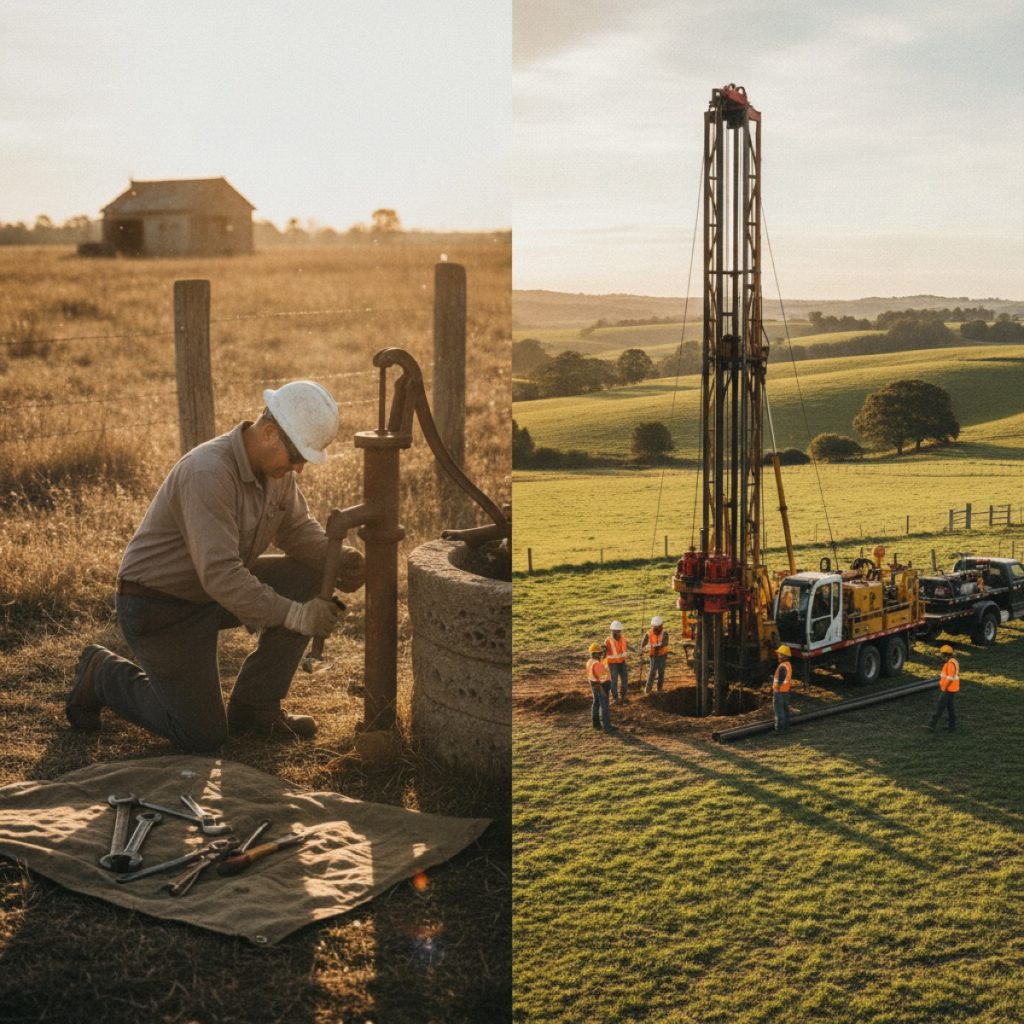
When a well starts failing, repairing it is usually the better first move. A failed pump, waterlogged pressure tank, blocked screen, damaged cap, or localized casing defect can often be corrected for far less than the cost of drilling a replacement well.
A new well becomes the stronger investment when the existing well has serious structural damage, repeatedly loses yield, draws from an unsuitable aquifer, cannot meet current construction rules, or needs a repair costing roughly 30% to 40% of a credible replacement quote with no dependable long-term result.
What common well repairs cost
The following figures are broad planning ranges for residential wells in the United States. They are not fixed national prices. Depth, casing diameter, pump size, local geology, rig access, regional labour rates, permits, and the amount of pipe and electrical cable being replaced can move a job well outside the range. Canadian homeowners should request prices in Canadian dollars and confirm whether tax, permits, laboratory testing, and well records are included.
The “expected service after repair” column is a budgeting guide, not a warranty. A new component can last for years while the surrounding well fails sooner, and rehabilitation results depend heavily on what caused the decline.
| Repair | What it addresses | Typical installed range | Planning expectation after repair |
|---|---|---|---|
| Pump replacement | A failed, worn, sand-damaged, or incorrectly sized pump | $1,500–$4,000+ | Often about 8–15 years, depending on cycling, water chemistry, sand, depth, and installation quality |
| Pressure tank replacement | Rapid pump cycling, unstable pressure, or a failed internal bladder | $500–$1,500 | Commonly 7–15 years when correctly sized and protected from moisture and freezing |
| Well rehabilitation or cleaning | Mineral scale, bacterial slime, sediment, or a partially blocked well screen | $1,000–$3,000 | Often several years; 3–10 years is a reasonable planning range when buildup is the true cause |
| Hydrofracturing | Low yield in a bedrock well by using controlled water pressure to open or reconnect rock fractures | $2,000–$5,000 | A successful result may last years or much longer, but increased yield is not guaranteed |
| Deepening the existing well | Insufficient water column or the possibility of reaching another productive fracture or layer | $3,000–$8,000+ | Potentially decades if the existing structure remains sound and the deeper interval is productive |
| Casing repair or liner | A localized leak, hole, split, or corroded section that can be isolated | $2,000–$6,000 | Often 10–25+ years when the defect is limited and the remaining well can support the liner |
| Well cap or sanitary seal replacement | Entry by insects, debris, runoff, or contaminants at the wellhead | $200–$500 | Often 10 years or more, with annual inspection still required |
Before authorizing one of these repairs, ask what testing established the diagnosis. A pump that stops delivering water does not prove the well is dry. The cause could be a failed control, broken wire, split drop pipe, worn pump, falling groundwater level, or a plugged intake. Replacing parts without separating those possibilities can become expensive guesswork.
A new well may cost $5,000 to $25,000—and sometimes much more
A complete residential well commonly falls somewhere between $5,000 and $25,000+, but that range is only a starting point. A shallow well in favourable ground with clear rig access may fall near the lower end. Deep bedrock, extensive steel casing, difficult access, low-yield drilling, high-capacity equipment, or several unsuccessful boreholes can push the total far beyond $25,000.
Drilling is not priced like an appliance because the contractor cannot see the final depth, rock conditions, water-bearing fractures, or water quality before the borehole is drilled. Even nearby wells provide clues rather than promises. Two properties on the same road can encounter different fracture systems and finish at very different depths.
What a complete new-well quote should address
- Permits and required notifications: Rules are set mainly by states, counties, provinces, territories, and local health authorities.
- Mobilization: Bringing the drilling rig, support truck, water, casing, and crew to the property.
- Drilling charges: Usually based partly on depth, with different rates possible for overburden, rock, and larger bore diameters.
- Casing and screen: The permanent pipe that supports the well and, in screened wells, admits water while holding back formation material.
- Grouting: Sealing the space outside the casing so surface water and poor-quality shallow groundwater cannot travel down the borehole.
- Well development: Removing drilling residue and fine material so water can enter efficiently.
- Pump testing: Measuring pumping rate, water-level decline, and recovery to judge sustainable performance.
- Pump, drop pipe, cable, and controls: These are not always included in the drilling price.
- Pressure tank and indoor equipment: The equipment that stores pressurized water and limits pump cycling.
- Trenching, plumbing, and electrical work: Connecting the new well to the house may involve separate contractors.
- Disinfection and laboratory testing: Confirm which tests are included and whether the laboratory is certified or accredited for drinking water.
- Well record: The final construction document should identify depth, casing, grout, water-bearing zones, static water level, pump setting, and test results.
- Proper closure of the abandoned well: An unused well can become a contamination route and normally must be sealed under local rules.
Timeline and property disruption
The drilling itself may take a day to several days, but scheduling, permits, utility locating, laboratory results, electrical work, and weather can stretch the overall project across several weeks. Difficult drilling or a low-producing first bore can extend it further.
A drilling rig also needs firm access and working room. Expect noise, drilling water or air, rock cuttings, soil piles, truck traffic, and possible lawn or driveway damage. Connecting the well may require trenching between the new wellhead and the house. Discuss access width, overhead wires, buried services, trees, septic components, restoration, and where drilling material will be placed before work begins.
Repair makes sense when the well itself remains valuable
A repair is usually the better investment when most of the following statements are true:
- The casing is intact, and there is no evidence that shallow water is entering through a failed seal.
- The failure is in the pump, controls, pressure tank, wiring, drop pipe, cap, or another replaceable component.
- A pumping test shows that the well still produces enough water for the household’s actual demand.
- Laboratory results show acceptable source-water quality, or an existing treatment system manages the known issues reliably.
- The well is less than about 30 years old and has a documented history of dependable performance.
- The proposed repair costs less than roughly 30% to 40% of a comparable new-well project.
- The contractor can explain the failure and provide a realistic basis for expecting the repair to last.
The 30% to 40% figure is a decision aid, not an industry rule. A $4,000 pump replacement in a sound, productive $20,000 well can be sensible even though the pump is not permanent. A $4,000 liner in an undocumented, repeatedly contaminated well may be poor value even if a new well would cost twice as much.
A new well makes sense when the old bore has become the liability
Replacement deserves serious consideration in the following situations:
The casing or grout cannot provide a dependable sanitary seal
The casing holds the borehole open. Grout seals the space between that casing and the surrounding ground. Together, they prevent contaminated surface water or undesirable shallow groundwater from travelling down beside the casing.
A liner may isolate a limited casing defect, but it reduces the inside diameter and must still leave enough room for the pump. A liner also cannot automatically repair failed grout outside the original casing. If corrosion is widespread, the borehole is unstable, or contamination has several entry paths, a new well may provide more dependable protection.
Low yield keeps returning
Rehabilitation can restore a well whose screen or surrounding formation is clogged. Hydrofracturing can improve some bedrock wells. Neither treatment creates regional groundwater. If the aquifer has declined, nearby pumping has changed conditions, or drought repeatedly lowers the water below the pump intake, repeated rehabilitation may deliver less benefit each time.
The water source itself is unsuitable
Bacteria entering around a damaged cap or failed surface seal may be corrected by repairing the entry route and disinfecting the system. Arsenic released from local rock, saltwater intrusion, or a broad PFAS plume is different: the contaminant may be present in the groundwater feeding the well.
A new well can help only if credible local evidence shows that another location or water-bearing interval is cleaner. Deeper does not automatically mean cleaner. In some regions arsenic concentrations increase with depth, and in coastal areas deeper or heavier pumping may increase the risk of drawing saline water.
The well cannot reasonably meet current construction requirements
Older wells may have buried heads, inadequate casing above grade, undocumented grout, unsafe separation from septic components, or construction methods that are no longer accepted. Requirements vary considerably. In the United States, check the state or county authority and use a properly licensed contractor where licensing applies. In Canada, well construction is governed provincially or territorially; hire a contractor and technician holding the required licence for that jurisdiction.
Age is combined with recurring failures
A well over 40 years old is not automatically finished. However, widespread steel corrosion, repeated sand production, recurring bacterial detections, declining yield, and multiple equipment failures form a stronger replacement case when they appear together. Spending heavily on one symptom may leave the other problems untouched.
Age matters, but construction and water chemistry matter more
There is no dependable expiration date for a private well. A properly built 50-year-old well in stable geology can remain productive and sanitary. A 20-year-old well can be beyond economical repair if it was poorly sealed, placed in unstable ground, exposed to corrosive water, or completed in an aquifer that no longer meets the property’s needs.
| Construction | Service-life outlook | Main concerns |
|---|---|---|
| Drilled well with steel casing | Often several decades; 30–50+ years is possible in favourable conditions | Corrosion rate depends on steel thickness, grout, soil, groundwater chemistry, and exposure to oxygen |
| Drilled well with approved PVC casing | Often several decades because PVC does not rust | Installation damage, unsuitable joints, ground movement, impact, sunlight exposure above grade, and depth limitations |
| Screened sand or gravel well | Can remain productive for decades if the screen, filter pack, and seal were properly selected | Screen blockage, corrosion, fine sediment, and changing groundwater levels |
| Dug, bored, or driven shallow well | Highly site-dependent; age alone says little about sanitary condition | Greater sensitivity to drought, runoff, septic influence, flooding, and shallow contamination |
Steel does not corrode on a universal schedule. Acidic or saline water can attack it faster, while thicker casing and effective grouting can extend service. PVC avoids rust but is not immune to physical damage. The material must be approved for potable-water wells and suitable for the depth, geology, and construction method.
The well log is your starting evidence
A well log—also called a well record or completion report—is the closest thing your well has to a birth certificate. Depending on the jurisdiction and the age of the well, it may show:
- Total depth and bore diameter
- Casing material, diameter, and depth
- Screen location or open-bedrock interval
- Grout type and depth
- Soil and rock layers encountered
- Water-bearing zones or fractures
- Static water level before pumping
- Pumping rate, pumping water level, and recovery
- Pump setting and original water-quality results
Compare those original figures with current measurements. If the static water level is similar but output has fallen, blockage or pump trouble becomes more likely. If the non-pumping water level has dropped substantially across the area, the aquifer or regional pumping may be the larger issue.
A downhole camera can reveal holes, heavy corrosion, broken casing, roots, deposits, and some obstructions. It cannot confirm the condition of grout hidden outside the casing. That distinction matters when recurring bacteria or shallow-water intrusion is part of the diagnosis.
Water quality can outweigh every other factor
Do not judge a well only by whether it produces clear water at acceptable pressure. Water can look, smell, and taste normal while containing bacteria, nitrate, arsenic, PFAS, or other contaminants.
Problems that may be corrected at the well
- A broken or non-sanitary cap allowing insects and debris to enter
- Ponding or runoff around a low wellhead
- A localized casing leak that can be sealed or lined
- A defective connection where piping passes through the casing
- Contamination introduced during pump service, followed by proper disinfection
- Mineral or biological buildup that can be removed through rehabilitation
Disinfection kills susceptible microorganisms present at that time; it does not close the route that allowed contamination to enter. Repeated positive coliform results after disinfection should trigger a structural and site investigation, not an endless cycle of chlorination.
Problems that may originate in the aquifer
Naturally occurring arsenic and radionuclides come from geological materials. Salt can result from natural saline groundwater, road salt, or coastal intrusion. PFAS and industrial chemicals may move in regional contamination plumes. In these cases, repairing the cap or pump does not change the source water.
Drilling deeper may reach a separate, cleaner water-bearing zone in some locations. In others, the deeper zone may have more arsenic, salt, hardness, iron, manganese, methane, or other unwanted constituents. The decision should be based on nearby well records, depth-specific testing where available, local geological knowledge, and advice from the environmental or health authority—not on a general belief that deeper water is purer.
Sometimes treatment is the better long-term choice. Arsenic, PFAS, hardness, iron, manganese, and other contaminants have different treatment requirements. Equipment must be selected for the actual contaminant and concentration, independently certified for the intended reduction where applicable, and maintained on schedule. Compare the full lifecycle cost—equipment, replacement media, electricity, wastewater, laboratory verification, and service—not just the installation price.
Declining yield: repair the restriction or replace the source?
“Yield” is the amount of water a well can produce over time. A weak shower does not by itself prove poor well yield; pressure-tank trouble, a blocked filter, undersized piping, a worn pump, or a control problem can produce the same symptom.
A contractor should measure the static water level before pumping, the pumping level while water is being withdrawn, the pumping rate, and the recovery after pumping stops. The difference between the static and pumping levels is called drawdown. Contractors may also calculate specific capacity, meaning gallons per minute produced for each foot of drawdown. Comparing current results with the original well log can show whether the well has lost efficiency.
Rehabilitation can help when the intake is blocked
Mineral deposits can narrow screen openings and water pathways. Iron-related bacteria and other organisms can form slime, known as biofouling. Fine particles can clog the screen or the formation immediately around it.
Depending on construction and chemistry, rehabilitation may include:
- Mechanical brushing or scraping
- Surging, which repeatedly moves water through the screen to loosen material
- High-pressure jetting
- Air or water development to remove loosened sediment
- Chemical treatment selected for the specific mineral or biological deposit
After treatment, the loosened material must be removed and the well should be disinfected, tested, and compared with its pre-treatment performance. A temporary rise in flow without measured pumping data does not establish a successful rehabilitation.
Hydrofracturing is mainly a bedrock-well option
Hydrofracturing isolates part of a bedrock borehole and applies controlled water pressure to open or reconnect fractures that can carry groundwater. It may improve yield when usable water exists in nearby fractures but does not enter the bore efficiently.
Results vary. The process may provide a substantial increase, a modest change, or no useful improvement. Ask for the pre- and post-treatment pumping results, whether the price changes if the target pressure cannot be reached, and whether local rules require reporting or special authorization.
Rehabilitation cannot reverse aquifer depletion
Drought, regional groundwater withdrawals, new high-capacity wells, and long-term depletion can lower water levels across an area. If neighbouring wells show the same decline and current water levels are far below historical records, cleaning one borehole may not address the cause.
Possible responses include lowering the pump when adequate clearance remains, reducing peak demand, adding properly sized storage, deepening the well, drilling into another suitable zone, or developing another water source. Each choice requires confirmation that it complies with local rules and will not damage the pump, draw sediment, connect poor-quality zones, or worsen saltwater intrusion.
A practical well repair vs new well decision framework
- Name the actual failure. Is the complaint no water, low pressure, sand, odour, bacteria, chemical contamination, or falling yield? Do not combine these into a vague diagnosis of “an old well.”
- Test the equipment. Check power, controls, pressure tank, pump output, drop pipe, and household treatment before blaming the borehole.
- Establish structural condition. Review the well log, inspect the wellhead, and use a downhole camera or other appropriate assessment when casing damage is suspected.
- Measure performance. Obtain static water level, pumping level, pumping rate, drawdown, recovery, and preferably a comparison with original data.
- Test the water. Use a certified or accredited drinking-water laboratory. Select additional contaminants based on local geology, land use, spills, flooding, and health-authority guidance.
- Decide whether the quality problem is an entry problem or a source problem. A failed seal may be repaired. Contamination throughout the aquifer may require treatment or another source.
- Price complete alternatives. Compare the proposed repair with a full new-well project, including equipment, permits, testing, connection work, restoration, and old-well closure.
- Consider the property horizon. If you expect to own the property for many years, a higher-cost solution with stronger evidence may be preferable to recurring repairs. If selling, disclosure rules and lender requirements still matter; a temporary measure should not be represented as a permanent correction.
How to get a useful second opinion
Well contractors earn money from different kinds of work. Some focus on pumps and service; others operate drilling rigs. That does not make either recommendation dishonest, but their equipment, experience, and business model can influence which solution they favour.
For an expensive or uncertain diagnosis, obtain an assessment from a contractor who performs both service and drilling, an inspection-only well professional, a hydrogeologist for difficult groundwater problems, or a second licensed well contractor who has not seen the first proposal.
Provide the second professional with the well log, repair history, laboratory reports, treatment records, and current symptoms. Ask for written answers to these questions:
- What evidence identifies the failed component?
- Is the casing intact, and how was that determined?
- Can the condition of the outside grout seal be evaluated?
- What are the current static level, pumping level, yield, and recovery?
- Is the water-quality problem entering through the well, or is it present in the aquifer?
- What measurable improvement should this repair target?
- What could cause the repair to fail or provide only temporary benefit?
- What parts, labour, and performance warranties apply?
- Would the work require a permit, amended well record, water test, or licensed well technician?
- If a new well is recommended, what nearby records support the proposed location and estimated depth?
- Who is responsible for closing the old well and documenting that work?
A credible recommendation should connect the evidence to the proposed work. “The well is old” is not enough. Neither is “we can try this and see” when the homeowner is being asked to spend several thousand dollars without baseline measurements.
Sources and methodology
This guide combines established well-construction and groundwater principles with broad residential cost ranges intended for early budgeting. Cost bands are not bids and can vary substantially by depth, geology, access, casing requirements, equipment, currency, and jurisdiction. The 30% to 40% repair threshold and the age ranges are screening tools developed for homeowner decision-making, not regulations or guarantees.
- U.S. Environmental Protection Agency: Learn About Private Water Wells—well components, casing, grout, caps, pumps, and contractor considerations.
- U.S. Environmental Protection Agency: Protect Your Home’s Water—testing, contamination risks, treatment, remediation, and circumstances that may require another water source.
- U.S. Centers for Disease Control and Prevention: Guidelines for Testing Well Water—annual testing and testing after repairs, flooding, or changes in water quality.
- U.S. Environmental Protection Agency: PFAS in Private Wells—laboratory testing, alternative water, and certified treatment considerations.
- U.S. Geological Survey: Groundwater Decline and Depletion—effects of pumping, drought, declining groundwater levels, and saline intrusion.
- Penn State Extension: Water Well Maintenance and Rehabilitation—declining performance, specific capacity, screen blockage, chemical treatment, brushing, jetting, surging, and hydrofracturing.
- Health Canada: Well Water and Your Health—private-well responsibilities and the provincial and territorial regulatory framework.
- Health Canada: Arsenic in Drinking Water—natural arsenic, testing, health guidance, and the Canadian drinking-water guideline.
- Ontario Ministry of the Environment, Conservation and Parks: Find Licensed Well Contractors—Ontario contractor and technician licensing requirements.
- Pennsylvania Department of Environmental Protection: Well-Drilling Documentation—construction records, casing, grout, static water level, pump setting, and pumping-test information.
Related Guides
- Well Pump Runs Constantly
- Low Water Pressure on a Well
- Annual Well Maintenance Checklist
- How Long Does a Well Last?
- Well Pump Replacement Cost
Browse all Problems & Repairs guides →

Author: Well Drilling Guide Editorial Team
The Well Drilling Guide editorial team researches and writes our guides on water-well drilling, pumps, and well water for homeowners across the US and Canada. We translate current cost data, NGWA and state well-construction standards, and EPA and CDC guidance into clear, practical answers. What we stand for: honest, independent help. Every price and claim is researched and fact-checked against multiple 2026 sources — never guessed, never borrowed from a single advertiser. We answer to homeowners, not to the companies we write about, because our only goal is to help you make a confident, well-informed decision about your water.
Find verified, local contractors who handle new installations, pump service, and water quality testing — in your area.