Well-pump replacement quotes can cover different combinations of equipment, labour, removal, testing, and site work. Ask each provider to state the currency—USD for a U.S. project or CAD for a Canadian project—and identify exactly what is included.
Bring the existing pump details and the well depth and pump-setting records you have. Ask how access, removal, reusable components, controls, and work discovered after removal will be handled in the written scope.
Compare replacement scope by pump type
Start with the equipment that is actually installed. Record the pump type, model, electrical details, controls, accessible components, and any available service history before comparing proposed replacements.
Submersible pump scope
Ask the provider to identify the pump and motor proposed, where the existing pump is set, and which well records or site measurements support the proposed work.
Request separate descriptions for the pump, pipe, electrical cable, fittings, removal equipment, labour, travel, testing, and disposal. The quote should say which existing components are assumed reusable and how a different condition will be handled.
For the removal and installation plan, ask how the crew will account for the actual pump setting, pipe material, suspended equipment, wellhead access, and safe working area at the property.
Ask each quote to address:
- The recorded pump setting and how it will be confirmed.
- The existing drop-pipe material and proposed reuse or replacement.
- The condition and proposed scope for wire, splices, and any safety cable.
- How stuck or damaged equipment would change the authorized work.
- Access needed around the wellhead for the proposed equipment.
- Whether excavation or work on the pitless adapter is included, excluded, or an allowance.
- Whether controls, wiring, or other electrical work are included.
Jet pump scope
Record where the existing pump and connected equipment are located, along with the model, piping arrangement, and accessible service records.
Ask the provider to explain whether the proposal keeps the current arrangement or changes it, and to list the equipment, piping, valves, electrical work, labour, testing, and site restoration included.
If part of the system is inside the well, ask what must be removed or inspected and how that work is priced and authorized.
For a like-for-like proposal or a change to another pump arrangement, request a written comparison of equipment, labour, assumptions, exclusions, and property access.
Variable-speed or constant-pressure system scope
Ask the provider to identify the pump, motor, controller, sensor, pressure tank, wiring, setup, and manufacturer instructions that apply to the proposed system.
When comparing this option, request written answers about:
- The household and property information used for the proposal.
- The well records and measurements used to select the equipment.
- Which controller, sensor, and pressure-tank work is included.
- Electrical, setup, programming, and surge-protection scope.
Ask how future service for the controller and other system components would be handled, and compare that scope with the other suitable proposals you receive.
Compare complete installed scopes
Ask for written quotes in USD for a U.S. project or CAD for a Canadian project. Each quote should distinguish a pump-only price from the complete installed scope and identify any permit research, excavation, rehabilitation, electrical, or site-restoration work that is included, excluded, or carried as an allowance.
| Quote component | Property or system information | Question for each provider | Comparison field |
|---|---|---|---|
| Pump and motor | Existing model, pump type, voltage, and service history | What exact equipment is proposed, and what records or measurements support it? | Model, warranty, labour, assumptions, and currency |
| Removal and access | Pump setting, wellhead access, pipe material, and working area | What removal equipment, travel, and access work are included? | Included work, exclusions, and allowances |
| Pipe and cable | Known material, length, condition, and prior repairs | What will be reused, replaced, or inspected after removal? | Quantities, materials, unit basis, and change process |
| Controls and electrical | Existing switch, control box, controller, wiring, and power supply | Which control and electrical items are included or separate? | Named components, labour, permits, and exclusions |
| Tank and plumbing | Tank label, condition notes, piping, valves, and leaks | Is this work part of the base scope or separately authorized? | Included items, optional items, and allowances |
| Site work | Excavation, building access, surface protection, and restoration needs | Who handles each task, permit question, and change? | Responsibilities, allowances, taxes, and exclusions |
| Testing and closeout | Requested system checks, cleanup, records, and disposal | What will be tested, documented, and provided at completion? | Deliverables, warranty, payment terms, and completion date |
Confirm the actual pump setting, pipe and cable arrangement, access conditions, and any records each provider used. Ask for the quote date, validity period, taxes, and a written process for approving work discovered after removal.
What “pump replacement” should include
Two estimates can both say “replace well pump” while covering very different work. Ask for a written scope that separates the pump, materials, labor, and work that will be authorized only if damaged components are discovered.
Diagnosing the failure before pulling the pump
No water does not automatically mean a dead pump. A technician should first examine the breaker, disconnect, pressure switch, control box where present, pressure tank, visible plumbing, and electrical readings. A broken wire, burned contact, failed capacitor, frozen line, or waterlogged tank can imitate pump failure.
Ask whether diagnosis, travel, testing, and after-hours service are separate quote items, and whether any stated credit applies if you authorize later work.
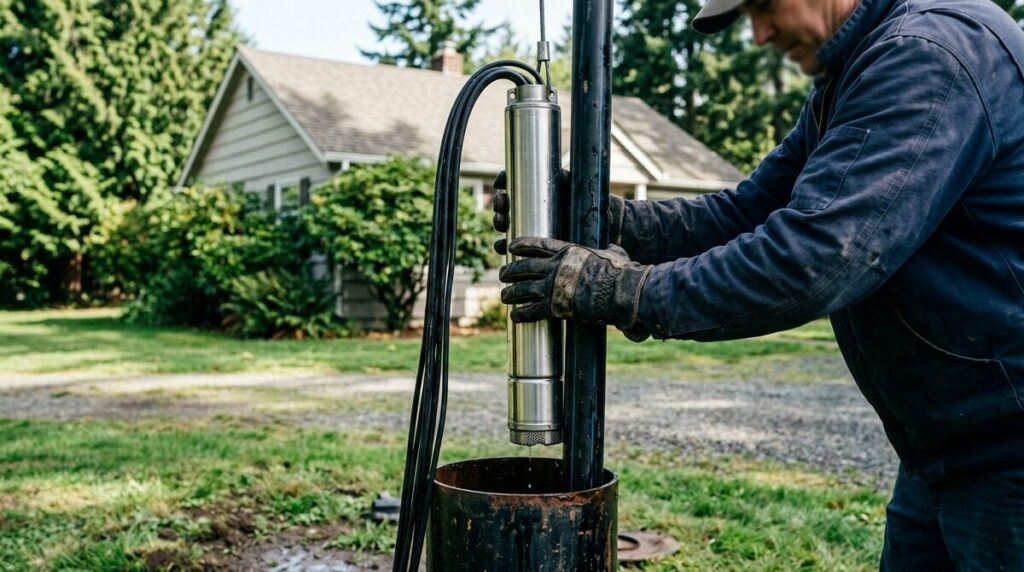
Pulling the old submersible pump
To reach a submersible pump, the crew disconnects the water line at the wellhead and lifts the drop pipe, cable, and pump. Flexible polyethylene pipe may come out as a continuous length. Rigid PVC or steel is normally handled in sections. The process must control the suspended weight and protect the casing, wiring, and workers.
Ask the provider to state the pump setting and removal equipment assumed in the quote, and to explain how any recovery work discovered during removal would be described, priced, and authorized.
The new pump, drop pipe, and electrical cable
A complete submersible estimate should identify the pump’s manufacturer, model, horsepower, flow rating, voltage, and warranty. It should also state whether the drop pipe and cable will be reused or replaced.
Ask the provider to identify which pipe and cable are assumed reusable, which are proposed for replacement, what inspection supports that proposal, and how a different condition found after removal would change the written scope.
Pitless adapter and wellhead fittings
The pitless adapter allows the buried water line to leave the casing without an open connection above the frost line. It does not have to be replaced with every pump. It may add substantial labor if it is leaking, corroded, seized, damaged during removal, or incompatible with the new arrangement.
The contractor should also inspect the well cap or sanitary seal. A damaged or poorly sealed cap can let insects, debris, and surface water enter the well.
Pressure tank
The pressure tank stores a limited amount of pressurized water and keeps the pump from starting every time a faucet opens. A failed or undersized tank can make a new pump switch on and off repeatedly. This is called short cycling, and it can shorten motor and control life.
Pressure tanks are frequently replaced during a pump job because the systems have often aged together and some installation labor overlaps. Replacement should still be based on condition, not habit. A sound tank with the correct capacity and air charge may remain in service. A tank that is waterlogged, leaking, badly corroded, unable to hold its air charge, or too small for the pump should be included in the work.
If pressure-tank work is proposed, ask for the exact tank, plumbing changes, labour, testing, taxes, and exclusions as separate items in the same currency as the rest of the quote.
Pressure switch, check valve, and torque arrestor
- Pressure switch: Starts and stops a conventional pump at set pressures, such as 40 and 60 psi. Burned contacts or a blocked sensing port can cause unreliable operation.
- Check valve: Allows water to move toward the house while preventing reverse flow. The correct number and location depend on the pump, well construction, and local requirements.
- Torque arrestor: A fitting used in some submersible installations to limit movement when the motor starts. It is not appropriate or required in every well, so installation should follow the pump manufacturer’s instructions and local practice.
- Cable guards or spacers: Help prevent wire from rubbing against the casing or pipe where the installation calls for them.
A responsible quote also explains system testing, cleanup, and any disinfection required after the well has been opened.
Compare diagnostic and replacement findings
Pump symptoms can overlap. Record what happened, when it began, and any readings or service history you have. Ask the person inspecting the system to document the tests performed before you compare a repair scope with a replacement scope.
| Observed issue | Information to provide | Inspection question | Written comparison detail |
|---|---|---|---|
| No water | When it began, breaker or control observations, prior work, and available records | What was tested, and what finding supports the proposed work? | Diagnostic scope, repair scope, replacement scope, and exclusions |
| Frequent starts and stops | Timing, water use, pressure readings, and equipment labels | Which measurements and components were checked? | Named work, parts, testing, and change authorization |
| Weak or changing pressure | Affected fixtures, timing, filters or treatment equipment, and prior readings | What test distinguishes the proposed options? | Diagnostic findings, suitable options, and itemized scope |
| Air at fixtures | Where and when it occurs, recent work, and water-level records | What was inspected or measured before recommending work? | Proposed work, assumptions, exclusions, and testing |
| Little or no delivered water | System behaviour, recent changes, well records, and equipment details | Which findings support repair, removal, or replacement? | Each suitable option, included labour, and approval steps |
| Noise, odour, or repeated shutdown | What was observed, when it occurs, and any control indications | Should the equipment remain off while it is inspected? | Diagnostic visit, proposed work, timing, and exclusions |
Request all amounts in USD for a U.S. project or CAD for a Canadian project. Separate diagnosis, repair, removal, replacement, travel, taxes, and work that needs later approval.
Service records and test results
Provide installation dates, equipment labels, warranties, service invoices, test readings, and earlier recommendations where available. Ask the provider to identify which current findings support each option.
Compare the suitable options in writing, including parts, labour, removal, testing, warranties, exclusions, quote date, validity period, and responsibility for changes.
What happens during a well pump replacement
- The system is diagnosed. The technician confirms the complaint, checks pressure behavior, examines accessible controls, and takes electrical measurements. When conditions allow, flow and water-level information are collected.
- The well record and existing equipment are reviewed. Useful details include total well depth, pump setting, casing diameter, static water level, pumping level, original well yield, pump model, wire arrangement, and pressure settings.
- The water and power connections are isolated. Electrical work and suspended equipment create serious hazards, particularly around wet or below-grade spaces.
- The old pump is removed. A submersible installation requires lifting the pump, pipe, and cable. An above-ground jet pump is disconnected, but its suction piping or down-well jet may also need attention.
- Retrieved components are inspected. The contractor looks for worn wire, leaking pipe, failed splices, corrosion, sediment damage, damaged valves, and clues that explain the failure.
- The replacement is installed. The pump is connected to correctly rated pipe and wire, then positioned at a depth that accounts for water levels, sediment clearance, and well construction.
- The pressure system is set up. The tank air charge, pressure switch, control box, relief protection, and constant-pressure controls where present are checked or adjusted.
- The system is tested. The crew confirms flow, operating pressure, shutoff behavior, electrical load, leaks, and pump cycling. Opening the well may also trigger disinfection and water-quality procedures under local rules.
An accessible shallow jet-pump change may be completed within part of a working day. A typical submersible replacement often takes several hours. Deep settings, rigid pipe, recovery work, excavation, poor access, or unexpected damage can extend the work through a full day or longer. A contractor should describe the expected schedule after inspecting the site, not promise a universal completion time over the phone.
Choosing the right replacement pump
The model number on the failed pump is useful, but matching it without checking the system can repeat an old sizing mistake. Pump selection is based on three connected requirements: how much water the home needs, how much water the well can supply, and how much pressure the pump must overcome.
Horsepower is only one part of pump capacity
Horsepower describes motor output; it does not tell you how many gallons the pump will deliver at your house. Two pumps with the same horsepower can have different internal stages and very different performance curves.
The contractor calculates the vertical lift from the pumping water level, the pressure required at the tank, and pressure lost through pipe and fittings. Together, these form the pump’s total workload, commonly called total dynamic head. The selected pump must deliver the target flow against that workload without operating at an unhealthy extreme of its performance range.
GPM must fit both the house and the well
Gallons per minute, abbreviated GPM, measures flow. Household demand depends on fixtures, occupancy, appliances, irrigation, livestock, and whether several uses occur at once. Well yield is the rate at which groundwater replenishes the well during pumping.
A pump should not be sized above the well’s dependable production merely because the house has high peak demand. A low-producing well may need controlled pumping and a separate storage arrangement so water can accumulate over time.
Wire size must match the motor and distance
Submersible cable is sized for the motor’s voltage and current, the length of the electrical run, starting demands, and permitted voltage drop. A long run may require larger wire even when the replacement pump has the same horsepower as the old one.
Some residential submersible motors use two powered conductors plus a ground and keep starting components inside the motor. Others use three powered conductors plus a ground and rely on an above-ground control box. Changing between these arrangements can affect cable, controls, and labor. Wire selection should follow the pump manufacturer’s tables and the applicable electrical code.
Planning for urgent pump-service calls
Before an urgent visit, ask what availability the provider can offer and whether dispatch, travel, after-hours labour, diagnosis, or temporary work are separate items.
Request a written USD or CAD quote that identifies the date and validity period, regular and after-hours charges, travel, parts, taxes, allowances, exclusions, and who must approve changes.
If the diagnosis shows a safe above-ground repair and the pump can remain in service temporarily, scheduling replacement during regular hours allows time to retrieve the well record, compare written scopes, and confirm parts. If the pump is running without water, repeatedly tripping protection, overheating, or producing contaminated water, continued operation can cause more damage or create a health concern.
Emergency planning is particularly important where the well serves livestock, medical needs, rental housing, fire protection, or buildings that cannot function without water. Stored drinking water addresses immediate consumption but not sanitation, heating equipment, or animals.
How to compare replacement quotes
Ask each contractor to put the following information in writing:
- Pump manufacturer, model, horsepower, voltage, and rated flow.
- Known or assumed pump setting and whether depth affects the quoted price.
- Whether pulling and disposal of the old pump are included.
- How much drop pipe and cable will be replaced.
- Whether the pressure tank, switch, control box, valves, and pitless adapter are included or optional.
- Charges for a hoist, service truck, excavation, permits, travel, or after-hours work.
- How additional work will be approved if concealed damage is found.
- Labor and equipment warranties, including exclusions for sand, lightning, dry-well conditions, or water chemistry.
- What testing, disinfection, cleanup, and documentation will be completed.
In the United States, pump-installer and well-contractor license requirements differ by state. In Canada, licensing or licence-class rules differ by province; Ontario, for example, has a specific well-technician licence class for pump installation. Insurance, electrical authorization, and local well regulations should also be confirmed where applicable.
Sources and methodology
For additional pricing information, see HomeGuide’s well-pump cost guide, Angi’s well-pump replacement data, and HomeAdvisor’s replacement-cost guide. Check each page’s publication date, geography, currency, and included scope before using it. The pages present different ranges and scopes, so their figures are not combined into a single current price range here.
Technical descriptions were checked against the Minnesota Department of Health Well Owner’s Handbook, which explains pump types, the 25-foot shallow-jet limitation, and the importance of well levels and peak demand; the Canada Mortgage and Housing Corporation well-water system guide, which describes how pressure tanks reduce pump cycling; and Penn State Extension’s well maintenance guidance, which identifies sediment abrasion and other causes of pump damage.
Pump-selection principles were checked against Goulds Water Technology’s residential pump technical manual. Canadian licensing context was checked against the Ontario well-technician licensing guide.
For a U.S. project, request quotes in USD; for a Canadian project, request quotes in CAD. Ask each provider to identify the pump-only and complete installed scopes, taxes, permits, excavation, recovery work, wiring, treatment, repairs, allowances, exclusions, quote date, validity period, and change responsibilities.
Related Guides
- Cost to Drill a Well on Vacant Land
- Well Inspection Cost
- How Deep Should a Well Be?
- How to Choose a Well Driller
- Do You Need a Permit to Drill a Well?
Browse all Drilling & Pump Costs guides →
Request Contact from Listed Well Drillers Near You
Tell us about your needs. A listed well driller in your area may contact you about the project. Free, no obligation.