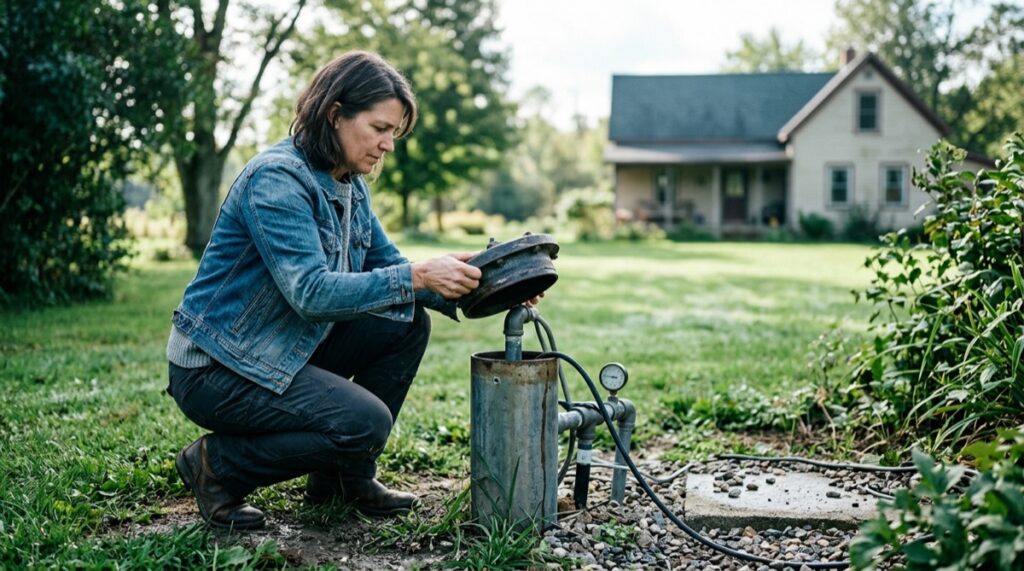
A positive test for coliform bacteria in well water does not necessarily mean the water has already made someone sick. It does mean the well’s protective barriers may have been breached. Soil, runoff, insects, plumbing work, or another source has given bacteria a route into the well or household water system.
Total coliform bacteria are indicator organisms. Most are not disease-causing. Laboratories test for them because they are common in soil, vegetation, surface water, and animal waste. Finding them warns that other organisms could have entered through the same route.
E. coli changes the situation. A positive E. coli result signals contamination by human or animal feces. The test does not identify every pathogen that may be present, so the water must be treated as unsafe. Stop using untreated well water for drinking, cooking, making ice, preparing infant formula, or brushing teeth.
How to read a coliform test result
Many laboratories report total coliform and E. coli as either present or absent in a 100-millilitre sample. For an untreated private drinking-water well, the desired result is absent for both. Any presence is a failed result that calls for action, although the urgency depends on which organism was found.
A presence-or-absence test answers a narrow question. It does not tell you when contamination began, where it entered, whether every glass of water contains bacteria, or which other organisms may be present. Those questions require confirmation, an inspection, and sometimes additional testing.
| Test result | What it means | Urgency | Immediate action | Next step |
|---|---|---|---|---|
| Total coliform absent E. coli absent |
No indicator bacteria were detected in this sample. | Routine | Keep the report and continue normal well protection. | Test on schedule and after floods, repairs, or changes in water quality. |
| Total coliform present E. coli absent |
The sample, plumbing, or well has been exposed to environmental bacteria. The well may be open to surface contamination. | Prompt attention, but generally not the same emergency as E. coli | Arrange a confirmation sample. Consider safe alternative water while waiting, especially for people at higher risk of severe illness. | Inspect the well, disinfect when advised, and retest. |
| Total coliform present E. coli present |
Human or animal fecal contamination has reached the sampled water. | Urgent health risk | Stop consuming untreated well water immediately. Use bottled or properly boiled water. | Contact public health, inspect and disinfect the system, correct the source, and obtain clean follow-up tests. |
| Total coliform absent E. coli present |
An unusual result that still must be treated as fecal contamination. Reporting or sampling details may need review. | Urgent health risk | Stop consuming untreated water. | Call the laboratory and local health authority, then collect a confirmation sample as directed. |
Total coliform without E. coli
This result is concerning because clean groundwater should not acquire environmental bacteria on its way to your tap. The cause could be a contaminated sample bottle, bacteria inside a faucet, recent plumbing work, or a defect at the well. A confirmation test helps separate a sampling problem from contamination within the water system.
Do not ignore the result because E. coli was absent. The test has revealed a weakness. Heavy rain next month could carry a more dangerous contaminant through the same opening.
Total coliform with E. coli
This combination requires immediate precautions. E. coli is associated with feces, and feces can carry organisms such as Campylobacter, Salmonella, Giardia, Cryptosporidium, and enteric viruses. A standard coliform test does not rule those organisms in or out.
Arrange a confirmation sample, but do not keep drinking the water while waiting. The protective action begins with the first positive E. coli result.
How bacteria get into a private well
A drilled well relies on several defenses. The cap closes the top. The casing forms the rigid wall. Grout seals the space between the casing and the drilled hole so shallow water cannot run down the outside. Proper grading sends rain and snowmelt away from the wellhead. Adequate distance from septic systems and animal areas reduces the contamination load nearby.
A failure in any one of those defenses can create a route into the water supply.
Damaged cap, casing, or grout
A loose cap can admit insects, dirt, and water. Cracks, corrosion, failed seals around wires, or an unscreened vent create other openings. Damage may be small enough to escape notice from the lawn yet large enough to admit runoff during a storm.
Grout is the sealing material placed around the outside of the casing. Missing, poorly installed, or deteriorated grout allows shallow water to travel downward beside the casing. Chlorinating the inside of the well will not rebuild that seal.
Septic system location or failure
Wells need a regulated separation distance, often called a setback, from septic tanks, absorption fields, manure storage, and other contamination sources. Required distances vary by state, province, territory, soil conditions, and well type. A distance that meets an old rule may still provide weak protection if groundwater flows from the septic field toward the well.
A failing or overloaded septic system raises the risk. Warning signs include sewage surfacing in the yard, slow drains, backups, persistent wet ground around the field, or strong sewage odours. The absence of those signs does not prove the system is functioning properly.
Floodwater and heavy runoff
Floodwater carries soil, sewage, manure, fuel, and debris. If it rises over the wellhead, the well should be considered contaminated even before a test result arrives. Intense rain and spring snowmelt can also collect around a casing that sits too low or stands in a depression.
Flooding may introduce chemical contamination as well as germs. Boiling kills many microorganisms, but it does not remove fuel, pesticides, metals, or other chemicals. When chemical contamination is possible, use a different water source until the appropriate tests and local guidance establish what is safe.
Construction, pump, or plumbing work
New pumps, pressure tanks, water lines, filters, and repaired plumbing can introduce bacteria from hands, tools, soil, or replacement parts. A new well can also test positive if it was not adequately disinfected after construction.
A positive result after household plumbing work may originate inside the building rather than underground. Comparing a properly collected sample near the pressure tank with a sample from a kitchen tap can help a qualified contractor locate the problem.
Animals near the wellhead
Livestock manure, pet waste, wildlife droppings, rodents, and insects all add bacteria near the well. Animals do not need to fall into the casing to cause contamination. Rain can wash waste toward a poorly sealed cap or carry it downward through disturbed soil around the well.
Poor original construction
Some older wells were built before current construction rules. They may be shallow, located in pits, finished below grade, fitted with non-sanitary caps, or missing an effective grout seal. Dug and driven wells are often more exposed to shallow groundwater than modern drilled wells. Repeated positive tests can be evidence that the well’s basic design cannot reliably exclude surface influence.
What to do after a positive test
Use a laboratory accredited or certified for drinking-water analysis. In the United States, your state or local health department can identify certified laboratories. In Canada, use an accredited laboratory or the service recommended by your provincial, territorial, or local public health authority.
The sequence below is a working plan for a private household well. Local health instructions take priority because testing protocols and well regulations vary. These are decision steps, not permission to keep drinking after an E. coli result. Water restrictions begin immediately when E. coli is detected.
| Step | Action | Timeline | Costs to confirm locally | Purpose |
|---|---|---|---|---|
| 1 | Collect a confirmation sample using the laboratory’s bottle and instructions. | As soon as the laboratory can accept it | Usually a laboratory fee; some public health programs offer testing at reduced cost or no charge. Availability varies by region. | Rule out contamination introduced during sampling and confirm which bacteria are present. |
| 2 | Use bottled, properly boiled, or another confirmed-safe water supply when required. | Immediately for E. coli; consider during confirmation of total coliform, based on local advice and household health risks | Ongoing household expense that depends on consumption, delivery, and how long restrictions remain in place | Prevent exposure while the cause is investigated. |
| 3 | Inspect the visible wellhead and shock chlorinate the well and plumbing as directed. | After confirmation or sooner when public health guidance calls for immediate disinfection | Ask for a quote that separates service, sampling, travel and any follow-up work. Do not choose a procedure on price alone. | Kill susceptible bacteria currently in the well and household water system. |
| 4 | Retest after chlorine has been fully flushed and the required waiting period has passed. | Commonly about 1 to 2 weeks after treatment; follow the local protocol if it specifies different timing or multiple samples | Another laboratory fee, varying by laboratory and region | Check whether bacteria remain after disinfection. |
| 5 | If the result remains positive, have the well, nearby land, and plumbing investigated. Repair the entry route or choose an appropriate long-term water solution. | Promptly after the repeat positive | Highly variable. A cap replacement and a casing or grout repair differ greatly in labour, equipment, and regional pricing. | Stop recontamination rather than repeatedly treating its result. |
Step 1: Retest correctly
Sampling errors account for some positive results. The inside of the sterile bottle or cap may have been touched. A dirty faucet aerator, swivel tap, hose, filter, or treatment device may also contaminate the sample. Delayed delivery or improper temperature control can make a sample unusable.
Follow the laboratory’s directions exactly. Use its sterile bottle. Select the requested sampling point, remove attachments if instructed, disinfect or flush the faucet as directed, and keep fingers away from the bottle mouth and cap interior. Deliver the sample within the stated time and temperature limits.
If the original report found E. coli, confirmation is still valuable, but it does not postpone the water restriction.
Step 2: Use safe water
For a confirmed or suspected microbial hazard, bottled water from a reliable source is the clearest temporary option. Clear water can also be brought to a rolling boil for one minute. The U.S. Centers for Disease Control and Prevention advises boiling for three minutes at elevations above 6,500 feet. Let the water cool in a clean, covered container.
Use safe water for drinking, cooking, ice, beverages, washing produce, infant formula, and brushing teeth. Do not assume a refrigerator filter, pitcher filter, water softener, or ordinary carbon cartridge removes bacteria. Most are not designed or certified for that job.
Step 3: Shock chlorinate the system
Shock chlorination exposes the well and household plumbing to a high chlorine concentration for a controlled period. The correct chlorine amount depends on the well diameter, the depth of water in the casing, the product strength, and the applicable local procedure. A universal number of cups cannot account for those differences.
Chlorine can injure skin and eyes, create harmful gas if mixed with other cleaners, damage treatment equipment, and accelerate corrosion. Removing a well cap may expose live wiring. If the well record is missing, the cap is difficult to access, electrical parts are exposed, or the construction is unfamiliar, hire a qualified contractor. Look for the appropriate contractor’s license in the United States or licence or registration required in your Canadian province or territory.
Step 4: Wait, then retest
Testing too soon can produce a misleading clean result if chlorine remains in the water. After the system has been flushed according to the approved procedure, wait for the interval required by your health authority or laboratory. A common follow-up window is roughly 10 to 14 days. Some authorities call for an earlier first sample followed by additional samples over several weeks.
One clean result is encouraging. A second clean result after more time provides stronger evidence that bacteria are not returning. Testing again after a few months can reveal seasonal or chronic recontamination.
Step 5: Investigate a repeat positive
A second positive result is evidence, not bad luck. Repeating chlorination without inspecting the well can create a cycle of temporary clean tests followed by another failure after rain, snowmelt, or plumbing use.
A well contractor may inspect the cap, vent, seals, casing, pitless adapter, wiring openings, casing height, drainage, and evidence of flooding. Further work can include a downhole camera inspection, pressure or integrity checks, well cleaning, or an assessment of the grout seal and nearby contamination sources. A septic professional may need to assess the wastewater system separately.
What shock chlorination can and cannot do
Shock chlorination can kill many bacteria living in the well, pressure system, water heater, and connected plumbing when the concentration, contact time, and circulation are adequate. It is commonly used after construction, pump service, flooding, or a confirmed bacterial result.
It cannot seal a cracked casing, raise a buried wellhead, replace missing grout, move a septic field, redirect runoff, or make a vulnerable shallow aquifer behave like a protected groundwater source. It also may not fully remove established biofilm, the layer of slime in which microorganisms can shelter on pipes and well components.
A clean test after one treatment proves that the sampled water was clean at that moment. It does not prove the entry route has closed. Picture a well cap with a failed gasket. Chlorine may clear the bacteria already inside, while the next hard rain delivers a new load through the same gap.
This is why follow-up testing matters. The aim is sustained protection, not a single favourable laboratory report.
When shock chlorination is not enough
The well has a structural defect
A broken seal, corroded casing, low wellhead, failed cap, or missing grout requires physical correction. Disinfection normally follows the repair because construction work can introduce more bacteria. If a defect cannot be repaired reliably, replacing or properly decommissioning the well may need consideration.
Bacteria keep returning
A positive test every spring, after heavy rain, or several weeks after chlorination points toward chronic recontamination. The pattern itself helps locate the cause. Rain-related failures suggest surface entry. A result that changes between a raw-water tap and a kitchen faucet may point toward plumbing or treatment equipment.
Keep dates, weather conditions, laboratory reports, repair records, and treatment details. That record gives a contractor more than a series of isolated test results.
The source is inherently vulnerable
Shallow wells, dug wells, wells in pits, and wells close to septic systems or livestock areas may face risks that maintenance alone cannot remove. Continuous treatment can reduce microbial exposure, but it does not turn poor siting or construction into a sound well. In some cases, a new well in a better location and aquifer offers the more dependable long-term answer.
Long-term protection after a positive test
Ultraviolet disinfection
An ultraviolet system exposes flowing water to light that inactivates microorganisms. A whole-house unit is usually placed where water enters the building. For microbial protection, look for a system certified to NSF/ANSI 55 Class A, sized for the home’s peak flow.
UV requires clear water. Sediment, colour, iron, manganese, hardness scale, or cloudiness can shield organisms from the light. Pretreatment must be based on a proper water analysis. The lamp and protective sleeve require scheduled service, and an alarm or automatic shutoff should warn when adequate treatment is unavailable.
UV leaves no disinfectant behind in the plumbing. It also stops treating water during a power failure unless backup power is provided. Those limits belong in the household’s water-safety plan.
Continuous chlorination
A chlorinator meters chlorine into the water as it enters the home, usually with a tank that provides enough contact time before use. Unlike UV, chlorine can leave a measurable residual that continues to suppress bacteria in downstream plumbing.
The dose has to match the water chemistry, flow, and contamination load. Cloudy water and organic material consume chlorine. Excess chlorine creates taste, odour, corrosion, and by-product concerns. Pumps, solution tanks, contact tanks, and residual levels all require maintenance and monitoring. This is equipment to manage, not an install-and-forget appliance.
Testing schedule
At minimum, U.S. guidance calls for annual testing of private wells for total coliform bacteria. Health Canada advises testing for E. coli and total coliforms every six months or more often, subject to provincial and territorial direction. Spring thaw and periods after heavy rainfall are valuable testing times because they challenge the well’s defenses.
Test outside the routine schedule when:
- Floodwater or heavy runoff reaches the well area.
- The pump, pressure system, well cap, casing, or household plumbing is repaired.
- A septic failure occurs nearby.
- The water’s taste, smell, colour, or clarity changes.
- Land disturbance, excavation, or manure spreading occurs near the well.
- Someone in the household develops an unexplained gastrointestinal illness.
- A pregnant person, infant, older adult, or person with a weakened immune system begins using the water.
Wellhead maintenance
Inspect the wellhead several times a year and after severe weather. The casing should stand above the surrounding ground and outside any place where water pools. Soil should slope away from it. The sanitary cap should be secure, vents should be screened, and openings around wires or pipes should remain sealed.
Keep animal waste, fertilizer, pesticides, fuel, and stored chemicals away from the well. Do not tie animals to the casing, bury it under landscaping, strike it with mowing equipment, or build over it. Maintain the septic system and know where the tank and absorption field lie in relation to the well.
Have unexplained corrosion, movement, cracks, missing bolts, damaged wiring, or a sunken wellhead inspected by a qualified well professional.
What coliform bacteria do to human health
Most total coliform bacteria do not cause illness. Their value lies in what their presence reveals: water from the surface, soil, plumbing contamination, or waste has reached a place intended to remain protected.
E. coli is part of the broader coliform group. Many E. coli strains live harmlessly in human and animal intestines, while certain strains can cause severe disease. In a water test, the main concern extends beyond the particular strain detected. Its presence shows that fecal material has entered the water, bringing the possibility of other bacteria, viruses, and parasites.
Waterborne illness may cause diarrhea, vomiting, nausea, stomach cramps, or fever. Some infections can lead to dehydration, kidney damage, or other severe complications. Infants, older adults, pregnant people, and anyone with a weakened immune system may face greater consequences.
Clear, cold water with no unusual taste can still contain pathogens. Appearance and smell cannot establish microbial safety. Laboratory testing provides the evidence.
If anyone develops gastrointestinal symptoms after using water from a well with a positive result, contact a healthcare professional and the local public health authority. Tell them about the well-water result so it can be considered during the medical assessment.
Sources and methodology
This article was developed from current public-health and well-protection guidance for private residential wells in the United States and Canada. Recommendations were compared across federal, state, and provincial sources because sampling schedules, contractor requirements, and disinfection procedures differ by jurisdiction.
- U.S. Centers for Disease Control and Prevention: Guidelines for Testing Well Water
- U.S. Centers for Disease Control and Prevention: Household Water Treatment
- U.S. Environmental Protection Agency: Protect Your Home’s Water
- U.S. Environmental Protection Agency: Septic Systems and Drinking Water
- Health Canada: Test Your Well Water
- Health Canada: Treat Your Well Water
- Minnesota Department of Health: Well Disinfection
- Ontario Ministry of the Environment, Conservation and Parks: Well Disinfection Technical Bulletin
Local public health instructions and well-construction rules should govern an individual property. They account for regional geology, flood conditions, approved laboratory methods, and the licensing or licencing system that applies where the well is located.