A fixed depth chart cannot choose between a jet pump and a submersible pump. Ask a qualified installer to document the well record, measured pumping water level, tested yield, casing and existing piping, required flow and pressure, elevation and pipe assumptions, electrical supply, and performance data used for the exact pump and configuration.
How the two systems differ
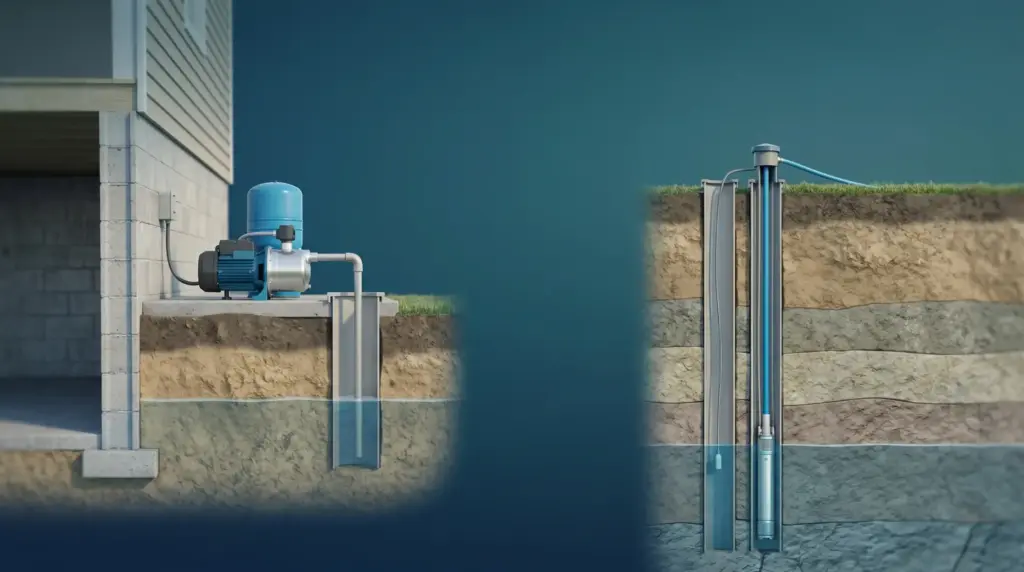
A jet-pump system has its main pump above the well. In a shallow-well arrangement, the jet assembly is at the pump and a suction pipe reaches the water. In a deep-well jet arrangement, the jet assembly is placed in the well and drive water circulates through the in-well assembly. Xylem’s technical manual explains that the jet creates a low-pressure area and atmospheric pressure moves water into it.
A submersible system places the motor and pump assembly in the well and sends water upward through the drop pipe. Ontario’s well-equipment guide shows jet and submersible installations in several well types and cautions that its diagrams do not cover every circumstance. The selected equipment still has to fit the actual well and follow its manufacturer’s instructions.
Why there is no universal depth cutoff
Do not use a universal depth cutoff. Ask the installer to show how the jet location, measured pumping level, elevation, pipe losses, required pressure, and exact pump configuration were applied to the manufacturer’s performance data. Require the same model-specific check for a submersible proposal.
Penn State’s pump-test guidance records water level while the well is being pumped. Static water level records where the water rests before pumping. Drawdown is the change as pumping continues. Total well depth remains useful for checking pump setting and available water column, but it does not replace the pumping-level measurement.
Gather the inputs before comparing pumps
Penn State Extension describes pump testing as the way to learn how much water a well can supply on a sustained basis and records water levels during pumping. Ask for the well completion record and pump-test results. If they are missing or conditions have changed, ask a well professional what measurements are needed rather than estimating from neighbouring wells.
Ask the installer to record these proposal inputs:
- Well construction: total depth, inside casing diameter, liner or screen details, obstructions, pitless adapter, and existing pipe arrangement
- Water levels: static level, pumping level at the tested flow, drawdown, seasonal concerns, and current pump setting
- Supply: tested well yield and any low-water history
- Demand: the fixtures or uses that may run together, target pressure, treatment-equipment flow needs, storage, and any outdoor use
- Delivery path: elevation to the building, pipe length and diameter, fittings, and pressure-tank arrangement
- Power and controls: available electrical supply, motor and control compatibility, existing protection devices, and local electrical requirements
The well-flow guide gives context for discussing yield, while the well-depth guide explains why total depth and water level are different records.
Questions for the installer
The table is a request for proposal details; it does not predict which system will perform better.
| Question | What to verify for a jet system | What to verify for a submersible system |
|---|---|---|
| Does it fit the well? | Jet location, one- or two-pipe arrangement, foot valve or in-well assembly, and suction-line condition | Pump outside diameter, casing clearance, pump setting, drop pipe, cable, and removal access |
| Can it meet demand? | Exact pump/jet curve at calculated lift and required pressure | Exact pump curve at calculated total head and required flow |
| How is it serviced? | Access to the above-ground pump plus access to any in-well jet components | Method and equipment needed to pull and reinstall the in-well assembly |
| What can interrupt operation? | Priming, air leaks, suction piping, freezing protection, and controls | Water level around the pump, motor cooling, cable and splice, check valves, and controls |
These are inspection questions, not promises that one type is always quieter, cheaper, more efficient, or longer-lived. Those comparisons depend on the selected models, system design, installation, electricity use, access, and service scope.
Match the pump to the well’s supply
A stronger pump does not increase the aquifer’s sustainable yield. Penn State defines well yield around the rate that can be pumped without lowering the water below the pump intake. If peak demand exceeds the well’s supply, the solution may involve demand management, storage, controls, or a different water-supply plan; simply increasing horsepower can create a new operating problem.
Ask how the proposed design prevents operation when the water level is too low and how it limits frequent starts. The answer should identify the specific controls and pressure-tank assumptions used in the proposal, not rely on a general claim that the pump includes protection.
Use the exact performance curve and manual
For each proposal, request the manufacturer, pump model, motor model, jet or impeller configuration, and the curve or table used for selection. Ask the installer to mark the proposed operating point and list the assumptions for pumping level, elevation, pipe loss, tank pressure, and required flow. Xylem’s manual relates pump selection to capacity, total head, and the system’s resistance; the selected model’s instructions set its actual limits.
For a submersible proposal, also request the application, installation, and maintenance instructions for the exact motor and controls. Franklin Electric publishes its AIM resources for these topics. Confirm voltage, phase, cable, control box or drive, motor cooling conditions, and protection requirements against the selected documents.
Compare complete quotes, not shelf prices
Ask each bidder to identify what the price includes: pump and motor; compatible jet assembly where applicable; removal of existing equipment; pipe, cable, splice, fittings, valves, tank and controls; well access or lifting equipment; start-up measurements; water sampling or disinfection if part of the work; permits or notices required locally; travel; and warranty labour. This exposes scope differences without relying on a national price range.
Ask what will remain from the old system and why it is compatible. A replacement that reuses piping, wiring, a pressure tank, controls, or an in-well assembly should state how those parts were assessed. Also ask for the final pump setting, operating readings, and model records after installation.
A conservative decision sequence
- Collect the well and existing-equipment records.
- Confirm pumping level and sustainable yield at a documented test flow.
- Define simultaneous demand and target pressure.
- Confirm casing, piping, access, power, and control constraints.
- Compare exact jet and submersible options at the calculated operating point.
- Review installation, protection, maintenance, and full quote scope.
- Keep the selected curve, manuals, settings, and start-up readings with the well record.
This process may identify a jet system, a submersible system, or a need to address the well or storage before selecting either. It provides a defensible basis for the choice without turning one manufacturer’s limit or a rule of thumb into a universal answer.
Primary sources
- Ontario: Water Supply Wells — Equipment Installation (Canada; accessed September 7, 2026)
- Penn State Extension: Before You Drill a Well (United States; accessed September 7, 2026)
- Penn State Extension: Using Low-Yielding Wells (United States; accessed September 7, 2026)
- Xylem Goulds Water Technology: Water Products Technical Manual (manufacturer; accessed September 7, 2026)
- Franklin Electric: Application, Installation and Maintenance resources (manufacturer; accessed September 7, 2026)