Jet Pump vs. Submersible Pump: How to Know Which One Your Well Needs

24 Jun 2026 16 min read No comments Problems & Repairs
Featured image

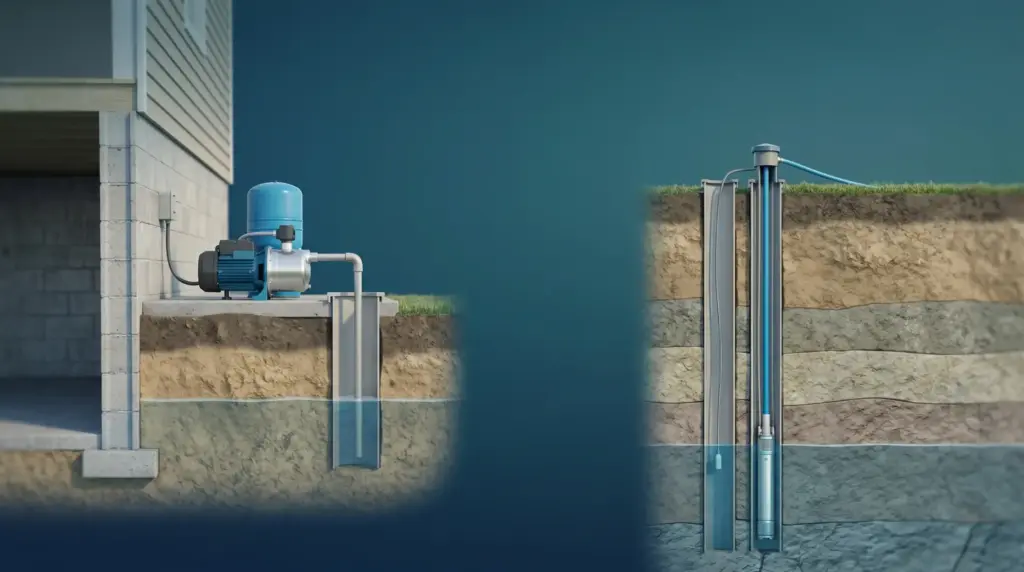
Whether you need a jet pump or a submersible pump depends mostly on how far the pump must move water vertically. Jet pumps sit above ground and can lift water from shallow sources. A shallow-well model generally serves water levels within about 25 feet of the pump, while a deep-well jet system may work at roughly 70 to 90 feet. Beyond that range, a submersible pump inside the well is the practical option.

Most modern residential drilled wells use submersible pumps. They push water upward instead of trying to pull it by suction, so they are more efficient, quieter, and capable of serving wells hundreds of feet deep. Jet pumps remain useful for shallow wells, narrow well casings, cottages, and older systems where above-ground access is valuable.

There is one important qualification: the total depth of the well is not the same as the pumping depth. A 150-foot well might have water standing only 15 feet below ground. What matters to a jet pump is how far the water level falls while the pump is running, including pressure requirements and resistance in the piping.

Key takeaway: For water less than about 25 feet below the pump, a shallow-well jet pump can be a practical choice. Between roughly 25 and 90 feet, either a deep-well jet system or a properly sized submersible may work, although the submersible is usually the stronger long-term choice. If the pumping water level is deeper than about 90 feet, use a submersible pump.

A jet pump pulls water from above the well

A jet pump normally sits in a basement, utility room, insulated pump house, or another weather-protected location near the well. Some older installations place the pump in a below-grade well pit. Those pits can create sanitary, flooding, and confined-space hazards, and many jurisdictions no longer permit them for new installations.

Inside the pump, a spinning impeller moves water through a narrowed passage called a venturi. The venturi speeds up the water and creates a low-pressure area. Atmospheric pressure acting on the water source then helps move water up the suction pipe toward the pump.

This distinction matters because a pump does not literally pull water upward with unlimited force. Atmospheric pressure can support only a limited column of water. Pipe friction, elevation, air leaks, altitude, water temperature, and the pressure required inside the house reduce the usable lift further.

Shallow-well jet pumps use one pipe

A shallow-well jet pump has its jet assembly at the pump. One suction pipe runs from the pump to the water source, usually ending at a foot valve that keeps water from draining back into the well.

These pumps are intended for a maximum suction lift of about 25 feet under favorable conditions. That measurement is taken from the pump to the water level while pumping, not automatically to the bottom of the well. Manufacturers may recommend a lower practical limit when the pipe is long, the site is at high elevation, or the water level changes substantially through the year.

A shallow-well jet pump may be suitable for:

  • A shallow driven well with compatible casing and screen
  • A properly protected dug or bored well
  • A cistern or storage tank
  • A seasonal property with a shallow, dependable water source
  • An existing one-pipe system that has performed reliably and still matches the household demand

Deep-well jet pumps use two water paths

A deep-well jet pump moves the jet assembly down into the well. One pipe sends pressurized water downward to operate the jet, while another path carries water back toward the surface. A conventional twin-pipe arrangement uses two separate pipes. A packer system can create the return path within a narrow casing.

Moving the jet into the well allows the system to work beyond the shallow-well suction limit. Depending on the pump, jet assembly, pipe size, elevation, and required household pressure, practical residential service is commonly limited to approximately 70 to 90 feet of lift.

The trade-off is that some of the water brought to the surface must be recirculated down the well to operate the jet. That consumes energy without adding an equal amount of usable water at the fixtures. Capacity also falls as lift and discharge pressure increase.

Where a jet pump earns its place

The strongest advantage of a jet pump is access. The motor and main pump assembly are above ground, so a technician can inspect or replace them without pulling a pump from deep inside the well. This can reduce labor when the problem is confined to the above-ground equipment.

Jet pumps also fit situations where the casing is too narrow for an available submersible pump. This is especially relevant to older two-inch wells equipped with packer-style jet systems.

The disadvantages become more noticeable in a full-time household. Jet pumps are usually louder because the motor operates inside or near the building. They are less energy-efficient than a comparable submersible system, have firm lift limits, and can lose their prime.

Prime is the water that must fill the pump body and suction piping before the pump can create the required low pressure. A leaking foot valve, loose fitting, cracked suction pipe, or failed seal can admit air or let that water drain away. The motor may then run without delivering water, potentially damaging the pump.

Watch out: Repeatedly adding water to reprime a jet pump addresses the symptom, not the reason the prime was lost. Air entering a suction line can also reduce pressure and make the pump run longer. The piping, foot valve, fittings, and water level should be checked before the motor is blamed.

A submersible pump pushes water from inside the well

A submersible pump combines a sealed electric motor with a stack of pumping stages. The complete assembly is lowered into the well and kept underwater during operation. Water enters through an intake, passes through the stages, and is pushed upward through a drop pipe to the pressure tank and household plumbing.

Pushing water is far more efficient than trying to lift it by suction. A correctly selected residential submersible can serve shallow wells as well as wells 500 feet deep or more, provided the model has enough pressure-producing capacity for the installation. “Works at any depth” does not mean one pump fits every well; deeper settings require models with greater total head, meaning greater ability to overcome vertical lift and pressure.

The motor is sealed from the well water, while the surrounding water carries away heat. Proper placement and water movement past the motor are therefore important. The pump must remain submerged during normal operation, but it should not be set carelessly against the bottom where sediment may be drawn into the intake.

Why submersible pumps dominate drilled wells

A submersible pump has no suction line to lose prime. Once properly installed, it remains flooded with water. Because the motor is underground, homeowners hear little more than the pressure switch or water entering the pressure tank.

Other advantages include:

  • Better electrical efficiency for the same useful water delivery
  • Stable performance across a wider range of well depths
  • Higher pressure capability when correctly selected
  • No above-ground pump body that must be kept warm in freezing weather
  • Fewer problems caused by suction-side air leaks
  • Long service life when sizing, cooling, water quality, and electrical conditions are favorable

The main disadvantage appears when service is required. The pump, drop pipe, safety cable where used, and electrical wiring may need to be pulled from the well. A deep installation can require specialized lifting equipment and more than one technician. If the drop pipe, wire, check valve, or fittings are deteriorated, replacing the pump alone may not produce a dependable repair.

Casing diameter can also decide the issue. Four-inch submersible pumps fit many modern drilled wells, and narrower models are available, but an older casing may not provide enough room. Internal obstructions, damaged casing, mineral buildup, or an existing packer assembly can further restrict access.

Jet pump vs. submersible pump comparison

Feature Jet pump Submersible pump
Depth capability About 25 feet for shallow-well models; commonly about 70–90 feet for deep-well systems Suitable from shallow settings to 500 feet or more with the correct model
Efficiency Lower, especially when a deep-well jet recirculates water Higher because it pushes water upward
Noise Motor and water movement are audible above ground Very quiet inside the home
Maintenance access Main pump is readily accessible, although an in-well jet or foot valve may still require pulling pipe Pump must be pulled from the well for direct service
Typical service life Often around 8–15 years Often around 10–20 years
Pump-only cost Usually lower; broad U.S. retail ranges are roughly $200–$1,200 depending on type and power Often roughly $400–$2,000 or more in the U.S., depending on construction, power, and pressure capability
Installed cost Often roughly $800–$2,500 in the U.S. for replacement work Often roughly $1,500–$5,000 or more in the U.S.; deep or difficult installations can exceed this range
Reliability concerns Air leaks, loss of prime, foot-valve failure, freezing, and reduced output as lift increases Dry running, electrical damage, sediment, corrosion, short cycling, and costly removal
Flow rate Adequate for many homes when shallow; output falls noticeably with greater lift Wide selection of flow and pressure ratings for household and higher-demand uses
Priming Required; the system must remain airtight and water-filled No manual priming under normal operation

The service-life figures are planning ranges, not promises or warranty periods. A correctly sized pump with a healthy pressure tank may outlast them. A pump that short-cycles, runs dry, handles abrasive sand, or operates under poor electrical conditions may fail much sooner.

Which pump does your well need?

Use the following decision path as a screening tool. Final pump selection should be based on the well record, measured water levels, tested well yield, required flow, pipe length, elevation, casing diameter, electrical supply, and desired household pressure.

  1. Find the well record. Look for total depth, casing diameter, static water level, pumping water level, well yield, and the existing pump setting.
  2. Use the pumping water level. Static level is where the water rests before pumping. Pumping level is where it settles while water is being withdrawn. The difference is called drawdown.
  3. Measure from the pump’s location. A jet pump in a basement below ground level has less vertical lift than one in an above-ground pump house.
  4. Confirm the casing can accept the equipment. Nominal casing size does not guarantee that a pump can pass through every fitting, liner, mineral deposit, or damaged section.
  5. Match the pump to the well’s production. Installing a pump that can move 15 gallons per minute does not make a five-gallon-per-minute well produce more groundwater.
  6. Calculate the actual demand. Household fixtures, irrigation, livestock watering, treatment equipment, and fire-protection storage can change the required flow and pressure.

If the pumping level is less than 25 feet

A shallow-well jet pump is viable. It may be the economical choice for an existing one-pipe installation, a seasonal property, or a shallow source where above-ground access matters.

A submersible can still be used if the well construction and diameter permit it. For a full-time home, its quieter operation, lower energy use, and resistance to loss-of-prime problems may justify the higher installation cost.

If the pumping level is between 25 and 90 feet

A deep-well jet system may work, but its performance must be checked at the actual lift and required pressure. Do not choose it solely because the product label says “deep well.” Its usable flow may be substantially lower near the far end of its depth range.

A submersible is usually the better choice in a compatible drilled well. It provides more room for seasonal water-level changes and generally uses less electricity to deliver the same amount of water.

If the pumping level is deeper than 90 feet

Use a properly selected submersible pump. The model must be capable of overcoming the vertical lift plus the pressure desired at the tank, friction through the pipe and fittings, and any additional elevation between the well and the building.

If the casing is too narrow for a submersible

A jet pump may be the only practical pump type for the existing well. Narrow driven wells and older packer systems often fall into this category. Narrow submersibles do exist, but their outside diameter, power requirements, service access, cooling needs, and compatibility with the casing must all be confirmed.

Watch out: A pump should not be selected from horsepower alone. Two pumps with the same horsepower can produce very different flow and pressure. The pump curve—the manufacturer’s chart showing output at different lifts—is the document that determines whether a model fits the well.

What the two systems really cost

Well-pump pricing has wider variation than appliance pricing. The pump itself may be only part of the invoice. Depth, access, drop-pipe material, wiring, control equipment, pressure tank condition, local labor rates, emergency timing, freezing protection, and permit requirements all affect the installed price.

The broad cost ranges in the table are planning figures in U.S. dollars, not national price guarantees. Canadian homeowners should request quotes in Canadian dollars rather than converting a U.S. estimate mechanically. Equipment distribution, travel distances, provincial requirements, taxes, and labor rates differ considerably across Canada.

Purchase price

A shallow-well jet pump is usually the least expensive unit. A deep-well jet installation adds an ejector or packer assembly, pressure-control components, and additional piping. That can narrow the price difference between a jet system and an entry-level submersible.

Submersible prices cover a large range. Stainless-steel construction, higher pressure capability, greater horsepower, premium motors, built-in protection, and variable-speed controls all raise the equipment cost. The cheapest pump that physically fits is not necessarily the lowest-cost choice over its service life.

Installation cost

Replacing an accessible shallow-well jet pump with a compatible model usually involves less lifting equipment and fewer labor hours than pulling a deep submersible. However, a jet-pump job can become expensive if the buried suction pipe leaks or the in-well foot valve, packer, or jet assembly must be removed.

A submersible replacement requires lifting the pump and its attached pipe and wire. Greater setting depth means more material to handle. Old steel pipe, a stuck pitless adapter, restricted vehicle access, damaged casing, or a pump lodged in the well can substantially increase the work.

A complete quote should identify whether it includes:

  • The pump and motor
  • Removal and disposal of the old pump
  • Drop pipe, electrical cable, splice kit, fittings, and check valve
  • Control box or variable-speed controller where required
  • Pressure-switch and pressure-tank testing
  • Well disinfection and any required water sampling
  • Permits, travel, lifting equipment, and emergency charges

Operating cost

A submersible normally uses less electricity per gallon delivered because it is pushing water rather than operating a suction system. The difference is most noticeable when comparing it with a deep-well jet pump that must recirculate water down the well.

Energy use still depends on correct sizing. An oversized pump may start and stop too frequently. This is called short cycling, and it increases motor wear while wasting energy. A failed or undersized pressure tank is a common cause.

Replacement cost

Jet pumps usually offer lower labor costs when the failure is in the accessible pump assembly. Submersible replacement costs include pulling and reinstalling the equipment. That service cost should be included when comparing long-term ownership, especially for a deep well.

On the other hand, a submersible’s better efficiency and lack of priming problems may offset part of its higher service cost. The sensible comparison is the complete system over time, not the shelf price of two pump motors.

How the choice changes in common well situations

Replacing an existing jet pump

Do not assume that replacing a jet pump with another jet pump is automatically the right answer. First determine why the current system failed or became unsatisfactory. A worn motor, leaking suction line, falling seasonal water level, failed foot valve, inadequate well yield, and waterlogged pressure tank require different responses.

Converting to a submersible often makes sense when the casing is wide enough, the well is structurally sound, the home is occupied year-round, and the owner wants quieter and more efficient operation. The conversion may require new wiring, drop pipe, a pitless adapter, excavation, pressure controls, and changes at the pressure tank.

Keeping a jet pump may be reasonable when the water remains shallow, the casing cannot accept a submersible, the existing piping is sound, and the system already meets demand. Changing pump type does not improve the well’s natural yield or correct poor water quality.

Old dug or driven wells

A dug well is usually shallow and wide, while a driven well commonly uses small-diameter pipe. A jet pump may be the only compatible arrangement, particularly with a two-inch driven well.

Pump compatibility is not the only concern. Shallow wells are more vulnerable to surface contamination and seasonal water-level changes. Before investing heavily in new pumping equipment, the well’s construction, sanitary protection, yield, and water quality should be assessed. A more powerful pump cannot make an unsafe well safe.

New drilled wells

A new residential drilled well will almost always receive a submersible pump. Modern casing dimensions, pitless adapters, buried water lines, and electrical controls are commonly designed around submersible equipment.

The pump should be selected after the well has been drilled and tested. Nearby well depths may help with planning, but they do not establish the final pumping level or yield on a particular property. Drilling is not like ordering an appliance with a known installation condition.

Constant-pressure systems and variable-speed drives

A conventional well system allows pressure to rise and fall between two switch settings, such as 40 and 60 pounds per square inch. A larger pressure tank stores water and limits how often the pump starts.

A variable-speed drive changes pump speed to hold pressure within a narrower range as household demand changes. It can provide steadier shower pressure and support homes with overlapping water uses. These systems are commonly paired with compatible submersible pumps.

Variable speed does not create additional water in the aquifer. The controller, motor, pump, well yield, and low-water protection must be designed as a system. Variable-speed equipment also adds electronic components and can cost more to diagnose or replace. In areas with unstable power or frequent lightning, appropriate surge protection is especially important.

Depth chooses the pump type, but sizing determines performance

The jet pump vs. submersible pump decision is only the first layer. A dependable installation must also account for how much water the well can supply and how the property uses it.

A technician should compare the well’s pumping level and tested yield with the pump curve, required household flow, pressure setting, pipe size, and elevation. The installation should also include appropriate protection against dry running, short cycling, freezing, voltage problems, and contaminated surface water entering the well.

For U.S. work, confirm whether the installer needs a state or local well-pump license. In Canada, confirm the applicable provincial licence or certification requirements. Local rules may also govern electrical work, well seals, pitless adapters, disinfection, and reporting.

For most modern drilled wells, the final answer is a submersible pump. A jet pump remains a valid tool where the water level is shallow, the casing is narrow, or the existing well construction favors an above-ground system. The right choice is the one supported by measured water levels, the well’s actual yield, and a pump curve—not by horsepower, habit, or purchase price alone.

Related Guides

Browse all Problems & Repairs guides →

Well Drilling Guide Editorial Team
Author: Well Drilling Guide Editorial Team

The Well Drilling Guide editorial team researches and writes our guides on water-well drilling, pumps, and well water for homeowners across the US and Canada. We translate current cost data, NGWA and state well-construction standards, and EPA and CDC guidance into clear, practical answers. What we stand for: honest, independent help. Every price and claim is researched and fact-checked against multiple 2026 sources — never guessed, never borrowed from a single advertiser. We answer to homeowners, not to the companies we write about, because our only goal is to help you make a confident, well-informed decision about your water.

Need a Licensed Well Driller?

Find verified, local contractors who handle new installations, pump service, and water quality testing — in your area.

Find a Contractor
Free · No obligation

Get Matched With Local Drillers

Tell us your project and we’ll line up to 3 free quotes from licensed well drillers near you.

Licensed pros No spam, ever US + Canada

Your details go to licensed local drillers only — never sold.

Your details go only to matched drillers — never sold or spammed.

By submitting, you agree we may share your details with up to 3 licensed well drillers near you (US & Canada) so they can contact you about your project. No fees, no obligation — and we never sell your information. See our Privacy Policy.

Tell us your project
We match local drillers
Up to 3 free quotes

Takes about 30 seconds.

Prefer a ballpark first?
Try the free Well-Cost Estimator →