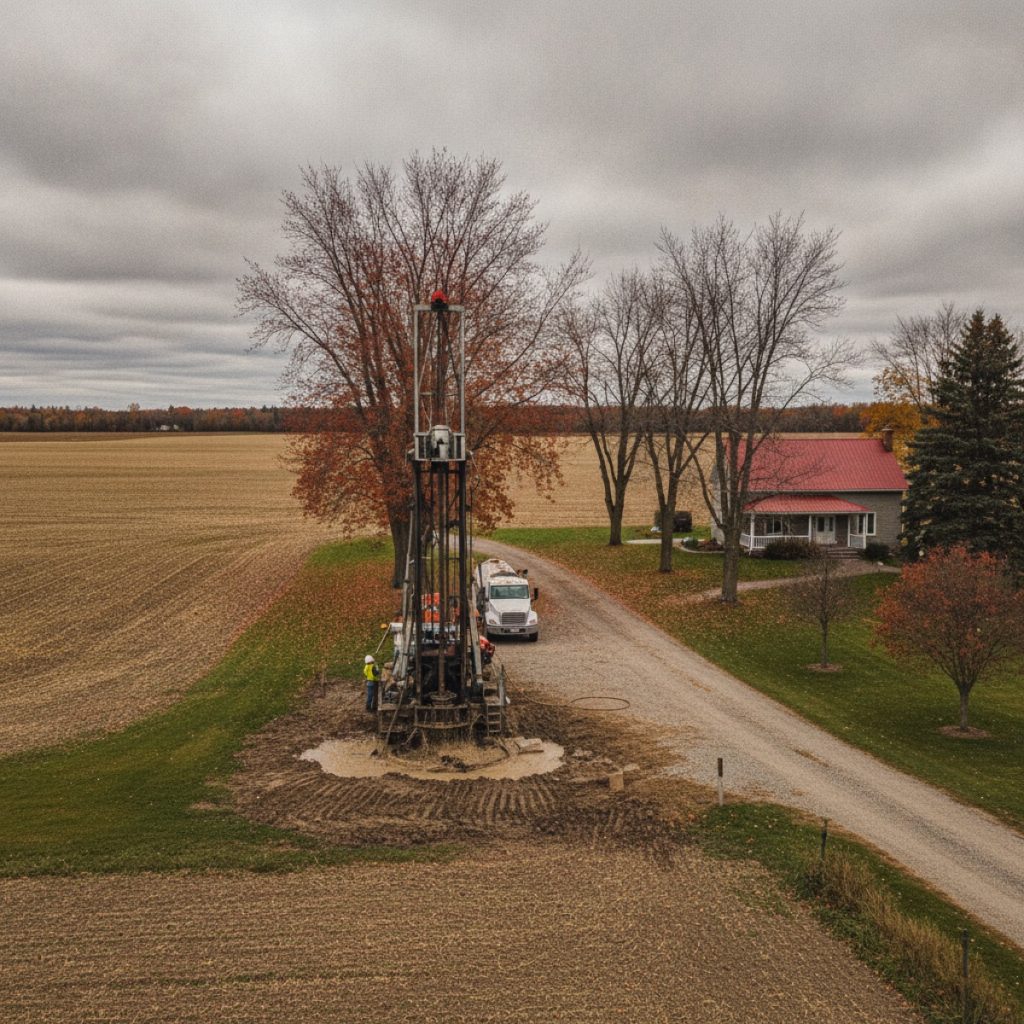
Drilling a well in Ontario means working within Ontario Regulation 903, not merely choosing a drilling company and a spot on the property. The regulation sets province-wide rules for well location, construction, sealing, disinfection, yield testing, documentation, maintenance and abandonment. It operates under the Ontario Water Resources Act and is overseen by the Ministry of the Environment, Conservation and Parks, usually shortened to MECP.
For paid well work, the business must hold a valid well contractor licence, and the person doing or supervising the work must hold the correct class of well technician licence. Drilling, digging, pump installation and monitoring are separate classes. A company licensed for one kind of work is not automatically authorized for every part of your project.
Ontario law contains a narrow exemption allowing an individual landowner, household member or unpaid helper to work on a well on that owner’s land without a technician licence. That exemption does not remove any construction, reporting or environmental requirements. A homeowner remains legally responsible for compliance and for any groundwater damage. In practical terms, a residential well should be constructed, altered and abandoned by appropriately licensed professionals.
How Ontario Regulation 903 governs private wells
Ontario Regulation 903, commonly called the Wells Regulation, applies to residential, agricultural, commercial, industrial and many other wells. It covers drilled wells as well as bored, dug, driven-point and jetted wells. It also addresses test holes and dewatering wells, although some requirements and exemptions differ for those uses.
The Ontario Water Resources Act provides the broader authority. Among other things, it prohibits discharges that may impair water quality and establishes the province’s well contractor and technician licensing system. Regulation 903 supplies the detailed construction and reporting rules used in the field.
MECP administers licensing, receives well records, issues well tags and handles compliance questions through its Wells Help Desk. Municipalities, conservation authorities and public health units have different roles. A municipality may require water-supply evidence or a hydrogeological report as part of a severance, subdivision or building application, while the local health unit deals with drinking-water health questions and bacterial sampling.
Do you need a permit to drill a domestic well?
Ontario does not treat every ordinary residential well as one identical permit application. Regulation 903 compliance and licensing are the main province-wide requirements, but other approvals can apply to a particular project. Before mobilizing a rig, confirm requirements with the municipality if the well is connected to a new home, lot creation, addition or development application.
A provincial Permit to Take Water is generally relevant when more than 50,000 litres may be taken in one day, subject to exemptions and alternative registration rules. That volume is well beyond normal household consumption but can arise with irrigation, commercial use, high-capacity agricultural wells, flowing wells or large pumping tests. Some pumping tests instead fall under Ontario’s Environmental Activity and Sector Registry rules.
The Water Resources Act also allows well-construction permits in areas designated by regulation. A homeowner should therefore have the contractor confirm whether any site-specific provincial, municipal, conservation-authority or development approval affects the property rather than assuming that Regulation 903 is the only consideration.
Well contractor and well technician licences are different
A well contractor licence authorizes a person or company to operate a well-construction business. It brings responsibility for insurance, staffing and compliance. It does not, by itself, authorize every employee to drill or install a pump.
A well technician licence belongs to the individual who performs or supervises the field work. The permitted work depends on the class printed on that licence.
| Class | Authorized work | Homeowner example |
|---|---|---|
| Class 1 | Well drilling using rotary, cable-tool, percussion, diamond and other listed drilling equipment | A conventional drilled residential well in overburden or bedrock |
| Class 2 | Well digging, excavation, boring and augering | A large-diameter bored or dug well |
| Class 3 | Other construction methods or equipment specifically described on the licence | Specialized work, such as driving or jetting where stated on the licence |
| Class 4 | Installation of pumps in or connected to wells | Installing the submersible pump, drop pipe and associated well equipment |
| Class 5 | Monitoring, sampling, testing and specified non-powered construction | Installing monitoring equipment, not drilling a normal domestic supply well |
A Class 1 driller is not automatically a Class 4 pump installer. One contractor may employ technicians covering both classes, or the drilling and pump work may be handled by different licensed businesses. Ask who will perform each stage and which class authorizes that work.
How to verify an Ontario well licence
- Search MECP’s licensed well contractor directory.
- Read the five-digit service code. A digit shown in a class position indicates that the contractor employs a technician for that class; zero means that class is not listed.
- Ask the company for its contractor licence number and the field technician’s licence and class.
- Confirm the status with the Wells Help Desk if the listing is unclear or appears out of date.
Ontario well contractor and technician licences expire on March 31 following the year in which they were issued. A printed licence that looks official can still be expired. The provincial directory is not a recommendation or quality ranking, so references, local experience, insurance and the written contract still matter.
Use Ontario well records before choosing a depth or budget
Ontario stores reported well information in the Water Well Information System, or WWIS. The province has records dating from 1899 to the present, although older wells may never have been reported and some historic locations are inaccurate.
Start with Ontario’s interactive Well Record Map. Search the property area, select nearby well symbols and examine several records. If the desired record is not visible, use the province’s well record request form. The underlying dataset is also available through the Ontario Data Catalogue.
What a well record tells you
A properly completed record may show:
- the well tag and record number;
- the reported location and a property sketch;
- the drilling or construction method;
- the sequence of clay, sand, gravel and bedrock encountered;
- well depth, casing diameter, casing length and screen details;
- depths at which water was found;
- the static water level before pumping;
- the pumping rate, pumping water level and recovery measurements;
- general observations about water, gas, minerals or drilling conditions; and
- the contractor and technician responsible for the work.
For new construction or a reportable alteration, the person constructing the well must provide the purchaser and landowner with a copy of the record within 14 days after the structural stage is completed. A copy must be forwarded to MECP within 30 days. The contractor keeps its copy for at least two years, but the owner should retain the record for the life of the well and transfer it with the property.
Use neighbouring records as evidence of a pattern, not as a promise. Review wells on comparable terrain and on the same side of major valleys, ridges or exposed bedrock where possible. Ten nearby records are more useful than one appealing record across a river or on a different landform. The WWIS metadata warns that location and other information can contain errors, especially in older submissions.
A local cluster can help a contractor estimate probable overburden thickness, bedrock depth, total drilling depth and yield. It cannot identify the exact depth of a productive fracture beneath your proposed well.
Ontario geology changes the drilling conversation
Ontario does not have one typical aquifer. The province spans ancient Canadian Shield rock, younger sedimentary basins, thick glacial deposits, sand and gravel moraines, clay plains and areas of carbonate rock with enlarged cracks and solution channels.
Canadian Shield: water comes from fractures
Across much of central and northern Ontario, including large parts of cottage country, the bedrock is granite, gneiss and other dense Precambrian rock. The solid rock itself stores little water. A drilled well succeeds by intersecting water-bearing fractures.
This is why two wells a short distance apart can have different depths and yields. One borehole may intersect several connected fractures; another may pass through mostly tight rock. Drilling deeper increases the amount of rock explored, but it does not guarantee that a productive fracture will be found.
A low-yield Shield well can still serve a house when the tested recovery rate, available water stored in the borehole, pump setting, pressure system and household demand are designed together. In some cases, an atmospheric storage tank or cistern allows a slowly recovering well to supply water over many hours and meet short periods of higher household demand.
Southern Ontario: sedimentary rock and glacial aquifers
Much of southern Ontario is underlain by limestone, dolostone, shale or sandstone and covered by glacial clay, silt, sand, gravel and till. Productive aquifers may occur in sand and gravel above the bedrock, within buried glacial channels or in cracks and bedding planes in sedimentary rock.
Coarse sand and gravel can produce strong yields, but an overburden well needs a correctly selected screen to admit water without continuously drawing sediment. Thick clay or till may protect a deeper aquifer from surface contamination while increasing the amount of casing required.
Carbonate bedrock can contain widened fractures or karst features. These openings may transmit substantial water, but they can also move contamination rapidly where protective soil and clay are thin. In those settings, merely satisfying the minimum setback does not always provide an adequate margin from septic systems, manure, fuel or neighbouring land uses.
Planning depths by broad Ontario region
The following bands are for early budgeting, not drilling specifications. Ontario notes that drilled wells are commonly about 15 to 60 metres deep, but wells of 185 metres or more exist. The local WWIS records and an experienced contractor should replace these broad ranges before a contract is signed.
| Area and common setting | Preliminary depth conversation | Main uncertainty |
|---|---|---|
| Southwestern and south-central Ontario, with glacial deposits over sedimentary bedrock | Often 15–60 m (50–200 ft), with shallower or much deeper local exceptions | Thickness of clay or till, buried sand and gravel, casing length and bedrock water quality |
| Eastern Ontario and the Ottawa–St. Lawrence lowlands | Often 15–75 m (50–250 ft), but highly local | Clay plains, limestone or sandstone fractures, mineralized water and the nearby Shield boundary |
| Central Ontario, Shield transition and cottage country | Frequently budgeted around 30–120 m (100–400 ft) | Whether the borehole intersects productive bedrock fractures |
| Northern Ontario and remote Shield properties | Common planning discussions also fall around 30–120 m, with substantial exceptions | Fracture yield, access, mobilization distance, winter conditions and local overburden |
Depth is not the same as water level. A 90-metre well may have water standing much closer to the surface. Conversely, a shallower well can experience a large drop in water level while being pumped. Pump sizing should use the well’s static level, pumping level, recovery and total depth rather than depth alone.
Construction standards under Regulation 903
The regulation contains detailed requirements that vary with the well type and site conditions. For a conventional new water-supply well, the major protections include:
- a minimum depth of 6 metres, unless the only useful aquifer requires a shallower well, in which case the minimum is 3 metres;
- new, clean casing and screen material;
- watertight casing extending through unstable material and, for a bedrock well, to the bedrock;
- casing extending at least 40 centimetres above the highest ground within 3 metres of the casing, subject to limited exceptions for driven or jetted points;
- ground sloped or mounded so water does not collect around the wellhead;
- sealing of the annular space—the gap outside the casing—to prevent movement of water, gas and contaminants;
- sealing the casing into competent bedrock where a drilled well obtains water from unweathered bedrock;
- a secure, vermin-resistant cover and proper screened venting where required;
- development to remove drilling fluids, cuttings and fine sediment;
- disinfection after construction, generally using 50–200 mg/L of free chlorine left undisturbed for at least 12 hours;
- a yield test before the structural stage is completed, unless an exemption applies; and
- a visible MECP well tag attached to the casing or associated permanent structure.
For wells tapping an aquifer deeper than 6 metres, the regulation generally requires casing to extend at least 6 metres below the original ground surface. If the only useful aquifer lies between 3 and 6 metres, at least 2.5 metres of casing below the original surface is required. The exact hole diameter, screen placement and sealing method depend on the construction method.
Minimum separation from common contamination sources
Regulation 903 separates wells according to their protection. A well with watertight casing extending at least 6 metres generally qualifies for the smaller sewage-system distances shown below; other wells require greater separation in several cases.
| Existing sewage or contamination source | Watertight casing to at least 6 m | Other well |
|---|---|---|
| Septic tank or treatment unit | 15 m | 15 m |
| Distribution pipe in a leaching or filter bed | 15 m | 30 m |
| Holding tank | 15 m | 15 m |
| Cesspool | 30 m | 60 m |
| Earth-pit privy | 15 m | 30 m |
| Greywater system or privy vault | 10 m | 15 m |
| Other source of contaminants | Generally 15 m for a qualifying drilled well | Generally 30 m |
These are minimums, not ideal siting targets for every property. Greater separation is prudent where the aquifer is shallow, bedrock is highly fractured, soil cover is thin, the well would sit downhill from contamination or neighbouring land uses cannot be controlled. Regulation 903 does not prescribe a general property-line setback for a new well, but placing a well close to a boundary can leave it vulnerable to future activity next door.
Drilled, bored and dug wells are not interchangeable
Drilled wells have relatively small diameters and can penetrate deep overburden or bedrock. They offer little water storage per vertical metre compared with a large-diameter well, so tested yield and recovery matter.
Bored wells are commonly large-diameter wells constructed in overburden with augering equipment. They may reach roughly 30 metres but often target shallower groundwater. Regulation 903 has particular requirements for the hole around concrete casing, filter material and sealing. The upper annular space must be constructed and sealed to prevent surface contamination.
Dug wells are large and usually less than about 10 metres deep. Their water storage can help when an aquifer yields slowly, but their shallow intake makes them more responsive to drought and more vulnerable to bacteria, septic leakage and runoff. An older dug well with low casing, loose tiles or a cover below grade should not be judged by the standards of a modern drilled well.
Testing private well water in Ontario
Ontario recommends bacterial testing at least three times per year, with one sample in early spring. A practical schedule is spring, summer and fall, with additional testing after flooding, a heavy rainfall event, plumbing or well work, a long period of non-use, an unexplained change in taste or appearance, or illness that may be water-related.
Public Health Ontario provides free testing for E. coli and total coliform bacteria for eligible private household drinking-water samples. Sterile bottles are available through public health units, Public Health Ontario laboratories and designated pickup points. Follow the current collection and delivery instructions: sample quality can be affected by the faucet, handling, temperature and time in transit.
The free test is a bacterial screen. It does not show whether the water is chemically safe. Ontario’s well-maintenance guidance recommends nitrate testing annually and broader metals and mineral testing at least every two years. A useful baseline panel from an accredited private laboratory may include:
- nitrate and nitrite, especially near farms, septic systems or fertilized land;
- sodium and chloride, including possible natural salt or road-salt effects;
- arsenic, uranium and other naturally occurring metals appropriate to local geology;
- iron, manganese, hardness, alkalinity and pH;
- fluoride, sulphate and turbidity; and
- additional parameters suggested by nearby land uses, historic spills, fuel storage, mining or the local health unit.
Test raw well water before treatment when you are assessing the source, and test treated drinking water when you are confirming treatment performance. A softener, filter or ultraviolet unit can change what appears at the tap, but treatment does not repair a leaking cap, failed casing or contaminated drainage around the wellhead.
What drilling a well costs in Ontario
Request itemized written quotes for your Ontario property, using the same description of the work for each business. Record every total in CAD.
| Local property distinction | Question for the written scope | Quote details |
|---|---|---|
| Location and available records | Which property, intended use, work area, nearby records, and requirements confirmed with the responsible local authority were considered? | Quote date, validity period, and CAD currency. |
| Access and proposed work | What mobilization, access, drilling or borehole, casing, sealing, development, testing, equipment, connection, and restoration work is included? | Inclusions, exclusions, allowances, taxes, and work assigned to others. |
| Unknown or changed conditions | How will extra depth or casing, changed site conditions, a dry or low-yield bore, and an unsuccessful bore be handled? | Who authorizes changes, how price changes are stated, and which records are delivered. |
First distinguish a drilling or borehole-only quote from a complete installation. Ask each business to identify inclusions, exclusions, allowances, taxes, quote date, validity period, and how changes require approval.
- What mobilization, travel, site access, and setup are included?
- Where does the drilling or borehole scope begin and end?
- Which casing, screen, liner, sealing, or completion items are included or excluded?
- Which development, yield, sampling, testing, and project-record items are included?
- Which pump, tank, controls, cable, pipe, and related equipment are included?
- Which electrical, plumbing, trenching, building-connection, and restoration work is included?
- Which authority fees, permits, inspections, reports, or laboratory items apply, and who handles them?
- Is any water-treatment work included, excluded, or deferred until property-specific results are available?
- What cleanup, removed-material handling, site restoration, and unsuccessful-bore work is included?
- How are additional depth or casing and dry or low-yield work documented, authorized, and priced?
Ask which taxes apply and whether the CAD total includes them. For any responsibility that could change because of site conditions or contract terms, ask the responsible authority and each business to explain it in writing before work begins.
Ask how the written quote handles additional or changed work, including extra depth or casing and a dry or low-yield bore, and who authorizes that work before it proceeds.
Your maintenance responsibilities after construction
Once the well’s structural stage is complete, Regulation 903 requires the owner to maintain it so surface water and other foreign materials cannot enter. That duty continues for as long as the well exists.
At least annually, and after flooding or damage, inspect:
- the casing for corrosion, cracks, holes or loose joints;
- the cap for damage, gaps and signs of insects or rodents;
- the vent to confirm that it is screened, open and high enough to avoid floodwater;
- the well tag, which should remain visible and legible;
- the ground around the casing for settlement or ponding;
- nearby fuel, salt, manure, fertilizer, waste and chemical storage;
- roots, vehicles or construction activity that could damage the casing or seal;
- changes in water pressure, pump cycling, sediment, colour, odour or taste; and
- bacterial and chemical test results compared with earlier years.
Keep the wellhead accessible. Do not bury it under a deck, addition, driveway or landscaping. Do not direct a downspout, sump discharge or drainage swale toward it. If repairs, casing extensions or pump work are needed, verify that the contractor employs the appropriate technician class.
Unused wells must be properly abandoned
An abandoned well is not an old well with a board, concrete slab or loose cap over it. It must be plugged and sealed in the sequence required by Regulation 903 so it cannot carry contamination from the surface into an aquifer or connect groundwater zones that were naturally separated.
The regulation can require immediate abandonment when a well is not being used or maintained for future use, produces mineralized water, produces non-potable water without the owner seeking and following the local medical officer of health’s direction, or contains unmanaged natural gas or another gas. A new dry well must also generally be abandoned unless the landowner agrees in writing to maintain it for future use as a well.
Proper abandonment normally includes removing equipment and debris, removing casing or screen where reasonably possible, placing a continuous approved sealing barrier from the bottom upward, removing at least the upper two metres of casing where reasonably possible, placing the prescribed bentonite and cover near the surface, stabilizing the ground, returning the well tag and filing an abandonment well record.
The person abandoning the well is generally required to retain a licensed contractor unless a legal exemption applies. Although a landowner exemption exists, the work demands correct volume calculations, compatible sealing materials, casing-removal equipment and a method that prevents gaps in the seal. Errors remain hidden underground and can create liability long after the property changes hands.
Where Ontario homeowners can find help
- MECP Wells Help Desk: 1-888-396-WELL (9355) or [email protected] for licensing, well records, tags and Regulation 903 questions.
- Ontario well guidance: the ministry’s Water Supply Wells: Requirements and Best Practices manual explains the regulation in field-oriented language.
- Local public health unit: sample bottles, bacterial-testing locations, result interpretation and health advice.
- Public Health Ontario: current private drinking-water sampling instructions and bacterial test services.
- Ontario Ground Water Association: well-owner resources and an industry member directory. Association membership is useful additional information but does not replace MECP licence verification.
- Municipality or planning department: local building, severance, subdivision, water-supply and hydrogeological-report requirements.