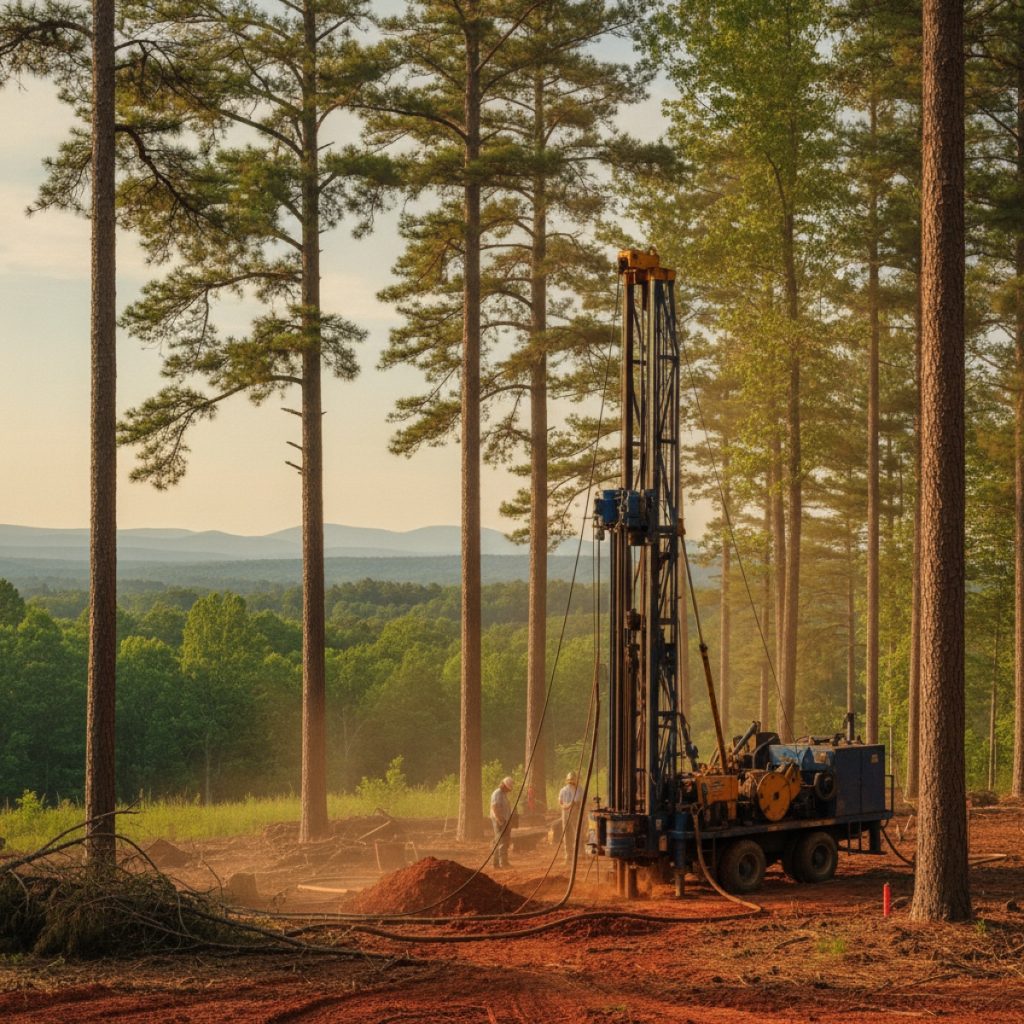
Drilling a well in North Carolina requires more than hiring a drilling rig and choosing a convenient spot. Every new private drinking-water well needs a construction permit, normally issued by the county or district health department. The site must be evaluated before drilling, the work must comply with North Carolina’s Well Construction Standards in 15A NCAC 02C, and a North Carolina Certified Well Contractor must perform or supervise the regulated work.
After construction, the county inspects the well and issues a Certificate of Completion if it meets the permit and construction rules. North Carolina then requires laboratory testing of the new well for bacteria and a substantial list of chemical constituents. In practical terms, do not treat a newly completed well as a drinking-water source until the required sampling is finished and you understand the results.
North Carolina is one of the more closely regulated states for private wells. That is valuable protection for homeowners, but it also means the well location must be coordinated early with the house, septic system, repair drainfield, driveway, fuel storage, streams, and future additions. A misplaced house stake or septic repair area can eliminate the best available drilling location.
Who regulates private wells in North Carolina?
Responsibility is divided between state agencies and local health departments. The North Carolina Department of Environmental Quality Division of Water Resources administers the statewide groundwater and well-construction framework. The detailed technical rules are contained in 15A NCAC 02C, including Rule .0107 for water-supply-well construction and Section .0300 for private drinking-water-well permitting and inspection.
For an ordinary well serving one house, your working contact is usually the county or district health department’s Environmental Health office. It accepts the application, evaluates the site, issues or denies the permit, records the approved drilling area, handles the completion inspection, and arranges or oversees required water sampling.
There are exceptions. A water-supply well or well system designed to pump at least 100,000 gallons per day is generally permitted through the state. Public water systems, monitoring wells, recovery wells, injection wells, and some unusual designs follow different programs. A domestic homeowner well is rarely in those categories, but a large farm, subdivision, business, or shared system should confirm the proper permitting path before design work begins.
North Carolina law gives the local health department up to 30 days after receiving an application to decide whether a proposed private well can comply with state requirements. Actual scheduling depends on county workload, site readiness, weather, and whether officials need more information. A construction or repair permit is generally valid for five years, although it can be revoked if the facts on which it was issued materially change.
North Carolina requires a certified well contractor
North Carolina uses the term Certified Well Contractor rather than merely relying on a general contractor’s license. State law generally prohibits an uncertified person from offering or performing well-contractor activities unless a certified contractor will perform the regulated work and the landowner receives the contractor’s name, employer, and certification number in writing.
Certification levels do not authorize identical work. Before signing a contract, use the state’s Find a North Carolina Certified Well Contractor list. Confirm the individual’s certification number, level, employer, and whether the listed services include well construction. The state recommends asking to see the contractor’s current photo wallet card as well.
Verify the individual who will supervise the job, not only the company name painted on the truck. Ask for proof of liability insurance and a written proposal that identifies:
- The drilling charge and how it changes with depth
- The included amount and type of casing
- Charges for additional casing, grout, screens, and difficult formations
- Pump, wire, drop pipe, pressure tank, controls, trenching, and electrical work
- Well development, disinfection, yield measurement, and water sampling responsibilities
- Mobilization charges, access requirements, and what happens if the first bore is unsuccessful
- Who pays for abandonment of an unusable test hole
- What written records and warranties you will receive
A guaranteed total price is uncommon because the contractor cannot see the water-bearing formation before drilling. A useful quote therefore gives you unit prices and clear decision points. It should explain who can authorize deeper drilling, more casing, a second location, hydrofracturing, or a larger pump.
The permit and site-evaluation process
Apply before drilling
No one may construct a private drinking-water well in North Carolina without first obtaining the local construction permit. The application normally identifies the owner and parcel, intended property use, proposed structures, existing or proposed wastewater systems, easements, existing wells and springs, surface water, wetlands, storage tanks, waste areas, and other possible contamination sources.
If the property has or will have an on-site wastewater system, a plat or qualifying site plan is required. Mark the proposed well area on the ground before the field visit. The inspector evaluates topography, drainage, available space, abandoned wells, and contamination risks on and around the parcel. The permitting review also checks state-published records for known contamination releases within 1,000 feet.
The permit usually approves an area rather than promising water at one exact point. Your contractor still chooses a drilling position within the permitted area based on rig access and local geology. If the house, septic system, repair field, grading, or landscaping changes, contact Environmental Health before drilling. A layout change can make the approved well area noncompliant.
North Carolina setback distances
Rule 15A NCAC 02C .0107 calls these horizontal separation distances. They are measured horizontally from the well to a potential contamination source. The following are important statewide minimums for a normally situated domestic well; special conditions and formally approved variances can change how a particular site is handled.
| Feature or contamination source | Typical state minimum |
|---|---|
| Septic tank, drainfield, and repair area serving a single-family dwelling | 50 feet |
| Single-family saprolite wastewater system | 50 feet under current statutory implementation; confirm the approved site plan with Environmental Health because older rule text and permits may show 100 feet |
| Other facilities with septic tank and drainfield | 100 feet |
| Watertight residential sewer lateral | 25 feet |
| Cesspool, privy, feedlot, manure pile, animal barn, or chemical-storage area | 100 feet |
| Building perimeter, including permitted attached decks, garages, and patios | 25 feet |
| Pond, lake, or reservoir acting as a groundwater-recharge source | 50 feet |
| Creek, river, sound, bay, or tidal estuary | 25 feet |
| Heating-oil tank | 50 feet |
| Regulated petroleum tank without secondary containment | 100 feet |
| Gravesite | 50 feet |
| Coal-ash landfill or impoundment | 200 feet |
| Sanitary, municipal solid-waste, or construction-and-demolition landfill | 500 feet |
The state construction table does not establish one universal setback from every property line. Boundaries still matter because the well, access area, contamination setbacks, easements, and facilities it serves must fit legally on the parcel. Zoning, recorded covenants, utility easements, or the approved site plan may also restrict placement. Do not assume that locating a well a few feet inside a survey pin makes the position acceptable.
What North Carolina’s construction standards require
North Carolina does not impose one statewide total well depth. The finished depth depends on where usable groundwater is encountered. The rules instead control where the well can be located, how contaminated or saline zones are isolated, the materials used, casing and grout depth, wellhead construction, development, disinfection, and documentation.
Casing and the water source
Casing is the solid pipe that supports the borehole and blocks shallow water or loose material from entering. In most parts of North Carolina, casing must extend at least 20 feet below land surface. Certain designated areas require at least 43 feet, while specifically identified coastal areas may use casing of less than 20 feet when the protected water source is shallow and all applicable conditions are met.
For a bedrock well in the Piedmont or mountains, the casing must normally be firmly seated at least five feet into consolidated rock. Below the casing, the borehole may remain open through competent rock so groundwater can enter through fractures. In the Coastal Plain, where aquifers may be sand, gravel, shell, or limestone, the contractor may install a screened and gravel-packed well. The screen opening and pack material must be chosen to admit water without continuously pulling formation sand into the system.
The top of the casing must terminate at least 12 inches above finished land surface. Openings for wiring, piping, and vents must be protected, and the final grade must direct runoff away from the well. A watertight cap or seal is required. These details become especially important during tropical rainfall, when water can pool around a poorly graded wellhead.
Grouting
Grout is the low-permeability seal placed in the space between the casing and the drilled hole. Its job is to stop contaminated shallow water from travelling down the outside of the casing. In most locations, the casing must be grouted to at least 20 feet below land surface. Deeper sealing is required where necessary to isolate saline, contaminated, or otherwise nonpotable zones.
The contractor must notify the health department before grouting and provide the required certification. Under current state law, the county may observe ordinary grouting, but a compliant contractor may self-certify when the statutory notice requirements are met. A variance involving grout depth receives different inspection treatment.
Development, yield, completion, and disinfection
After drilling, the contractor develops the well by removing drilling mud, cuttings, and loose formation material. The well’s yield and static water level should be recorded. Yield is the sustainable rate at which the well produces water; static level is the resting water level before pumping. Neither total depth nor the presence of water alone tells you whether the well will support the household during sustained use.
The contractor must attach an identification plate showing information such as total depth, casing depth and diameter, screened intervals where applicable, yield, static water level, and completion date. Pump-installation information is recorded separately. The contractor also submits the GW-1 Well Construction Record to the state and local health department. Keep your copy permanently.
North Carolina requires disinfection after construction, repair, testing, maintenance that opens the well, or pump installation. The standard chlorination procedure produces at least 100 parts per million of chlorine in the well, circulates the solution, leaves it in contact for at least 24 hours, and pumps the well until no total chlorine residual is detectable before use or sampling.
When construction is complete, the county verifies compliance and issues the Certificate of Completion. A private drinking-water well cannot legally be placed into service without that certificate.
Required water testing for a new North Carolina well
Within 30 days after issuing the Certificate of Completion, the local health department must collect samples or ensure that a certified laboratory collects and analyzes them. North Carolina’s required new-well panel is broader than the minimum testing performed in many states.
The required analysis includes:
- Total coliform bacteria, with further testing for fecal coliform or E. coli when indicated
- Arsenic, barium, cadmium, chromium, copper, lead, mercury, selenium, silver, and zinc
- Fluoride, iron, magnesium, manganese, sodium, nitrate, and nitrite
- pH, which shows how acidic or alkaline the water is
The legal panel is a strong starting point, but it cannot detect every possible contaminant. Property history may justify tests for pesticides, volatile organic compounds, petroleum compounds, radionuclides, PFAS, or other locally relevant substances. If the permitting search identifies a known contamination release within 1,000 feet, review that notice with Environmental Health and ask which targeted analyses address the specific risk.
A failed bacterial test usually leads to an inspection for pathways such as a loose cap, defective seal, damaged casing, or poor drainage, followed by corrective work, disinfection, flushing, and another sample. Chemical results require contaminant-specific decisions. Boiling can kill many microorganisms, but it does not remove nitrate, metals, salts, or fuel compounds and can concentrate some dissolved contaminants.
Testing an existing well
North Carolina does not operate or routinely sample your private well after the new-well process. Ongoing testing becomes the owner’s responsibility. The North Carolina Division of Public Health recommends:
- Every year: total and fecal coliform bacteria, plus a visual wellhead inspection
- Every two years: heavy metals, nitrate, nitrite, lead, and copper
- Every five years: pesticides and volatile organic compounds, with more frequent targeted testing when nearby land use creates a known risk
- After flooding, repairs, or a change in taste, odor, or color: inspect and test before resuming normal use
- During pregnancy or before preparing infant formula: confirm nitrate and nitrite results
Use the State Laboratory through your local health department or a North Carolina-certified commercial laboratory. Follow the laboratory’s collection instructions; an unsterile bottle, untreated faucet aerator, or sample held too long can invalidate a bacteria result.
North Carolina geology: three regions, three drilling problems
A contractor’s local experience matters because North Carolina’s Coastal Plain, Piedmont, and Blue Ridge obtain groundwater in fundamentally different ways. Depth ranges below are planning ranges, not construction requirements or promises. Review nearby GW-1 records and ask contractors what they have encountered within the immediate area.
| Region | Common well conditions | Planning depth |
|---|---|---|
| Coastal Plain | Layered sand, clay, shell, and limestone aquifers; screened wells are common; shallow water can be productive but vulnerable to contamination; salinity becomes a concern near sounds, barrier islands, and deeper eastern aquifers | Often roughly 50–300 feet for domestic work, but the usable aquifer can be shallower or considerably deeper |
| Piedmont | Clay-rich weathered rock over fractured crystalline bedrock; water enters mainly through fractures; ridge sites and Triassic-basin rocks can be less productive | Common planning discussions begin around 150–400 feet, with deeper holes possible when useful fractures are sparse |
| Blue Ridge and mountains | Fractured bedrock, steep terrain, irregular soil and rock thickness, difficult rig access, and large yield differences over short distances | Frequently planned around 150–500 feet; difficult sites can extend well beyond 500 feet |
Coastal Plain
The Coastal Plain contains multiple sedimentary aquifers rather than one uniform underground reservoir. The surficial aquifer is often shallow and can yield household water, but it is more exposed to septic leakage, agricultural chemicals, stormwater, and flooding. Its water is commonly acidic and may be corrosive.
The Yorktown aquifer is important in northeastern North Carolina. The Castle Hayne aquifer, composed largely of limestone and sand, is the state’s most productive aquifer, although its limestone can produce hard water. Deeper Cretaceous aquifers serve much of the western Coastal Plain. Near the coast, a deeper well does not automatically mean better water: chloride and salinity may increase with depth or heavy pumping.
In Beaufort, Carteret, Craven, Duplin, Edgecombe, Greene, Jones, Lenoir, Martin, Onslow, Pamlico, Pitt, Washington, Wayne, and Wilson counties, large withdrawals may also fall within the Central Coastal Plain Capacity Use Area program. A normal single-family well is usually far below the large-withdrawal threshold, but farms and multi-user systems should verify their obligations.
Piedmont
In the Piedmont, the weathered material above bedrock stores water, while fractures in the underlying rock deliver it to the borehole. Drilling deeper only helps if the bore intersects additional productive fractures. A deep hole that misses useful fractures can yield less than a shallower well nearby.
North Carolina research using thousands of well records found that wells in draws and valleys produced, on average, about three times the yield of wells on hills and ridges. That does not authorize drilling in a drainageway or flood-prone depression; the construction rules prohibit locating a well where runoff accumulates. It does explain why topography and fracture patterns matter so much.
Blue Ridge
Mountain wells also depend heavily on fractured rock. Two neighboring lots may have different bedrock, fracture density, access, and elevation. A lower landscape position may offer better groundwater conditions, while steep access can make the best geological location impractical for a large drilling rig.
Discuss turnaround space, road width, overhead wires, slope stability, and wet-weather access before mobilization. Also discuss the response to a low-yield hole. Depending on the well and contractor’s authority, options may include greater depth, a different bore, hydrofracturing to open existing rock fractures, or a storage system that accumulates water slowly between periods of high household demand.
What does drilling a well in North Carolina cost?
Request itemized written quotes for your North Carolina property, using the same description of the work for each business. Record every total in USD.
| Local property distinction | Question for the written scope | Quote details |
|---|---|---|
| Location and available records | Which property, intended use, work area, nearby records, and requirements confirmed with the responsible local authority were considered? | Quote date, validity period, and USD currency. |
| Access and proposed work | What mobilization, access, drilling or borehole, casing, sealing, development, testing, equipment, connection, and restoration work is included? | Inclusions, exclusions, allowances, taxes, and work assigned to others. |
| Unknown or changed conditions | How will extra depth or casing, changed site conditions, a dry or low-yield bore, and an unsuccessful bore be handled? | Who authorizes changes, how price changes are stated, and which records are delivered. |
First distinguish a drilling or borehole-only quote from a complete installation. Ask each business to identify inclusions, exclusions, allowances, taxes, quote date, validity period, and how changes require approval.
Ask the responsible local authority which current fees, inspections, sampling, laboratory, or record items apply and whether each is included in the written quote.
Ask how the written quote handles additional or changed work, including extra depth or casing and a dry or low-yield bore, and who authorizes that work before it proceeds.
Hurricanes, flooding, and well protection
Flooding is not only a Coastal Plain concern. Hurricane Helene demonstrated that extreme rainfall, landslides, damaged septic systems, and river flooding can compromise mountain wells too. Shallow, bored, dug, damaged, or poorly sealed wells are particularly vulnerable, but any submerged wellhead should be treated as contaminated until assessed and tested.
Where the property permits it, place the well on ground that drains away from the casing and outside areas likely to collect stormwater. Maintain at least 12 inches of exposed casing above finished grade, keep the cap and electrical conduit sealed, and do not bury the wellhead under landscaping. Preserve access for a service truck after construction.
After a flood:
- Do not restore power to a submerged pump or damaged electrical system until the floodwater has receded and the equipment has been evaluated.
- Do not drink the well water or use it for ice, food preparation, infant formula, tooth brushing, dishwashing, or hand washing until the well has been assessed and tested.
- Use bottled or properly treated water while waiting. Boiling addresses microorganisms but not fuel, pesticides, metals, or other chemicals.
- Have a certified well contractor inspect damaged casing, seals, caps, wiring, and pump components.
- Disinfect the well and plumbing, then arrange post-disinfection sampling through the health department or a certified laboratory.
- Request additional chemical testing if floodwater may have crossed a fuel tank, farm field, animal operation, industrial property, landfill, or chemical-storage area.
A generator can keep a pump operating during an outage, but it must be sized and connected safely. It does not protect the well from contaminated floodwater. If dependable water during long outages is important, discuss electrical backup and stored-water capacity while designing the system.
Buying or selling a North Carolina home with a well
North Carolina requires applicable residential sellers to provide the state property disclosure statement, which addresses the water supply and sewage-disposal system. Known well-water contamination can also be a material fact that real estate brokers must disclose.
That disclosure is not a substitute for current testing. North Carolina’s mandatory comprehensive test applies to newly constructed private drinking-water wells; the state does not automatically require every existing private well to receive a fresh full laboratory panel solely because the property is being sold. A purchase contract, lender, insurer, or loan program may impose its own inspection and testing conditions.
During the due-diligence period, a buyer should obtain:
- The construction permit, Certificate of Completion, and GW-1 construction record
- The well’s location and any recorded access or shared-well agreement
- Recent laboratory results, followed by independent current sampling
- Depth, casing, static level, reported yield, pump depth, pump age, and pressure-tank information
- Invoices for repairs, disinfection, treatment equipment, and recurring filter service
- County records for the septic system, including the drainfield and repair area
- Information about abandoned wells, fuel tanks, flooding, nearby contamination, and unusual water shortages
A useful transaction inspection includes the visible wellhead, cap, casing height, drainage, electrical condition, pressure performance, pump cycling, and an appropriate laboratory panel. Testing only for bacteria can miss arsenic, lead, nitrate, corrosive pH, manganese, petroleum compounds, or other location-specific concerns.
For a shared well, review the recorded agreement closely. It should identify ownership, access, electricity, testing, repairs, treatment, capacity, monthly expenses, and what happens when a participant fails to pay. A well that physically produces water can still create a serious property problem if access and maintenance rights are poorly documented.
Well repairs and abandonment
A repair permit is required when work alters or repairs the private drinking-water well, with exceptions for maintenance that does not open the well seal and for pump or tank repair or replacement. Because the boundary depends on the work being performed, describe the planned repair to Environmental Health before the contractor begins.
Damaged casing, screens, seals, fixtures, and wellhead components must be repaired or replaced, or the well must be properly abandoned. Any work that opens the well requires disinfection. A permitted repair must pass the completion process before the well returns to service.
An unused well cannot be covered with a board, filled with loose debris, or forgotten beneath a new building. It can become a direct route for surface contamination to reach groundwater and may create a physical hazard. The owner is generally responsible for permanent abandonment unless another party’s improper work created the need.
Before permanently abandoning a private drinking-water well, obtain an abandonment permit from the local health department and provide the required notice. A certified contractor normally sounds the well to confirm its depth, removes obstructions where possible, disinfects it, and seals it according to the formation and construction type. Unconsolidated-formation wells are generally filled completely with approved grout. Rock wells may use permitted fill within competent rock, but the upper section must be grouted to the surface; if casing or bedrock depth cannot be confirmed, the entire well is grouted.
The contractor must submit the required abandonment record, commonly Form GW-30, within 30 days. Keep that record with the deed, survey, septic documents, and remaining well records. If an improperly abandoned well is found during a new-well site evaluation, the county can condition the new construction permit on proper closure of the old well.
Records that should stay with the property
A completed North Carolina well file should contain the permit and approved site plan, contractor certification information, GW-1 construction record, Certificate of Completion, original laboratory report, pump and pressure-equipment specifications, treatment-system records, repair permits, later test results, and any abandonment documentation.
Those records explain what cannot be seen from the surface: the well’s actual depth, casing and grout, aquifer or rock interval, tested yield, pump setting, and original water quality. They also make future repairs, additions, storm recovery, and real estate reviews far more informed. For a North Carolina homeowner, that file is part of the water system—not optional paperwork.