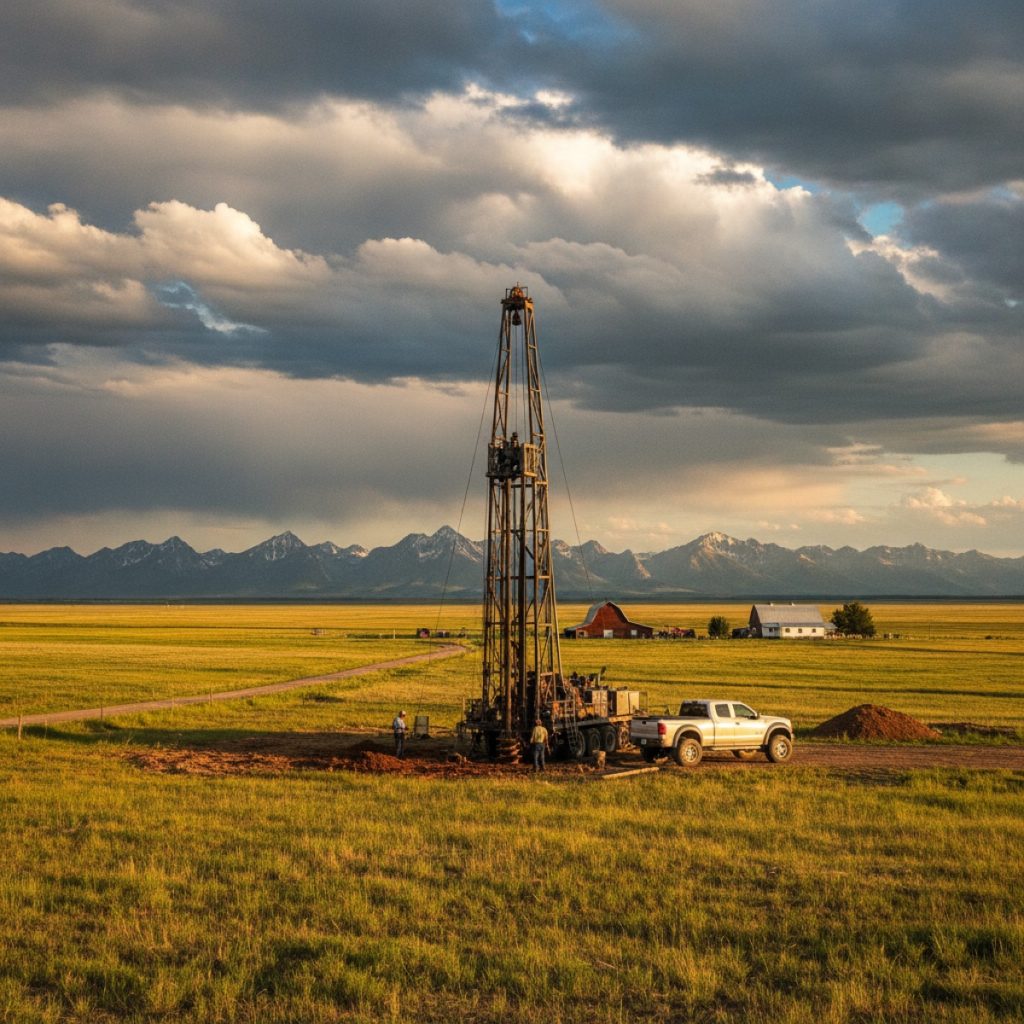
For an ordinary household well in Alberta, the homeowner does not apply for a Water Act licence or a separate household authorization. The Water Act gives qualifying households a statutory right to divert up to 1,250 cubic metres of groundwater per year. The authorization most homeowners need to verify belongs to the drilling contractor: a typical drilled well should be constructed under a current Class A Approval to Drill Water Wells issued by Alberta Environment and Protected Areas (AEPA).
The contractor must follow Alberta’s construction rules, test the well’s yield and submit a Water Well Drilling Report to AEPA within 60 days. You should receive a copy. That report becomes the permanent record of the well’s depth, casing, geology, water levels and tested production.
The uncertain part is what the drill will encounter. Alberta contains shallow sand-and-gravel aquifers, buried glacial channels and layered bedrock aquifers. A successful 30-metre well on the plains and a 150-metre bedrock well near the foothills are very different projects. Even neighbouring properties can have different depths, yields and water chemistry.
Who regulates water wells in Alberta?
The central law is Alberta’s Water Act. It governs both the physical work of drilling a well and the legal right to divert groundwater. AEPA administers most private groundwater matters, including approvals issued to drilling contractors, Water Act licences for non-household diversions and the provincial well-record system.
The Water Act’s household-use provisions give household users a statutory right with the highest priority among Alberta water users. Eligible purposes include human consumption, sanitation, fire prevention and watering household animals, gardens, lawns and trees. The limit is 1,250 cubic metres per household per year, approximately 3,425 litres per day when averaged across the year.
| Proposed use | Usual Water Act position |
|---|---|
| One household: drinking, sanitation, fire protection, household garden, lawn, trees and household animals | Statutory household right, up to 1,250 m³ per year; no diversion licence |
| Commercial greenhouse, business, industrial use, multi-user supply or substantial irrigation | A Water Act licence will normally be required |
| Agricultural livestock or pesticide use established before January 1, 1999 | May be protected by a traditional agricultural registration or statutory exemption tied to historic use |
| New or expanded farm use that does not fit household use or another exemption | Usually requires a Water Act licence |
Do not treat “domestic,” “farm” and “household” as interchangeable descriptions. A rural home can use its well for qualifying household purposes, but a large livestock operation, irrigated crop, campground, rental complex or home-based commercial operation may fall outside that right.
Driller licensing and the Approval to Drill
In everyday conversation, people refer to a “licensed Alberta well driller.” The more precise provincial language is a contractor holding an Approval to Drill Water Wells. A Class A approval covers drilled or bored wells used to divert groundwater. Class B applies to dug wells, while other classes cover investigation, saline-water and ground-source heat-exchange work.
For a conventional drilled domestic well, ask the contractor for:
- The legal business name shown on its current Class A approval.
- The approval number and expiry date. Provincial drilling approvals are issued with an expiry date, so an approval from a previous season is not enough.
- The name and qualifications of the journeyperson responsible for the rig.
- Confirmation that the proposed work, pump installation, yield testing, disinfection and reporting are included in the contract.
- Proof of liability coverage and workers’ compensation standing.
The Alberta Water Well Drilling Association contractor directory is a useful place to find established companies. AWWDA is an industry association, however, and membership is not a substitute for government approval. Confirm the approval directly with AEPA when comparing contractors.
Alberta’s directive contains a narrow exemption for an owner who owns both the land and the drilling machine and drills solely for household purposes. That exemption does not remove the construction, reporting, safety or groundwater-protection obligations. For a homeowner, using an approved contractor remains the defensible approach: Alberta geology can involve gas, saline water, unstable formations and aquifers that must be kept separate.
When a Water Act licence is required
If the planned diversion goes beyond household use, discuss the purpose with AEPA before the well is designed. A well intended for licensing must be constructed differently in important respects. In particular, it cannot be completed across multiple aquifers as though they were one water source. The production opening is restricted and the space outside the casing must be sealed from the aquifer to the surface.
A groundwater-licence application is submitted through Alberta’s Digital Regulatory Assurance System. The supporting information can include:
- The well location and legal land description.
- The intended aquifer and depth interval.
- The annual quantity, maximum pumping rate and seasonal pattern of use.
- A constant-rate yield or pumping test.
- An inventory of nearby groundwater users.
- An assessment of effects on neighbouring wells, the aquifer and the environment.
- Professionally prepared groundwater information for a larger or more sensitive diversion.
Public notice may be required, giving affected water users an opportunity to submit concerns. AEPA may place conditions on metering, annual reporting, water levels, water quality or complaint investigation.
There is no dependable province-wide approval timeline. A complete application for modest livestock use and a high-volume irrigation proposal are not equivalent reviews. Aquifer data, nearby users, public concerns, basin conditions and requests for further technical work can all affect timing. If a licence is needed, plan in months rather than assuming that drilling and authorization will occur during the same week. Do not begin the proposed diversion until the required licence has been issued.
Your municipality may also have development, building, private-sewage or road-access requirements. These local requirements are separate from the provincial right to use groundwater.
Water Well Drilling Reports and nearby records
During drilling, the driller must keep a current construction record and geological log. Within 60 days after completion, the approval holder must provide the completed Water Well Drilling Report to both AEPA and the well owner. The report commonly records:
- The legal location, owner and drilling contractor.
- The drilling method and completion date.
- Total depth and the materials encountered at different depths.
- Casing, liner, screen, perforation and seal details.
- Water-bearing intervals and any gas or saline water encountered.
- Static water level before pumping.
- Pumping rate, drawdown and recovery during the yield test.
- The driller’s recommended pumping rate.
Keep the report with the property records, not only with the drilling invoice. It will be useful when sizing a replacement pump, diagnosing declining production, selecting treatment equipment, selling the property or decommissioning the well.
How to search the Alberta Water Well Information Database
The public Alberta Water Well Information Database contains roughly half a million records. Search by legal land description, survey plan, owner name, Government of Alberta well-tag number or Groundwater Information Centre identification number. A reconnaissance report lets you compare several wells at once.
- Search the quarter-section or surrounding legal subdivisions rather than looking at only the closest map symbol.
- Compare total depth, geological log, static level, tested pumping rate and completion date.
- Separate sand-and-gravel completions from bedrock completions; their depths should not be averaged together.
- Look for repeated patterns, such as several wells finishing in the same sandstone interval or several shallow holes recorded as abandoned.
- Give greater weight to recent, complete reports with measured locations and proper yield-test data.
Map symbols are often approximate. If precise coordinates were not submitted, the database may place a well at the centre of a legal subdivision or quarter-section. Older wells may be missing because compulsory reporting began in the mid-1970s. A nearby record is evidence of local conditions, not a promise that the same aquifer crosses your drilling location.
Alberta geology: why depth and water quality change so much
Southern Alberta plains
Across southern Alberta, some homes obtain water from sand and gravel left by glaciers, rivers or older buried drainage channels. These deposits can form productive shallow aquifers, but they are not continuous sheets. A gravel-filled buried channel may supply a strong well while a nearby hole encounters mostly clay or low-yield shale.
Shallow groundwater is also more responsive to snowmelt, drought and land use. Nitrate, bacteria and agricultural influences deserve attention where the aquifer is close to the surface. In other southern locations, the usable target is a sandstone bed within the Belly River, Milk River or related bedrock units. Mineral content commonly increases as groundwater spends more time in contact with rock.
Central Alberta
The Edmonton–Calgary corridor has a mixture of glacial sediments and layered bedrock. The Paskapoo Formation is one of Alberta’s most heavily used bedrock aquifer systems, while Horseshoe Canyon, Scollard and other units also supply wells. These formations contain alternating sandstone, siltstone, shale and coal. The water-bearing sandstone bodies can be lens-shaped, meaning they thin, split or disappear over relatively short distances.
Central Alberta well water frequently presents treatment questions involving hardness, iron, manganese, sodium, sulphate or dissolved gas. Treatment should be selected from a laboratory analysis after the well has been developed and flushed—not from a neighbour’s equipment list.
Foothills and Rocky Mountain region
In the foothills, folding, faulting, steep terrain and variable bedrock make groundwater occurrence less predictable. Water can move through sandstone beds, fractures and local surficial deposits. A deep hole is not automatically a better well: depth can add storage and reach another water-bearing interval, but it can also encounter more mineralized water, gas or low-permeability rock.
Rig access, slope, winter conditions and distance from suppliers can add substantial mobilization cost. A hydrogeological review may be worth considering before committing to an expensive deep target, particularly where database records show scattered success or widely varying depths.
Northern and northwestern Alberta
Peace Country and northwestern Alberta also contain important basal sand-and-gravel deposits near the bedrock surface, along with bedrock aquifers. Thick clay-rich glacial and lake deposits can conceal those targets. Remote access, muskeg, seasonal road restrictions and longer material hauls may matter as much to the budget as drilling depth.
Construction rules that protect the aquifer
Alberta’s enforceable technical standard is the Water Wells and Ground Source Heat Exchange Systems Directive. It sets minimum requirements for location, materials, casing, sealing, yield testing, disinfection, reporting and reclamation.
Alberta does not prescribe one minimum total depth for every domestic well. The required depth depends on the aquifer and the construction needed to exclude surface contamination and unsuitable water. A contractor should stop at a defensible water-bearing interval, not at an arbitrary province-wide number.
| Construction item | Alberta requirement or practical meaning |
|---|---|
| Casing diameter | A well intended for a submersible or independent jet pump must generally have at least 10.16 cm of inside casing diameter down past the optimum pump intake depth. |
| Casing materials | Materials must be new, uncontaminated and meet applicable CSA or ASTM specifications. Plastic casing must be approved for potable-water use and protected by anchored steel casing at the surface. |
| Casing above grade | The casing must normally extend at least 20 cm above the pumphouse floor or established ground surface, with additional protection where flooding is possible. |
| Annular seal | The gap between the borehole and casing must be filled as required with suitable cement, grout, bentonite or another permitted low-permeability material. This blocks contaminated shallow water from travelling down the outside of the casing. |
| Well cap | A drilled well must be sealed at the top with a commercially manufactured well cap when pumping equipment is installed. |
| Yield test | A new well must normally be pumped continuously for at least two hours at a constant rate, followed by recovery measurements for up to two hours or until 90% recovery. |
| Disinfection | The completed well and newly installed pumping equipment must be disinfected. The prescribed chlorine concentration is maintained for at least 12 hours before flushing. |
Location is part of construction quality. A non-saline groundwater well must be at least 10 metres from a watertight septic or sewage-holding tank, 15 metres from a subsurface disposal field or evaporation mound, 50 metres from an above-ground petroleum tank or surface sewage discharge, and 100 metres from a sewage lagoon. Alberta public-health rules add other separations, including 30 metres from a leaching cesspool and 450 metres from a landfill. More separation is sensible where the land allows it.
What does drilling a well in Alberta cost?
Request itemized written quotes for your Alberta property, using the same description of the work for each business. Record every total in CAD.
First distinguish a drilling or borehole-only quote from a complete installation. Ask each business to identify inclusions, exclusions, allowances, taxes, quote date, validity period, and how changes require approval.
| Local property distinction | Question for the written scope | Quote details |
|---|---|---|
| Location and available records | Which property, intended use, work area, nearby records, and requirements confirmed with the responsible local authority were considered? | Quote date, validity period, and CAD currency. |
| Access and proposed work | What mobilization, access, drilling or borehole, casing, sealing, development, testing, equipment, connection, and restoration work is included? | Inclusions, exclusions, allowances, taxes, and work assigned to others. |
| Unknown or changed conditions | How will extra depth or casing, changed site conditions, a dry or low-yield bore, and an unsuccessful bore be handled? | Who authorizes changes, how price changes are stated, and which records are delivered. |
Ask which taxes apply and whether the CAD total includes them. Record how additional depth or casing, changed conditions, low-yield storage questions, treatment questions, and an unsuccessful bore would be authorized and priced.
- What mobilization, travel, site access, and setup are included?
- Where does the drilling or borehole scope begin and end?
- Which casing, screen, liner, sealing, or completion items are included or excluded?
- Which development, yield, sampling, testing, and project-record items are included?
- Which pump, tank, controls, cable, pipe, and related equipment are included?
- Which electrical, plumbing, trenching, building-connection, and restoration work is included?
- Which authority fees, permits, inspections, reports, or laboratory items apply, and who handles them?
- Is any water-treatment work included, excluded, or deferred until property-specific results are available?
- What cleanup, removed-material handling, site restoration, and unsuccessful-bore work is included?
Ask how the written quote handles additional or changed work, including extra depth or casing and a dry or low-yield bore, and who authorizes that work before it proceeds.
Testing and treating Alberta well water
A clear, cold well can still contain bacteria or dissolved chemicals. The private well owner—not AEPA or the driller—is responsible for confirming that the water is safe to drink.
Current Alberta Health Services guidance recommends testing private drinking water for total coliforms and E. coli twice each year. Spring after snowmelt and fall are useful times. Test again after flooding, repairs, a loose cap, a change in taste or odour, or an unexplained gastrointestinal illness. AHS also advises chemical and trace-metal testing about every three years, with additional parameters chosen for local risks.
For a new well, obtain a broad untreated-water analysis before buying treatment equipment. Depending on the location and geological log, the panel may include hardness, alkalinity, total dissolved solids, iron, manganese, sulphate, sodium, nitrate, fluoride, arsenic, selenium, uranium and dissolved gas. Sample both before and after treatment when checking whether equipment is working.
Use the approved container and instructions supplied by Alberta Health Services or the laboratory. AHS and Alberta Precision Laboratories accept qualifying private drinking-water samples through designated bottle pickup and drop-off locations. Real-estate, commercial, research and agricultural testing can have different eligibility and fee rules, so confirm the purpose when arranging the test.
Oil and gas activity near a private water well
Alberta’s oil and gas history makes good baseline documentation especially valuable. Before nearby energy work begins, preserve the drilling report, photograph the wellhead, record the static water level and arrange defensible testing of water quality and well production. Use an accredited laboratory and retain the original results.
A major rule changed in 2026. On March 31, 2026, the Alberta Energy Regulator rescinded Directive 035, which had required baseline testing around certain shallow coalbed-methane wells. AEPA changed the associated technical standard from a mandatory requirement to a best-management practice. The AER still encourages baseline testing and the submission of results, and landowners can ask a company to perform it, but homeowners should not assume that every nearby project automatically triggers company-funded testing.
If you notice a sudden change in water quantity, colour, odour, gas, sediment or taste after nearby energy activity:
- Stop using the water for drinking if contamination is suspected and arrange appropriate testing.
- Document the date, photographs, water appearance, odour, pressure changes and nearby activity.
- Notify the energy company and request an investigation and comparison with baseline results.
- Report the concern to the AER’s Energy and Environmental 24-hour Response Line at 1-800-222-6514. Provide the legal land description and a factual description of the change.
Alberta also maintains a Water Well Restoration or Replacement Program as a last-resort reimbursement route where energy activity is suspected, attempts to resolve the matter with the company have failed and the owner has already completed eligible restoration or replacement work. Review its conditions before assuming costs will be covered.
Decommissioning an abandoned water well
An abandoned water well is not merely an unused pipe. It can connect shallow contaminated water with deeper aquifers, allow poor-quality water to move between formations and create a physical hazard. That risk is particularly important on Alberta properties with old farmsteads, former industrial activity or multiple generations of oil, gas and water infrastructure.
The owner is responsible for properly reclaiming a well that is no longer used, cannot be repaired or produces water unsuitable for its intended supply. A driller is responsible for immediately reclaiming a newly drilled hole that cannot be completed because of construction problems or inadequate yield.
Under the provincial directive, reclamation includes:
- Cleaning foreign material from the well.
- Disinfecting the standing water with at least 200 milligrams of chlorine per litre.
- Removing casing and equipment where practicable, or cutting remaining material at least 0.5 metre below ground.
- Filling the full well depth with approved low-permeability material so water cannot move vertically through the bore.
- Backfilling the upper 0.5 metre with material appropriate to the future land use.
- Submitting the reclamation details so the decommissioning becomes part of the provincial well record.
Sand, debris, refuse or a cap placed over an open bore does not meet that objective. The fill must be selected and placed so it does not bridge inside the casing and leave an open pathway beneath it. This is work for a water-well contractor with the equipment to measure, clean and fill the entire bore.
If a replacement well is being drilled, include decommissioning of the old well in the same contract. The rig and sealing equipment are already on the property, and the contractor can update the Alberta record while the old construction details are still available.
Documents to keep after the well is completed
- The signed drilling contract and final itemized invoice.
- The Water Well Drilling Report and Government of Alberta well-tag number.
- The complete yield-test sheet, including pumping and recovery readings.
- Pump model, setting depth, electrical information and pressure-tank settings.
- The initial untreated-water laboratory analysis.
- All later bacteria, chemistry and treatment-performance results.
- Records of repairs, disinfection, deepening, reconditioning or decommissioning.
- Any Water Act licence, municipal approval or energy-development baseline report applicable to the property.
Together, these records describe what was built, which aquifer supplies it, how much water it produced when completed and how its water quality has changed. That history is far more useful than relying on the recollection of a previous owner when the pump, treatment system or well itself eventually needs attention.