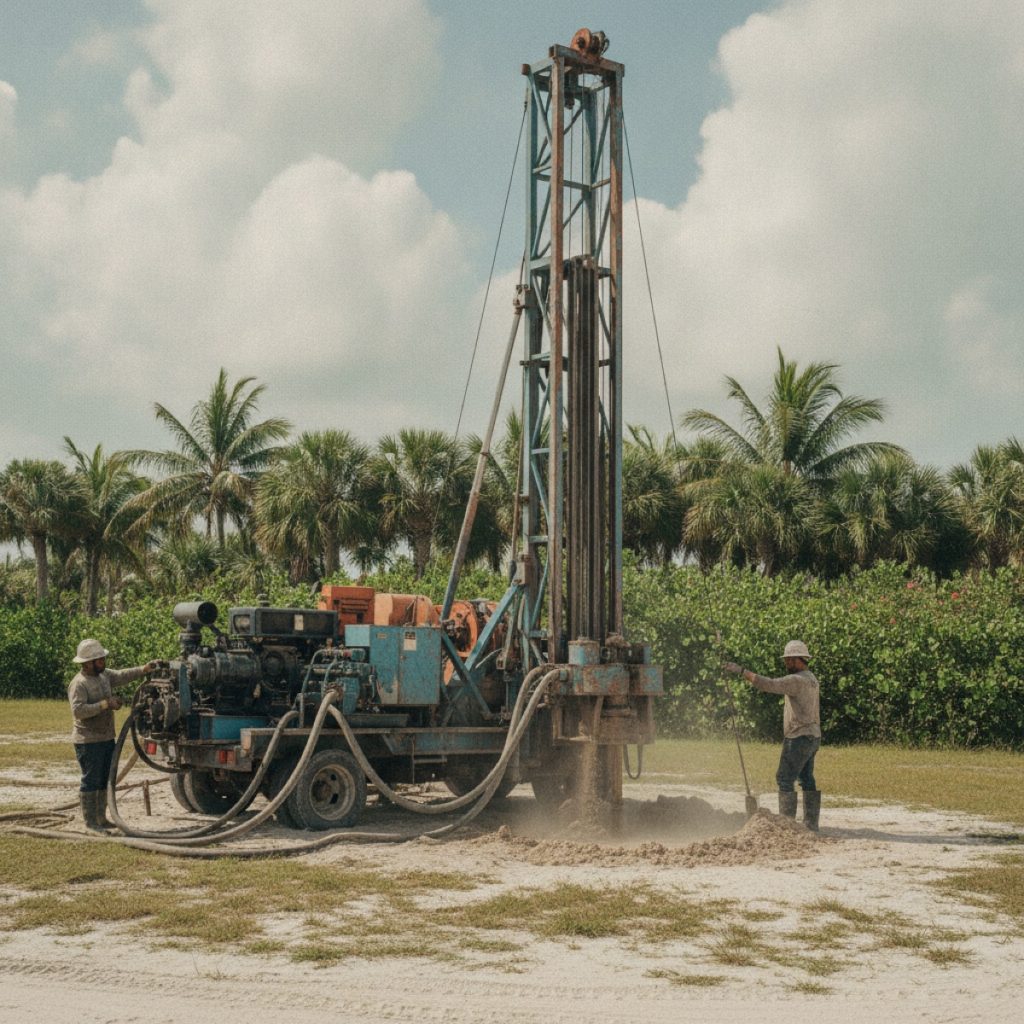
Drilling a well in Florida is different from drilling in most of the United States. Groundwater is abundant, the water table is often high, and productive limestone or sand may be reached at comparatively shallow depths. In parts of the state, a residential well may be only 40 to 100 feet deep. In other locations, the usable aquifer is several hundred feet down—or the deeper water is too salty to drink.
The practical answer is this: you need a well construction permit before drilling, and a typical residential well should be built by a Florida-licensed water well contractor. The correct depth, casing design, and water treatment plan depend on the exact property. A neighbor’s well log is useful evidence, but it is not a guarantee of what will be found beneath your lot.
Who regulates water wells in Florida?
Florida divides responsibility among several agencies. The Florida Department of Environmental Protection, usually called FDEP or DEP, has overall authority for water well construction under Part III of Chapter 373, Florida Statutes. DEP establishes the statewide rules.
The five regional water management districts carry out the contractor-licensing and well-permitting programs. A district may issue a permit itself or delegate that work to a county health department or another local agency.
| Water management district | District well rules |
|---|---|
| Northwest Florida Water Management District | Chapter 40A-3, Florida Administrative Code |
| Suwannee River Water Management District | Chapter 40B-3 |
| St. Johns River Water Management District | Chapter 40C-3 |
| Southwest Florida Water Management District | Chapter 40D-3 |
| South Florida Water Management District | Chapter 40E-3 |
Statewide minimum construction requirements are in Chapter 62-532, Florida Administrative Code. District rules can add location-specific requirements for casing, grouting, well depth, inspections, contaminated areas, saltwater intrusion zones, and other local conditions.
Does the county health department issue the permit?
Sometimes. Florida’s water management districts have delegated well permitting to county health departments in a number of counties, including Broward, Miami-Dade, Palm Beach, Orange, Osceola, Sarasota, Volusia, Brevard, Marion, Lake, and several others. Elsewhere, the permit may come directly from the water management district or another delegated local office.
This distinction matters because permit fees, inspection arrangements, required site plans, and local water-testing conditions can differ. Use the Florida Department of Health’s well-permitting agency map rather than assuming the county health department is responsible.
Florida water well contractor licensing
A person engaged in the business of constructing, repairing, modifying, or abandoning water wells must hold a Florida water well contractor license. The license is issued through a water management district and is valid statewide. DEP establishes the licensing framework under Chapter 62-531, while the districts process applications, examinations, renewals, and disciplinary matters.
This is occasionally confused with Department of Health licensing because county health departments issue permits and conduct inspections in some counties. The water management districts—not the Department of Health—issue Florida water well contractor licenses.
Florida law contains a narrow exception allowing an owner or renter to construct a well no larger than two inches in diameter on the property for personal residential or farming use. That exception does not automatically remove the permit, construction-standard, or completion-report requirements. Most dependable residential water systems use larger casing and fall outside the exception. A homeowner-sized bore also leaves little room for a submersible pump, future service, and the casing and sealing design needed at many Florida sites.
Before signing a contract, verify that the individual or company is currently licensed. Ask which person’s license will cover the work and make sure that number appears on the permit application and written proposal.
Well permits are required throughout Florida
A permit must generally be issued before a water well is constructed, repaired, modified, or abandoned in any Florida county. This applies to drinking-water wells and usually to irrigation, test, and monitoring wells as well. Narrow statutory exemptions exist, but a homeowner should never begin drilling based on an assumed exemption.
A licensed contractor commonly prepares and submits the application. A typical application identifies:
- The property owner and well contractor.
- The contractor’s Florida water well license number.
- The well location, property boundaries, and nearby sanitary hazards.
- The proposed use, such as household supply or irrigation.
- The anticipated depth, diameter, casing material, casing depth, and drilling method.
- Any related water-use permit or exemption.
- Known contamination areas, special construction zones, or local restrictions.
After construction, repair, or abandonment, a State of Florida Well Completion Report must be filed with the permitting authority within 30 days. This report is the permanent record of the work. It should show the total depth, casing, formation information, grouting, pump details where required, and the final status of the well.
Request a copy for your property records. A completion report is valuable when selecting a replacement pump, diagnosing changes in water quality, selling the home, or planning a future abandonment.
Consumptive use permits for larger withdrawals
A well construction permit authorizes the physical well. It does not necessarily authorize every proposed volume of groundwater withdrawal. Larger irrigation systems, farms, commercial operations, multiple-well systems, and other substantial uses may also need a consumptive use permit or water use permit from the regional district.
Thresholds and exemptions differ among districts. For example, the South Florida Water Management District generally exempts one well serving a single-family home or duplex from its water use permit, although the well construction permit is still required. A larger withdrawal may need water-use approval before the district will approve construction.
For an ordinary household well, the contractor should document the applicable exemption. If the well will also supply acreage irrigation, livestock, rental units, a business, or several homes, have the district classify the proposed use before drilling.
Florida’s aquifers: why well depth varies so much
The Floridan Aquifer System underlies all of Florida and parts of Georgia, Alabama, and South Carolina. It is one of the world’s most productive aquifer systems. That does not mean every Florida homeowner should drill directly into it. In some regions it contains excellent fresh water at accessible depths. In southeastern and far southern Florida, deeper Floridan water is commonly brackish or saline and may require advanced treatment.
The surficial aquifer system
The surficial aquifer is the water-bearing sand, shell, sandstone, or limestone closest to the surface. It is replenished by rainfall and can be productive at shallow depths. Many lawn-irrigation wells and some household wells use it.
Its proximity to the surface is both an advantage and a weakness. A shallow well may cost less to drill, but it is more exposed to septic leakage, fertilizer, animal waste, fuel spills, floodwater, and seasonal changes in the water table. Proper casing, grouting, wellhead elevation, and sanitary separation matter more than the fact that water was reached early.
The Biscayne Aquifer
The Biscayne Aquifer is a highly permeable part of the surficial aquifer system beneath Miami-Dade, Broward, and portions of Palm Beach and Monroe counties. Water moves readily through its limestone. That productivity supports major public wellfields, but the same openings allow contaminants and saltwater to move through the aquifer with relatively little natural filtration.
The Biscayne is vulnerable to coastal saltwater intrusion, canal leakage, urban contamination, and flood-related pollution. In these counties, a depth that produces abundant water may still be unsuitable if it approaches the mapped saltwater front or a contaminated zone.
The intermediate aquifer system
In parts of southwest and west-central Florida, water-bearing zones within the sediments between the surficial and Floridan systems can provide usable water. These zones are not uniform. Clay and other lower-permeability layers may separate them, and the well must be designed so it does not create a passage between waters of different quality.
Northwest Florida’s sand-and-gravel aquifer
In the western Panhandle, many water supplies come from thick deposits of sand and gravel rather than limestone of the Floridan Aquifer. These formations can produce good water, but local depth, iron, acidity, and surface contamination remain important. Florida is not geologically uniform from Pensacola to Miami.
Why some Florida wells are only 40 to 100 feet deep
Florida has low elevations, abundant rainfall, and productive shallow sands or limestone in many areas. The water table can be only a few feet below ground during wet periods. A contractor may encounter a useful water-bearing formation at 40, 60, or 100 feet in some inland or central Florida communities.
Water level and well depth are not the same measurement. A 100-foot well might have water standing 15 feet below ground, while its screened or open interval is much deeper. The additional depth and casing are intended to produce dependable flow, reach better-quality water, and keep unstable or contaminated shallow material out.
Deeper is not automatically better. A deeper bore can enter mineralized water, saltwater, or another aquifer that the permit does not allow the well to connect. The correct stopping depth is based on local well records, drilling observations, water quality, and the approved construction plan.
Karst limestone and sinkhole considerations
Much of Florida is karst terrain: limestone has gradually dissolved, leaving fractures, channels, cavities, springs, and sinkholes. These openings help the Floridan Aquifer transmit large volumes of water. They also make groundwater conditions change over short distances.
A contractor may encounter voids, lose drilling circulation into an opening, or find that nearby wells have different depths and yields. The construction must keep soil and polluted shallow water from travelling down the outside of the casing. It must also prevent one water-bearing zone from draining into another.
Residential well drilling does not mean a sinkhole will develop. However, large or concentrated pumping can lower groundwater levels, and groundwater helps support some underground materials. Risk deserves additional attention where there are existing depressions, cracking, a known sinkhole history, rapidly draining ponds, or major nearby agricultural and municipal withdrawals.
A water well contractor evaluates the bore and well design. A licensed geologist or geotechnical professional evaluates land stability. Those are different jobs. If the property shows signs of ground movement, resolve the stability question before choosing the rig location.
Saltwater intrusion along Florida’s coasts
Coastal groundwater normally exists as freshwater above or beside denser saltwater. When freshwater levels fall, the freshwater-saltwater boundary can move inland or upward. Heavy pumping can also pull salty water toward a well, a process known as upconing.
This issue is prominent in the Biscayne Aquifer, the Lower West Coast, coastal portions of the Floridan Aquifer, and the Southwest Florida Water Management District’s Southern Water Use Caution Area. Conditions can vary between nearby neighborhoods because of canals, wellfields, confining layers, and historic pumping.
There is no single statewide coastal depth limit
Coastal well-depth limits and mandatory construction designs are established by the applicable district, delegated agency, permit conditions, and sometimes local ordinance. A permit reviewer may limit the finished depth, require casing through certain zones, specify the aquifer that may be used, or require chloride testing.
In South Florida, drilling deeper can encounter brackish Floridan water beneath the freshwater Biscayne Aquifer. Near other coasts, excessive depth or an intake placed too low can reach the saltwater wedge. A contractor should review nearby completion reports, current saltwater-interface information, and special construction criteria before proposing a depth.
What homeowners should monitor
A salty taste is a late and unreliable warning. Laboratory testing can identify a trend before the water becomes obviously unpleasant. Coastal owners should consider baseline and follow-up measurements for:
- Chloride, a primary indicator of saltwater influence.
- Specific conductance, which reflects the water’s ability to conduct electricity as dissolved minerals increase.
- Total dissolved solids, the combined amount of dissolved mineral material.
- Sodium, particularly where a household member has a medically restricted sodium intake.
If chloride or conductance begins rising, do not respond by lowering the pump without reviewing the well construction. A different intake position might worsen the problem. Depending on the cause, the response may involve reducing the pumping rate, repairing damaged casing, changing irrigation demand, adding storage, reconstructing the well, or using another approved supply.
Hurricanes, storm surge, and flooded wells
Florida’s storm risk should influence well construction from the beginning. A well may remain structurally intact while floodwater enters around a damaged cap, low casing, conduit, vent, or underground enclosure. Floodwater can carry sewage, bacteria, fuel, pesticides, and debris.
Flood-resistant wellhead planning
- Place the well on the highest practical part of the approved site.
- Keep finished grade sloping away from the casing.
- Use a watertight sanitary seal and protect all openings.
- Keep the casing at least 12 inches above finished grade, as Florida’s statewide rule requires for private wells, and meet any greater local flood-elevation requirement.
- Avoid locating the well in a low enclosure that collects runoff.
- Anchor and protect exposed equipment where storm surge or moving debris is possible.
- Raise vulnerable electrical controls and use a qualified electrician for generator connections.
A generator can restore pumping during an outage, but electrical safety and water safety are separate. Powering a flooded or contaminated well does not make its water drinkable.
What to do after a hurricane or flood
- Stop using the water for drinking and food preparation if floodwater reached the wellhead or you are uncertain whether it did. Use bottled water, or follow current Florida Department of Health instructions for boiling or disinfecting emergency drinking water.
- Wait for floodwater to recede. Do not open a flooded cap or energize submerged electrical equipment.
- Inspect the system. Look for displaced casing, a loose cap, cracked seals, exposed wiring, damaged pressure equipment, erosion, or changes in the surrounding ground. Have a licensed contractor assess structural damage.
- Disinfect the well and household plumbing using instructions appropriate to the well diameter, depth, pump, and treatment equipment. Chlorine quantity is not one-size-fits-all.
- Flush the system until the disinfectant has cleared, following local environmental instructions for discharge.
- Test through a certified laboratory for total coliform and E. coli before returning the well to drinking use. Follow the county health department’s directions regarding confirmation samples.
Chlorination addresses microorganisms; it does not remove gasoline, pesticides, solvents, or other chemical contamination. If chemical exposure is possible, continue using another drinking-water source and ask the county health department which chemical tests are appropriate.
What does drilling a well in Florida cost?
Request itemized written quotes for your Florida property, using the same description of the work for each business. Record every total in USD.
First distinguish a drilling or borehole-only quote from a complete installation. Ask each business to identify inclusions, exclusions, allowances, taxes, quote date, validity period, and how changes require approval.
Use the well-use and flow questions as background for the project description, not as a price result.
| Quote comparison field | Question to record in writing |
|---|---|
| Property and access record | What property location, intended use, work area, access information, and available well or site records were used? |
| Drilling or borehole scope | Does the quote end at the drilled borehole, or which casing, sealing, development, testing, and completion items are included? |
| Complete-installation scope | Which pump, tank, controls, electrical, plumbing, building connection, treatment, restoration, and other trade work is included or excluded? |
| Permits, fees and records | Which authority fees, permits, inspections, reports, sampling, or laboratory items apply, who handles them, and where are they priced? |
| Uncertain or changed work | How are additional depth or casing, changed site work, a dry or low-yield bore, and an unsuccessful bore documented, authorized, and priced? |
| Quote terms | What are the quote date, validity period, USD total, taxes, allowances, exclusions, payment terms, and change-order process? |
Ask how the written quote handles additional or changed work, including extra depth or casing and a dry or low-yield bore, and who authorizes that work before it proceeds.
Florida-specific well construction standards
Chapter 62-532 establishes minimum standards, while district and local requirements may be more protective. Important statewide provisions include:
- Casing, liner pipe, couplings, and screens must be new or in like-new condition and free from damage or corrosion.
- PVC casing must meet at least Schedule 40 or SDR 21 specifications unless stronger casing is required.
- Materials used in potable wells must meet applicable NSF drinking-water standards.
- Casing joints must be watertight.
- Casing seated in consolidated rock must be seated or sealed with neat cement grout.
- Where a bore is larger than casing with an outside diameter of four inches or more, the annular space generally requires at least a nominal two-inch thickness of neat cement grout. Smaller casing generally requires a nominal one-inch thickness.
- The well must prevent movement between water-bearing zones where that movement could degrade water quality or reduce artesian pressure.
- Only potable water may be used in construction, equipment cleaning, and drilling-fluid preparation.
- A private or irrigation well casing must normally terminate at least 12 inches above finished grade and remain accessible for inspection and service.
- Pumping equipment and piping must pass through a proper well seal.
- An unused well must have a watertight cap or valve.
- A flowing artesian well must be controlled so water is not continuously wasted at the surface.
Sanitary setback distances are governed by the applicable district and local rules. In the Southwest Florida Water Management District, guidance for a single-family potable well includes 75 feet from septic tanks, drainfields, and drainage or retention ponds. Requirements elsewhere may differ, especially for public or limited-use systems. The approved site plan—not a statewide rule of thumb—should control placement.
Testing Florida well water
A private well serving one home is not monitored like a public water system. The homeowner is responsible for ongoing water quality. Florida does not impose a statewide routine sampling requirement for every private household well, and the state does not require a private well test merely because a home is being sold. Counties, lenders, insurers, and special programs may impose their own conditions.
The Florida Department of Health recommends annual testing for bacteria and nitrate. It also recommends that most homeowners test for lead every three years.
A useful baseline panel
- Total coliform and E. coli.
- Nitrate and nitrite.
- Lead.
- pH, hardness, iron, manganese, and total dissolved solids.
- Chloride, sodium, and specific conductance for coastal wells.
- Arsenic or radiological contaminants where local health officials recommend them.
- Pesticides, solvents, fuel compounds, or ethylene dibromide where land use or contamination maps indicate a risk.
Test after construction and disinfection, after pump or casing work, after flooding, whenever taste or odor changes, and after a nearby spill or septic failure. Use a Florida-certified drinking-water laboratory and follow its sampling instructions. Samples for bacteria require sterile containers and careful handling.
Iron staining, hardness scale, and hydrogen sulfide—the familiar rotten-egg odor—are common treatment concerns in parts of Florida. They do not tell you whether the water is free of bacteria, nitrate, lead, or other health contaminants. Choose treatment only after testing the untreated water and confirming the required household flow rate.
Delineated areas of known contamination
Florida has mapped areas where groundwater contamination is known under Chapter 62-524. New potable wells in these delineated areas face additional construction and testing requirements. If a property inside a delineated area is also within 500 feet of an available public water system, the permitting authority generally cannot issue a permit for a new potable well; connection to the public system is required.
Where a well is allowed, the Department of Health or county health department must clear the finished water for potable use. This review should occur before money is committed to an assumed well design.
Abandoning an old Florida well
An unused well is more than an open pipe. It can allow polluted surface water to enter an aquifer, connect freshwater and salty zones, waste artesian water, or create a physical hazard. Covering it with soil, cutting it below grade, or filling only the top does not meet Florida’s abandonment standard.
Obtain an abandonment permit from the district or delegated authority and use a licensed water well contractor. Under Chapter 62-532, an abandoned well must be filled from bottom to top with neat cement grout or bentonite and capped with at least one foot of neat cement grout, unless the permitting authority approves an equivalent method in writing.
The contractor should account for the well’s depth, diameter, casing, open intervals, artesian pressure, and any connected aquifers. The completed abandonment must be reported to the permitting authority within 30 days. Keep the permit and completion report with the property records so a future owner can verify that the well was legally sealed.