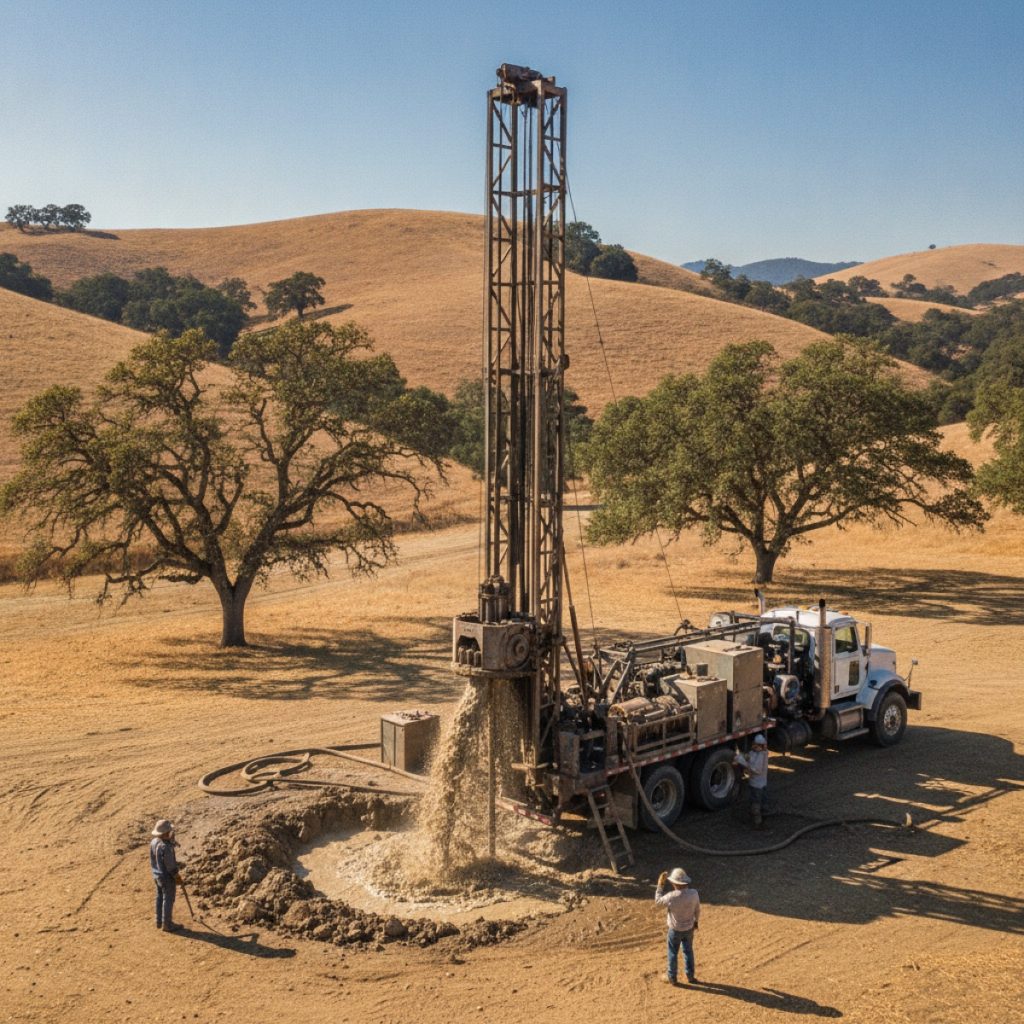
California does not issue one statewide residential well permit. If you are drilling a well in California, the permit normally comes from the county environmental health department—or, in a few places, a city or water agency. That local agency decides whether the proposed location, setbacks, construction details and intended use comply with its well ordinance.
The state still plays a major role. California publishes minimum well-protection standards, requires licensed contractors, receives Well Completion Reports and oversees groundwater planning. But two properties on opposite sides of a county line can face different applications, review times, setbacks and groundwater restrictions.
Do not schedule a drilling rig until the correct local agency has approved the permit. A productive well drilled in the wrong location, without required inspections or contrary to a groundwater plan can become an expensive compliance problem.
California sets the framework, but local agencies issue the permits
The California Department of Water Resources, usually called DWR, publishes the state’s technical well standards. The core documents are Bulletin 74-81 and the Bulletin 74-90 supplement. They address well location, casing, seals, surface protection, repair and destruction.
There is an important technical distinction: DWR describes Bulletin 74-90 as a draft supplement that was not formally finalized or incorporated into the statewide Model Well Ordinance. Nevertheless, many counties adopted its provisions in their own ordinances. For a homeowner, the controlling requirements are therefore the current local ordinance and permit conditions, not an isolated table found in one of the old bulletins.
| Authority | What it controls |
|---|---|
| California DWR | Well-protection standards, Well Completion Reports, well-record maps and statewide groundwater information. |
| Contractors State License Board | C-57 contractor licensing, license status, bonds and complaint information. |
| County, city or local water agency | Permit approval, local setbacks, inspections, construction conditions and well-destruction permits. |
| Groundwater Sustainability Agency | Groundwater use, spacing, pumping limits, reporting or other basin-management measures where applicable. |
| State Water Resources Control Board | Public water systems, drinking-water standards, water-quality programs and possible state intervention in deficient groundwater plans. |
DWR maintains a statewide list of well-permitting agencies. Use the property address and parcel number when contacting the agency. Do not assume the county handles the parcel merely because it is physically inside that county; incorporated cities and special water districts retain authority in some locations.
How the county well-permit process usually works
Most California counties require a permit before constructing, deepening, reperforating, repairing or destroying a well. The application is commonly submitted by the C-57 contractor, sometimes with the owner’s signature. A typical residential application includes:
- The assessor’s parcel number and legal property information.
- A scaled plot plan showing the proposed well, property lines, buildings, septic tank, leach field, sewer lines, waterways, existing wells, storage tanks and other possible contamination sources.
- The intended use, expected depth, casing diameter, drilling method and proposed annular seal. The annular seal is the watertight material placed between the casing and the drilled hole to stop contaminated shallow water from travelling down the outside of the casing.
- The contractor’s C-57 license information.
- Permit and inspection fees.
- Additional groundwater, water-quality, floodplain or land-use information where local conditions require it.
After approval, the contractor must arrange any required inspections. The seal installation is a common inspection point because it becomes inaccessible once the well is completed. Counties may also require a construction notice, completion documents, a yield test, laboratory results or final approval before the well can serve a new home.
County requirements are genuinely different
| Local example | What makes it different |
|---|---|
| Fresno County | The county well program covers unincorporated areas, requires the licensed driller to obtain approval before work begins and issues permits that are normally valid for 180 days. The county directs applicants in critically overdrafted subbasins to consult the appropriate GSA about use restrictions. |
| Monterey County | Each well requires a separate owner-signed, C-57-submitted application. New single-connection domestic wells require source-capacity testing. Some parcels using onsite sewage face acreage requirements, while wells in parts of the Salinas Valley receive additional groundwater review. Wells within the county’s Groundwater Monitoring Program zone must also be registered. |
| Sonoma County | The permit application requires a detailed site plan. The driller must give advance notice before completion or destruction work, and the permit process calls for completion records and applicable sample results. Permits expire if the work is not completed within the stated period. |
| Mojave Water Agency area | In addition to the county construction permit, Mojave Water Agency requires a notice of intent before construction under its Ordinance 14. New wells can also be subject to a groundwater replacement-cost assessment. |
When CEQA can enter the review
The California Environmental Quality Act, or CEQA, is not automatically a full environmental study for every domestic well. Many permits based entirely on fixed construction rules are processed as ministerial approvals, meaning staff applies established requirements without making a broader policy judgment.
CEQA may become relevant when the well is part of a subdivision or other development, the local agency has discretion to approve or condition it, pumping could affect a sensitive resource, or special basin rules require environmental findings. Monterey County, for example, states that its Environmental Health Bureau performs environmental review as part of its well-permit decision. Ask the permitting agency whether the application is ministerial, exempt or subject to additional review before relying on an expected approval date.
Only a properly licensed C-57 contractor may drill the well
California Water Code section 13750.5 requires the person responsible for drilling, deepening, reperforating or destroying a water well to hold a C-57 Water Well Contractor’s License. That license is issued by the California Contractors State License Board, not by DWR.
Before signing a contract, use CSLB’s Check a License service and confirm:
- The license is current and active.
- C-57 appears among the approved classifications.
- The business name on the license matches the name on the proposal and contract.
- The contractor’s bond is current.
- Workers’ compensation coverage or a valid exemption is shown.
- Any disclosed disciplinary or complaint information has been reviewed.
A pump contractor with a machinery-and-pumps classification may be qualified for certain pump work, but that classification alone does not authorize drilling the well. The drilling contract should identify who is responsible for the permit, inspections, Well Completion Report, pump, electrical connection, trenching, pressure tank, testing and cleanup.
SGMA can affect whether and how a new well is used
The Sustainable Groundwater Management Act, known as SGMA, requires local Groundwater Sustainability Agencies to manage California’s high- and medium-priority groundwater basins. Their plans are intended to prevent chronic groundwater declines, land subsidence, degraded water quality, seawater intrusion and other serious effects.
The county still issues the physical well permit in most locations. A GSA may, however, regulate extraction, establish spacing requirements, limit or suspend pumping, control new well construction, assign groundwater allocations, require registration or impose charges within its legal authority. California Water Code section 10726.4 also allows a GSA to ask a county to forward certain well applications for review.
Many household wells pumping no more than two acre-feet per year for domestic use fit SGMA’s definition of a “de minimis” user. That classification can provide relief from some SGMA measurement or fee provisions, but it is not a universal exemption from county permits, local well ordinances, adjudicated-basin rules or every GSA measure.
Old online material may refer to Action 9 of drought Executive Order N-7-22, which temporarily imposed extra state-level findings on well permits. That emergency provision was terminated in 2023. Current applicants should focus on the county ordinance, the applicable groundwater sustainability plan and any active basin rules rather than relying on an expired drought order.
What to ask before drilling in a managed basin
- Which GSA covers the parcel?
- Is the property inside a high-priority, critically overdrafted or adjudicated basin?
- Must the well be registered or metered?
- Are domestic wells exempt from pumping charges or allocations?
- Does the GSA specify a minimum well depth, screen interval or separation from existing wells?
- Is there a mitigation program if groundwater management causes a domestic well to fail?
- Are new wells, replacement wells and deepened wells treated differently?
These questions are especially important in the San Joaquin Valley, Salinas Valley, Paso Robles area, parts of Ventura County and desert basins with court-administered groundwater rights.
Use California well records before estimating depth
The driller must file a Well Completion Report with DWR within 60 days after constructing, altering or destroying a well. The report records the total depth, materials encountered, casing and screen details, seal construction, intended use and the yield observed during the driller’s test.
Homeowners can search DWR’s Well Completion Report map and OSWCR resources. OSWCR is commonly pronounced “Oscar.” Start with the property address, then examine several surrounding records rather than the nearest single point.
These records have limitations. Older reports may be missing, addresses may have changed and many mapped locations are generalized to a one-square-mile survey section. A reported yield also reflects a test performed when the well was completed; it is not a promise of present-day production.
For an existing home, obtain both the DWR report and the county permit file when possible. The county file may contain inspection notes, test results, repair permits and destruction records that do not appear on the statewide map.
California well depths vary sharply by region
Depth is controlled by the local aquifer, water quality, seasonal groundwater level and the depth needed to maintain supply through future dry periods. “We hit water at 150 feet” does not mean a 150-foot well is adequate. The driller may need to continue to a productive water-bearing interval and install the screen or open hole where it can provide usable water without drawing excessive sediment or poor-quality groundwater.
| Region | Planning depth, not a guarantee | Main concerns |
|---|---|---|
| Sacramento Valley | Many domestic wells fall roughly within 100–350 feet, although local conditions can require shallower or deeper construction. | Layered sand, gravel, silt and clay; agricultural nitrate; seasonal declines; differing water quality between shallow and deep zones. |
| San Joaquin Valley | About 200–600 feet is a reasonable initial research range for many domestic projects. Wells of 600–1,000 feet or more occur in heavily stressed or geologically difficult areas. | Severe overdraft in several subbasins, subsidence, dry shallow wells, nitrate, arsenic, salinity and poor-quality water in particular layers. |
| Coastal valleys | Common domestic projects may be in the 150–500-foot range, but basin structure can push wells much deeper. Salinas Valley aquifers, for example, include named 180-foot and 400-foot zones plus deeper formations. | Seawater intrusion, chloride, nitrate, limited recharge, pumping restrictions and the need to isolate saline or contaminated layers. |
| Sierra Nevada foothills | Roughly 200–500 feet is common in parts of the northern foothills; studies of central Sierra supply wells report depths around 300–750 feet. | Water occurs mainly in fractures in granite and metamorphic rock. A nearby successful well may not predict the yield one parcel away. |
| Desert basins | Approximately 250–700 feet is a useful research range in many developed desert areas. A USGS Mojave study found a median domestic-well depth near 300 feet, with sampled domestic wells reaching more than 600 feet. | Deep water levels, limited recharge, adjudicated pumping rights, high dissolved minerals, arsenic, fluoride, uranium and costly drilling if the first target interval is poor. |
Fractured-rock areas deserve extra caution. Water is stored in joints and cracks rather than a broad, uniform layer. Two wells at similar elevations and depths can have very different yields. In an alluvial basin, the major risk may instead be selecting the correct sand-and-gravel interval while sealing off shallow contamination or saline water.
What drilling a California well may cost
Request itemized written quotes for your California property, using the same description of the work for each business. Record every total in USD.
First distinguish a drilling or borehole-only quote from a complete installation. Ask each business to identify inclusions, exclusions, allowances, taxes, quote date, validity period, and how changes require approval.
| Quote comparison field | Question to record in writing |
|---|---|
| Property and access record | What property location, intended use, work area, access information, and available well or site records were used? |
| Drilling or borehole scope | Does the quote end at the drilled borehole, or which casing, sealing, development, testing, and completion items are included? |
| Complete-installation scope | Which pump, tank, controls, electrical, plumbing, building connection, treatment, restoration, and other trade work is included or excluded? |
| Permits, fees and records | Which authority fees, permits, inspections, reports, sampling, or laboratory items apply, who handles them, and where are they priced? |
| Uncertain or changed work | How are additional depth or casing, changed site work, a dry or low-yield bore, and an unsuccessful bore documented, authorized, and priced? |
Ask how the written quote handles additional or changed work, including extra depth or casing and a dry or low-yield bore, and who authorizes that work before it proceeds.
- What mobilization, travel, site access, and setup are included?
- Where does the drilling or borehole scope begin and end?
- Which casing, screen, liner, sealing, or completion items are included or excluded?
- Which development, yield, sampling, testing, and project-record items are included?
- Which pump, tank, controls, cable, pipe, and related equipment are included?
- Which electrical, plumbing, trenching, building-connection, and restoration work is included?
- Which authority fees, permits, inspections, reports, or laboratory items apply, and who handles them?
- Is any water-treatment work included, excluded, or deferred until property-specific results are available?
- What cleanup, removed-material handling, site restoration, and unsuccessful-bore work is included?
- How are additional depth or casing and dry or low-yield work documented, authorized, and priced?
- What are the quote date, validity period, USD currency, taxes, allowances, and exclusions?
State setback and construction benchmarks
Local rules control the permit, but the combined Bulletin 74 standards provide a useful baseline. They list the following minimum horizontal separations where suitable unsaturated soil exists between the surface and groundwater:
| Potential contamination source | State benchmark |
|---|---|
| Sanitary, industrial or storm sewer | 50 feet |
| Watertight septic tank | 100 feet |
| Subsurface sewage leach field | 100 feet |
| Cesspool or seepage pit | 150 feet |
| Animal or poultry enclosure | 100 feet |
These distances are not universally adequate. A county can require more separation because of fractured rock, shallow groundwater, permeable soil, slope, flooding, chemical storage, known contamination or the direction of groundwater movement. A reduced setback requires local approval and added protection; it is not something the owner and driller can agree to privately.
For an individual domestic well, the Bulletin 74 baseline annular seal extends at least 20 feet below the ground surface. The seal generally must be at least two inches thick between the casing and borehole wall. A well approved closer to a contamination source may require a seal extending at least 50 feet or to an appropriate low-permeability layer.
The casing should terminate above grade and known flooding, with surrounding drainage directed away from the well. The cap, vents, wiring openings and pipe connections must prevent surface water, insects and contaminants from entering. The completed well must be developed to remove drilling material and disinfected before domestic use. Local inspectors may impose additional casing, pad, backflow, sampling or flood-protection requirements.
Plan for drought, not only today’s water level
Groundwater levels in California can decline dramatically during a multi-year drought and may not fully recover after one wet winter. Shallow domestic wells are often the first to lose production when agricultural or municipal pumping lowers the shared water level.
Before selecting a completion depth, review nearby well records, seasonal monitoring data and the applicable groundwater sustainability plan. Ask for the current static water level—the depth of the water when the well is not pumping—and the pumping water level observed during the yield test. The pump must remain submerged while allowing clearance above sediment and the bottom of the well.
A deeper well is not automatically more reliable. It may encounter saline water, arsenic, old groundwater with undesirable minerals or a different aquifer subject to pumping restrictions. The design should balance drought resilience, water quality, construction cost and local basin requirements.
If an existing household well goes dry, report it through DWR’s Dry Well Reporting System. Statewide homeowner reporting is voluntary, but it helps agencies identify shortages and connect households with available programs. Filing a report is not itself an application for financial assistance, so the owner should also contact the county’s drought or emergency-services office.
Test the water before relying on it
Most private domestic wells are not monitored by the state like public water systems. The homeowner is responsible for confirming that the water is fit to drink. Use a California ELAP-accredited laboratory when making health or treatment decisions; an ELAP laboratory follows state-recognized analytical procedures.
The State Water Board’s domestic-well guidance recommends annual testing. A practical California baseline includes:
- Every year: total coliform bacteria, E. coli when indicated, nitrate and electrical conductivity. Conductivity is a broad indicator of dissolved minerals and changing water chemistry.
- For a new well: arsenic, uranium or other radionuclides where locally relevant, major minerals, iron, manganese, hardness, pH, total dissolved solids and chloride.
- In agricultural regions: nitrate plus locally used pesticides and legacy contaminants such as DBCP or 1,2,3-TCP where the county or laboratory recommends them.
- Near the coast: chloride, total dissolved solids and conductivity to establish a baseline for seawater intrusion.
- Near fuel storage, industrial sites, airports or fire-training areas: the specific volatile chemicals, petroleum compounds or PFAS associated with the site.
- After flooding, wildfire, well repair, loss of pressure or a change in taste, odor or color: repeat bacteriological testing and any tests related to the event.
California’s private-well guide recommends annual coliform, nitrate and conductivity testing, with a broader mineral panel about every five to ten years or when conditions change. Local environmental health officials may recommend a different schedule based on known groundwater problems.
As of 2026, California also has targeted requirements for certain rental properties under AB 2454. A landlord whose rental property is supplied by a domestic well and lies within an eligible state-funded or state-regulated free testing program may be required to participate, provide results to tenants and follow the program’s replacement-water rules.
Do not purchase treatment equipment before receiving laboratory results. Ultraviolet light, water softeners, activated carbon, reverse osmosis and specialty arsenic or nitrate systems solve different problems. Treatment must be selected for the confirmed contaminants and the complete water chemistry, then verified by follow-up laboratory testing.
Abandoned wells must be properly destroyed
An unused well is a direct pathway from the surface into groundwater and can also be a serious physical hazard. Under California standards, a well that has not been used for one year is generally considered abandoned or permanently inactive unless the owner demonstrates an intention to use it and maintains it in a protected condition.
An inactive well being retained for future use must remain securely covered, identifiable, protected from contamination and surrounded by a clear area. A deteriorated casing, open wellhead or forgotten hand-dug well should be reported to the local permitting agency.
Permanent destruction requires a local permit and a C-57 contractor. The contractor investigates the well, removes obstructions and pollutants, fills it from the bottom upward and seals intervals so that water cannot move between aquifers. At minimum, the upper 20 feet must be sealed under the Bulletin 74 baseline, although the county may require substantially more. The contractor must then file the applicable completion or destruction report with DWR within 60 days.