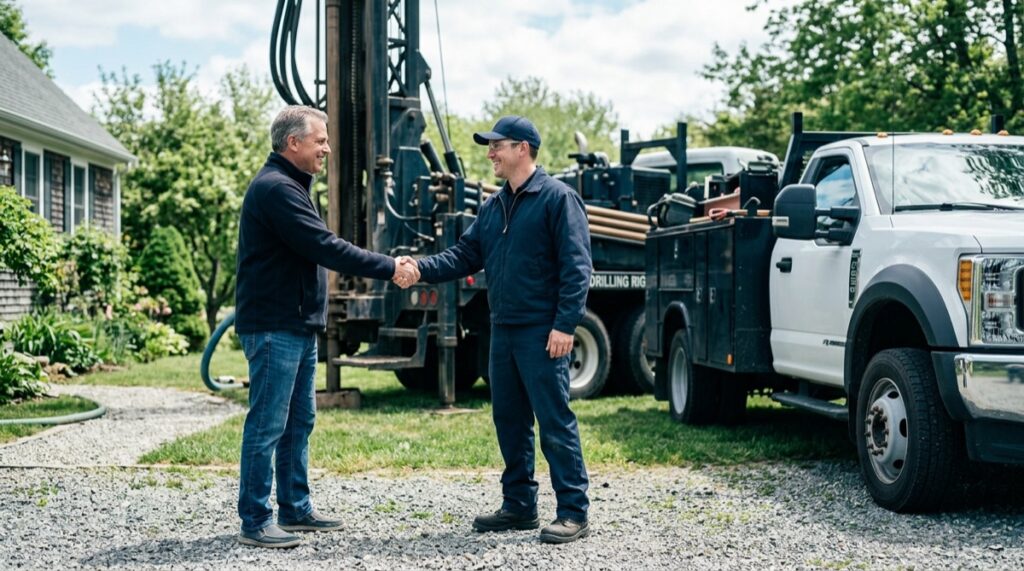
Hiring a well driller is not like hiring a general contractor. You are trusting someone to bore through your property into the water supply your household may depend on for decades. A poor installation can leave you with contaminated water, a collapsed borehole, avoidable repair costs, or a well that underperforms from its first day.
The best way to choose a well driller is to verify the contractor’s credentials yourself, compare written scopes rather than headline prices, and ask detailed questions about depth, casing, sealing, water yield, payment, and the final well record. The right questions separate experienced groundwater professionals from companies that merely own drilling equipment.
Before you call anyone, verify the license
Do not rely on a truck logo, website badge, association membership, or a license number printed on an estimate. Look up the contractor through the government authority responsible for wells in your location.
In the United States, private-well oversight is largely handled at the state, county, tribal, or local level. The responsible office may be a health department, environmental agency, natural-resources department, or licensing board. The US Environmental Protection Agency maintains a directory of private drinking-water well programs by state, which is a useful starting point. Your county may impose additional permitting, setback, construction, or inspection requirements.
Canada also regulates wells provincially rather than through one national licensing system. Terminology differs by province. Ontario, for example, licenses both well contractors and individual technicians, while British Columbia maintains registers of qualified well drillers and well pump installers. Search the official provincial website for “well contractor licence,” “well technician licence,” or “registered well driller.”
What to confirm in the registry
- The license or licence is active and has not expired.
- The business name on your quote matches the licensed business.
- The individual supervising the work holds the correct class of credential.
- The credential covers water-well drilling, not only environmental drilling, geothermal work, excavation, or another specialty.
- The regulator does not list restrictions, suspensions, or unresolved disciplinary action.
- A separate pump credential is present if that jurisdiction requires one for pump installation.
A general contractor’s license does not necessarily authorize water-well construction. Likewise, a licensed plumber, electrician, excavator, or pump salesperson may not be authorized to drill or alter a well.
What “licensed” actually proves
The meaning of a license varies. Depending on the jurisdiction, a license may require documented field experience, approved training, a competency examination, continuing education, a financial bond, proof of insurance, or some combination of these. Ontario’s well-technician process, for example, includes education, work-experience, and examination requirements.
Do not assume that licensing automatically confirms every protection you need. A contractor may hold an active drilling license while carrying inadequate insurance for your project. Bonding, workers’ compensation coverage, commercial vehicle coverage, and liability insurance can be separate matters. Ask the licensing authority what its credential establishes, then verify the remaining protections independently.
A drilling credential and a pump credential may be different
Drilling creates and completes the well bore. Pump installation involves selecting and installing the pump, drop pipe, wiring, controls, pressure equipment, and related components that bring water into the building. Some jurisdictions authorize both types of work under one credential; others distinguish between well drillers and pump installers.
If one company intends to handle the entire system, ask which licensed person is responsible for each portion. The answer should identify actual people or properly licensed subcontractors, not merely state that the company “does wells.”
| Question | Why it matters | A good answer sounds like | Red-flag answer |
|---|---|---|---|
| 1. Are you licensed here? | Authority is location- and work-specific. | Provides the current number, class, and supervising technician. | “We’ve worked here for years.” |
| 2. Can I see your insurance certificate? | Drilling can damage property, utilities, equipment, or groundwater. | Supplies a current certificate covering the business and drilling operations. | “Our license includes insurance.” |
| 3. How many wells have you drilled locally? | Nearby geology affects methods, depth, and risk. | Discusses comparable wells and provides local references. | Talks only about company age or total wells. |
| 4. What depth do you expect? | Depth is a major cost variable but cannot be known exactly beforehand. | Gives a range based on nearby records and explains uncertainty. | Promises an exact depth without evidence. |
| 5. What casing will you use? | Casing stabilizes and protects the well. | Names the material, diameter, standard, and anticipated depth. | “Whatever we normally carry.” |
| 6. How will you seal around the casing? | The seal helps keep shallow contamination from moving down the borehole. | Explains the grout, placement method, depth, and local rule. | Dismisses grouting as unnecessary without a code-based reason. |
| 7. What is included? | Two similar totals may cover very different work. | Provides itemized rates, allowances, exclusions, and taxes. | Offers only a one-line total. |
| 8. What if expected water is not found? | A dry or low-producing bore is a real possibility. | Defines stopping authority, added-depth pricing, and abandonment costs. | “We always find water.” |
| 9. Is there a yield guarantee? | Finding water is not the same as supplying household demand. | States the test method and exactly what any guarantee covers. | Promises “plenty of water” without a measurable standard. |
| 10. What is the timeline? | Permits, weather, access, and subsurface conditions can cause delays. | Gives a realistic window and names likely delay factors. | Guarantees a date regardless of conditions. |
| 11. What is the payment schedule? | Payments should reflect work and materials delivered. | Uses a stated deposit and defined progress or completion milestones. | Demands the entire estimated amount before mobilization. |
| 12. Will I receive the well record? | The record documents construction, geology, water level, and testing. | Confirms who files it, when you receive it, and what it contains. | “The government keeps that.” |
The 12 questions to ask every well driller
1. Are you licensed in this state or province?
Ask for the business license number and the name and credential of the person who will supervise the drilling. If pump installation is included, ask whether that portion requires a different license. Then confirm the information in the official registry.
A strong answer is specific: “Our company license is active, I hold the drilling class required for this method, and our pump installer is licensed separately.” A business card carrying a number is not independent verification.
2. Can I see your certificate of insurance?
Ask for a current certificate showing commercial general liability coverage and coverage appropriate to water-well drilling. Workers’ compensation requirements also matter when employees will be on your land. The certificate should name the insured business, policy dates, insurer, and coverage limits.
Call the insurer or broker using independently confirmed contact information. Ask whether the policy is active and whether drilling operations are covered. Standard contractor coverage may contain exclusions that matter when equipment is boring hundreds of feet into the ground.
3. How many residential wells have you drilled in this area?
Local experience matters more than a broad statement such as “thirty years in business.” A driller familiar with your area may have encountered the same bedrock, unstable formations, flowing conditions, mineral concerns, and access limitations that affect your property.
Ask about wells within the same township, county, rural municipality, or geological area. A good driller can discuss patterns without pretending every neighbouring property will behave alike. Request references for recent residential projects with comparable conditions.
4. What depth do you expect, and what is that based on?
No responsible contractor can see the exact underground conditions before drilling. An expected-depth range should come from nearby well logs, geological mapping, the contractor’s local experience, and the intended aquifer. Even adjacent properties can have different depths and yields.
Ask to see the nearby records used for the estimate. Then establish a decision point in the contract: at what depth must the driller stop and contact you before continuing? This prevents an uncertain depth estimate from becoming open-ended spending authority.
5. What type of casing will you use, and to what depth?
Casing is the pipe that supports and protects the well opening. Its material, diameter, wall specification, joints, and depth must suit the geology, drilling method, pump, and local construction code. Steel and approved plastic casing each have appropriate applications; one is not universally superior.
The contractor should explain where the casing is expected to end, whether an open bedrock section or well screen is anticipated, and how the final choice may change with the formation encountered. The quote should state unit pricing if additional casing becomes necessary.
6. How will the annular space be sealed?
The annular space is the gap between the drilled hole and the outside of the casing. If that pathway is not sealed as required, shallow water carrying bacteria, fuel, fertilizer, or other contaminants may travel downward beside the casing.
Ask what grout will be used, how deep the seal will extend, and how it will be placed. Depending on local rules and conditions, grout may be bentonite-based, cement-based, or another approved material. Placement from the bottom upward through a grout pipe is used in many circumstances to reduce gaps and bridging. The driller should describe the method in ordinary language and connect it to the applicable construction standard.
7. What is included in your quote, and what is not?
Well estimates often combine fixed charges, per-foot rates, allowances, and work billed only if needed. Request separate pricing for mobilization, drilling, casing, screen, grout, development, yield testing, disinfection, permits, water sampling, pump installation, electrical work, trenching, pressure equipment, excavation, spoils removal, and site restoration.
Clarify whether the quoted total assumes a particular depth and casing length. Ask how standby time, lost tools, difficult formations, extra trips, winter conditions, or restricted access are handled. You are not demanding certainty; you are making the uncertainty visible before work begins.
8. What happens if you do not find usable water at the expected depth?
A driller cannot manufacture an aquifer. The contract should explain what happens if the bore is dry, produces too little water, encounters poor-quality water, or reaches the agreed stopping depth without an acceptable result.
Ask who decides whether to continue, what added depth costs, whether moving to a second location requires another mobilization charge, and who pays to seal an unsuccessful bore. Require your written authorization before drilling beyond the stated limit. “We always hit water” is sales language, not a risk plan.
9. What is the yield guarantee, if any?
Yield is the rate at which the well can supply water, usually expressed in gallons per minute in the US and gallons or litres per minute in Canada. A short burst of water while drilling is not the same as a sustained supply.
Many drillers offer no yield guarantee because groundwater is uncertain. Others define a minimum tested rate or offer limited remedies. Ask how yield will be measured, how long the test will run, whether recovery will be recorded, and whether the guarantee covers the bore only or the completed water system. Every promise should use measurable terms and appear in the contract.
A modest-yield well may still serve a household when storage and pumping equipment are designed around its recovery rate. That is a system-design discussion, not proof that every low-yield result is acceptable.
10. What is your timeline, and what can delay it?
Ask for a realistic start window, expected onsite duration, and the sequence for permits, utility locating, access preparation, drilling, development, testing, pump work, and cleanup. A precise date far in advance may be less credible than a well-explained scheduling window.
Common delays include permit review, road restrictions, wet or frozen ground, equipment availability, utility conflicts, inaccessible terrain, severe weather, difficult formations, artesian flow, material shortages, and prior projects taking longer underground than predicted. Establish how schedule changes will be communicated.
11. What is the payment schedule?
A deposit may be reasonable when the contractor must reserve equipment, obtain permits, or order materials. Full payment before work begins shifts nearly all financial risk to the homeowner.
The written schedule should connect payments to defined events, such as mobilization, completion of drilling and casing, pump-system installation, or delivery of required records. It should also explain how variable-depth charges are calculated and when you will receive itemized invoices. Do not rely on a verbal promise to “settle up at the end.”
12. Will I receive a complete well record or log?
The well record is the permanent construction history of your water source. Depending on the jurisdiction, it may document location, total depth, geological formations, casing and screen details, grout, static water level, pumping level, yield test, completion date, and contractor information.
Ask who files the official record, the filing deadline, and when you will receive your copy. California requires well completion reporting, Ontario requires contractors to provide and submit well records, and British Columbia requires reports for specified well work. Exact deadlines and access rules vary.
Keep the record with your property documents. Future pump installers, inspectors, water-treatment professionals, buyers, and regulators may need it. A final invoice is not a substitute.
Red flags and green lights during the hiring process
| Red flag | Green light |
|---|---|
| No written contract, or a scope that says only “drill well.” | A detailed scope identifies materials, unit rates, exclusions, tests, records, and change authorization. |
| The contractor wants the full estimated price before arriving. | Payments are tied to documented work, delivered materials, and completion milestones. |
| Casing and grouting decisions are brushed aside as details homeowners should not question. | The driller explains the proposed construction and identifies what field conditions could change it. |
| “We’ve never had a problem” replaces answers about dry holes, damage, delays, or complaints. | The contractor discusses risks, contract procedures, and examples of how difficult jobs were handled. |
| You are pressured to sign immediately because the quoted price or schedule will supposedly disappear. | You are given time to verify credentials, compare scopes, contact references, and read the agreement. |
| Depth, yield, or water quality is guaranteed verbally with no limits or test method. | Predictions are supported by records, uncertainty is acknowledged, and written terms are measurable. |
Compare multiple quotes by scope, not just price
Obtain written quotes from at least two qualified contractors when local availability permits. Give each contractor the same property information and requested scope. Tell them the intended use, expected household demand, proposed well location, access constraints, known septic locations, property boundaries, overhead lines, buried services, and any local records you have found.
Create a comparison sheet using the same assumed depth and casing length for every quote. Separate fixed charges from per-foot and hourly rates. Then compare:
- Expected depth range and the records supporting it
- Drilling, casing, screen, and grouting specifications
- Mobilization and additional-trip charges
- Well development, disinfection, and yield-testing methods
- Pump, pressure tank, controls, trenching, plumbing, and electrical scope
- Permits, inspections, laboratory sampling, and record filing
- Site-access requirements and restoration responsibilities
- Dry-hole, low-yield, and added-depth terms
- Warranty coverage and exclusions
- Payment milestones and change-approval procedures
A lower quote may exclude the pump, electrical connection, water line, testing, or cleanup. A higher quote may include work that another contractor will bill separately. The useful comparison is the likely cost of reaching the same finished and documented result—not the largest number printed at the bottom of the first page.
Price still matters. It just becomes meaningful after you understand what each contractor has promised to provide.
Your contract should put the uncertain parts in writing
Because final depth and underground conditions cannot be confirmed in advance, a well contract needs both technical detail and financial decision points. At minimum, it should include:
- Legal names, contact information, license numbers, and responsible technicians
- Property address and proposed well location
- Who obtains permits, locates utilities, and confirms required setbacks
- Drilling method and proposed bore diameter
- Casing material, diameter, specification, anticipated depth, and unit price
- Screen, liner, drive shoe, cap, pitless connection, and other planned components
- Grout material, seal depth, and placement method
- Fixed charges plus per-foot, hourly, and optional-item rates
- An initial depth estimate and a depth that cannot be exceeded without written approval
- Procedures and charges for a dry, low-yield, contaminated, unstable, or flowing bore
- Well development, disinfection, yield testing, recovery measurements, and water sampling
- Work excluded from the price
- Site damage, drilling-fluid, cuttings, and cleanup responsibilities
- Start window, delay communication, payment schedule, warranties, and dispute terms
- Delivery and government filing of the completed well record
Changes made during drilling should be documented before the additional work proceeds whenever conditions allow. If the contractor recommends more casing or greater depth, ask what was encountered, what the added work will cost, and what alternatives exist. Record the authorization in writing.
References are most useful when you ask about decisions, not satisfaction
“Were you happy?” usually produces a polite yes or no. Ask previous customers questions that reveal how the contractor behaved when the outcome was uncertain:
- Was the final bill consistent with the written unit rates and approved changes?
- Did the contractor explain why the completed depth differed from the estimate?
- Were casing, grouting, testing, and pump details documented?
- Did the crew protect the property and explain unavoidable damage?
- How were delays or unexpected conditions communicated?
- Did the customer receive the well record and test results?
- Was a service or warranty concern handled responsibly?
- Would the customer hire the company for another well under similar conditions?
Recent local references are the most relevant. A flawless review from a shallow sand-and-gravel well does not tell you much about a contractor’s ability to manage a deep bedrock bore, artesian pressure, or unstable formations.
Sources and methodology
This article was developed from homeowner hiring concerns, common well-contract provisions, and current public guidance from US and Canadian authorities. Technical recommendations were checked against the US EPA directory of state private-well programs, the Montana guide for prospective well owners, and Penn State Extension guidance on new well construction.
Canadian licensing and record practices were checked against Ontario’s official information for well-technician licensing and well records, along with British Columbia’s registry of well drillers and pump installers. California’s well completion reporting guidance was reviewed as a US example of required construction records.
These sources illustrate why homeowners must check their own state, provincial, county, municipal, or tribal requirements. Licensing standards, approved materials, minimum setbacks, sealing rules, testing obligations, and reporting deadlines are not uniform across North America. Local law and site-specific groundwater conditions take precedence over general guidance.