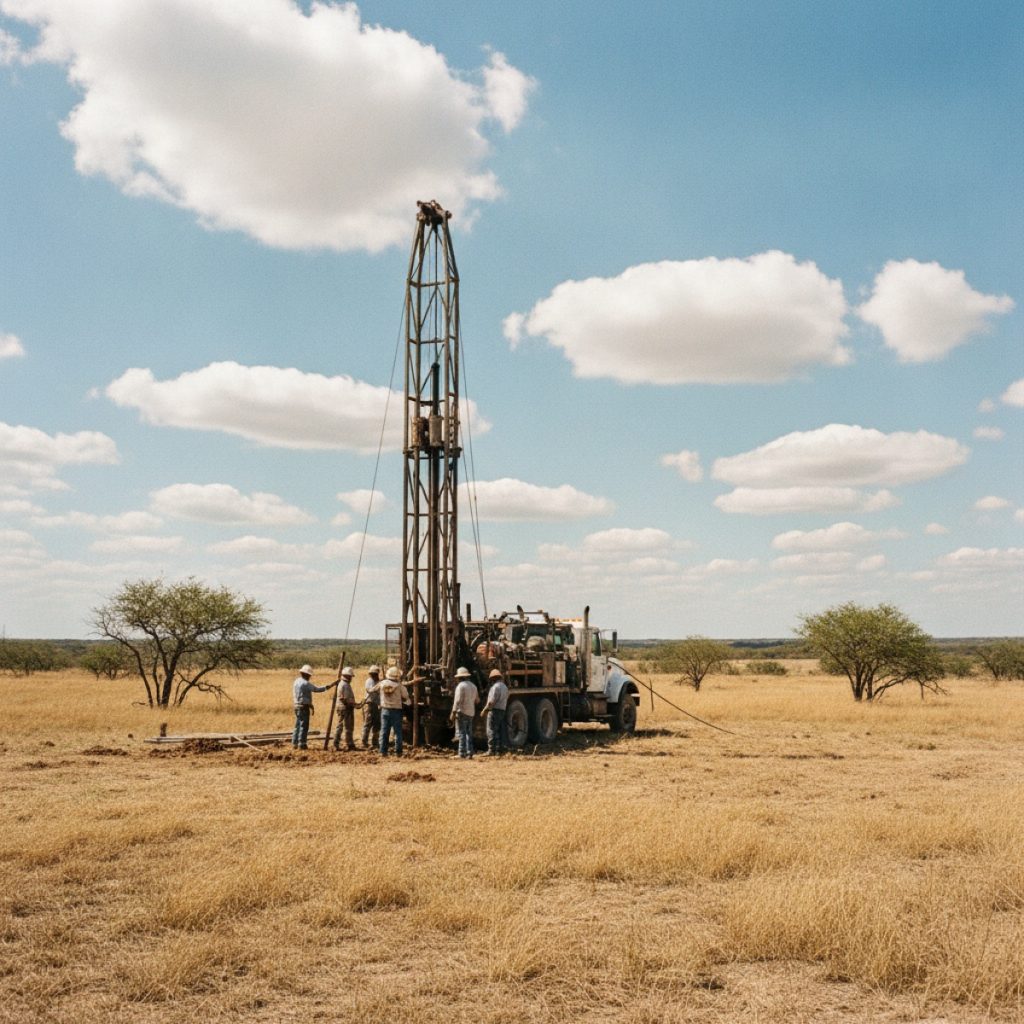
Drilling a well in Texas starts with an unusual regulatory combination: Texas licenses water-well drillers statewide, but it does not issue a statewide site permit for an ordinary domestic well. If you hire someone to drill or equip the well, that person needs the appropriate Texas Department of Licensing and Regulation credential. Whether the well itself needs a permit, registration, spacing approval, or production authorization depends on the groundwater conservation district, county, or city governing the property.
That local variation matters. One Texas property may need a groundwater-district application before a rig arrives, while a comparable domestic well in another county may require no drilling permit. Even an exempt well may still have to be registered and comply with local spacing, construction, drought, and reporting rules.
Cost and depth vary just as widely. A shallow well in favorable East Texas sand may reach usable water near 50 to 150 feet. A Trinity, Hill Country, Panhandle, or West Texas project may run several hundred feet, and wells exceeding 800 feet are not unusual in some areas. Nearby well records are useful evidence, but they cannot guarantee your final depth, yield, or water quality.
Who regulates private wells in Texas?
Texas divides responsibility among several agencies and local authorities. Understanding those boundaries will prevent a common mistake: asking the right question of the wrong office.
Texas Department of Licensing and Regulation
The Texas Department of Licensing and Regulation, usually called TDLR, licenses water-well drillers and pump installers. It also administers the construction, completion, reporting, capping, and plugging rules in Title 16, Texas Administrative Code, Chapter 76.
TDLR’s role is mainly concerned with who performs the work and how the well is built. It does not normally approve the location of each private domestic well through a statewide permit. TDLR can inspect work, investigate complaints, discipline license holders, and consider requests for alternative construction procedures when standard requirements cannot be used.
Groundwater conservation districts
Groundwater conservation districts, or GCDs, are local government bodies with authority to manage groundwater within their boundaries. A district may regulate well spacing, require registration, issue drilling or operating permits, limit production from non-exempt wells, collect reports, inspect wells, and adopt drought restrictions.
District rules are not uniform. Domestic wells may be:
- exempt from both drilling and operating permits;
- exempt from a production permit but still subject to registration;
- required to obtain a drilling authorization before construction;
- limited by tract size, pump capacity, intended use, aquifer, or well spacing; or
- subject to additional construction or drought rules even when permit-exempt.
Under Texas Water Code Section 36.117, many GCDs must provide a permit exemption for a well used solely for domestic, livestock, or poultry purposes when it is on a tract larger than 10 acres and is incapable of producing more than 25,000 gallons per day. That exemption should not be read as a universal ten-acre rule. District enabling laws and local rules differ, smaller tracts may be treated differently, and registration or construction requirements can remain in effect.
Counties, cities, and health departments
A county environmental or health department may administer septic-system requirements and review whether the proposed well can satisfy required separation distances. Cities can also regulate wells through ordinances, especially inside municipal limits. Some cities require a local well permit even though the state does not.
Recorded subdivision restrictions and property-owner association documents deserve separate review. A tract may be physically large enough for a well but subject to a recorded restriction requiring connection to a public water system or controlling where a well can be located.
TCEQ and public water systems
The Texas Commission on Environmental Quality regulates public water systems. A private well serving one household is generally outside that program. A well that supplies multiple residences, the public, a business with enough users, or water offered for sale may fall under public-water-system rules, which involve more demanding design, approval, testing, and operating requirements.
How to verify a Texas well driller’s license
Anyone you hire to drill a water well should hold an active TDLR water-well driller license with the Water Wells endorsement. Pump work should be performed by a properly licensed pump installer. A company name on a truck is not enough; confirm the credential belonging to the responsible individual.
Use the official TDLR Active License Search at https://www.tdlr.texas.gov/LicenseSearch/. Select “Water Well Drillers, Pump Installers” as the license type, then search by the individual’s name, business name, or license number. Confirm:
- the license is active and has not expired;
- the name matches the person responsible for the job;
- the license includes the Water Wells endorsement for domestic-well drilling;
- the installer has the endorsement appropriate for the proposed pump; and
- any apprentice or assistant is working under lawful supervision.
Texas driller endorsements include water wells, monitor wells, injection wells, dewatering wells, and closed-loop geothermal wells. A master driller holds all listed drilling endorsements. Pump-installer endorsements cover single-phase pumps, three-phase pumps, line-shaft turbine pumps, and windmills, hand pumps, and pump jacks. Most homes use a single-phase submersible pump, but larger ranch or irrigation systems may require a different credential.
Texas law contains a provision allowing a landowner to drill on the landowner’s own property, provided all construction, reporting, and local district requirements are followed. That provision is not permission to hire an unlicensed person or pay unlicensed helpers to run a drilling business. For a household supply, using a licensed contractor also gives you access to experience with local formations, sanitary construction, testing, and required reports.
Does a domestic well need a permit?
There is no statewide TDLR site permit for an ordinary domestic well. Your local answer depends on the exact parcel, not merely the county name. GCD boundaries can divide counties, overlap only part of a county, or follow boundaries that are not obvious from a mailing address.
Find the district before requesting bids
Enter the property address in the Texas Alliance of Groundwater Districts GCD Index. You can also use the TWDB Groundwater Data Viewer and turn on the Groundwater Conservation Districts layer.
If the parcel is in a GCD, contact that district directly and ask for its current rules and domestic-well application or registration form. Ask whether approval must be issued before drilling, whether an exempt well must be registered, and whether the district has separate spacing or pump-capacity limits.
If the map shows no district, check with the county environmental or health office, the city if the property is within municipal boundaries, and the authority responsible for the septic system. No GCD does not necessarily mean no local ordinance.
Information commonly required
A local application or registration commonly requests:
- the owner’s name and contact information;
- the property address and legal description;
- tract acreage and proof of ownership or authorization;
- GPS coordinates or the proposed well location;
- a site plan showing property lines, buildings, septic components, existing wells, roads, and contamination sources;
- the well’s intended use;
- estimated depth, casing diameter, and proposed aquifer;
- pump size, production capacity, or expected daily use;
- the driller’s name and TDLR license number; and
- an application fee, where applicable.
A permit exemption does not necessarily exempt the well from spacing or waste-prevention rules. Some districts require domestic wells to be registered before drilling so they can confirm that the well actually qualifies for the exemption.
Do not assume that the driller will obtain every local approval unless the written proposal assigns that responsibility. The owner ultimately needs to know that the site is authorized. A well drilled in the wrong place may require corrective construction, a variance, or abandonment.
Well logs and Texas well records
A Texas State Well Report is one of the most valuable documents you will receive. It records the location, drilling dates, borehole depth, formations encountered, casing and screen intervals, sealing materials, water-bearing zones, static water level, and available yield or pump-test information.
Under Chapter 76, the driller must file the report no later than 60 days after completing, ceasing, deepening, or altering the well. Copies go to the state reporting system, the well owner, and the applicable GCD. Keep your copy with the deed, septic documents, pump records, laboratory results, and property survey.
Finding reports for nearby wells
Reports for wells drilled since the early 2000s are generally available through the Texas Water Development Board’s Submitted Drillers Reports database, known as the SDR database. The Groundwater Data Viewer displays reports on a map and lets you open records by tracking number.
For a useful local review:
- Search the property address in the Groundwater Data Viewer.
- Examine wells within a reasonable radius, paying attention to terrain and aquifer boundaries.
- Record total depth, drill date, static water level, producing interval, casing, and reported yield.
- Separate domestic wells from irrigation, municipal, oil-field supply, and monitoring wells.
- Review several records rather than relying on the nearest dot.
Older reports submitted on paper are available through the TCEQ Water Well Report Viewer. Well locations in both systems can be inaccurate. Older reports may use road sketches, landowner names, or approximate coordinates. If a report is missing, search by the owner’s name at the time of drilling, county, driller, and approximate year.
Texas geology and typical well depths
Texas recognizes nine major aquifers and numerous minor aquifers. A single parcel can sit over more than one water-bearing formation. “Depth to water,” “well depth,” and “pump depth” are different measurements: the water level may stand far above the producing formation, and the pump is normally set below the lowest expected pumping water level rather than at the bottom of the hole.
| Aquifer or region | What homeowners should know |
|---|---|
| Ogallala and the High Plains | The Ogallala consists largely of sand, gravel, clay, and silt. It is unconfined, meaning there is no continuous confining layer above it. Saturated thickness and water levels have declined substantially in heavily pumped areas. A well that worked for a previous generation may now have less water above the pump. Local GCD rules and long-term water-level trends are central to planning. |
| Edwards Aquifer | The Edwards is dissolved limestone with fractures, channels, and cavities. Wells can be productive, but yield may change sharply over short distances. Because water moves rapidly through the rock, the aquifer responds quickly to rainfall, drought, pumping, and contamination. The Edwards Aquifer Authority and local districts impose region-specific rules in parts of Central and South-Central Texas. |
| Trinity Aquifer | The Trinity underlies much of Central and North Texas and includes several sands, limestones, clays, gravels, and conglomerates. Water is often hard, and deeper water can become more mineralized. Wells may be several hundred feet deep, with 500- to 800-foot construction encountered in some areas. Pumping pressure and local drawdown deserve careful review. |
| Carrizo-Wilcox | This aquifer extends in a broad band from Northeast Texas toward the Mexican border. Its sand units are interbedded with clay, silt, gravel, and lignite. Shallower outcrop wells and deeper confined wells can have very different pressure and chemistry. Iron, manganese, mineral content, and salinity vary by location and depth. |
| Gulf Coast Aquifer | The Gulf Coast system contains discontinuous beds of sand, silt, clay, and gravel. Drillers use screens and gravel packs to admit water while controlling sand. Salinity generally becomes a greater concern toward the coast and at depth. Heavy pumping has also contributed to land subsidence in parts of the Houston-Galveston region. |
| West and Far West Texas | Conditions include basin-fill sand and gravel, limestone, volcanic rock, fractured hard rock, and brackish formations. Productive fractures can be difficult to predict. Domestic wells may exceed 800 feet, and a deep hole can still produce limited or mineralized water. Arsenic, fluoride, radionuclides, and salinity warrant location-specific testing. |
In unconsolidated sand and gravel, the design normally depends on casing, a manufactured well screen, and carefully sized filter material. In limestone or fractured rock, water may enter through open fractures below the casing. Those designs require different drilling methods, development work, and cost assumptions.
A depth of 50 feet is possible in favorable shallow formations, particularly in parts of East Texas or river alluvium. It should not be treated as a Texas norm. Many domestic wells are 200 to 500 feet deep, and some areas routinely require substantially more. Before accepting a quoted allowance, compare it with recent logs targeting the same aquifer and located on similar ground elevation.
What does drilling a well in Texas cost?
Request itemized written quotes for your Texas property, using the same description of the work for each business. Record every total in USD.
First distinguish a drilling or borehole-only quote from a complete installation. Ask each business to identify inclusions, exclusions, allowances, taxes, quote date, validity period, and how changes require approval.
| Quote comparison field | Question to record in writing |
|---|---|
| Property and access record | What property location, intended use, work area, access information, and available well or site records were used? |
| Drilling or borehole scope | Does the quote end at the drilled borehole, or which casing, sealing, development, testing, and completion items are included? |
| Complete-installation scope | Which pump, tank, controls, electrical, plumbing, building connection, treatment, restoration, and other trade work is included or excluded? |
| Permits, fees and records | Which authority fees, permits, inspections, reports, sampling, or laboratory items apply, who handles them, and where are they priced? |
| Uncertain or changed work | How are additional depth or casing, changed site work, a dry or low-yield bore, and an unsuccessful bore documented, authorized, and priced? |
Use the well-cost planning resource for background questions, not as evidence of a local property price. Ask how the written quote handles extra depth or casing and a dry or low-yield bore.
Texas well construction and setback requirements
Texas private-well construction standards are found primarily in TDLR Chapter 76. Local rules may be more restrictive. The purpose is to keep contaminated surface water from following the borehole into the aquifer and to prevent water of different quality from moving between underground zones.
Required separation distances
The standard state siting requirements include:
- 150 feet from concentrated contamination sources such as livestock or poultry yards, cemeteries, pesticide mixing or loading areas, and privies;
- 100 feet from a septic absorption field, septic spray area, or dry-litter poultry facility;
- 50 feet from a watertight septic tank or other watertight sewage or liquid-waste collection facility; and
- 50 feet from an adjacent property line under the standard construction approach.
TDLR recognizes alternatives to the usual property-line distance in defined circumstances. Technical guidance allows a well as close as five feet from a property line when the annular space is enlarged and pressure cemented or grouted from 100 feet to the surface, or from the top of the water-producing zone if that is shallower. GCD spacing rules, recorded property restrictions, and certain alternative provisions can also affect the result.
Do not design a narrow lot around that exception before the driller and local authority confirm it in writing. Septic geometry, drainage, neighboring contamination sources, utility easements, and rig access may still make the proposed location unacceptable.
Casing and the annular seal
Casing is the watertight pipe that supports the borehole and helps isolate water-bearing zones. Chapter 76 permits specified water-well-grade plastic, steel, and fiberglass casing. The material and wall strength must be appropriate for the depth and conditions.
The annular space is the space between the drilled hole and the outside of the casing. Under the general rule, the upper section must provide at least a three-inch difference in diameter and be sealed from the surface to at least 10 feet below ground with approved cement or bentonite materials. This seal blocks runoff, bacteria, fuel, pesticides, and septic contaminants from travelling down the outside of the casing.
Texas does not impose one universal full-casing depth for every domestic well. The casing must extend far enough to stabilize the hole, exclude unwanted water, and keep aquifers or zones of different quality separated. That may mean modest casing in competent limestone or hundreds of feet through unstable or poor-quality formations.
Wellhead completion
A typical above-ground completion keeps the casing at least 12 inches above the land surface, uses a sanitary seal, and directs drainage away from the well. Plastic-cased wells generally require an approved concrete slab or sealing block unless a compliant sleeve or pitless-adapter arrangement is used.
A new well should be located outside flood-prone ground whenever possible. When a flood-prone location cannot be avoided, Chapter 76 calls for a watertight sanitary seal and elevated protective construction. The wellhead should never sit in a depression where stormwater collects.
Water testing for a private Texas well
Texas does not routinely test or certify water from an individual private well. TCEQ regulates public water systems, not the drinking water in an ordinary one-household well. The private owner is responsible for deciding what to test, arranging the sampling, and responding to the results.
For a new well, test after the well has been developed and disinfected and before relying on it for drinking or cooking. Use a laboratory accredited for drinking-water analysis when the result will guide a health decision.
A sensible initial panel includes:
- total coliform bacteria and E. coli;
- nitrate and nitrite;
- arsenic;
- lead and copper, especially when evaluating household plumbing;
- iron and manganese;
- hardness, pH, alkalinity, and total dissolved solids;
- chloride, sulfate, and fluoride; and
- any local concerns identified by nearby records, the GCD, county officials, or previous land use.
Additional tests may be appropriate near oil and gas activity, fuel storage, landfills, industrial sites, intensive agriculture, mining, or known contamination cases. West Texas and some other regions warrant closer attention to arsenic, fluoride, salinity, and radionuclides. Coastal properties may need chloride and total dissolved solids testing to evaluate salinity.
Test for bacteria and nitrate at least annually, and test again after flooding, well repairs, a change in taste or odor, unexplained illness, or a long period without use. Treatment equipment should be selected only after laboratory results identify the actual problem. A softener does not remove every health-related contaminant, and boiling does not remove nitrate or dissolved minerals.
Drought, pumping rights, and long-term reliability
Texas groundwater law is associated with the Rule of Capture. Outside a GCD, groundwater brought to the surface generally belongs to the landowner who captures it. Important limits prohibit malicious pumping intended to harm a neighbor, willful waste, negligent pumping that causes neighboring land to subside, and a slanted well crossing a property line.
The Rule of Capture does not guarantee that a particular quantity of water will remain beneath your land. It also does not override a GCD. Districts can regulate non-exempt production through permits, spacing requirements, meters, pumping allocations, aquifer-specific rules, and drought reductions.
For a domestic owner, drought planning begins with measurements rather than assumptions:
- Keep the original static water level recorded when the well is resting.
- Record the pumping water level and recovery observed during the pump test.
- Confirm the pump setting and the amount of water above the pump.
- Install low-water protection so the pump shuts down before running dry.
- Consider atmospheric storage when the well produces a modest but dependable flow.
- Match irrigation demand to the well’s tested sustainable yield.
- Track changes in pressure, recovery time, sand, air, and pump run time.
A large pump does not make a weak aquifer produce more water. Oversizing can pull the water level down faster, cycle equipment harshly, draw sand, or leave the pump exposed. In drought-sensitive areas, a smaller well pump filling a storage tank over time can provide better household service than attempting to meet every peak demand directly from the borehole.
Check the GCD’s current drought stage before adding major irrigation, livestock, guest-house, or short-term-rental demand. A well classified as domestic may lose its exemption if its use changes or it begins serving additional properties or commercial activity.
Abandoning or plugging an unused well
An unused open well is both a physical hazard and a direct pathway for contamination. Under Texas rules, the landowner of record is responsible for bringing an abandoned or deteriorated well into compliance or having it properly plugged.
A landowner may hire a licensed water-well driller or pump installer to perform the plugging. Texas also allows an owner to plug a well on the owner’s property, but the work must comply with Chapter 76.104 and a State of Texas Plugging Report is still required. Because the correct materials and placement depend on casing condition, depth, aquifers, and poor-quality water zones, professional plugging is normally the defensible choice for a drilled domestic well.
State specifications generally require removable casing to be pulled or an attempt made to pull it, followed by filling the well from the bottom upward with approved material. The objective is to prevent vertical water movement and eliminate the open conduit. A plywood cover, loose cap, soil fill, or concrete placed only at the top does not constitute proper plugging.
The person who plugs the well must submit the plugging report within 30 days. Copies must go to TDLR, the owner, and the applicable GCD. Keep that report permanently with the property records.
Documents a Texas well owner should retain
- local GCD registration, exemption confirmation, or permit;
- city or county approval, if applicable;
- the signed drilling and pump proposal;
- the contractor’s TDLR license and endorsement information;
- the final State of Texas Well Report;
- pump-test results, including static and pumping water levels;
- pump model, depth, motor size, controls, and warranty;
- the wellhead and underground-line location;
- laboratory water results and treatment records;
- maintenance, disinfection, and repair history; and
- any later plugging report.
Those records establish how the well was built, help diagnose declining performance, guide pump replacement, and give a future buyer far more useful information than a statement that the property “has a working well.”