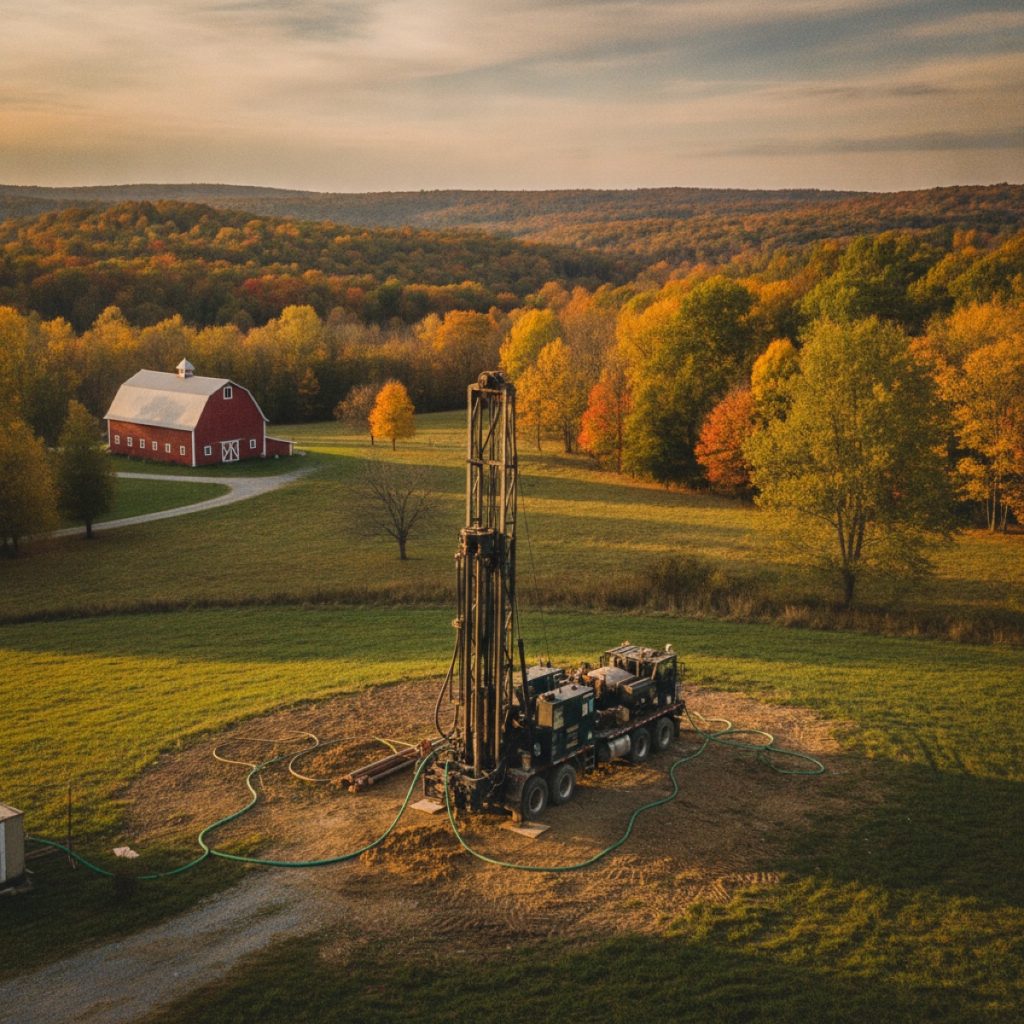
Drilling a well in Pennsylvania usually does not require a state permit. The Pennsylvania Department of Environmental Protection (DEP) does not regulate an ordinary private well serving one household, and the Commonwealth does not require routine testing of that water. Pennsylvania also has no statewide siting or construction code for private domestic wells.
That makes Pennsylvania one of the most hands-off states in the country. The state licenses commercial well drillers and collects well-completion records, but it generally does not approve the location, inspect the construction, certify the yield, or declare the finished water safe for a private home.
There is an important local exception: counties, townships, and boroughs may adopt their own well ordinances. Montgomery County, Bucks County, and a number of individual municipalities have requirements covering permits, setbacks, grouting, inspections, testing, or abandonment. Always check the county health department and municipality before signing a drilling contract.
The practical result is that the homeowner must specify good construction, obtain an independent water test, preserve the completion report, and verify that the well can support the household. A state driller license alone does not provide those assurances.
Does Pennsylvania require a permit for a private well?
No statewide DEP permit is required for a private well serving a single home. DEP expressly states that it does not regulate private homeowner wells. This is different from a public water system, which generally has at least 15 service connections or regularly serves at least 25 people. Public systems are regulated under Pennsylvania’s Safe Drinking Water rules and face a much more involved approval process.
Large commercial, institutional, agricultural, community, or high-volume withdrawals can also fall under other state or river-basin requirements. The no-state-permit answer applies to a customary household well, not every project that happens to draw groundwater.
| Question | Pennsylvania answer for an ordinary domestic well |
|---|---|
| State construction permit | Not required |
| DEP approval of the well site | Not required |
| State inspection after drilling | Not routinely required |
| Mandatory state water test | Not required |
| Licensed commercial driller | Required under Act 610 |
| Completion report | Driller must submit one and give a copy to the owner |
| County or municipal rules | May apply and can be more demanding |
Who registers Pennsylvania wells?
Private-well records are maintained by the Department of Conservation and Natural Resources’ Bureau of Geological Survey, commonly called the Pennsylvania Geological Survey. DEP provides health and environmental guidance, but the Geological Survey administers driller licensing and the state’s groundwater-record system.
Under 17 Pa. Code Chapter 47, a licensed driller files a notice of intent after entering a drilling contract and supplies a completion record after the well is finished. This is a reporting system, not homeowner permit approval.
Local well ordinances can change the answer
Pennsylvania’s lack of statewide private-well regulation leaves room for local governments to establish their own standards. A local rule may control where the well can be placed, how much casing or grout is required, who can perform the work, which contaminants must be tested, and whether an inspection is needed.
For example, Montgomery County requires a permit before installing a drinking-water well. Its process includes a construction permit, observation of grouting, a completion report, pump-test information, water-quality results, and approval to operate. Bucks County maintains its own residential well program with permitting, siting, construction, inspection, testing, and abandonment requirements.
Other municipalities regulate wells through health, subdivision, sewage, zoning, or use-and-occupancy ordinances. Rules can change at a municipal boundary, even where neighboring properties share the same geology.
Pennsylvania water well driller licensing
The Water Well Drillers License Act, usually called Act 610, requires a commercial water well drilling contractor to hold a Pennsylvania license. Each drilling rig must also have a permit. Employees working under a licensed contractor do not need separate individual licenses.
The law contains narrow exemptions for a person drilling at their own residence and certain farmers working on land they own or lease. Those exemptions do not turn residential well drilling into an appropriate owner project. A bedrock well involves heavy equipment, borehole stability, groundwater protection, electrical components, pressure equipment, and decisions that can affect neighboring water supplies.
How to verify a driller
Search the official Pennsylvania Licensed Water Well Drillers Database by company, county, or service. Match the business name and license number to the proposed contract, and confirm that the rig arriving on the property displays its permit number.
There is an unusual limitation Pennsylvania homeowners should understand: the state says a driller license does not prove knowledge of proper well construction. Licensing establishes legal authority to perform the work and creates reporting duties, but Pennsylvania does not use the license as a guarantee of workmanship.
Experience in the property’s formation therefore matters. Ask each bidder for recent wells drilled within the same township or geologic unit, along with approximate depths, yields, casing lengths, and water-quality issues encountered. References from the other side of Pennsylvania may say little about conditions under your lot.
Well-completion reports and PaGWIS records
After drilling, the contractor must prepare a water well completion report, submit the information to the Pennsylvania Geological Survey, and provide a copy to the owner. The report should document:
- The well location and date drilled
- Total depth and borehole diameter
- Casing material, diameter, and depth
- Depth to bedrock
- Rock and soil encountered during drilling
- Water-bearing fractures or zones
- Static water level, meaning the resting water level when the well is not being pumped
- Measured or estimated yield in gallons per minute
- How the yield was measured
Keep this report with the deed, septic plan, pump information, water tests, and treatment records. A future pump installer needs the depth, casing size, static water level, and pumping information to select and place equipment. Without the log, troubleshooting often begins with additional investigative work.
Finding an older Pennsylvania well record
The state’s well records are available through the Pennsylvania Groundwater Information System, or PaGWIS, now searched through the PaGEODE mapping application. The system contains hundreds of thousands of well records, primarily from driller completion reports, plus historic USGS data.
Reporting began in the mid-1960s with paper forms. Older records vary considerably in detail. Some have a scanned paper report and basic owner or municipality information but no reliable coordinates. When searching, include unlocated wells within the intersected municipality and try former owner names, nearby roads, and adjacent parcels.
An absent map point does not prove that a property has no well. Older wells were sometimes unreported, and a record without coordinates will not necessarily appear where expected. The Geological Survey may be able to help locate a paper record if the online search fails.
Pennsylvania geology: why one property can differ from the next
Most Pennsylvania household wells obtain water from openings in bedrock rather than from a large, uniformly porous underground reservoir. The borehole intersects joints, bedding planes, solution openings, or fractures containing groundwater. A fracture can provide a dependable household supply; missing it by a modest distance can produce a much lower yield.
This is why a neighbor’s 140-foot well does not guarantee water at 140 feet on your property. The neighbor’s log is useful evidence, but it is not a depth promise.
Appalachian Plateau
The Appalachian Plateau covers much of western, north-central, and northeastern Pennsylvania, including large portions of Marcellus Shale country. Domestic wells commonly enter layers of sandstone, siltstone, and shale. Water occurs mainly in fractures, weathered zones, and contacts between rock layers.
Many wells fall within roughly 80 to 250 feet, but 300- to 500-foot wells are not unusual where shallow fractures have limited yield. Water quality may change with depth. Iron, manganese, hardness, sulfate, salinity, methane, and impacts associated with historic coal mining or oil and gas development deserve attention in parts of this region.
Ridge and Valley Province
Central and south-central Pennsylvania contain long folded ridges and valleys. The ridges are often underlain by resistant sandstone and shale, while many valleys contain limestone or dolomite.
Wells in shale or sandstone generally depend on fractures and may fall in the 80- to 250-foot range. Carbonate valleys can produce much larger yields through enlarged fractures and solution channels, but they can also be vulnerable to contamination. In karst terrain—land underlain by soluble limestone with sinkholes, channels, and caves—surface contamination may move into groundwater rapidly after rain.
Piedmont and southeastern Pennsylvania
The Piedmont includes a complicated mix of schist, gneiss, quartzite, limestone, dolomite, sandstone, shale, and hard diabase. Crystalline rocks such as schist and gneiss store most usable water in the weathered material above bedrock and in fractures within the rock.
Domestic crystalline-rock wells often fall around 75 to 200 feet, but local fracture conditions can require greater depth. The Newark Basin’s sandstone and shale and the region’s carbonate valleys behave differently, so a single “southeastern Pennsylvania depth” is not meaningful. Naturally occurring arsenic, radon, uranium-related radioactivity, hardness, and corrosive water can be locally important.
Glaciated deposits and river valleys
Parts of northwestern and northeastern Pennsylvania contain sand and gravel deposited by glaciers or rivers. These unconsolidated aquifers can yield substantial water at depths of roughly 20 to 200 feet, but construction generally requires a properly selected screen and filter pack rather than an open bedrock borehole. Fine sand, iron, and vulnerability to nearby surface activities can influence design and treatment.
| Aquifer setting | Broad depth context | Main uncertainty |
|---|---|---|
| Sandstone and shale | Commonly about 80–200 feet; may exceed 400 feet | Location and openness of fractures |
| Limestone and dolomite | Commonly about 100–250 feet; may exceed 500 feet | Solution openings, karst, and contamination pathways |
| Crystalline schist and gneiss | Commonly about 75–150 feet; deeper wells occur | Whether the borehole intersects productive fractures |
| Sand and gravel | Commonly about 20–200 feet | Layer thickness, grain size, screen design, and surface influence |
These figures are regional context, not target depths. Pennsylvania wells range from less than 10 feet to more than 1,000 feet, although Penn State reports that the average is generally between 100 and 200 feet.
Well yield matters as much as depth
Well yield is the rate at which groundwater can enter the well without the pumping water level falling below a usable point. It is expressed in gallons per minute, or gpm. A short air-lift estimate made while drilling is useful, but it does not provide the same information as a controlled pumping test that records the pumping rate, water-level decline, and recovery.
A low-yield well can sometimes serve a home because the borehole stores water between periods of use. A six-inch well holds about 1.47 gallons per vertical foot of water. A 1-gpm well can theoretically produce 1,440 gallons over 24 hours, but the household needs enough storage and pumping capacity to handle concentrated morning and evening demand.
Put the test method and expected documentation in the drilling contract. If the sustained yield is limited, the design may need a larger pressure tank, a separate atmospheric storage tank, protective pump controls, or a household water-use plan. Drilling deeper does not guarantee better yield and can introduce poorer-quality water.
Water-quality concerns specific to Pennsylvania
Clear water with no odor can still contain bacteria, nitrate, arsenic, lead, or radioactive constituents. Pennsylvania does not test private wells on behalf of the owner, and the federal Safe Drinking Water Act does not regulate a well serving one household.
Bacteria and surface contamination
Total coliform bacteria are common warning organisms in Pennsylvania private wells. Their presence suggests that soil, surface water, insects, or waste may be entering the system. E. coli is a stronger indication of fecal contamination.
Risk increases with an ungrouted casing, loose well cap, buried wellhead, nearby septic system, flooding, or karst geology. A positive result should be treated as a health issue, not merely a treatment-equipment problem. The source of entry should be investigated before relying on disinfection.
Arsenic and naturally occurring metals
Arsenic occurs naturally in some Pennsylvania formations and has been found above the federal public-water limit of 10 micrograms per liter in a portion of sampled private wells, including wells in northern Pennsylvania. It has no reliable taste, smell, or color.
Iron and manganese are more commonly noticed because they create stains, sediment, metallic taste, or dark deposits. They are often nuisance problems at typical concentrations, but manganese can become a health concern at elevated levels. Test before selecting treatment because iron, manganese, hardness, pH, and arsenic require different approaches.
Radon, uranium, and gross alpha radioactivity
Pennsylvania has extensive naturally occurring radon concerns. Radon can enter a home from soil gas, and it can also be released into indoor air from well water during showering, laundry, and other uses. Testing indoor air remains the first priority, but water testing may be warranted where well-water radon is suspected.
In southeastern crystalline-rock areas, discuss uranium and gross alpha testing with the laboratory. Gross alpha is a screening measurement for certain radioactive particles. A result above a screening level generally leads to more specific testing rather than an immediate treatment decision.
Nitrate in agricultural and septic areas
Nitrate can reach groundwater from fertilizer, manure, animal operations, and failing or poorly located septic systems. Infants are particularly vulnerable to high nitrate. Agricultural land nearby, a shallow well, permeable sand and gravel, or limestone channels all strengthen the case for regular nitrate and nitrite testing.
Coal mining, road salt, fuel, and industrial land use
In Pennsylvania coal regions, test selection may include pH, acidity or alkalinity, iron, manganese, sulfate, total dissolved solids, and sometimes aluminum. Historic mining can affect groundwater long after active operations end.
Chloride and sodium are useful where road salt, brine, or salt storage may affect a well. Petroleum compounds and volatile organic compounds should be considered near fuel tanks, repair facilities, landfills, dry cleaners, chemical sites, or known spills. PFAS testing is most relevant near a documented release, certain industrial sites, fire-training areas, military facilities, landfills, or an official investigation.
Marcellus Shale and oil or gas development
Living near an oil or gas operation does not establish that a private well is contaminated. Methane, salts, iron, manganese, and other constituents can occur naturally in Pennsylvania groundwater. That is precisely why a defensible pre-drill baseline matters.
DEP recommends testing before oil or gas site drilling and earth disturbance. Its suggested panel includes methane, ethane, propane, barium, calcium, iron, manganese, sodium, chloride, pH, alkalinity, total dissolved solids, turbidity, and other indicators. Arsenic, bromide, strontium, sulfate in coal areas, and petroleum hydrocarbons in western oil-producing regions may also be appropriate.
Have an independent qualified person collect the sample and use a Pennsylvania-accredited laboratory. Preserve the laboratory report, sampling notes, chain-of-custody documentation, photographs of the wellhead, and a quantity measurement. A homeowner-collected sample may be useful for personal information but can be challenged if a dispute arises.
Under Pennsylvania Act 13, an unconventional oil or gas operator is presumed responsible in certain circumstances when pollution affects a water supply within 2,500 feet and occurs within 12 months after the later of drilling, completion, stimulation, or alteration. The presumption can be rebutted and is not a substitute for baseline evidence. DEP advises landowners of the advantages of arranging their own pre-drill survey.
What should a Pennsylvania well owner test?
| When | Recommended starting panel |
|---|---|
| Every year | Total coliform bacteria, E. coli when included by the lab, nitrate, total dissolved solids, and pH |
| New well or newly purchased home | Annual panel plus nitrite, arsenic, lead at the drinking tap, iron, manganese, hardness, alkalinity, chloride, sulfate, and turbidity |
| Formation or location dependent | Radon in water, uranium, gross alpha, methane and related gases, pesticides, volatile organic compounds, PFAS, or mining indicators |
| After an event | Test after flooding, repairs, loss of pressure, nearby excavation, a spill, changed taste or odor, recurrent stomach illness, or a new nearby land use |
The Pennsylvania Department of Health recommends annual testing for total coliform, nitrate, total dissolved solids, and pH. Use a laboratory accredited for each requested analysis. Accreditation for bacteria alone does not necessarily mean the same laboratory is accredited for arsenic, PFAS, methane, or radiological testing.
Sample location also matters. A raw-water sample taken before treatment shows what the well produces. A kitchen-tap sample can reveal lead or copper contributed by household plumbing. If treatment equipment is already installed, testing before and after treatment helps distinguish the source water from treatment performance.
Private-well construction standards in Pennsylvania
Pennsylvania has mandatory construction standards for public water-supply wells, but not for ordinary private wells statewide. State construction recommendations for private bedrock wells are therefore guidance unless a county or municipality adopts them as enforceable requirements.
Likewise, 17 Pa. Code Chapter 47 is binding for licensing, notices, records, and abandonment reporting, but it is not a complete private-well construction code. DEP rules and design manuals for public water systems should not be presented as though every one-home well is legally required to meet them.
Outside a local regulatory program, the drilling contract is where the homeowner secures sanitary construction. A well designed for drinking water should ordinarily include:
- Durable casing extending into competent bedrock to keep loose material and shallow contaminated water out of the borehole
- A grout seal around the casing to close the space between the casing and drilled hole
- A sanitary, vermin-resistant cap with a gasket and protected vent
- An above-grade wellhead, commonly at least eight inches above the finished ground and higher where flooding is possible
- Ground sloped away from the casing so rain and snowmelt do not pond around it
- A sanitary pitless adapter where the buried water line passes through the casing below frost depth
- Backflow protection where hoses, treatment equipment, livestock systems, or chemical mixing could draw contaminated water backward
- Development and disinfection after drilling and pump installation
- A documented pumping test followed by recovery measurements
- Laboratory testing after flushing before the water is used for drinking
Recommended separation from contamination sources
Local ordinances and site conditions control the final location. As general Pennsylvania guidance, Penn State recommends keeping a well at least 50 feet from sewers and septic tanks and at least 100 feet from absorption fields, cesspools, barnyards, and pastures. It also recommends at least 25 feet from a silo.
Greater separation may be appropriate downhill from a septic system, in fractured limestone, near fuel storage, or where surface drainage concentrates. The well must also remain accessible to a drilling rig and future pump-service equipment. Do not place a permanent structure, large tree, paved patio, or major landscaping feature where it blocks service access.
How much does drilling a well in Pennsylvania cost?
Request itemized written quotes for your Pennsylvania property, using the same description of the work for each business. Record every total in USD.
First distinguish a drilling or borehole-only quote from a complete installation. Ask each business to identify inclusions, exclusions, allowances, taxes, quote date, validity period, and how changes require approval.
| Local property distinction | Question for the written scope | Quote details |
|---|---|---|
| Location and available records | Which property, intended use, work area, nearby records, and requirements confirmed with the responsible local authority were considered? | Quote date, validity period, and USD currency. |
| Access and proposed work | What mobilization, access, drilling or borehole, casing, sealing, development, testing, equipment, connection, and restoration work is included? | Inclusions, exclusions, allowances, taxes, and work assigned to others. |
| Unknown or changed conditions | How will extra depth or casing, changed site conditions, a dry or low-yield bore, and an unsuccessful bore be handled? | Who authorizes changes, how price changes are stated, and which records are delivered. |
| Complete-installation comparison | Does the total cover only drilling or borehole work, or a complete working installation with all stated equipment and connections? | Payment terms, cancellation terms, change orders, and responsibility for omitted work. |
If water-treatment scope is being discussed, use the acidic-water topic guide only to organize questions. Keep treatment outside the drilling quote unless the proposed work and property-specific basis are stated.
What a drilling quote should state
- What mobilization, travel, site access, and setup are included?
- Where does the drilling or borehole scope begin and end?
- Which casing, screen, liner, sealing, or completion items are included or excluded?
- Which development, yield, sampling, testing, and project-record items are included?
- Which pump, tank, controls, cable, pipe, and related equipment are included?
- Which electrical, plumbing, trenching, building-connection, and restoration work is included?
- Which authority fees, permits, inspections, reports, or laboratory items apply, and who handles them?
- Is any water-treatment work included, excluded, or deferred until property-specific results are available?
- What cleanup, removed-material handling, site restoration, and unsuccessful-bore work is included?
- How are additional depth or casing and dry or low-yield work documented, authorized, and priced?
- What are the quote date, validity period, USD currency, taxes, allowances, and exclusions?
- What payment, cancellation, change-order, warranty, and record-delivery terms are written into the proposal?
Buying or selling a Pennsylvania home with a well
Pennsylvania does not impose a universal statewide well test at every residential sale. The sales contract, municipality, county health department, appraiser, or lender may nevertheless require one. Some local resale or use-and-occupancy procedures require current water documentation, while other municipalities impose no transfer-related test.
A buyer should arrange both a water-quality test and a mechanical inspection during the inspection period. The inspection should identify the wellhead, compare its location with the septic system, inspect the casing and cap, find the pressure tank and treatment equipment, measure flow and pressure, and obtain the completion report if available.
Do not treat a short faucet-flow demonstration as a well-yield test. A house can show strong pressure for several minutes while drawing stored water from the pressure tank, then lose capacity when the tank is depleted.
FHA and VA financing
Government-backed financing adds another layer. Current FHA policy requires a continuous supply of safe, potable water and can require a valid laboratory test based on local requirements, suspected contamination, appraisal conditions, or lender requirements. When an FHA test is required, the current handbook provides for collection through the local health authority or a qualified laboratory, and the report generally cannot be more than 180 days old at disbursement.
VA guidance requires an individual water supply to meet the standards of the health authority with jurisdiction or applicable EPA guidance when no local standard exists. Testing must be performed by a disinterested third party; the buyer, seller, or another interested person cannot collect and transport the sample. VA water-test results are generally valid for 90 days unless the local authority specifies otherwise.
Lenders may impose requirements beyond the agency minimums, and loan guidance changes. Confirm the test panel, approved sampler, laboratory credentials, separation distances, yield documentation, and validity period with the lender before sampling. A test collected under the wrong procedure may have to be repeated.
A practical sequence for drilling a well in Pennsylvania
- Check local rules. Contact both the municipality and county health department. Ask about well permits, site plans, construction standards, inspections, testing, and abandonment.
- Review the property. Map the septic tank, absorption field, replacement septic area, property lines, buildings, drainage, flood hazards, buried utilities, fuel tanks, farms, mines, and known contamination concerns.
- Search nearby records. Use PaGWIS or PaGEODE to study nearby depths, casing, bedrock, static levels, and yields. Treat the records as evidence, not guarantees.
- Obtain itemized bids. Compare construction details and contractor experience in the local formation, not only the estimated total.
- Verify the license and rig permit. Use the Pennsylvania Geological Survey’s official database.
- Use a written contract. Specify grout, casing, sanitary cap, development, disinfection, pumping test, documentation, and the process for authorizing additional depth.
- Document construction. Keep photographs, invoices, pump specifications, test data, and the completion report.
- Test before drinking. Use a Pennsylvania-accredited laboratory and select additional parameters based on geology and nearby land use.
- Retest and maintain. Inspect the wellhead annually, protect access, maintain treatment, and repeat the core water panel each year.
Abandoning an unused Pennsylvania water well
An abandoned well is not merely an old pipe to cover. It can become a direct path for surface contamination, allow water to move between aquifers, leak methane in some settings, or create a physical hazard.
Under 17 Pa. Code §47.8, a notice of intent to abandon must be sent to the state at least 10 days before a water well is sealed or filled. DCNR states that the property owner is responsible for effective filling and sealing and provides a Water Well Abandonment Form and technical guidelines. Local rules may add a permit, inspection, material specifications, or a licensed-contractor requirement.
Proper abandonment begins by identifying the well’s depth, diameter, casing, obstructions, and aquifers. Pumps, wiring, pipe, and other equipment are removed where feasible. Depending on the construction and geology, casing may be removed, cut, or perforated, and the borehole is filled with approved grout, bentonite, aggregate, or a designed combination that prevents vertical water movement. Pouring debris into the opening or cutting the casing below grade and burying it does not provide a dependable seal.
Use a licensed well driller experienced in abandonment, file the required notice, retain the completed abandonment record, and update the property documents. If the feature may be an old oil or gas well rather than a water well, do not disturb it; Pennsylvania DEP’s oil and gas program handles legacy oil and gas wells under different rules.
Pennsylvania’s limited statewide oversight gives homeowners considerable control over a private well, but it also leaves critical safeguards outside the state approval process. The most dependable protection is a locally compliant site, sanitary construction written into the contract, a documented pumping test, an accredited laboratory analysis, and complete records that remain with the property.