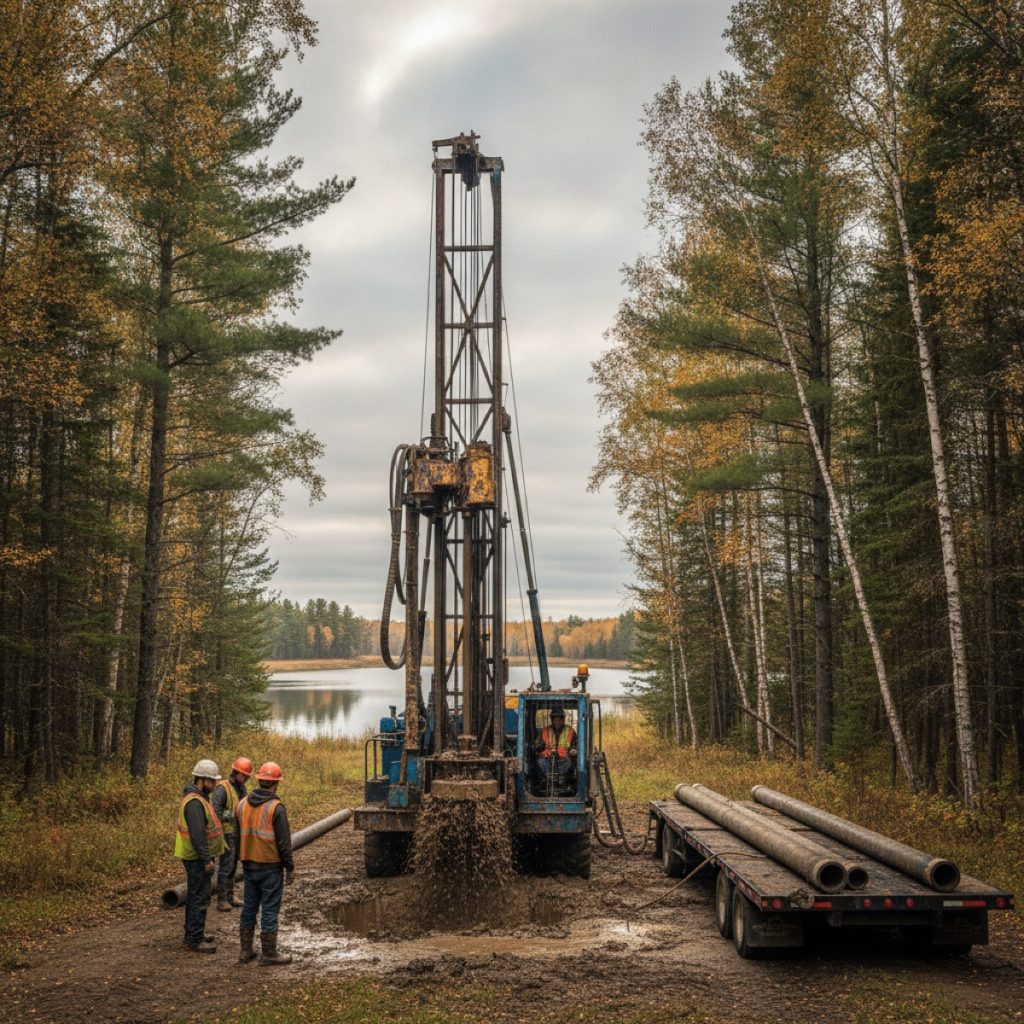
Yes, you need local approval before drilling a well in Michigan. For a normal residential project, the county or district health department reviews the proposed location and issues the well permit or other required authorization before drilling begins. The finished well must comply with Michigan’s detailed construction code, and the health department reviews the well record, water-test results, and inspection findings before approval.
Michigan’s rules are among the more developed private-well programs in the country. The legal foundation is Part 127 of the Michigan Public Health Code, 1978 PA 368, together with the Michigan Water Well Construction and Pump Installation Code. The former Department of Environmental Quality, commonly called the DEQ, is now the Michigan Department of Environment, Great Lakes, and Energy, or EGLE.
Most homeowners should hire an EGLE-registered water well drilling contractor. Michigan does recognize a narrow exception for an owner constructing a well at the owner’s primary residence, but that does not waive the permit, construction, testing, inspection, or reporting rules. Given the equipment, sanitary controls, and geological judgment involved, owner drilling is not a sensible basis for planning a household water supply.
Who regulates private wells in Michigan?
EGLE administers the statewide well-construction program and registers drilling contractors and pump installers. Part 127 establishes the legal framework, while the administrative rules set minimum requirements for such matters as well location, casing, grouting, well caps, pumping equipment, disinfection, records, and abandonment.
The work homeowners see locally is handled primarily by county and district health departments. These departments issue well permits, review proposed sites, investigate groundwater concerns, inspect water supplies, review completion records, and determine whether a new installation can be approved. Each health department also has a local sanitary code.
That local layer matters. A county can require greater separation from a septic system, additional water tests, a deeper casing, or other protective construction where local geology or known contamination justifies it. Some Michigan communities also have recorded plat restrictions specifying minimum well depths. In designated “well first” areas, an acceptable water supply may have to be demonstrated before a sewage-disposal or building permit is issued.
The statewide code is therefore the floor, not necessarily the complete rule for your parcel. Your permit conditions are part of the job specifications, and drilling contrary to those conditions can lead to corrective work or a replacement well.
Michigan well permits: what happens before and after drilling
All Michigan counties require a well permit or the applicable local notification and approval before drilling. For an ordinary new residential well, treat this as a firm rule: do not let drilling begin until the local health department confirms that the project is authorized. Major repairs and replacement wells may also require a permit.
What the application normally includes
The health department will generally request a site plan showing the proposed well, buildings, property lines, septic tank, drainfield, sewers, surface water, fuel tanks, animal areas, and other possible contamination sources. Known hazards on adjoining land may also be relevant. The application fee and required level of detail vary by jurisdiction.
During its predrilling review, the department may examine:
- Nearby Wellogic records and expected geological conditions
- Potential water-quantity or water-quality problems
- Known contaminated sites, groundwater plumes, or land-use restrictions
- Required separation from septic components and other hazards
- Recorded subdivision or plat restrictions
- Whether the site will remain accessible to a drilling rig and future service equipment
- Whether the proposed contractor has a current registration
A staff member may visit the property before issuing the permit, particularly where the plan is unclear, the lot is constrained, or contamination and geological concerns require an on-site review. In other cases, the initial review may be completed from the submitted plan and available records.
Common state minimum separation distances
The following are selected Part 127 minimums for a private household well. They are not a substitute for the permit because the health officer can require greater distances, and local sanitary codes may be more protective.
| Potential contamination source or feature | Michigan minimum |
|---|---|
| Septic tank, drainfield, cesspool, or private sewage lagoon | 50 feet |
| Animal or poultry yard | 50 feet |
| Small residential motor-fuel or heating-fuel tank | Generally 50 feet |
| Approved watertight gravity sewer of specified material | 10 feet |
| Surface water, including a lake, stream, pond, or ditch | 10 feet |
| Building or building projection | 3 feet |
| Landfill or dump site | 800 feet |
A health officer may approve a written deviation in qualifying circumstances, but a contractor should not assume that a tight lot will receive one. The department evaluates groundwater direction, geology, well depth, grouting, property dimensions, and the nature of the hazard. Moving the proposed well is usually preferred when the minimum distance can be met elsewhere.
What happens after construction
The driller develops the well to remove drilling debris and fine sediment, measures the static water level, performs a yield test, installs the pumping equipment, disinfects the system, and prepares the water well and pump record. The local health department then reviews the record and required laboratory results. Its process may include an on-site final inspection of the wellhead, location, cap, visible casing, and other components.
Approval can depend on the well record, satisfactory water samples, compliance with permit conditions, and inspection findings. Ask the health department exactly what must be completed before the well supplies the house.
Hiring and verifying a Michigan well driller
EGLE registers water well drilling contractors and pump installers annually. Registration is Michigan’s equivalent of occupational licensing for this work. The registered contractor is responsible for supervising construction and for the work performed by unregistered employees under that registration.
Use EGLE’s Water Well Construction program page and select the directory of registered contractors. Ask the company for its registration number and current certificate, then make sure the business name in the directory matches the name on the proposal. If a different company will install the pump, verify the pump installer as well.
A homeowner should also request proof of insurance, recent references from the same area, and a written proposal explaining:
- The estimated depth and the nearby records used to develop that estimate
- The drilling and casing charge per foot
- The casing material, diameter, and amount included
- How additional depth, additional casing, difficult rock, and a dry hole are billed
- The pump, pressure tank, controls, wiring, trenching, and piping included
- Who obtains the permit and required inspections
- Which water tests are included
- Who restores the yard and removes drilling material
- The cost of plugging the old well, if applicable
A contractor cannot guarantee the final depth merely by looking at the property. Nearby records narrow the uncertainty, but sand-and-gravel layers can thin out, bedrock fractures can disappear over short distances, and water quality can change between aquifers.
Using Wellogic before you request quotes
Michigan’s Wellogic database is one of the best public well-record systems in the United States. It contains more than one million records, and members of the public can search without creating an account. Contractors have filed new-well, pump, and abandonment records electronically since 2000, while some older paper records are available through a separate scanned-record collection.
A well record may show the total depth, casing depth and diameter, geological layers encountered, static water level, pumping level, reported yield, screen placement, grouting, nearest contamination source, completion date, contractor, and pump details. That information is useful when estimating a new well and invaluable when servicing an existing one.
How to research your property
- Start with the address in Wellogic or EGLE’s Water Well Viewer. The map is often more convenient when an address search does not return the expected record.
- Confirm that the mapped point is actually on your parcel. Older records and address-matched locations can be displaced.
- Open several nearby household-well records, preferably from recent construction on similar terrain.
- Compare total depth, casing depth, static water level, yield, and the sequence of clay, sand, gravel, and bedrock.
- Look for repeated patterns rather than relying on the shallowest or highest-yielding well.
- For pre-2000 wells, check EGLE’s scanned records using the county, township, town-and-range, and section information.
Pay particular attention to the lithology, meaning the materials reported while drilling. Several nearby logs showing sand and gravel beneath a thick clay layer provide more useful evidence than one nearby well of unknown construction. A sequence of shallow bedrock wells tells a different story from deep wells completed entirely in glacial deposits.
Wellogic is a planning resource, not a water guarantee. Logs reflect conditions at individual boreholes, and older handwritten records may be incomplete. The reported map location, yield, and geological descriptions can also contain errors. A local driller’s experience interpreting those records remains important.
Your contractor must submit the completed well record within 60 days, provide a copy to you, and retain a copy. Keep it with the property records. It will help with pump selection, later service, water-quality investigations, real-estate transactions, and eventual abandonment.
Michigan geology and likely well depth
Michigan sits within the Great Lakes Basin, but proximity to enormous surface-water bodies does not tell you how deep a private well will be. A household well draws groundwater stored in permeable underground material. Across much of Michigan, the usable aquifer is in glacial drift; elsewhere it is in bedrock.
Glacial drift aquifers
Glaciers left much of the state covered by unconsolidated clay, silt, sand, gravel, and mixtures collectively called glacial drift. Sand and gravel can store and transmit substantial quantities of water. Clay transmits far less water but can protect a deeper aquifer by slowing downward movement from the surface.
Drift thickness varies dramatically. Parts of the northern Lower Peninsula have 400 to 600 feet of glacial material, with localized thicknesses exceeding 800 feet in counties such as Wexford, Osceola, and Otsego. By contrast, drift can be less than 50 feet in portions of Huron and Monroe counties, near Alpena and Presque Isle, and in several Upper Peninsula settings.
A drift well normally uses a screen opposite a productive sand-or-gravel layer. Its success depends on the thickness and grain size of that layer, not merely on reaching the water table. Drillers continue to a formation capable of supplying water without continually pulling sand into the well.
Bedrock aquifers
Where drift is thin or lacks a dependable water-bearing layer, the well may be completed in sandstone, limestone, dolomite, or fractured crystalline rock. Bedrock wells depend on pores, bedding planes, joints, or fractures that transmit water. Two neighboring rock wells can therefore have different yields.
Bedrock is commonly used in the western and eastern Upper Peninsula, the northeastern Lower Peninsula, the Thumb, the Monroe area, and a band extending southwest from Saginaw Bay toward Branch and Hillsdale counties. In parts of the western Upper Peninsula, groundwater may be available mainly from fractures in hard igneous and metamorphic rock.
Michigan also has karst areas, where soluble limestone or dolomite contains enlarged fractures and openings. These settings can yield water, but they are vulnerable because contaminants may move through the rock with less natural filtration. Local permit conditions and grouting are particularly important there.
Planning depth by broad region
| Region | Common planning range | Why it varies |
|---|---|---|
| Southern Lower Peninsula | About 75–175 feet, with shallower and much deeper exceptions | Alternating glacial clay, sand, and gravel; bedrock is used in some eastern and central areas |
| Northern Lower Peninsula | About 75–250 feet; some wells exceed 300 feet | Very thick drift in some counties, thin drift and shallow rock in others |
| Thumb, Saginaw-to-southern-border belt, and parts of Monroe County | About 50–200 feet or more | Relatively thin drift often makes bedrock construction relevant; water quality can influence the selected aquifer |
| Upper Peninsula | About 50–300 feet or more | Thin drift, fractured hard rock, variable sandstone and carbonate aquifers, and remote access |
These are budgeting ranges, not state specifications or depth promises. The useful comparison is the cluster of wells nearest your parcel, not a statewide average.
Michigan well construction standards homeowners should recognize
You do not need to supervise drilling, but you should understand the protective features you are purchasing. Their purpose is to keep surface water and shallow contamination from traveling down the outside or inside of the casing.
Casing depth and diameter
Michigan’s general rule requires permanent casing to extend at least 25 feet below ground and terminate at least 12 inches above grade. A health officer can require more casing where shallow bedrock water is unsuitable or where local conditions need additional protection. Written approval is required for the limited situations in which less casing may be allowed.
State rules generally set a minimum inside diameter of two inches for steel permanent casing and five inches for PVC permanent casing, subject to listed exceptions. Modern household wells commonly use larger casing suited to a submersible pump. PVC casing must be placed in an oversized borehole and cannot be driven into the ground.
Grouting
Grout is a low-permeability seal placed between the casing and the drilled hole. It prevents contaminated shallow water from using the borehole as a pathway to a deeper aquifer and helps prevent water from moving between aquifers.
For a well drilled with an oversized borehole, approved neat-cement or bentonite grout is generally placed from the bottom of the space around the casing upward to the surface. For a screened gravel-pack well, grouting normally begins no more than 10 feet above the top of the screen and continues upward. Driven-casing methods have separate bentonite requirements.
When bedrock is encountered within 25 feet of the surface, Michigan requires an oversized borehole and at least 25 feet of casing grouted with neat cement. Health officials can require construction beyond the general minimum where upper bedrock may contain unsuitable water.
Wellhead, cap, and vent
Michigan prohibits a buried wellhead. The casing should remain visible above grade and accessible to service equipment. The cap or seal must be weathertight, tightly secured, and resistant to insects and rodents. Required vents must be screened, point downward, and terminate at least 12 inches above grade and 24 inches above a known flood level.
Grade the surrounding soil so water drains away from the casing. Do not bury the wellhead under landscaping, build a deck over it, or place fertilizers, fuel, animal waste, or snow-storage piles beside it. Future pump work may require a truck or hoist to reach the well.
How much does drilling a well in Michigan cost?
There is no dependable statewide fixed price. Most drilling is billed by the foot, and the final footage is not known in advance. Current Michigan planning figures commonly place drilling and casing around $25 to $65 per foot, but hard rock, large casing, grout volume, difficult access, and mobilization can move a quote beyond that range.
For a complete household system in current dollars, the following broad allowances are more realistic than pricing the drilled hole alone:
| Project setting | Broad planning allowance |
|---|---|
| Shallower Lower Peninsula drift well with ordinary site access | Approximately $7,000–$13,000 |
| Deeper drift or mixed drift-and-bedrock project | Approximately $10,000–$20,000 |
| Deep, hard-rock, remote, or difficult-access project | Approximately $15,000–$25,000 or more |
These ranges should include more than drilling: casing, grout, screen where required, development, yield testing, sanitary cap, pump, pressure tank, controls, normal wiring and piping, permit, and basic water testing. Confirm every inclusion because contractors divide proposals differently.
Treatment is often separate. Iron, manganese, hardness, arsenic, nitrate, PFAS, methane, sulfur odor, or sediment can require equipment ranging from modest filtration to a substantial treatment system. Do not purchase treatment until a certified laboratory identifies the actual problem.
Water testing requirements and a Michigan testing schedule
Michigan requires new, repaired, and reconditioned wells to be disinfected with chlorine. Before a new well is placed in service, testing must demonstrate that the water is free of coliform bacteria. The local health department may also require nitrate, arsenic, chloride, volatile organic compounds, or other analyses based on local conditions and nearby contamination.
After approval, the owner becomes responsible for ongoing testing. Michigan health agencies recommend:
- Every year: total coliform, E. coli, nitrate, and nitrite
- Every three to five years: arsenic and lead
- At least once: PFAS, with repeat testing when local investigation findings or health guidance warrant it
- After a flood, well repair, cap damage, or unexplained water change: bacteria and any contaminants relevant to the event
- When an infant, pregnant person, or medically vulnerable person will use the water: consult the health department about an appropriate panel
Michigan groundwater can also contain iron, manganese, hardness minerals, sodium, chloride, sulfate, fluoride, uranium, and other naturally occurring constituents. Some mainly affect taste, staining, plumbing, or treatment cost; others can affect health. Water that looks and tastes acceptable can still contain bacteria, nitrate, arsenic, lead, or PFAS.
Use a Michigan-certified drinking-water laboratory and follow its bottle, preservation, and sampling instructions. The EGLE drinking-water testing page explains how to obtain test kits. Discuss unexpected results with the local health department before selecting treatment or changing how the well is used.
PFAS and private wells in Michigan
PFAS are a major Michigan-specific concern. These persistent manufactured chemicals have been associated with firefighting foam, plating operations, landfills, airports, military facilities, industrial sites, and other sources. Michigan’s PFAS Action Response Team, or MPART, has identified hundreds of sites and areas of investigation across the state.
Private residential wells are not regulated under Michigan’s public-water PFAS standards. However, state agencies use drinking-water standards and health information when evaluating private-well results and deciding what protective actions may be appropriate.
Before drilling or buying a well property, check the MPART site and investigation map. Also ask the health department whether the parcel is within or near a known groundwater investigation. A deeper well is not automatically protected; the answer depends on the affected aquifer, groundwater movement, and construction.
If your home is near a potential PFAS source, call the MDHHS Drinking Water Hotline at 844-934-1315. If the property falls within an active investigation, the state may be able to provide testing without charge. Homeowners outside an eligible investigation can order testing from a certified PFAS laboratory.
PFAS samples require careful handling because many consumer products can contaminate the sample. Use the current MPART residential sampling instructions and the containers supplied by the laboratory. Do not substitute a general water-test kit.
Buying a Michigan property with an existing well
Start by matching the visible well to its Wellogic record. Confirm the completion date, depth, casing, reported yield, geological layers, and contractor. If no modern record appears, search the scanned pre-2000 records and ask the local health department.
A purchase evaluation should include the exposed wellhead, sanitary cap, drainage, distance from septic components, pressure system, pump performance, and laboratory testing. A yield written on an old log describes conditions at completion; it does not prove present performance. Likewise, a prior clean test does not establish current water quality.
Look for abandoned wells around former houses, barns, windmills, pump houses, and old water-line routes. A disconnected pipe or covered casing is not proof that a well was properly plugged.
Michigan well abandonment requirements
A well is considered abandoned when its use has permanently ended, it is impractical to use because of disrepair, it was left unfinished, or it presents a health, safety, or groundwater threat. An unused opening can carry contaminants downward and can allow poor-quality water to move between aquifers.
The property owner is ultimately responsible for plugging an abandoned well. Connecting a building to municipal water does not allow the old well to be forgotten. Part 127 requires a well abandoned when municipal service is installed to be plugged. Some jurisdictions prohibit keeping it; others may allow continued irrigation use if the well is operational, meets local requirements, and is physically separated from the municipal plumbing.
Michigan allows an owner to plug a well serving the owner’s residence, but EGLE recommends using a registered drilling contractor. Pumps, pipe, wire, valves, and other obstructions must be removed so plugging material can reach the bottom. This frequently requires a drilling rig or pump-hoist truck.
The approved method depends on construction and geology. Drift wells may use specified bentonite products, while wells completed in bedrock and flowing wells require cement-based grout. Material must fill the well from the bottom upward so hidden voids are not left behind. Cutting off or capping the casing at ground level does not meet the plugging requirement.
An abandoned-well plugging record must be submitted within 60 days. If an old well is closed while a replacement is drilled, the information may be included with the replacement record; otherwise, a separate record is filed. Keep your copy with the new-well log and property documents.
A well retained for possible future use is considered temporarily abandoned and must remain compliant with current isolation and construction requirements, be disconnected from water-distribution piping, and have its casing securely capped. The local health department should confirm whether that status is acceptable for the property.
Documents to keep after the project
- The approved permit, site plan, and any written deviations or special conditions
- The contractor’s proposal, registration information, invoices, and equipment warranties
- The completed Wellogic water well and pump record
- The yield-test information and pump specifications
- Initial and subsequent laboratory reports
- Inspection and final-approval documents from the health department
- The plugging record for every abandoned well on the property
Together, these records establish how the well was built, which aquifer it uses, what it produced when completed, and how its water quality has changed. In Michigan, that paper trail is part of responsible ownership—not an administrative detail to discard after construction.
Related Guides
- Drilling a Well in Alberta
- Drilling a Well in Ontario
- Do You Need a Permit to Drill a Well?
- Well-Septic Setback Distance
- How Much Does It Cost to Drill a Well?
Browse all Regulations & Permits guides →

Author: Well Drilling Guide Editorial Team
The Well Drilling Guide editorial team researches and writes our guides on water-well drilling, pumps, and well water for homeowners across the US and Canada. We translate current cost data, NGWA and state well-construction standards, and EPA and CDC guidance into clear, practical answers. What we stand for: honest, independent help. Every price and claim is researched and fact-checked against multiple 2026 sources — never guessed, never borrowed from a single advertiser. We answer to homeowners, not to the companies we write about, because our only goal is to help you make a confident, well-informed decision about your water.
Find verified, local contractors who handle new installations, pump service, and water quality testing — in your area.