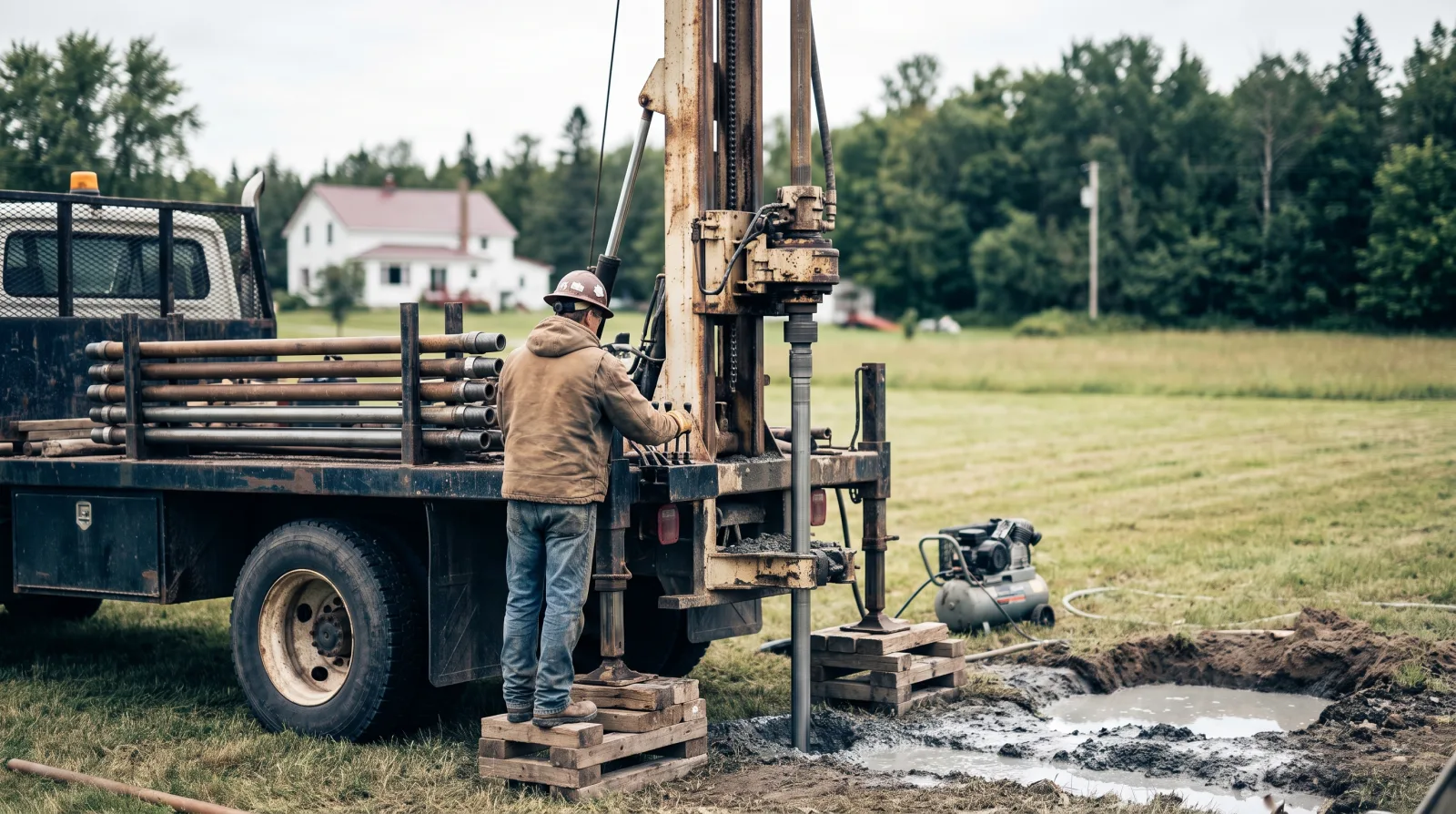
Most residential wells cost about $3,000 to $15,000 for a complete project, although that range is almost meaninglessly wide when you are budgeting for a particular property. Local geology, the depth needed to reach a usable water-bearing formation, casing requirements, contractor availability, and access for the drilling rig can move the price far beyond a national average.
The advertised per-foot drilling rate is only the starting point. A functioning household water system also needs casing, grout, a sanitary cap, a pump, a pressure tank, controls, wiring, buried plumbing, permits, and laboratory testing. Some contractors include several of these items in one price; others quote the borehole and equipment separately.
Online calculators cannot see what is underground. They do not know whether your driller will encounter loose sand, stable sandstone, fractured granite, collapsing shale, buried boulders, salty water, or a low-yield fracture that requires another 150 feet of drilling. They also cannot tell whether a 40-ton rig can reach the proposed well location without road construction or tree removal.
Unless otherwise noted, the figures below are 2026 planning ranges in U.S. dollars. Canadian homeowners should use the same budgeting method but obtain local prices in Canadian dollars. Provincial rules, frost depth, travel distances, and the number of available contractors can matter more than a currency conversion.
Why the drilling price per foot varies so much
A common 2026 planning range for residential drilling is approximately $15 to $50 or more per foot. In expensive regions, hard formations, isolated locations, and jobs requiring larger equipment, the rate can be substantially higher. The important question is not merely “What do you charge per foot?” It is “What is included in that rate, and what formation do you expect to drill through?”
Rock type can matter more than raw depth
Two wells can both be 200 feet deep and have very different bills. The material being drilled affects the rig, drilling speed, casing design, well screen, grout volume, and risk of the hole collapsing before construction is complete.
- Unconsolidated formations are loose materials such as sand, gravel, clay, and glacial deposits. Drilling may progress rapidly, but the borehole often needs casing and a properly selected screen to hold material back while allowing water to enter. Running casing through most or all of the well can erase any savings from faster drilling.
- Sedimentary rock includes sandstone, limestone, dolomite, and shale. Sandstone may drill predictably in one district, while fractured limestone can lose drilling fluid or contain cavities. Some shale formations swell, cave, or produce poor-quality water. “Sedimentary” does not automatically mean inexpensive.
- Igneous rock, such as granite or basalt, can require powerful air-hammer equipment and more drilling time. Water usually comes from fractures rather than pores in the solid rock. A productive fracture might be found early, or the crew may drill hundreds of additional feet before obtaining an acceptable yield.
The U.S. Geological Survey notes that drilled wells can extend several hundred to more than 1,000 feet. Wells in loose sediment generally use casing and a screen, while bedrock wells are commonly cased through the overlying soil and left as an open borehole in competent rock. That construction difference directly affects the bill.
Regional rates reflect more than wages
The $15-to-$50-plus-per-foot range changes by region because drilling methods, fuel costs, insurance, local construction rules, casing materials, and contractor availability all differ. A county with several active drilling companies may have more competitive scheduling than a remote district served by one crew traveling several hours.
Local rules can also require minimum casing depths, specific grout materials, yield testing, setbacks from septic systems, or additional inspections. Those requirements protect groundwater and household health, but they add labor and material. Ask whether a quoted per-foot rate covers only advancement of the borehole or also includes casing, grout, development, and the completion record.
The required depth is a local question
The depth of the water table is not necessarily the depth at which the driller should stop. The crew needs a formation that can provide enough water through seasonal changes. The first water encountered may have poor yield or unsuitable chemistry. Conversely, drilling deeper does not guarantee cleaner water; deeper formations can contain iron, manganese, arsenic, salt, hardness, or naturally occurring radionuclides.
Nearby well records are the best starting evidence. Many states and provinces publish construction records showing total depth, casing length, geology, water level, and reported yield. Examine several nearby records rather than relying on one neighbour’s well. Groundwater conditions can change over a short distance, especially in fractured rock.
Mobilization and access have their own price
A drilling rig is a large, heavy vehicle supported by water trucks, pipe, compressors, and service equipment. The contractor may charge a mobilization fee to move that equipment to the property and remove it afterward. Long travel, ferry crossings, weight-restricted roads, or a second mobilization for pump installation can increase the charge.
The crew also needs enough room to raise the drill mast, handle casing, manage cuttings, and work without striking overhead power lines. A lawn that can support a pickup truck may not support a loaded drilling rig. Mats, towing assistance, road reinforcement, or restoration of ruts may fall outside the drilling contract.
What affects your cost
| Factor | How it changes the cost | Example |
|---|---|---|
| Formation | Changes drilling speed, equipment, casing, screen, and the chance of borehole problems. | Loose sand may require full-depth casing and a screen; granite may require air-hammer drilling. |
| Final depth | Adds drilling footage, pipe, wire, and often pump capacity. | A well expected at 180 feet may reach 320 feet before an acceptable water-bearing zone is found. |
| Casing length and material | More casing means more material and installation labor. Steel generally costs more than common plastic casing. | Deep loose deposits may require casing far below the minimum sanitary depth. |
| Water yield | Low yield can require additional drilling, longer testing, or added storage. | A low-producing well may need a large storage tank and controls that protect the pump. |
| Distance to the house | Increases trenching, water pipe, electrical cable, and pressure-loss considerations. | Required setbacks may place the well 250 feet from the mechanical room rather than 60 feet away. |
| Site access | May require clearing, grading, mats, a temporary road, or a smaller specialized rig. | A steep wooded lot needs a stable rig pad before drilling can begin. |
| Season and weather | Frozen ground, snow removal, spring mud, fire restrictions, or limited road access can add time and equipment. | A winter project may need plowing and heated water management before the rig can operate. |
| Local rules | Affects permits, setbacks, sealing, testing, inspections, and required records. | One county may require a basic bacteriological test; another may require a broader laboratory panel and yield test. |
The complete well project budget
The following ranges are budgeting allowances, not prices that every contractor will use. Several items may be bundled. Do not add every high number together unless your quotes price each item separately.
| Line item | Typical 2026 planning range | What to confirm |
|---|---|---|
| Rig mobilization | $500–$2,500+ | Travel radius, number of rig visits, fuel surcharge, and charges if the site is not ready. |
| Drilling the borehole | $1,500–$12,000+; commonly $15–$50+ per foot | Included diameter, drilling method, minimum charge, and different rates for soil and rock. |
| Casing and well screen | $1,000–$6,000+ | Material, diameter, price per foot, expected length, screen, drive shoe, and liner charges. |
| Grouting and sanitary sealing | $500–$2,500+ | Required depth, grout material, placement method, and whether the price is bundled with casing. |
| Well development and yield test | $300–$1,500+ | Test duration, discharge handling, measured recovery, and written results. |
| Well cap or sanitary seal | $100–$500 | Vermin-resistant construction, venting, frost protection, and local code compliance. |
| Pump system | $1,500–$5,000; deep or constant-pressure systems can exceed this | Pump, drop pipe, tank, pressure switch, controls, downhole cable, safety rope where used, and installation. |
| Buried water line and plumbing tie-in | $500–$4,000+ | Trench length, frost depth, pitless adapter, foundation entry, backfilling, and indoor plumbing. |
| Electrical service to the pump | $500–$3,000+ | Panel capacity, breaker, disconnect, trench, conduit, permits, and electrician labor. This is separate from downhole pump wire. |
| Permits and inspections | $100–$1,200+ | Well, electrical, plumbing, environmental-health, and local inspection fees. |
| Water testing | $100–$500 for a common panel; $400–$1,000+ for broader analysis | Required contaminants, certified laboratory, sampling fee, lender rules, and repeat testing. |
A lower-cost, shallow project with good access and modest casing requirements may remain near the bottom of the overall $3,000-to-$15,000 range. A deep bedrock well with extensive casing, road work, a larger pump, and a long run to the house can exceed $20,000 or even $30,000. Very deep or technically difficult projects can cost considerably more.
Conditions that make a well more expensive
Hard rock can slow drilling and increase wear on bits, hammers, compressors, and support equipment. The effect depends on the rock’s hardness and fracture pattern. Solid granite may drill slowly but hold an open borehole well; unstable rock may require a liner or additional casing.
A deep water table or deep productive fractures add more than drilling footage. A deeper pump setting requires more drop pipe, electrical cable, and lifting capacity. The pump may need more horsepower to overcome the vertical distance between the pumping water level and the pressure tank.
Problem formations include swelling clay, running sand, large boulders, cavernous limestone, collapsing shale, and formations that cause drilling fluid to disappear. A contractor may need to change methods, install casing earlier than planned, ream the hole, or bring additional materials.
Remote or steep access can require grading, tree clearing, temporary culverts, gravel, equipment mats, or a purpose-built road. The drilling pad must remain stable under equipment that is much heavier than ordinary residential traffic.
Winter work may involve snow removal, frozen hoses, heated water handling, shorter daylight, frost excavation, or seasonal road limitations. In other areas, spring mud or summer wildfire restrictions create the greater cost and scheduling risk.
Blasting is more likely to be associated with preparing an access road, rig pad, utility trench, or foundation route through exposed rock than with drilling the wellbore itself. If blasting might be required, obtain a separate written allowance from a qualified contractor and confirm insurance and local permit requirements.
Utility work can become a project of its own. Clearing a route, trenching below frost depth, upgrading the electrical panel, and running water and power several hundred feet may add thousands of dollars after the drilling crew leaves.
Costs homeowners frequently forget
Decommissioning the old well
An abandoned well can allow contaminants to move directly into groundwater and may create a physical hazard. Many jurisdictions require an unused well to be properly plugged and sealed rather than covered with soil or left disconnected. The cost may range from several hundred dollars to several thousand, depending on depth, diameter, access, casing condition, and whether obstructions must be removed.
Ask the local authority whether the old well must be decommissioned when the replacement is completed. Ontario, for example, places legal responsibilities on owners for maintaining or abandoning wells and recommends using a properly licensed well contractor and technician. Similar rules exist in many U.S. states and Canadian provinces.
Treatment after the laboratory report arrives
Clear water is not proof of safe water. A new well may test positive for bacteria or contain nitrate, arsenic, uranium, salt, iron, manganese, hardness, or other constituents associated with local geology and land use.
Treatment cost depends on the contaminant and concentration. A sediment filter is a different system from ultraviolet disinfection, nitrate removal, arsenic treatment, radon aeration, or whole-house reverse osmosis. Budgeting a generic “filter” before testing can lead to buying equipment that does not address the actual result. Pay for certified laboratory analysis first, then have any treatment system sized from the report and household water demand.
Electrical service beyond the pump package
A pump installer’s price may include cable running down the well but not the power supply from the house. An electrician may need to add a breaker, disconnect, control wiring, conduit, trench, or panel capacity. Confirm who obtains the electrical permit and who coordinates the electrician with the pump installer.
A lender-required inspection or test
A building department’s final approval and a lender’s property requirements are separate matters. A lender may request a well inspection, yield test, laboratory analysis, proof of separation from contamination sources, or third-party sample collection. These costs can appear late if financing requirements are not checked before drilling.
How to obtain and compare well quotes
Start by finding records for wells near the property. State and provincial databases may show completed depth, casing length, formations, static water level, and reported yield. These records are evidence, not a promise: even official databases warn that historical locations and entries may be incomplete or inaccurate.
Then request itemized estimates from two or three licensed contractors in the United States or contractors holding the required provincial licence or registration in Canada. Give each contractor the same site information so the proposals can be compared on equal scope.
Ask each bidder to state:
- The expected depth range and the nearby records or experience supporting it.
- The drilling rate for each type of formation and what that rate includes.
- The casing material, diameter, price per foot, and estimated length.
- The grout, screen, liner, cap, development, and yield-testing charges.
- The mobilization fee and conditions that trigger another mobilization.
- Whether cuttings, drilling water, site restoration, and trench backfill are included.
- The proposed pump, tank, controls, warranty, and assumptions about well yield.
- Which permits, inspections, completion records, and laboratory tests are included.
- The policy for additional depth, a dry hole, an unusable yield, or an abandoned borehole.
- Items that must be completed by an electrician, plumber, excavator, or the homeowner.
Do not choose solely by comparing the per-foot number. One contractor may include casing and grout while another lists them separately. One pump package may include a pressure tank and controls; another may include only the submersible pump. Rewrite the quotes into the same line-item format before comparing totals.
Also verify current credentials, liability insurance, and workers’ compensation coverage where applicable. In the United States, check the state well-contractor license and any local registration. In Canada, confirm the contractor licence and technician licence or provincial registration required for the work. Ask who will submit the final well record and when you will receive a copy.
Payment structure and financing
How contractors commonly bill
Payment terms vary, but a project may include a scheduling deposit, a mobilization payment, charges based on actual drilling and casing footage, and a later payment for the pump system. Final payment may be tied to completion records, testing, or the plumbing connection.
The contract should identify each payment point and explain how added depth is approved. A useful arrangement sets estimated depth bands and requires the contractor to contact you before drilling beyond an agreed threshold. A fixed total may be available where local formations are predictable, but a responsible contractor will still identify conditions excluded from that price.
Avoid assuming that the drilling company, pump installer, electrician, excavator, and laboratory will all appear on one invoice. Ask for a payment calendar that includes every company involved and keep the contingency funds available until the tested system is operating.
FHA and VA financing requirements
FHA- and VA-backed mortgages do not function as general-purpose rebates for drilling a well. They are mortgage programs, and the property must satisfy the applicable lender, appraisal, local-code, and program requirements.
For an FHA-financed property, the lender will use the current HUD Single Family Housing Policy Handbook 4000.1. Private water requirements can involve an adequate continuing supply, acceptable water quality, separation from contamination sources, and testing performed under the required procedure. Local standards generally matter, and the lender may impose additional documentation.
VA-financed properties must meet VA minimum property requirements as applied by the lender and VA appraiser. The current VA guidance addresses individual water supplies, local-authority requirements, pollution-source separation, and the validity of required water tests. Confirm the current requirements with the lender before scheduling sampling because the collector, laboratory, test panel, and timing may all matter.
If a well is part of new construction or a financed rehabilitation, ask the lender whether drilling, the pump system, treatment, and contingency can be included in the construction budget. Obtain that answer in writing before signing the drilling contract.
Federal, state, provincial, and local assistance
In eligible rural U.S. areas, the USDA Rural Development housing programs may help qualified households purchase, build, or repair a home. The Section 504 Home Repair program currently offers loans to qualifying very-low-income homeowners and grants to certain homeowners age 62 or older for health and safety hazards. Eligibility, available funding, approved work, and current limits must be confirmed with the local USDA office before work begins.
Some states, counties, health departments, and water districts offer testing, repair, reconstruction, or well-plugging assistance. Iowa’s Private Well Grants Program is one example, providing eligible services through local public-health agencies. These programs are often narrow, income-dependent, reimbursement-based, or subject to annual funding. Apply before authorizing work if prior approval is required.
Canadian assistance is similarly location- and purpose-specific. A province may offer free laboratory services, emergency replacement help, or assistance connected to a documented contamination or industrial impact without offering a general new-well grant. Ontario, for example, provides free bacterial testing for private residential well water through its public-health system, while Alberta has a specialized restoration or replacement program for eligible wells affected by energy activity.
When an online estimate is useless—and when it helps
An online estimate is unreliable when it uses only desired depth, property size, or a national average. It is especially weak for vacant land with no nearby well records, fractured bedrock, difficult access, coastal salinity concerns, mountain terrain, or an area where productive well depths vary widely.
A calculator becomes more useful after you have local evidence. Enter a depth range based on several nearby records, use current rates supplied by local drillers, separate drilling from casing, and add actual distances for trenching and electrical work. Run at least three scenarios:
- Expected case: the depth and casing most local evidence supports.
- Higher-cost case: additional depth, more casing, and a larger pump.
- Problem case: difficult access, an unsuccessful first borehole, treatment, or added storage.
The result is still a planning model, but it can show whether the property remains affordable if the well costs $20,000 rather than $9,000. That is a much better use of a calculator than treating its single estimate as a contractor’s commitment.
Sources and methodology
The price ranges in this article are national planning ranges assembled from 2026 consumer cost reporting, public permit and laboratory fee schedules, contractor cost components, and university extension examples. They are not presented as a national database of paid invoices. Well prices are intensely local, and some published figures bundle casing or equipment while others report borehole drilling alone.
The $3,000-to-$15,000 total range and $15-to-$50-plus-per-foot planning range were checked against current consumer cost reporting, including Angi’s 2026 well-drilling cost data. The wider component ranges account for regional projects that fall outside those national figures.
Construction and groundwater explanations were checked against the U.S. Geological Survey guidance on domestic wells. Water-testing recommendations were checked against the U.S. Environmental Protection Agency’s private-well guidance. The EPA recommends annual testing for total coliform bacteria, nitrate, total dissolved solids, and pH, with additional testing based on local risks.
The recommendation to examine nearby records reflects public resources such as the Washington State Well Report Viewer and comparable state and provincial databases. Canadian construction and credential guidance was checked against current information from Ontario’s Wells on Your Property program and British Columbia’s well-driller and pump-installer program.
Financing information was checked against the current FHA Handbook 4000.1, VA home-loan guidance, and USDA Section 504 program fact sheet. Permit fees, lending rules, grant limits, and testing requirements can change, so the authority and lender responsible for the property should confirm the requirements in force when the project is scheduled.
Related Guides
- Cost to Drill a Well on Vacant Land
- Well Inspection Cost
- How Deep Should a Well Be?
- How to Choose a Well Driller
- Do You Need a Permit to Drill a Well?
Browse all Drilling & Pump Costs guides →
Find verified, local contractors who handle new installations, pump service, and water quality testing — in your area.