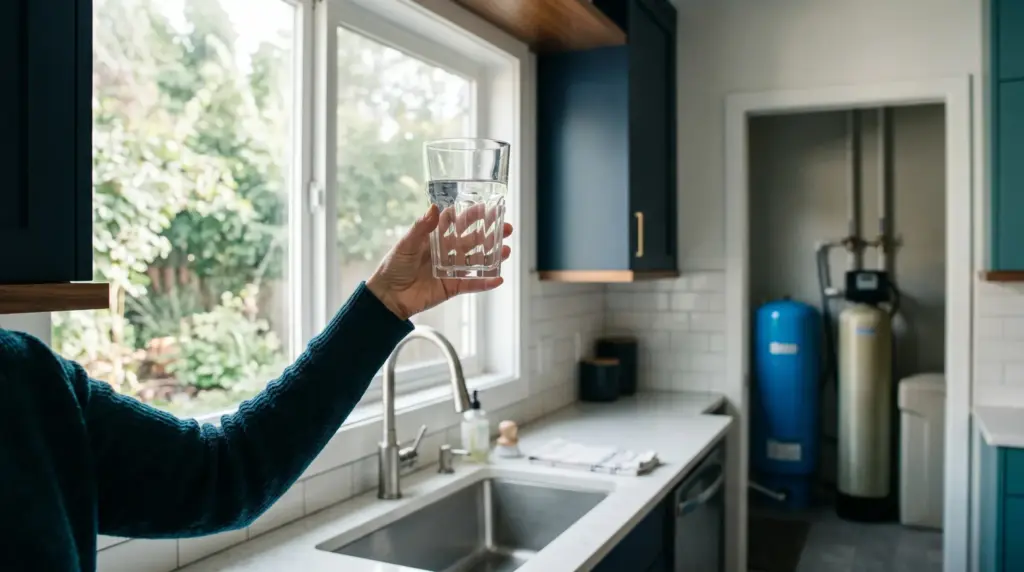
Salty-tasting well water has several possible causes, and some are more serious than others. Naturally occurring chloride, sodium, or sulfate may be dissolving from rock around the well. Road salt may be reaching the groundwater. A water softener may be sending brine into the household plumbing. In coastal areas, seawater may be moving into a freshwater aquifer.
The first step is a laboratory water test. Taste alone cannot identify which dissolved mineral is present or explain how it entered the well. Before arranging major treatment or drilling work, test the untreated water for total dissolved solids, chloride, sodium, and sulfate. If the change was sudden, include bacteria, nitrate, and other contaminants appropriate to nearby land use.
Until the results are available, anyone following a sodium-restricted diet should use another confirmed drinking-water source. A sudden or pronounced change also deserves prompt investigation, especially if neighboring wells have changed or the property is near a salted road, coastline, industrial site, manure storage area, or irrigation operation.
What causes a salty taste in well water?
“Salt” is a broad description. Several dissolved substances can produce salty, mineral, bitter, or brackish flavors. People also have different taste thresholds, so one person may notice a change before another does.
| Possible cause | Useful clues | First confirmation step |
|---|---|---|
| Natural minerals | Taste has existed for years, nearby wells are similar, or the well enters mineral-rich rock | Test untreated water and compare it with the original well record or older results |
| Road salt | Well is near a road, parking area, driveway, or salt pile; levels may rise during or after winter thaws | Test chloride and sodium, then repeat seasonally if contamination is suspected |
| Water softener trouble | Only softened taps taste salty, or the change followed a regeneration cycle or service visit | Compare samples taken before and after the softener |
| Saltwater intrusion | Coastal location, increasing chloride over time, drought, heavy pumping, or similar changes in neighboring wells | Review chloride trends with a qualified well professional or hydrogeologist |
| Industrial or agricultural source | Nearby brine, fertilizer, manure, wastewater, mining, oil and gas, or chemical handling | Order a broader laboratory panel selected for the surrounding land use |
Natural chloride, sodium, and sulfate
Groundwater spends months, years, or centuries in contact with soil and rock. During that time, it dissolves minerals. Some aquifers contain old marine deposits, salt-bearing sedimentary rock, or groundwater that has moved through mineral-rich formations. The resulting water may contain chloride paired with sodium, calcium, magnesium, or potassium.
Sulfate can also contribute a mineral or bitter edge. High total dissolved solids may produce a generally brackish taste even when no single constituent dominates. This water can be unpleasant without being caused by recent surface contamination.
Road salt contamination
Sodium chloride and other chloride-based deicers dissolve in snow and rain. The dissolved ions move with runoff, seep through soil, and can enter shallow groundwater. Salt applied to public roads is only part of the load. Parking lots, private lanes, sidewalks, loading areas, and uncovered salt storage can all matter.
A well downhill or downgradient from these areas may be vulnerable. “Downgradient” means groundwater flows from the salted area toward the well. That direction does not always match the visible slope of the land.
Water softener problems
A properly operating ion-exchange softener replaces hardness minerals, mainly calcium and magnesium, with sodium or potassium. Some increase in sodium is therefore expected when sodium chloride is used. The water should not receive a mouthful of concentrated brine.
A stuck control valve, blocked injector, restricted drain, interrupted regeneration, excessive brine refill, or incorrect programming can leave salty water in the treatment tank. That brine may then reach household faucets. Excessive salt or water in the brine tank can be a clue, although a tank containing a substantial amount of salt is not automatically defective.
Saltwater intrusion
Fresh groundwater near a coast often sits above denser saltwater. Pumping lowers pressure around a well. If withdrawals are too large for local conditions, the freshwater zone can thin and salty water can move inland or rise from below. Sea-level rise, drought, reduced groundwater recharge, canals, nearby pumping, and damaged well casings can add to the problem.
Industrial or agricultural contamination
Less common sources include industrial brines, wastewater lagoons, fertilizer, manure storage, irrigation return water, landfills, mining, and oil or gas operations. These sources may contribute far more than sodium and chloride. A narrow salt test can miss contaminants such as nitrate, metals, petroleum compounds, or solvents.
How to test salty tasting well water
Use a laboratory accredited or certified for drinking-water analysis. In the United States, choose a state-certified drinking-water laboratory. In Canada, use a laboratory accredited for the requested drinking-water tests or one recommended by the provincial or territorial authority.
Call before collecting the sample. The laboratory may provide specific bottles, preservation instructions, and a delivery deadline. A sample kept too warm, placed in the wrong container, or delivered late may produce results the laboratory cannot accept.
Start with total dissolved solids
Total dissolved solids, usually shortened to TDS, estimates the combined amount of dissolved material in the water. It includes minerals and salts such as calcium, magnesium, sodium, chloride, sulfate, and bicarbonate.
TDS is a useful first indicator because a rising result confirms that the water carries more dissolved material than before. It does not identify that material. Two wells with the same TDS can have very different chemistry and require different responses.
A handheld TDS meter can help compare the raw well water with treated water or track changes between laboratory tests. Most consumer meters estimate TDS from electrical conductivity. They cannot establish that the water is safe, distinguish road salt from seawater, or replace a laboratory analysis.
Request a chloride test
Chloride is one of the most useful measurements when water tastes salty. The U.S. Environmental Protection Agency lists 250 milligrams per liter as a secondary standard for chloride. A secondary standard addresses taste, appearance, odor, corrosion, or similar water-quality concerns rather than setting a federal health limit for private wells. Health Canada also uses an aesthetic objective of no more than 250 mg/L for chloride.
Do not treat 250 mg/L as a line below which no problem exists. A homeowner may notice a change at a lower concentration when the water historically contained little chloride. A result that rose from 20 to 120 mg/L can be important evidence even though it remains below 250 mg/L.
Test sodium separately
Chloride and sodium often occur together, but their relationship is not fixed. Calcium chloride and magnesium chloride deicers can raise chloride without producing a matching sodium increase. A softener can raise sodium while leaving the raw well-water chloride unchanged.
The EPA’s drinking-water advisory uses 20 mg/L as a reference for people whose doctors prescribe very restrictive sodium diets. This is not a general federal maximum for everyone, and water above 20 mg/L is not automatically unsafe for a healthy adult. The result matters most when a clinician is calculating total sodium intake for someone with heart, kidney, blood-pressure, or fluid-balance concerns.
Include sulfate and supporting measurements
Sulfate can produce a bitter, medicinal, or salty impression. Include it when the source is unknown, especially in areas with sulfate-bearing rock. A basic chemistry panel should also include conductivity, pH, hardness, alkalinity, calcium, magnesium, and potassium. These results help explain the water’s overall mineral balance and guide treatment sizing.
| Test | What it tells you | What it cannot prove alone |
|---|---|---|
| TDS or conductivity | Whether the overall dissolved-mineral load is elevated or changing | Which mineral caused the change |
| Chloride | Whether a major salty-taste indicator is elevated | Whether the source is road salt, geology, seawater, or another brine |
| Sodium | The amount relevant to dietary sodium and softener performance | Whether chloride is also high |
| Sulfate | Whether sulfate contributes to taste or digestive concerns at high levels | The complete source of elevated TDS |
| Full mineral or major-ion panel | The balance of common dissolved minerals and useful treatment information | Whether bacteria, fuels, pesticides, or solvents are present unless separately included |
Where to take the sample
If the house has a softener or other treatment equipment, collect one sample from a tap before treatment and another from a normal cold-water drinking tap after treatment. Label them clearly. The untreated sample describes the well. The treated sample shows what reaches the household.
Avoid hot water, swivel faucets, leaking taps, and hoses unless the laboratory specifically directs otherwise. Do not remove treatment equipment or alter plumbing merely to collect a sample. A well contractor or water-treatment professional can locate a safe raw-water sampling point.
What testing costs
Prices vary by region, laboratory, number of parameters, shipping, and government subsidies. As a broad planning range, an individual chloride test may cost roughly US$15 to $50, while a useful mineral panel may run about US$70 to $200 or more. Canadian chemistry panels commonly fall around C$100 to C$200 or more. Some provincial, county, or watershed programs subsidize private-well testing. Broader testing for metals, petroleum compounds, pesticides, or other industrial chemicals can cost several hundred dollars.
Ask for a written price before submitting the sample. Confirm that the quoted panel actually includes TDS or conductivity, chloride, sodium, and sulfate. A low-cost bacteria test will not answer a salty-water question.
When the salt comes from natural geology
Some wells have always produced mineralized water. This is common where aquifers pass through ancient seabed deposits, evaporite beds, shale, limestone, or other salt-bearing formations. Regional well records may show a recognizable pattern by depth or rock unit.
Depth can matter, but deeper does not always mean better. Fresh water may occupy one fracture or sediment layer while saltier water lies below it. A deep borehole can intersect both. Pumping may draw the poor-quality water toward the pump intake or allow it to mix inside an uncased section of the well.
Compare the current laboratory report with the original well test, drilling log, nearby well records, and any results from a property sale. Stable chemistry over many years supports a geological explanation. A sharp rise calls for further investigation.
Treatment choices for naturally salty water
Reverse osmosis, often called RO, forces water through a membrane that rejects much of the dissolved salt. A point-of-use unit under the kitchen sink may be practical when only drinking and cooking water need treatment. Whole-house RO costs more, wastes some source water, requires pretreatment in many wells, and creates a concentrated reject stream that needs an acceptable discharge location.
Distillation boils water and condenses the steam, leaving most salts behind. It can produce drinking water in modest quantities but uses energy and requires cleaning as minerals accumulate.
Blending combines mineralized water with a tested lower-salinity source. On some properties, a separate shallower well or another permitted supply can provide that source. Blending must be designed around verified water quality and legal withdrawal limits. A shallower well may carry greater risk from surface contamination, so “less salty” does not mean “safer.”
Drilling another well is a geological decision, not a guaranteed cure. Review local well logs and speak with a contractor holding the appropriate well license in the United States or well licence in Canada. Where the subsurface is complex, a hydrogeologist can evaluate which water-bearing zones are likely to remain usable.
Road salt and private wells
Road salt becomes a groundwater problem after it dissolves. Soil can trap sediment, but it does little to stop dissolved chloride. Meltwater may move through sandy soil, drainage ditches, fill around utility trenches, or fractures in bedrock. Chloride can remain in groundwater and continue moving long after the last snowbank disappears.
Shallow wells near heavily salted pavement are often the most exposed because they draw from groundwater closest to the surface. Poor casing seals, a low well cap, ponded water around the casing, or an old dug well can increase vulnerability. Deep bedrock wells are not immune. A water-bearing fracture can connect the well to a roadside source some distance away.
Seasonal patterns
Some affected wells show their highest chloride during winter thaws or spring snowmelt. Others respond weeks or months later because water moves slowly through soil and rock. Chloride stored in shallow groundwater may also keep levels elevated throughout summer.
One sample cannot establish a seasonal pattern. If road salt is suspected, test during a low-salt period and again during or after the local melt season. Use the same sampling tap and laboratory. Record the date, recent precipitation, taste changes, and any unusual road or parking-lot salting.
Setbacks and construction improvements
There is no universal setback distance that protects every well from road salt. Soil, fractures, groundwater direction, road drainage, pumping rate, and well construction all affect the required separation. Local well rules may establish minimum distances, but a vulnerable site may need more.
Possible protective work includes redirecting runoff away from the wellhead, correcting low ground that holds meltwater, extending or repairing casing, sealing the space around the casing, replacing a damaged sanitary cap, and relocating a replacement well farther from the salt source. These measures require site-specific assessment. They cannot remove chloride that has already entered an aquifer.
If a public road or salt-storage facility appears responsible, preserve dated laboratory reports and well records. Contact the road authority and the agency responsible for groundwater or private wells. Documentation from repeated accredited laboratory tests carries more weight than descriptions of taste alone.
Saltwater intrusion in coastal areas
Coastal groundwater is a moving freshwater system, not an underground tank with a fixed wall between fresh and salt water. Fresh groundwater generally flows toward the coast and helps hold seawater back. Heavy pumping can reduce that freshwater pressure. Saltwater then moves inland, rises beneath a pumping well, or enters through a connected canal or deeper formation.
A single household well can contribute to local drawdown, but nearby irrigation, municipal, commercial, and neighboring residential wells may have a larger combined effect. Drought reduces recharge and can intensify the pressure. Sea-level rise can shift coastal conditions over longer periods.
Warning signs of an advancing salt front
- Chloride, sodium, conductivity, or TDS rises across repeated laboratory tests.
- The water becomes saltier during drought or periods of heavy irrigation.
- Water quality improves when pumping is reduced, then declines when demand increases.
- Nearby wells show similar changes.
- Local groundwater agencies report movement of the freshwater-saltwater transition zone.
A salty taste alone cannot prove intrusion. Old marine water trapped in rock, leaking canals, road salt, or a corroded well connection can produce overlapping clues. Historical test results and regional monitoring are especially valuable.
Why drilling deeper may make matters worse
In many coastal aquifers, saltier water lies beneath the freshwater zone. A deeper well may enter the transition zone directly. Heavy pumping can also pull deeper saltwater upward in a process called upconing. Picture a mound of salty water rising beneath the pump as freshwater is withdrawn above it.
Before deepening or replacing a coastal well, obtain local well logs, water-quality records, and advice from a qualified professional familiar with that aquifer. The answer may involve a different screened depth, lower pumping rate, water storage that reduces peak demand, another well location, treatment, or connection to a regulated supply.
Some coastal counties, states, water-management districts, and provinces restrict well locations, drilling depths, or withdrawal volumes. Permits may be required even when an existing well is already on the property. Regulatory limits are intended to protect the shared aquifer, since one owner’s pumping can affect neighboring supplies.
How to tell whether the water softener is responsible
Start by identifying which taps receive softened water. Outdoor faucets and a cold kitchen line are sometimes left untreated, but plumbing arrangements vary. Do not assume an outdoor tap represents the raw well until the pipe route is confirmed.
- Collect a glass from a confirmed untreated tap before the softener.
- Collect another from a softened cold-water tap.
- If only the treated sample tastes salty, place the softener in its normal bypass position according to the manufacturer’s instructions.
- Flush a cold tap long enough to replace water that was already sitting in the household pipes.
- Compare the bypassed water and arrange laboratory testing before making treatment changes.
If the raw water tastes normal and the post-softener water is salty, the softener or its controls are the leading suspect. If both samples taste salty, the source is probably the well or plumbing upstream of the softener.
Common softener faults
- Interrupted regeneration: A power loss, closed valve, or water interruption can stop the rinse before brine has been cleared.
- Restricted drain line: A kink, blockage, frozen section, or poor drain arrangement can prevent proper rinsing.
- Clogged injector or venturi: This small component draws brine through the treatment tank. Fouling can disrupt both brine draw and rinse.
- Stuck control valve: Internal seals or moving parts can leave the unit in the wrong stage of its cycle.
- Incorrect settings: Excessive salt dose, unsuitable cycle length, or incorrect water-hardness programming can waste salt and impair rinsing.
- Brine-tank overfill: A float, refill control, or valve problem may place too much water in the brine tank, creating more brine than the unit can manage correctly.
Do not taste water during regeneration. If concentrated brine continues reaching faucets, keep the unit in bypass and arrange service. A properly set softener should be checked against the actual hardness, iron content, household use, and model capacity.
When salty well water is a health concern
For most healthy adults, chloride at the EPA’s 250 mg/L secondary standard is chiefly a taste and plumbing concern. The number is not a health-based dividing line for private wells. Elevated chloride can still matter because it may signal contamination, increase corrosive behavior under some water conditions, and accompany high sodium or other substances.
Sodium deserves separate attention for anyone with heart failure, kidney disease, high blood pressure, fluid-retention concerns, or a medically prescribed sodium limit. The EPA’s 20 mg/L advisory reference is intended for very restrictive diets. It should not be interpreted as a universal danger level.
Ask the treating clinician how much sodium from drinking and cooking water fits the prescribed diet. Give the clinician the laboratory result in milligrams per liter and an estimate of daily water consumption. Test both untreated and softened water because a sodium-based softener can raise the concentration reaching the tap.
Switching a softener from sodium chloride to potassium chloride is not automatically appropriate. Added potassium can be dangerous for some people with kidney disease or those taking certain medications. That decision belongs with the clinician who knows the person’s health and prescriptions.
High sulfate can cause diarrhea or other digestive effects, particularly in visitors who are not accustomed to the water and potentially in infants. Water used to prepare infant formula deserves careful attention whenever sodium, sulfate, nitrate, bacteria, or overall mineral content is uncertain.
A new salty taste can also be a warning about the well’s surroundings rather than the direct health effect of salt itself. Road runoff, industrial brine, manure, fertilizer, and seawater can bring a different set of concerns. A targeted mineral panel identifies the salt problem. Testing selected for nearby hazards determines whether something more serious is present.
Related Guides
- Tannins in Well Water
- Radon in Well Water
- Annual Well Maintenance Checklist
- How to Shock Chlorinate a Well
- How to Test Well Water
Browse all Water Quality guides →
Find verified, local contractors who handle new installations, pump service, and water quality testing — in your area.
