Geothermal Loop Fields Explained: Types, Installation and What Well Owners Should Know

20 Jun 2026 18 min read No comments Planning
Featured image

A geothermal heat pump uses the relatively stable temperature underground to heat and cool a home. The indoor equipment gets most of the attention, but the geothermal loop field buried outside is usually the most expensive and permanent part of the system.

That matters if you own a private well. A closed-loop installation may place trenches or boreholes near existing water, septic and utility infrastructure. An open-loop system goes further by pumping groundwater through the heat pump itself. Whether you are planning geothermal alongside a new well or considering it for an established rural property, the first question is not which heat-pump model to buy. It is whether your land, geology and groundwater can support the proposed loop field.

Key takeaway: A geothermal loop field can provide decades of efficient heating and cooling, but it must be designed for the home, climate and actual ground conditions. Horizontal loops need substantial usable land, vertical loops trade land area for drilling, pond loops require a suitable year-round water body, and open loops require both dependable well yield and acceptable water chemistry. Compare complete designs and verified site information—not just heat-pump prices.

How a ground-source heat pump moves heat

A ground-source heat pump does not create heat by burning fuel. It moves heat between the house and the ground, using electricity to run a compressor, pumps and fans.

In a closed-loop system, a water-and-antifreeze mixture circulates through sealed plastic pipe underground. The fluid returns to the indoor heat pump, transfers heat through a heat exchanger, and then goes back outside to repeat the cycle. The underground fluid and the refrigerant inside the heat pump remain in separate sealed circuits.

Heating mode

During winter, the circulating fluid returns from the ground carrying low-temperature heat. The heat pump concentrates that energy to a temperature useful for indoor heating. It can then deliver warm air through ducts or heated water to a compatible distribution system.

The ground does not need to feel warm to your hand. Heat can still be extracted from soil or groundwater that is much cooler than the temperature you want indoors.

Cooling mode

During summer, the process reverses. The heat pump removes heat from the house and sends it into the ground. The loop field acts as a place to release that heat, much as an outdoor coil does for a conventional air conditioner.

Why underground temperature is more stable

Air temperature can change dramatically between afternoon and midnight or between January and July. Soil near the surface follows those swings, but the changes become smaller and more delayed with depth. Below the frost-affected zone, ground temperature is relatively stable and generally reflects the region’s long-term average climate.

“Stable” does not mean identical everywhere. Ground temperature in Minnesota or Manitoba will differ from ground temperature in Georgia or British Columbia. Moisture, groundwater movement, soil and rock also affect how readily the ground can absorb or release heat. Those differences belong in the loop-field design.

The four loop-field arrangements homeowners encounter

Most residential systems use one of four arrangements: horizontal closed loops, vertical closed loops, pond or lake loops, or open loops that use groundwater directly. They all serve the same broad purpose, but their land requirements, construction methods and risks are very different.

Loop type Usually considered when Main constraint
Horizontal closed loop The property has a large, accessible area that can be excavated Land area, trench conditions and surface restoration
Vertical closed loop Space is limited or shallow excavation is impractical Drilling conditions and completed bore depth
Pond or lake closed loop A suitable water body is close to the house and under the owner’s control Year-round depth, volume, access and environmental rules
Open loop A well can supply enough clean groundwater and lawful discharge is available Well yield, water chemistry, pumping cost and discharge approval

Horizontal loops use land instead of deep drilling

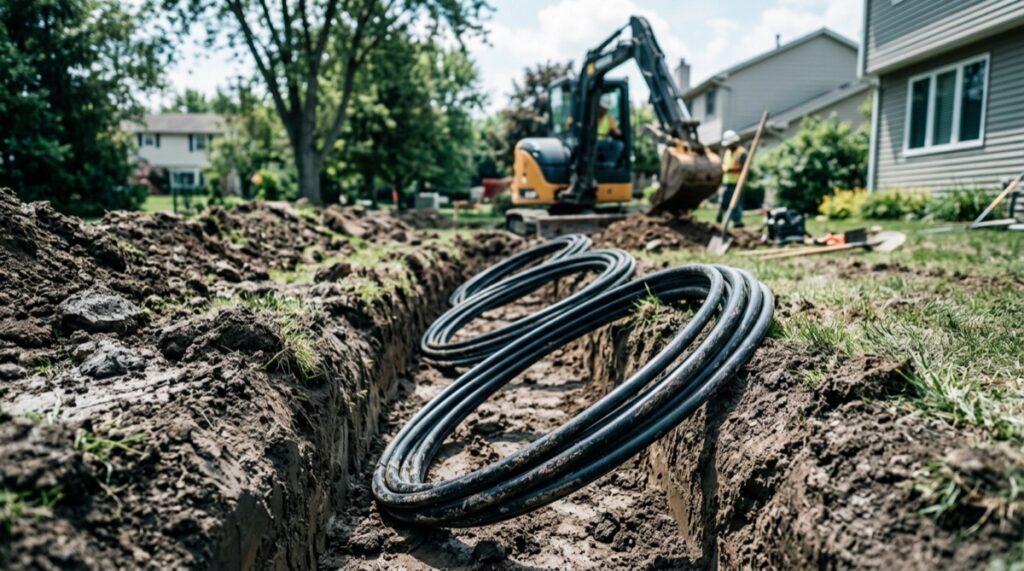
A horizontal geothermal loop field places pipe in excavated trenches, commonly several feet below grade. Residential designs may use long parallel pipes, multiple pipes in one trench, or coiled “slinky” sections that fit more pipe into a smaller excavation. The appropriate depth depends on climate, soil, local rules and the engineered design; roughly 4 to 8 feet is common, but it should not be treated as a universal specification.

Horizontal loops are often attractive on rural properties because excavation usually costs less than drilling the same required amount of vertical bore. They can also work well during new construction, when heavy equipment already has access and the future lawn has not been established.

The trade-off is disturbance. A horizontal field may occupy a substantial portion of the usable yard, and trenching can affect grading, drainage, landscaping and future plans. Saturated ground, large boulders, shallow bedrock or limited equipment access can erase the expected cost advantage.

The loop area should be recorded on an accurate property plan. Future owners need to know where not to install a pool, addition, retaining wall, pond, utility line or deep-rooted planting. Driving ordinary lawn equipment over a completed field is normally expected; excavating through a buried header pipe is not.

Vertical loops trade yard area for borehole cost

A vertical closed-loop system uses one or more drilled boreholes. A U-shaped length of plastic pipe is lowered into each hole, and the remaining space is filled with grout. Grout is a pumped sealing material that protects groundwater zones and helps transfer heat between the pipe and surrounding formation.

Residential bores are often approximately 150 to 500 feet deep, although actual depth and bore count vary. A design might use several shorter bores or fewer deeper ones. Available drilling equipment, bedrock, groundwater conditions, required spacing and local construction rules influence that choice.

Vertical loops suit smaller lots because the surface footprint is modest compared with a horizontal field. They may also reduce widespread landscape disruption, although drilling still requires rig access, water handling, space for excavated material and a route for connecting pipes.

Ask how the drilling portion is priced. Contractors may quote by drilled foot or metre, by completed bore, or as one loop-field amount. A low drilling rate may exclude mobilization, casing through unstable ground, grout, pipe, pressure testing, connection trenches, excess material removal or difficult drilling. Depending on depth and geology, one completed residential bore can cost several thousand dollars or well into five figures. A “cost per bore” without a defined depth and scope is not a useful comparison.

Watch out: A geothermal bore is not automatically interchangeable with a water well. Closed-loop boreholes have their own sealing, spacing, reporting and contractor requirements. Use a properly licensed driller in the United States or a properly licensed/licenced contractor where required in Canada, and confirm local rules before drilling begins.

Pond and lake loops need more than visible water

A pond or lake loop uses sealed coils submerged in a water body. The pond water never circulates through the heat pump; it surrounds the closed piping and exchanges heat with the fluid inside.

This arrangement can reduce excavation or drilling costs when a suitable pond is close to the house. Suitability, however, involves more than surface area. The water body must maintain adequate depth and volume through drought, winter ice and seasonal changes. Federal guidance commonly describes coils being placed at least about eight feet below the surface, but the system designer must evaluate local conditions.

Ownership and access matter too. A shared pond, public lake or regulated shoreline may involve permissions that a privately owned farm pond does not. The installer must account for anchors, protection from boats or aerators, the buried supply lines between the house and water, and a way to service the coils if they move or become damaged.

A shallow pond that warms substantially in summer, freezes deeply in winter or loses considerable water during dry periods may not provide reliable conditions. A pond assessment should consider its worst season, not how it looks on installation day.

Open-loop systems use groundwater directly

An open-loop system pumps groundwater to the heat pump, passes it through a water-to-refrigerant heat exchanger, and discharges it. The well water does not normally enter the home’s heating ducts or mix with the heat pump refrigerant, but it does contact the equipment’s water-side passages.

Two common variations are:

  • Pump-and-discharge, often called pump-and-dump: Water is taken from a supply well and sent to an approved surface location, pond, watercourse or other permitted outlet after passing through the heat pump.
  • Return-well systems: Water is pumped from a production well and placed back into the aquifer through a second well. Some regions classify a return well as an injection well and regulate it accordingly.

A standing-column well is a more specialized open arrangement. Water circulates through a deep water-filled bore and the heat pump, with some systems allowing a controlled amount of water to leave the system under certain conditions. Its design depends heavily on rock, groundwater movement and local rules. It should not be assumed to function like an ordinary domestic well.

Using an open-loop system with a private well

An existing well needs verified capacity, not an optimistic estimate

An existing well can sometimes supply an open-loop heat pump, but only if it can sustain the equipment flow while still meeting household needs. The relevant questions are:

  • What flow does the selected heat-pump model require?
  • Can the well sustain that flow for long heating or cooling cycles?
  • How far does the water level fall while pumping?
  • How quickly does the well recover?
  • Can the pump, wiring, pressure tank and water line handle the added duty?
  • Will showers, laundry, livestock watering and other domestic demands occur at the same time?

Many current residential units call for approximately 1.5 to 2 gallons per minute per ton of heat-pump capacity under particular water-temperature conditions. “Ton” is an HVAC capacity rating equal to 12,000 British thermal units per hour; it is not the equipment’s weight. Some equipment and colder entering water require higher flow. A four-ton unit might therefore need roughly 6 to 8 gallons per minute while operating, but the manufacturer’s performance tables govern the actual design.

A short bucket test at an outdoor faucet does not establish long-duration well yield. A qualified well professional should conduct an appropriate pumping test and record pumping level, recovery and available drawdown—the usable change in water level before the pump or well reaches its operating limit.

Open-loop economics must also include electricity for lifting and pressurizing the groundwater. A deep well, oversized pump or high household pressure setting can consume enough pumping energy to reduce the expected savings.

The discharge plan is part of the system

Every gallon entering an open-loop heat pump must go somewhere. Possible destinations include a return well, infiltration area, pond or approved surface outlet. Legality varies sharply between jurisdictions, and approval for groundwater withdrawal does not automatically approve discharge.

A return well must accept the required flow without backing up, and it must be positioned and constructed to limit thermal short-circuiting. That occurs when recently discharged water reaches the supply well too soon, gradually making the entering water less useful for heating or cooling.

Surface discharge can create erosion, icing, saturated soil or drainage disputes if poorly planned. Heat-pump water should not be directed into a septic system. Some jurisdictions also prohibit sanitary-sewer or storm-sewer disposal.

Rules can differ even between neighbouring municipalities. In the United States, a return well may fall under federal Underground Injection Control rules as well as state and local requirements. In Canada, provincial water-taking, well-construction and wastewater-discharge rules may apply. For example, Ontario treats open-loop supply and return holes as wells and can require additional water-taking or discharge approvals, while Natural Resources Canada notes that open-loop systems are not permitted in every province.

Water chemistry can rule out an open loop

Water that is safe to drink is not necessarily suitable for continuous use in a heat exchanger. Before selecting an open loop, test for the factors identified by the equipment manufacturer, including hardness, pH, iron, manganese, sediment, chlorides, sulphates, hydrogen sulphide and total dissolved solids.

Hard water can leave scale on heat-transfer surfaces. Iron and iron bacteria can form deposits in the heat exchanger, valves and return well. Sediment can erode or plug small passages. Acidic or chloride-rich water can corrode metals. These problems reduce heat transfer, restrict flow and may shorten equipment life.

Some conditions can be managed with filtration, a more corrosion-resistant heat exchanger or a secondary heat exchanger that isolates the heat pump from the raw groundwater. Those additions have installation and maintenance costs. Heavy scaling potential or iron-bacteria growth may make a closed-loop geothermal loop field the more dependable choice.

Watch out: Do not base an open-loop purchase on a standard drinking-water test alone. Ask the heat-pump contractor for the manufacturer’s current water-quality limits, then have the raw well water tested against those limits. Confirm in writing whether the proposed water chemistry and heat-exchanger material preserve the equipment warranty.

Installation cost is driven by the ground as much as the equipment

Geothermal installation is not priced like replacing a refrigerator. Two similar houses on opposite sides of the same county can receive very different quotes because one has deep soil and open equipment access while the other has shallow rock, buried utilities and limited drilling space.

Published North American project data illustrates the spread. U.S. studies have reported complete detached-home installations ranging from the mid-teens to $60,000 or more in U.S. dollars. A Manitoba program reported completed projects from about C$17,000 to C$80,000. These are broad historical examples, not dependable price guides for a particular property. Local labour, geology, system capacity, exchange rates, incentives and the amount of indoor work can move a quote outside those ranges.

Land area and drilling depth trade against each other

A horizontal field can reduce deep-drilling expense but requires more excavation and restoration. A vertical field occupies less yard but adds drilling, grout and borehole-completion costs. A pond loop may reduce both if the pond is genuinely suitable. An open loop may have less buried pipe but can require well upgrades, a second well, discharge construction and ongoing water-side maintenance.

The least expensive loop to install is not automatically the least expensive system to own. Include pumping power, maintenance exposure, landscape repair, permit costs and the consequences of a poor water source.

Soil and rock can change the quote dramatically

Wet, dense soil often transfers heat more effectively than dry, loose soil. Rock type, fractures and groundwater movement influence vertical designs. These characteristics affect the amount of pipe or bore depth needed to exchange the home’s heat without pushing loop temperatures beyond the equipment’s operating range.

Construction conditions matter separately from heat transfer. Loose formations may require temporary casing to keep a bore open. Hard or abrasive rock can slow drilling and wear tooling. Flowing groundwater can complicate bore completion and grout placement. A contractor who understands local formations is often more valuable than one offering an attractive generic price per foot.

Square footage alone does not size the system

Floor area is one input, but it does not determine geothermal capacity by itself. A 2,000-square-foot house with good insulation, modern windows and controlled air leakage can have a much smaller heating load than a similarly sized house with exposed floors, older windows and substantial drafts.

A residential design should begin with a room-by-room heating and cooling calculation—commonly an ACCA Manual J calculation in the United States or an applicable CSA-based heat-loss calculation in Canada. It should account for:

  • local winter and summer design temperatures;
  • insulation levels and air leakage;
  • window area, orientation and shading;
  • ceiling height and exposed foundation walls;
  • duct condition and location;
  • indoor temperature expectations;
  • whether the system will provide all or only part of the peak heating demand.

The geothermal loop field must then be sized for the selected equipment, the home’s seasonal load and the ground’s ability to exchange heat. Oversizing the heat pump raises purchase cost and may produce short operating cycles. Undersizing the loop can cause extreme entering-fluid temperatures, lower efficiency and greater reliance on backup heat.

Compare complete scopes, not bottom-line totals

A useful proposal should identify:

  1. The heating and cooling load used for sizing.
  2. The heat-pump capacity at the proposed entering-water or loop-fluid temperatures.
  3. The loop type, total pipe length, bore count and depth, or required well flow.
  4. The ground assumptions used in the design.
  5. Drilling, trenching, grout, headers and pressure testing.
  6. Permits, utility locating, spoil removal and landscape restoration.
  7. Duct, electrical, plumbing and backup-heat work inside the home.
  8. Water testing, pumping tests and discharge construction for an open loop.
  9. Parts, labour and loop-field warranties.
  10. Items specifically excluded or priced as allowances.

Allowances deserve attention. An allowance is a provisional amount that can increase when actual site conditions become known. Ask what happens financially if drilling encounters unstable ground, unexpectedly hard rock, artesian flow or a dry production well.

Maintenance and expected service life

A properly designed closed geothermal loop field is commonly expected to remain in service for 50 years or longer. The buried pipe has no compressor, fan or burner, and the fluid circulates in a sealed circuit. The U.S. Department of Energy estimates more than 50 years for ground loops and up to roughly 24 years for indoor components.

For homeowner planning, treating the indoor heat-pump unit as equipment with an approximate 15- to 25-year service life is reasonable. Actual life depends on operating hours, installation quality, maintenance, water or loop conditions, electrical quality and whether the unit is correctly sized.

Routine care happens mostly indoors

Closed-loop maintenance generally includes changing or cleaning air filters, checking airflow and ducts, inspecting condensate drainage, testing controls and recording loop-fluid temperatures and pressures. The contractor may also check the antifreeze concentration and circulation pumps.

Open loops add water-side tasks. Strainers, control valves and flow rates need inspection. The heat exchanger may require professional cleaning if mineral deposits form. The supply pump and pressure equipment accumulate far more operating time than they would for household water alone, while a return well may gradually lose its ability to accept water.

What can go wrong underground

Closed-loop failures are uncommon compared with indoor equipment problems, but they are disruptive when they occur. Potential problems include:

  • Pipe or joint leakage: A poorly fused connection, manufacturing defect or later excavation damage can release loop fluid and reduce pressure.
  • Air trapped in the piping: Air can restrict circulation, create noise and reduce heat transfer if the system was not fully flushed during commissioning.
  • Damaged headers: The larger pipes connecting individual loops are often closer to the surface and therefore more exposed to landscaping or construction damage.
  • Inadequate bore sealing: Poor grout placement can reduce heat transfer and, more importantly, create a pathway between groundwater zones.
  • An undersized field: The pipe may remain intact while loop temperature drifts too cold in winter or too warm in summer, reducing performance.
  • Settlement or ground movement: Improper trench backfill or unusual soil movement can stress piping and leave low areas at the surface.

Keep the final loop-field drawing, bore logs, pressure-test results, grout records and commissioning report with the house documents. If a problem arises years later, those records can prevent extensive exploratory digging.

When geothermal makes financial sense—and when it may not

Geothermal tends to make the strongest financial case when the property has a favourable loop location, the owner expects to remain for many years, and both heating and cooling equipment are due for replacement. The comparison improves further when the current system uses expensive fuel, the home has a large annual heating or cooling load, and meaningful rebates, grants or tax incentives are available.

It can also make sense during new construction. Excavation access is better, indoor distribution can be designed around the heat pump, and loop pipes can be coordinated with the well, septic system, driveway, utilities and future structures before the site is finished.

The case is weaker when:

  • drilling conditions make the loop field unusually expensive;
  • the home has low annual heating and cooling costs already;
  • a modern cold-climate air-source heat pump can meet the need at far lower installed cost;
  • the building requires major insulation, window or duct work first;
  • the owner expects to sell before operating savings can recover the added investment;
  • an open-loop proposal depends on marginal well yield or difficult water chemistry;
  • local electricity rates, rate structures or backup-heat use undermine projected savings;
  • qualified geothermal service is scarce in the area.

Be cautious with guaranteed payback claims. Energy savings depend on what geothermal replaces, future electricity and fuel prices, actual weather, thermostat settings, equipment performance and pumping energy. Incentives can improve the calculation, but they should be confirmed before signing because eligibility, funding and tax treatment change.

A sound comparison uses total installed cost after confirmed incentives, realistic annual operating estimates, maintenance expectations and the likely timing of indoor equipment replacement. It should also recognize that the loop field is a long-lived property improvement: when the first heat pump reaches the end of its service life, a compatible replacement may be able to use the existing field after its condition and capacity are verified.

For well owners, the dividing line is especially clear. A closed-loop geothermal field largely separates home comfort from groundwater quantity and chemistry. An open loop ties the heating and cooling system to the well every hour it operates. That can be an effective arrangement on the right property, but only after sustained well yield, water quality, discharge approval and pumping cost have been established. The underground design—not the equipment brochure—is what determines whether the system belongs on the property.

Related Guides

Browse all Planning Your Well guides →

Well Drilling Guide Editorial Team
Author: Well Drilling Guide Editorial Team

The Well Drilling Guide editorial team researches and writes our guides on water-well drilling, pumps, and well water for homeowners across the US and Canada. We translate current cost data, NGWA and state well-construction standards, and EPA and CDC guidance into clear, practical answers. What we stand for: honest, independent help. Every price and claim is researched and fact-checked against multiple 2026 sources — never guessed, never borrowed from a single advertiser. We answer to homeowners, not to the companies we write about, because our only goal is to help you make a confident, well-informed decision about your water.

Need a Licensed Well Driller?

Find verified, local contractors who handle new installations, pump service, and water quality testing — in your area.

Find a Contractor
Free · No obligation

Get Matched With Local Drillers

Tell us your project and we’ll line up to 3 free quotes from licensed well drillers near you.

Licensed pros No spam, ever US + Canada

Your details go to licensed local drillers only — never sold.

Your details go only to matched drillers — never sold or spammed.

By submitting, you agree we may share your details with up to 3 licensed well drillers near you (US & Canada) so they can contact you about your project. No fees, no obligation — and we never sell your information. See our Privacy Policy.

Tell us your project
We match local drillers
Up to 3 free quotes

Takes about 30 seconds.

Prefer a ballpark first?
Try the free Well-Cost Estimator →